The Openings for the Introduction of Zyklon B, Part 1
The Roof of the Morgue of Crematorium I at Auschwitz
1. Transformations of Crematorium I (1944 – 1947)
During a visit to Auschwitz on July 16, 1944, SS-Obergruppenführer Pohl approved the “Installation of a gas-tight surgery and fragment-proof shelter in the former crematorium for the garrison surgeon”,[1] which became work-site BW 98M.
On August 26, 1944, SS Obersturmführer Heinrich Josten who held the post of “chief air-raid warden” wrote to the camp commander a letter on the subject of “modification of the old crematorium for air-raid protection purposes.”[2]
This project, entitled “Modification of old crematorium. Air-raid shelter for SS sick-bay with a surgery” (Plan no. 4287) was drawn up on September 21, 1944.[3]
On October 17, 1944, SS Sturmbannführer Karl Bischoff, Head of Waffen-SS and Police Building Inspectorate “Silesia,” wrote a letter to the Central Construction Office requesting that the work, “on account of the urgency,” be undertaken immediately without going through the usual bureaucratic formalities.[4]
On November 2, 1944, SS Obersturmführer Werner Jothann, head of Central Construction Office, drew up an “Explanatory note re: transformation of the old crematorium into an air-raid shelter with surgery for SS sick-bay at concentration camp Auschwitz O/S. BW 98M.”[5]

Document 1: Inventory plan of building no. 47a. B.W. 11. Crematorium. Plan no. 1241 of April 10, 1942. RGVA, 502-2-146, p. 21. This shows the building at a time while it was allegedly used for homicidal gassings. Note: The door from the morgue (“gas chamber”) to the furnace room swings through to both sides – it could not have served as a gas chamber door, as such a door could neither be made gas-tight nor panic-proof!
The same day, he also compiled a “cost estimate for the transformation of the old crematorium into an air-raid shelter with surgery for SS sick-bay at concentration camp Auschwitz O/S. BW 98M,” arriving at a total amount of 4300 RM,[6] and drew a “Location sketch construction of an air raid shelter for SS sick-bay.”[7] The work was completed during the second half of November.
Plan no. 1241 of April 10, 1942, tells us that crematorium I had a morgue measuring 17 by 4.60 m, connected to a “washing room” of 4.17 by 4.60 m, and a “room for laying-out of corpses,” of 4.10 by 4.60 meters.[8]
This morgue, according to the official historiography, had been transformed into a homicidal gassing chamber as early as September 1941 by equipping it with two gas-tight doors and by opening up in the flat roof an undetermined number of holes for the introduction of Zyklon B. These openings, in fact, numbered two according to Stanisław Jankowski[9] and Hans Stark,[10] six according to Pery Broad[11] and Filip Müller.[12] For his part, Rudolf Höß, in the session of March 12, 1947, of his trial, speaks of only one such opening:[13]
“The gassing occurred in this way: a hole was opened in the ceiling and through this opening the gas was dropped in – a crystalline mass.”
Finally, the alleged workman for the openings – the detainee Czesław Sułkowski – who should have been the person best informed about their number, size, shape and position, actually knew nothing in this respect. In his declaration of September 28, 1971, he, in fact, limited himself to an evasive statement, saying:[14]
“We had first set up an oven in the crematorium. I myself did the openings in the ceiling of the morgue where the first Soviet POWs were gassed. I saw these Russians when they were taken [there]. They stood in the street near the Block leader’s room between the present hotel and the crematorium, hundreds of them, naked, waiting to be gassed. I saw SS [men] dropping the gas through the openings into the morgue.”
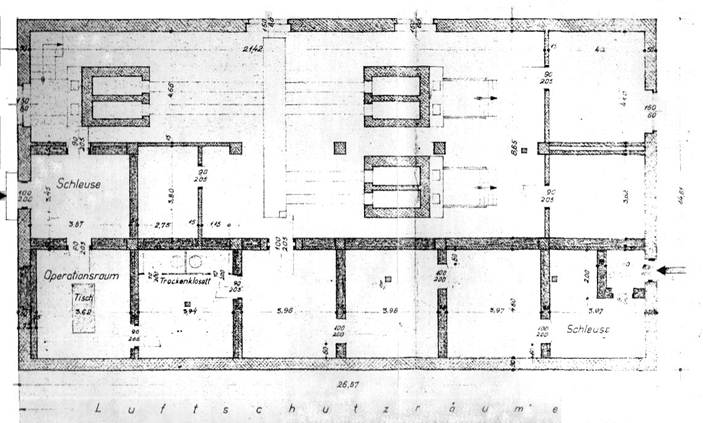
Document 2: Conversion of the old crematorium. Air raid shelter for SS hospital with surgery room. Plan no. 4287 of September 21, 1944. RGVA, 502-2-147, p. 20.
The transformation of the crematorium into an air-raid shelter, on the basis of the plan no. 4287 of September 21, 1944, (see document 2), was done by splitting the morgue into four rooms by means of three partitions. In the first room, on the south side, which functioned as an airlock, an entrance from the outside was opened up and a small vestibule was installed measuring two by two meters. Furthermore, the “antechamber,” which stood behind the main entrance to the crematorium was closed by means of a partition and the other walls were reinforced to make another airlock of 3.87 by 3.45 meters.
According to the letter from Josten already mentioned, “7 pcs. doors gas-tight and fragment-proof”[15] had been planned, but Jothann’s estimate of November 2, 1944, mentions “6 pcs. doors simple interior.”[16] Actually, for reasons of economy, the camp administration had only two “gas- and fragment-proof” doors installed – those of the two airlocks (still existing). The six partitions were equipped with ordinary doors and the two small cabinets of the “dry [chemical] toilet” received two doors measuring 70 by 200 cm according to the plan no. 4287 and Josten’s letter of August 26, 1944: “2 pcs. doors single 70 by 200 cm.”[17] But then what happened to the two alleged gas-tight doors of the alleged homicidal gas-chamber? One of them – the one which separated the morgue from the furnace hall – is said to have been dismantled (because the corresponding opening was walled up) and not re-used;[18] the other, which separated the washing room from the laying-out room, was simply removed and replaced with an ordinary door[19] – and all this in a gas-tight air-raid shelter, in which every single door had to be “gas- and fragment-proof”!
Needless to say, at the liberation of the camp not the slightest trace was found of the two gas-tight doors of the alleged homicidal gas chamber and no trace of them exists in the documentation of the Central Construction Office.
Between 1946 and 1947, the Poles, in an effort to reconstitute the “original state” of the alleged homicidal gas chamber, demolished not only the three partitions mentioned above, but also the one, which separated the morgue from the washing room. In the space thus obtained, they created four openings – the alleged openings for the introduction of Zyklon B – into which they inserted small wooden casings with lids (see documents 11 and 12). Today, the alleged gas chamber of crematorium I is, therefore, 21.32 m long, i.e. 4.32 m longer than the original room. The Poles also re-opened the door linking the morgue with the furnace room (which had been walled up by the SS), but moved it half a meter out of its original position and gave it a rather crude shape.
2. The Alleged Openings for Introducing Zyklon B
2.1. Jean-Claude Pressac’s interpretation

Document 3: Drawing of the morgue of crematorium I with rooms to the left (original state). A,B,C,D: position of current openings in the roof. 1, 2, 3, 4: position of original openings of the air raid shelter. T: original door to the furnace room; T1: current opening to the furnace room; T2: Current access door from the outside; S: Current vestibule, included when converted into an air raid shelter. © Carlo Mattogno.
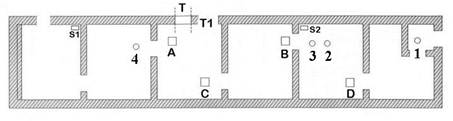
Document 4: Drawing of the morgue with rooms to the left after conversion to air raid shelter. A,B,C,D: position of current openings in the roof. 1, 2, 3, 4: position of original openings of the air raid shelter. T: original door to the furnace room. T1: current door (both were closed during the use of this facility as an air raid shelter). S1, S2: position of air raid shelter’s ventilation shafts. © Carlo Mattogno.
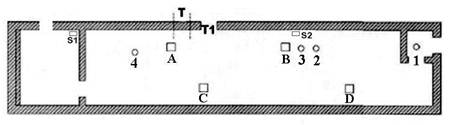
Document 5: Drawing of the morgue with room to the left, current situation. A,B,C,D: position of current openings in the roof. 1, 2, 3, 4: position of original openings of the air raid shelter. T: original door to the furnace room. T1: current door. S1, S2: position of ventilation shafts. © Carlo Mattogno.
In 1989, J.-C. Pressac published one photograph from a series of shots taken by Stanisław Luczko,[20] probably in May 1945. It shows the flat roof of crematorium I. The French historian gave it the title “Dance on the roof of the old crematorium” and commented as follows:[21]
“View of the roof of Krematorium I, looking south-north, 1945 (May?). The chimney has not yet been rebuilt. The features of the roof are:
– two ventilation chimneys for the furnace room (two-tone with a dark cap)
– two other brick chimneys, probably for ventilating the air raid shelter in view of their newly-built appearance
– in addition, on a line parallel to and to the left of that on which the two brick chimneys are built, it is possible to see THREE places where the former traps for introducing Zyklon-B have been filled, thus indicating that the morgue had been used as a gas chamber.
Above the stage, dominated by a red star with the hammer and sickle, fly the flags of Poland (left) and the Soviet Union (right), with lamps mounted above them.
This photograph proves that a dance was organized in 1945 on the roof of Krematorium I, and that people actually danced above the homicidal gas chamber. This episode appears almost unbelievable and sadly regrettable, and the motives for it are not known. This photo also proves that the present covering of roofing felt and the zinc surround of the roof are not original.”
The argument is surprising: Pressac undertakes to demonstrate the construction, in 1941, of three openings in the ceiling of the morgue on the basis of a photograph taken in 1945. Let us look into this question more closely.
The ex-detainee Adam Żłobnicki, in a statement given on November 18, 1981, made the following declaration:[22]
“I remember perfectly well that the openings for the introduction of Zyklon B, which were located on the flat roof of this crematorium, were also rebuilt.[23] The reconstruction was made easier by the fact that at the locations of the former feed openings there remained clear traces after the closing up of the former openings with cement. At these very points, the openings were re-established and the little chimneys[24] were raised. This work, too, was done in 1946 – 1947.”
The four shafts constructed by the Poles after the war are located as indicated in document 5. They consist of two parallel pairs along the internal (A-B) and the external (C-D) wall of the morgue. The shafts C and D are 82 cm away from the external wall, shaft A is 90 cm, and shaft B 85 cm away from the internal wall. Hence, the shafts are the corners of an irregular parallelogram with a height of 2.40 m.
The interesting thing is that, as things stand at present, chimney D is 5.10 m from the wall with the door to the outside; chimney C is 7.10 m away from the opposite wall, which separated the washing room from the laying-out room; chimney B is 7.10 m away from the wall of the little vestibule near the entrance; and chimney A is 5.10 m from the opposite wall.

Document 6: The roof of crematorium I, photo taken by Stanisław Luczko (probably in May 1945).[21] 1,2,3,4: dark spots of rectangular shape on the roof felt. The arrow links the left-hand sides of spots no. 1 and 4.
© Carlo Mattogno.
Such an arrangement makes sense only in relation to the present state of the morgue. It is, in fact, clear that the placement of the chimneys was determined with respect to the outside walls of the present hall by a reasonable division of the available length of 21.3 meters: The shafts A and D are 5.10 m, the shafts B and C 7.10 m away from the wall. Oddly enough, the respective distance of shaft B was apparently not measured from the outer wall, but from the wall separating the vestibule. As a result, shaft B was shifted 2 m against shaft D. But at the time when the alleged original shafts are said to have been broken through the ceiling of the morgue, the wall forming the vestibule did not exist, whereas a wall separating the washing room from the morgue was still in place. This means that the locations of today’s shafts make sense only when considering the current layout of this room of crematorium I. Hence, these shafts have no relation to the original state of this room.
Considering the original structure of the morgue (see document 3), such an arrangement of the chimneys is altogether senseless because chimney D would still be at 5.10 m from the wall, but chimney B would be 9.1 m away from it, while chimney A would be only 0.7 m away from the partition towards the washing room, and chimney C some 2.8 m from it.
The irrationality of such an arrangement becomes all the more apparent if we consider that, in this fashion, the rear half of the morgue, adjoining the washing room, with its surface area of (8.5 m × 4.60 m = 39.1 sqm) would have been equipped with three shafts (A, B, C); whereas the other half, of equal dimensions, would have had only one (D)!
Let us now look at the photograph from 1945 published by Pressac. The three quadrangular dark spots (designated 1, 2 and 3 in document 6) are aligned parallel to the two brick aeration chimneys, of which the first one (the one closest to the camera) is located on top of the morgue. Furthermore, the first dark spot appears to the right of the first chimney (2 in Doc. 3-5), whereas in the reconstruction by the Auschwitz Museum the alleged opening for the introduction of Zyklon B closest to this ventilation chimney (cf. docs. 3-6) is to its left. If these dark spots were the traces of the alleged Zyklon B introduction openings and if, as the witness Żłobnicki tells us, the present openings were constructed at the same locations where traces of the original openings appeared, why was no opening made at the point where dark spot no. 1 can be seen? Inversely, the Auschwitz Museum had an opening done (point “C” in documents 3-5) at a point where the photograph in question shows no dark spot.
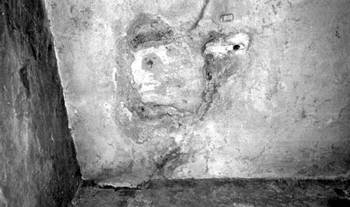
Document 7: Photo of opening no. 1 in the roof of the vestibule, part of the former morgue. © Carlo Mattogno.
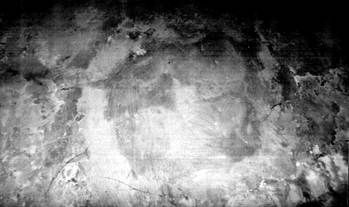
Document 8: Photo of opening no. 2 in the roof of the morgue. © Carlo Mattogno.
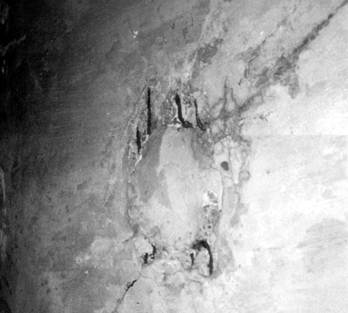
Document 9: Photo of opening no. 3 in the roof of the morgue. © Carlo Mattogno.

Document 10: Photo of opening no. 4 in the roof of the . © Carlo Mattogno.
When the crematorium was transformed into an air-raid shelter for the SS sick-bay, the work sheet specified, i.a., “creation of pipes and wall openings for the heating ovens and the intake and outlet of the aeration system” and, more specifically, “5 pcs. wall openings for installation.”[25]
However, the walls surrounding the morgue show no traces of openings; what is more, the outside wall was and still is covered with an earth embankment. This also goes for the rear wall with the exception of the narrow passage through this embankment leading to the entrance door. On the other hand, the front wall is completely bare and has only one window on the side of the morgue. Finally the wall between the morgue and the furnace hall shows no traces of openings either, and it would have made no sense, anyway, to pierce it for the installation of stovepipes or ventilators.
It is thus clear that the five openings mentioned above were created in the ceiling of the rooms that had been turned into an air-raid shelter.
In the ceiling of the morgue, in its present state, there are two rectangular ventilation shafts, one in a corner of the former laying-out room (the later surgery room, marked as S1 in docs. 4 and 5), the other in a corner of the second air raid shelter room seen from the entrance (S2). Due to their location, it is generally assumed that these shafts were added during the transformation of the building into an air raid shelter.
In addition to these two shafts, one can still distinguish the traces of four circular openings crudely walled up.[26] They originally had a diameter of about 35 cm. The corresponding traces are situated (as measured from their centers) at 1 m, 7.2 m, 8.5, and 18.30 m from the rear wall of the morgue (where the entrance is), and at distances of 1.0 m and 1.4 m from the wall between the morgue and the furnace hall (see docs. 7-10).
Because the morgue was 17 m long, the forth opening is located in the ceiling of the room which, in 1942, was the room where the corpses were washed (the washing room). That is the first proof that those openings had nothing to do with the alleged Zyklon B introduction devices. The second proof is their shape – circular instead of square.
We therefore have six original openings in the ceiling of the rooms investigated, four of which have been walled up at some point. The document mentioned above, however, refers only to five openings to be added.
From other documents it can be derived that there must have been a ventilation opening in the ceiling of the morgue while it was actually used to store corpses.[27] It can be assumed that opening no. 1 was this ventilation opening, first of all because intelligent design suggests to put a ventilation opening at one end of a long room, and secondly because the area around opening 1 turned into a vestibule on the building’s transformation into an air raid shelter, for which a ventilation opening was not required.
2.2. The interpretation by the Holocaust History Project
Of late, three members of the Holocaust History Project – Daniel Keren, Jamie McCarthy and Harry W. Mazal – have dug out the photograph published by Pressac with the aim to “correct some common misconceptions about the crematorium I gas chamber, specifically about the location of the Zyklon holes.”[28]
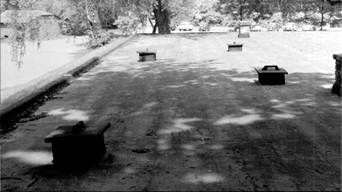
Document 11: Photo of the roof of the morgue. All four shafts constructed by the Poles after the war.
© Carlo Mattogno.

Document 12: Photo of the roof of the morgue. One of the four shafts constructed by the Poles after the war. © Carlo Mattogno.

Document 13: Photo of the ceiling of the morgue. One of the four shafts constructed by the Poles after the war. © Carlo Mattogno.
Even these authors rule out the possibility that the traces of the openings 3 and 4 correspond to the rectangularly shaped spots visible on the above mentioned post-war photo as published by J.-C. Pressac, because they have a circular shape:[29]
“At two other locations holes were sealed, but these were circular ventilation openings.”
The authors affirm that there were originally five holes in the roof of the crematorium for the introduction of the Zyklon B, a figure which is at odds with all testimonies. They identified on the photograph the traces of the fourth dark spot in the roofing felt on the roof of the crematorium (see document 6, spot no. 4.), which had obviously escaped J.-C. Pressac’s attention. They then state that four of the alleged five holes for the introduction of Zyklon B, which the Poles had constructed in the post-war years, were sunk exactly where the aforementioned dark spots were located, and labeled them Z3 [= 3 in my document 6], Z2 [= 2] and Z4 [ = 4]; dark spot Z1 [= 1] was not reopened, according to the authors, whereas dark spot Z5, which they place between Z3 and Z2, does, in fact, not appear on the photograph.
The authors claim to have identified the traces of the alleged opening Z1 on the ceiling of the morgue and present a photograph of it.[30] It is what remains of the opening which I called no. 2; however, it was not square – as the authors affirm – but round and was not located at the site of Z1 but some 2 m away from toward shaft B (see docs.3-5, 8).
Dark spot Z1 was located practically on the perpendicular of dark spot Z4, as results from the extension of the respective sides (see document 6), and was thus on the prolongation of the axis A-B in front of the present opening D (see docs. 3-5). In this area there is no trace of a walled-up opening in the ceiling of the morgue.
Hence, no opening in the roof of the morgue – current or former – corresponds to dark spot Z1. But then, why should dark spots Z2, Z3 and Z4 correspond to such openings?
The authors claim that, when the crematorium was converted into an air-raid “bunker,” the alleged Zyklon B introduction openings were again sealed,[31] but this assertion, which they owe to Franciszek Piper,[32] has no documentary foundation and is even disqualified by the cost estimate of November 2, 1944, mentioned above which, not only does not mention any kind of closing up of holes, but specifies the creation of five openings in walls, i.e. in the ceiling, as I have pointed out above.
The authors furthermore speak of the chemical proof:[31]
“As at the other gassing installations in the camp, cyanide compounds can still be detected in the chamber’s walls, as forensic examinations by the Cracow Institute for Forensic Research demonstrate.”
They refer here to the article by Jan Markiewicz, Wojciech Gubała and Jerzy Łabędź, “A Study of the Cyanide Compounds Content in the Walls of the Gas Chambers in the Former Auschwitz and Birkenau Concentration Camps.”[33] Of the seven brickwork samples taken in the alleged gas chamber (numbers 16 – 22), three gave negative results (samples 18, 19 and 21) and the others showed a maximum content of 292 micrograms (0.292 milligrams) of cyanides per kilogram of substance.[34] Leaving aside the strange decision by the Polish scientists to drop the Prussian blue from the number of cyanides to be determined by chemical analysis (which explains the extremely low values they found compared to the samples taken by Germar Rudolf and Fred Leuchter),[35] another point on which the Polish chemists can be taken to task is that they did not indicate exactly from where they took their samples.
Fred Leuchter has done this. The plan of crematorium I, which is in appendix III of his report,[36] shows the points from where he took his seven samples in the present morgue. One of them, sample no. 28, contained 1.3 milligrams (1300 micrograms) per kilogram of substance, a value of the same order of magnitude as the other samples, except for one of them.[37] As opposed, however, to those samples, which were taken in the space that originally belonged to the morgue, sample no. 28 (as has already been pointed out by Enrique Aynat) was taken by Leuchter from the wall separating the washing room from the laying-out room, which was not part of the original morgue and thus not part of the alleged gas chamber.
Therefore, the presence of cyanides in sample no. 28 cannot be explained by homicidal gassings, but only by normal disinfestations (or by analytical uncertainties or variations). This raises, of course, the question, what evidentiary value similar cyanide residues can have in the first place.
3. Conclusion
The four openings now existing in the roof of the morgue are not original, and the dark spots, which appear on the photograph published by J.-C. Pressac, were not traces of openings (as borne out by the fact that no trace of a square opening on the ceiling corresponds to dark spot Z1).
Furthermore, closing up any openings in the roof of the crematorium would hardly have left depressions of such clarity. Leveling of the surface of an opening that has been filled with sand mortar and cement needs only a simple wooden board larger than the hole itself; but if one had wanted to create such depressions, it would have been necessary to painstakingly scratch out the cement from the surface of the hole filled with mortar. It would have amounted to a form of sabotage on the part of the bricklayer Kommando to leave such obvious traces of the alleged openings. No detainee would have risked that because on the inside, on the ceiling of the morgue, obvious traces of the closure of the holes would remain apparent regardless.
The detainees of the roofing detail would have had to do a similar kind of sabotage by shaping the roofing felt to fit exactly the profile of the alleged quadrangular depressions in the cement.
The explanation of the dark spots is much simpler: they were caused by the compression of the roofing felt that had become soft from sunlight, under the action of a flat and heavy object such as a cement vase or other decoration from the Soviet-Polish dance frolic – and that explains why the fold in the roofing felt is so marked along the edges instead of being slightly concave.
4. Summary
- There is no proof that the alleged openings for the introduction of Zyklon B ever did exist in the ceiling of the morgue of crematorium I.
- There is no proof that the morgue was ever equipped with two gas-tight doors.
- In contradiction with any kind of logical planning, these alleged doors are said to have been later removed by the SS when the crematorium was converted to a gas-tight air-raid shelter, and substituted with two normal doors.
- The traces of cyanides present in the walls of the morgue do not prove that the room was used as a homicidal gas chamber.
- The number of openings constructed by the Poles after the war (four) is at variance with all available testimonies; this also goes for the number (five) adopted by the members of the Holocaust History Project.
- The Polish “reconstruction” with respect to both the location of the openings and the structure and dimensions of the Zyklon B introduction shafts has neither basis in documents nor in witness statements.
- There is no proof that the four rectangular dark spots visible on the roof of crematorium I in the photograph published by Pressac are traces of former openings that were later sealed; on the contrary, no trace on the ceiling of the morgue corresponds to dark spot 1.
- The remaining traces of closed openings are circular and are no doubt connected to the transformation of the crematorium into an air-raid shelter.
- The openings constructed by the Poles make sense, geometrically speaking, only in the context of the present state of the morgue, but are totally asymmetric and irrational when seen in the context of its original state. This is further proof that they have nothing whatsoever to do with any alleged original openings.
© Carlo Mattogno, June 2004
Abbreviations
| AGK: | Archiwum Głównej Komisji Badania Zbrodni Przeciwko Narodowi Polskiemu Instytutu Pamieci Narodowej (Archive of the Central Commission of Investigation into the Crimes against the Polish People – National Monument), Warsaw |
| APMO: | Archiwum Państwowego Muzeum Oświęcim-Brzezinka (Archive of the National Museum of Auschwitz-Birkenau) |
| RGVA: | Rossiiskii Gosudarstvennii Vojennii Archiv (Russian State War Archive), Moscow |
| ZStL: | Zentrale Stelle der Landesjustizverwaltungen (Central Office of the State’s Justice Administrations), Ludwigsburg |
Notes
First published as “Die Einfüllöffnungen für Zyklon B – Teil 1: Die Decke der Leichenhalle von Krematorium I in Auschwitz”, Vierteljahreshefte für freie Geschichtsforschung, 8(3) (2004), pp. 267-274; translated by Henry Gardner.
| [1] | Letter from SS-Sturmbannführer Bischoff to Central Construction Office of October 17, 1944. RGVA, 502-2-147, p. 124. |
| [2] | RGVA, 502-1-401, p. 34. |
| [3] | RGVA, 502-2-147, p. 20. Cfr. J.-C. Pressac, Auschwitz: Technique and operation of the gas chambers. The Beate Klarsfeld Foundation, New York 1989, p. 156. |
| [4] | Letter from SS-Sturmbannführer Bischoff to Central Construction Office of October 17, 1944. RGVA, 502-2-147, p. 124. |
| [5] | RGVA, 502-2-147, p. 125. |
| [6] | RGVA, 502-2-147, pp. 126-126a. |
| [7] | RGVA, 502-2-147, p. 122. |
| [8] | RGVA, 502-2-146, p. 21. Cf. document 1. |
| [9] | “Aussage von Stanisław Jankowski (Alter Feinsilber),” in: Inmitten des grauenvollen Verbrechens. Handschriften von Mitgliedern des Sonderkommandos, Hefte von Auschwitz, Sonderheft I, Verlag des Staatlichen Auschwitz-Birkenau Museums, 1972, p. 42. |
| [10] | Interrogation report, Hans Stark, Cologne, April 23, 1959. ZStL, Ref.: AR-Z 37/58 SB6, p. 947. |
| [11] | “Erinnerungen von Perry Broad,” in: Hefte von Auschwitz, Wydawnictwo Państwowego Muzeum w Oświęciumiu, 9, 1966, p. 31 |
| [12] | F. Müller, Sonderbehandlung. Drei Jahre in den Krematorien und Gaskammern von Auschwitz. Verlag Steinhausen, Munich 1979, p. 62. |
| [13] | AGK, NTN, 105, pp. 110-111. |
| [14] | APMO, Oświadczenia, t. 74, pp. 6-7. |
| [15] | RGVA, 502-1-401, p. 34. |
| [16] | RGVA, 502-2-147, p. 12a. |
| [17] | RGVA, 502-1-401, p. 34. |
| [18] | It would have found a logical place in the small vestibule of the lock (Schleuse) which remained without a door and where there is only a light wooden door today. |
| [19] | The present door even has a window. Cf. document 14. |
| [20] | APMO, sygn. 5149. Cf. document 6. |
| [21] | J.-C. Pressac, op. cit. (note 3), p. 149. |
| [22] | APMO, Oświadczenia, t. 96, p. 59. |
| [23] | Earlier, the narrator had spoken of the reconstruction of the chimney of crematorium I that was carried out between late 1946 and early 1947. |
| [24] | The small wooden casings set in the ceiling panels of the morgue |
| [25] | “Kostenüberschlag zum Ausbau des alten Krematoriums als Luftschutzbunker für SS-Revier mit einem Operationsraum im K.L. Auschwitz O/S – BW 98 M,” RGVA, 502-2-147, p. 126. |
| [26] | The room, which originally served as a laying-out chamber and in which today the Kori oil-fired oven from the crematorium at Trzebinia is preserved, is not open to tourists. I have therefore been unable to ascertain whether its ceiling shows traces of any further openings. |
| [27] | C. Mattogno, Auschwitz: Crematorium I, Theses & Dissertations Press, Chicago, in preparation, docs. 2 and 9; RGVA, 502-1-327, pp. 191f., 502-1-312, p. 111. |
| [28] | D. Keren, J. McCarthy, H.W. Mazal, The Ruins of the Gas Chambers: A Forensic Investigation of Crematoriums at Auschwitz I and Auschwitz-Birkenau, in: “Holocaust and Genocide Studies”, vol. 9, n. 1, spring 2004, pp. 97-99. |
| [29] | Ibid., p. 98. |
| [30] | Ibid., figure 31 on p. 92. |
| [31] | Ibid., p. 97. |
| [32] | F. Piper, Gas Chambers and Crematoria, in: Yisrael Gutman and Michael Berenbaum Editors, Anatomy of the Auschwitz Death Camp. Indiana University Press, Bloomington and Indianapolis, 1994, p. 177 note 16: “When crematorium I was converted into an air-raid shelter, the openings were bricked up”. |
| [33] | Z Zagadnień Nauk Sądowych, z. XXX, 1994, pp. 17-27. |
| [34] | Ibidem, table III on p. 23. |
| [35] | Cf. Rudolf’s critique, The Rudolf Report, Theses & Dissertations Press, Chicago, IL, 2003, pp. 270-273. |
| [36] | Fred A. Leuchter, An Engineering Report on the Alleged Execution Gas Chambers at Auschwitz, Birkenau and Majdanek, Poland. Fred A. Leuchter, Associates, Boston, Massachusetts, 1988. |
| [37] | In order, the values are as follows: 1.9, 1.3, 1.4, 1.3, 7.9, 1.1 mg/kg. |

Bibliographic information about this document: The Revisionist 2(4) (2004), pp. 411-419
Other contributors to this document:
Editor’s comments: First published as “Die Einfüllöffnungen für Zyklon B – Teil 1: Die Decke der Leichenhalle von Krematorium I in Auschwitz”, in: "Vierteljahreshefte für freie Geschichtsforschung," 8(3) (2004), pp. 267-274