
From Greece to Birkenau
Leon Cohen, From Greece to Birkenau: The Crematoria Workers’ Uprising, Salonika Jewry Research Center, Tel Aviv, 1996.
Without a doubt the most important piece of evidence regarding the Holocaust are the testimonies of the members of the so-called Sonderkommandos. They were the workers in the crematories who allegedly took the bodies from the gas chambers to be cremated. Normally, such witnesses should not exist, as the orthodox narrative has it that they were killed every few months to be replaced by others. And yet they do, even claiming that they were Sonderkommando members for many months, even years.
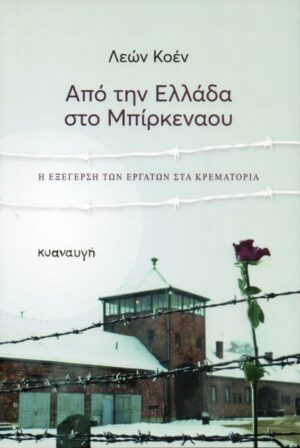 Enter Leon Cohen. He was deported to Auschwitz in the middle of April 1944. He was then transferred to Birkenau where he received the registration number 182,492, and soon he was put to work in the Sonderkommando. He claims to have remained there for 11 months (which is impossible, as the crematories went out of service in November 1944). Strangely, he and his co-workers were not killed, and after the evacuation, he was sent to Mauthausen and other camps, where he was liberated by the Americans on May 5, 1945. He returned to Greece, and in 1980 he migrated to Israel.
His memoir From Greece to Birkenau: The Crematoria Workers’ Uprising was first published by the Salonika Jewry Research Center in Tel Aviv in 1996 (English edition). He is one of three Sonderkommando members, along with Marcel Nadjari and Filip Müller, to have written their memoirs. Let’s see what this most important witness has to say.
Gas Chambers and Crematories
Cohen gives a detailed description of the crematories and the procedures followed (pp. 111-114):
“There were four brand new crematories. They were numbered from 1 to 4 and they were built on the two sides of the buildings. Number 1 was in front of number 2, and, similarly, number 3 was in front of number 4. Between them there was a distance of 250 meters. The whole setting was quite uniform, except for Crematories 3 and 4 which were located at the center of the camp, whereas the first two were at its corner. Each crematory had its own basement, ground floor and upper floor.”
The first two major mistakes. Crematories 3 and 4 (IV-V) were not at the center of the camp but at the north-west corner. Furthermore, they did not have a basement or an upper floor. Cohen seems to think that all four were similar in design.
“One could reach the basement by walking down twelve steps four meters wide, which led to an anteroom 250 m2, about 20 x 12 meters.”
The stairway that led to the basement had actually 10 steps and it was about 2 meters wide. As for the anteroom (Leichenkeller or Morgue #2), it was about 50 meters long and 8 meters wide.
“When the people arrived at the basement, they were told that they would have a shower, so to disinfect them and their clothes. Then they would enter a room with showers, in which the only visible thing was a fake spout nailed on the ceiling. They all had to undress. For reasons of decency, women and children entered first, then men. When a group was ready, the door of the anteroom was opened, which was 16 m2. That room led from the shower to the gas chamber.”
This account totally contradicts the orthodox version. The gas chamber itself was supposed to be the fake shower room, but according to Cohen the fake shower room was in the undressing room – and with only one fake shower head!
“This diabolical chamber was about 30 meters long, 15 meters wide and 3.5 meters high.”
Actual dimensions of Morgue #1 said to have been that “chamber”: 30 x 7 x 2.4 m.
“Its maximum capacity was 500 people, but we managed to squeeze up to 750.”
An interesting divergence from the usual claims of about 2,000 to 3,000 people. Cohen gives more realistic figures, putting 750 people in a chamber of 30 x 15 m. Obviously he’s done the math.
“Inside there were hollow pillars, placed every 8 meters. The pillars were covered with pierced metal plates, which had holes of 15 mm and through them the gas entered the chamber.”
Curiously, instead of just saying the number of pillars, he places one pillar every 8 meters. In a room 30 meters long, that would mean 3 pillars in total, but only if there was only one row. With a second row, there would have been 6 pillars. And he doesn’t seem to notice that there were also 7 concrete pillars supporting the roof.
Also, in another divergence, he claims that the pillars were covered (probably referring to their sides) with iron plates which had small holes, whereas they were supposedly made of several layers of iron wire-mesh with a wire-mesh insert for inserting and removing the Zyklon B pellets.
“The prisoners would remove the slab from outside and the soldiers added the frozen gas, which was in the form of liquid crystals weighing about one kilogram. From closure till the crystals turned to gas, about one hour passed. In the winter we would first preheat the chamber, setting fire with coals to accelerate the evaporation. To make sure that they were all dead, we had to wait one more hour before opening the door.”
Cohen seems to be aware that high temperatures were needed in the gas chamber but his description of Zyklon (which he does not name) is wrong. It implies that it was in the form of ice crystals which melted and turned to gas, whereas it was gypsum granules soaked with hydrogen cyanide that slowly evaporated upon opening the can. Furthermore, he gives two full hours for an execution (followed by two more hours for ventilation), again a realistic figure, but in total contradiction with all the witnesses who speak of only a few minutes up to half an hour at most for the whole procedure.
“Strangely, the corpses near the pillars were completely bruised, almost black, while those further away were pink. I suppose this was due to the amount of gas they had inhaled but as I am not a scientist nor a doctor, I cannot draw a conclusion.”
Cyanide poisoning causes a pink discoloration, a fact that almost all witnesses get wrong. Cohen seems to get it right. But does he? Other Sonderkommando members like Dario Gabbai have claimed that the bodies were black and blue. Cohen’s statement looks like an attempt to reconcile those claims with reality.
The Cremation
We now move to the cremation of corpses (pp. 115-118).
“As for the third stage, the 35 meters long chamber-furnace was divided in two sections. The crematories were in the first section, which was the largest. The second, smaller section, was about 10 meters long and it had been converted to a luxurious chrome-plated paved bathroom.”
Cohen does not explain what was supposed to be the purpose of that bathroom. In fact, there was no such bathroom. Next to the furnace room there were several rooms: The coke bunker, the commanding officer’s office, a toilet, and the quarters of the workers.
“Two groups of workers worked there, each on a twelve hour shift, from six to six. The burning, that is, would continue non-stop round the clock. The ovens had been assembled in units of three and were about five meters apart. Each oven could take five corpses. The capacity, that is, was 15 corpses per unit and 75 in total. The procedure lasted for half an hour. […] In short, within 24 hours and if there was no stop, 3,600 corpses could be cremated.”
Cohen describes correctly the ovens (five triple-muffle furnaces), but his other data is absurd. It was physically impossible to fit five corpses into one muffle, as they were designed only for one corpse each. But even if it had been possible, the cremation would have lasted several hours, because so many corpses would have clogged the muffle and overtaxed the coke hearths, making a proper cremation impossible.[1]
“Although the male corpses were more than the female ones in an analogy three to two, when the crematory was full, the surplus of the female fat was absolutely capable by itself to keep the fire going.”
This is absolute nonsense. Fat is flammable, but the amount of fat contained in a normal body is not enough to keep a cremation going in the kind of furnaces installed at Auschwitz. They were neither insulated nor had any means of recovering the heat from the exhaust gases. Without additional fuel, the muffles would have swiftly cooled down, and the cremation would have stopped.
Finally, according to Cohen the cremation ashes weigh 700 grams, a figure close to Nadjari’s 640 grams. But their actual weight is 2 to 3 kg.
The Pits
The orthodox narrative has it that during the deportation of the Hungarian Jews in late spring and summer of 1944, the crematories could not keep up with the thousands of corpses. So some pits were dug in the northern backyard of Crematorium V to burn them, in addition to similar burning pits dug near the so-called Bunker 2 outside of the camp proper. What does Cohen have to say about this?
Well, for starters he does give neither their number nor their location. Additionally, he claims that pits were regularly used:
“Under normal circumstances, the corpses were burned in the crematories. But whenever too many prisoners arrived at the same time, it was impossible to squeeze them all in the crematories and the burning had to be done inside the pits.” (p. 119)
He also adds that pits and crematories were working for 10 months (p. 122). Now here’s the description of a pit:
“A pit was a trench five meters deep, with a gradually narrowing width from about six meters to one meter. It was full to the top with alternating layers of fir and pine branches and of corpses. As soon as it was full, they would pour oil and set fire. To speed up the cremation procedure, the Sonderkommandos were standing at both sides of the pit poking the fire with long stakes. The completion of the job on each pit usually lasted two days and two nights. When the fire went off due to shortage of fuel, the trench had to be cleared from the remains, like the half-burned branches and the accumulated fat.” (p. 119)
In the swamp that was Birkenau, it would be impossible to dig a pit five meters deep.[2] Also the heat would have been so intense (he speaks of flames five to six meters high) that approaching the fire would have caused severe burnings if not death. Finally, even more ridiculous is the claim about the accumulated fat. The same fat that was allegedly enough to keep the cremation going in the cremation furnaces did not burn off in the pits but rather gathered to such a degree that it had to be cleared out?
Gas Vans?
As it turns out, gas chambers, crematories and flaming pits were not enough for Cohen, so he discovered gas vans at Birkenau, of which the orthodox narrative knows nothing:
“The trucks were permanently parked at the center of the fields, about 300 meters from the trenches. In there up to 100 people were squeezed, and half an hour after the doors were closed, the gas would enter through a small opening, that closed afterwards. Hearing those unfortunate people screaming and hitting the walls was unbearable. All this lasted ten to fifteen minutes and then, all of a sudden, there was a terrifying silence. Fifteen minutes later, we opened the back door of the truck and loaded the corpses on special carts, which we pushed on the temporary railways to the trenches. When we reached there, we tipped over the carts and emptied the corpses into the trenches.” (p. 121)
Commander Wire
Leaving aside for a moment the gas chambers and the fires, let’s have a look at another example that highlights the historical value of this book. Before his deportation, Cohen was held at a camp in Haidari, a suburb of Athens. As they did not know the commander’s name (in a footnote the editor writes that it was Paul Radomski), they had named him Wire (from a Greek expression). Later, on one day while in Birkenau, they were ordered to clean the crematorium, because the new camp commander was about to come any time soon. Several days later, a black Mercedes arrived and an officer with a uniform full of medals and a whip in hand got out. And what a surprise, it was Wire himself! Long time, no see…
The Uprising
Finally, let’s see what Cohen has to tell us about the famous uprising of the Sonderkommandos, which is officially placed on October 7, 1944.
First, he seems to be quite confused regarding the date. In the Introduction he claims it was on July 7 (p. 21). Then he writes it was on October 7 (p. 128). Lastly, when he starts describing the event (p. 151), he places it on September 7! Anyway, here’s what allegedly happened (pp. 155f.):
“At two o’clock the prisoners were ordered to gather in the furnace room and submit a report at the Disinfection Unit. At that point, a Greek yelled: Upon them! That was the starter to begin the uprising. The other Greeks responded immediately and charged at two guards to grab their weapons. However, the expected help from the rest never came. On the contrary, in fact, some non-Greek prisoners tried to take the weapons from the rebels and give them back to the Germans. I still cannot understand their attitude. There were some shootings in the air and amidst the panic a group of 25 Greeks ran towards the exit. They ran a distance of 50 meters to Crematorium 3 and grabbed the weapons of two more Germans. Subsequently they let the Germans go, fortified themselves in the crematory and waited. All the prisoners, Greek or not, waited with them. […] The Germans responded quickly. One or two minutes later one of the soldiers of Crematorium 4 regained his nerve, ran to the watchtowers and raised the alarm. […] Within 15 minutes trucks full of armed soldiers arrived, who surrounded the crematory and ordered the rebels to surrender. They responded with a fusillade of bullets. Obviously, some of the rebels’ bullets had hit their target, because the Nazis stopped shooting and in a few minutes ambulances arrived. Soon they started shooting again. […] The battle, however, could not go on forever. The Germans started throwing grenades and opening holes on the walls. […] The next step was to set the crematory on fire. Within a few minutes, Crematorium 3 was engulfed in flames and all Greeks perished.”
A number of German wartime documents have surfaced in the meantime proving that an attempt at mass escape did indeed happen on October 7, 1944, which was thwarted by the camp authorities.[3]
This confirms an attempted mass escape. The usual narrative about this event, however, has it that the prisoners blew up Crematorium IV themselves and set it on fire, and that most participants of this attempted escape were shot while trying to flee, or during subsequent reprisals.[4]
Summary
The witness obviously lacks any credibility. His book is quite similar to Eyewitness Auschwitz by Filip Müller: Full of errors, contradictions, fictional events and outrageous claims. Cohen writes that one reason for putting his experiences to paper is because of the intense allusions that the Holocaust is a myth. Unfortunately, his book provides even more fuel to these allusions.
Notes
| [1] | The hearths, also designed for only one corpse per muffle at a time, had to provide the heat and combustion gases needed for the cremation. On the Auschwitz cremation devices see C. Mattogno, F. Deana, The Cremation Furnaces of Auschwitz: A Technical and Historical Study, Castle Hill Publishers, Uckfield 2015. |
| [2] | On this see Carlo Mattogno: Auschwitz: Open-Air Incinerations, 2nd ed., Castle Hill Publishers, Uckfield 2016, in particular the three contributions on that problem in the appendix. |
| [3] | See Carlo Mattogno, Miklós Nyiszli, An Auschwitz Doctor’s Eyewitness Account: The Bestselling Tall Tales of Dr. Mengele’s Assistant Analyzed, Castle Hill Publishers, Uckfield 2018, Section 3.6.2. |
| [4] | See Danuta Czech, Kalendarium der Ereignisse im Konzentrationslager Auschwitz-Birkenau 1939-1945. Rowohlt Verlag, Reinbek bei Hamburg, 1989, pp. 899f. |

Bibliographic information about this document: Inconvenient History, Vol. 10, No. 1 (winter 2018)
Other contributors to this document: n/a
Editor’s comments: n/a