
The Life and Death of My Father, Rudolf Hess
A Son's Struggle for His Father's Honor
(Presented by videotape at the Eleventh IHR Conference, 1992)
Wolf Rüdiger Hess studied at the Technical University in Munich, from where he graduated as a government-certified engineer in 1964. He is chairman of the Rudolf Hess Society (Postfach 1122, 8033 Planegg, Germany). He and his wife live in Bavaria. [He passed away on October 24, 2001; ed.]
When my father flew to Scotland on May 10, 1941, I was three-and-a-half years old. As a result, I have only very few personal memories of him in freedom. One of them is a memory of him pulling me out of the garden pond. On another occasion, when I was screaming because a bat had somehow gotten into the house. I can still recall his comforting voice as he carried it to the window and released it into the night.
In the years that followed, I learned who my father was, and about his role in history, only bit by bit. Slowly, I came to understand the martyrdom he ured as a prisoner in the Allied Military Prison in Berlin-Spandau for 40 long years – half a life-time.
Growing Up in Egypt and Germany
My father was born in Alexandria, Egypt, on April 26, 1894, the first son of Fritz Hess, a respected and well-to-do merchant. The Hess family personified the prosperity, standing and self-assurance of the German Reich of that period. They also personified all those things that aroused envy, fear and a combative spirit on the part of Britain and other great powers.
Fritz Hess owned an imposing house with a beautiful garden on the Mediterranean coast. His family, which came from Wunsiedel in the Fichtelgebirge region of Germany, owned another house in Reicholdsgrün, in Bavaria, where they regularly spent their summer holidays. The source of this wealth was a trading firm, Hess & Co., that Fritz Hess had inherited from his father, and which he managed with considerable success.
His eldest son, Rudolf, was a pupil at the German Protestant School in Alexandria. His future appeared to be determined by both family tradition and his father's strong hand: he would inherit the property and the firm, and would, accordingly, become a merchant. Young Rudolf, though, was not very inclined toward this kind of life.
Instead, he felt drawn toward the sciences, above all physics and mathematics. His abilities in these fields became obvious as a student at the Bad Godesberg Educational Institute, a boarding school for boys in Germany that he atted between September 15, 1908, and Easter, 1911. In spite of this, his father insisted that he complete his secondary school education by passing an examination that would permit him to enter the école Supérieur de Commerce at Neuchâtel in Switzerland, after which he became an apprentice in a Hamburg trading company.
Front Line Combat Service
These well-laid plans were soon to change. The start of the First World War in 1914 found the family at its vacation home in Bavaria. Rudolf Hess, then 20 years of age, did not hesitate for a moment before reporting as a volunteer with the Bavarian Field Artillery. A short time later, he was transferred to the infantry, and by November 4, 1914, he was serving as a poorly trained recruit at the front, where he took part in the trench warfare of the first battle of the Somme.
Along with most young Germans of that time, Rudolf Hess went to the front as a fervent patriot acutely conscious of Germany's cause, which he regarded as entirely just, and determined to defeat the British-French arch-enemy. After six months of front-line service, my father was promoted to lance corporal. To his men he was an exemplary comrade, always the first to volunteer for raids and reconnaissance patrols. In bloody battles among the barbed wire, trenches and shell craters, he distinguished himself by his cheerful composure, courage and bravery.
By 1917 he had been promoted to the rank of Lieutenant. But he also paid the price of this “career” advancement: He was gravely wounded in 1916, and again in 1917 when a rifle bullet pierced his left lung.
A Humiliating and Vengeful Peace
Scarred by the hardships and wounds of front line duty, on December 12, 1918 – that is, after the humiliating armistice of Compiègne – Rudolf Hess was “discharged from active military service to Reicholdsgrün without maintenance,” as the official army record rather baldly puts it. That is, without pay, pension or disability allowance.
Already during the war, the family had lost its considerable holdings in Egypt as a result of British expropriation. Now the defeat of the German Empire in the First World War brought wrenching, even catastrophic changes in the life of the Hess family.
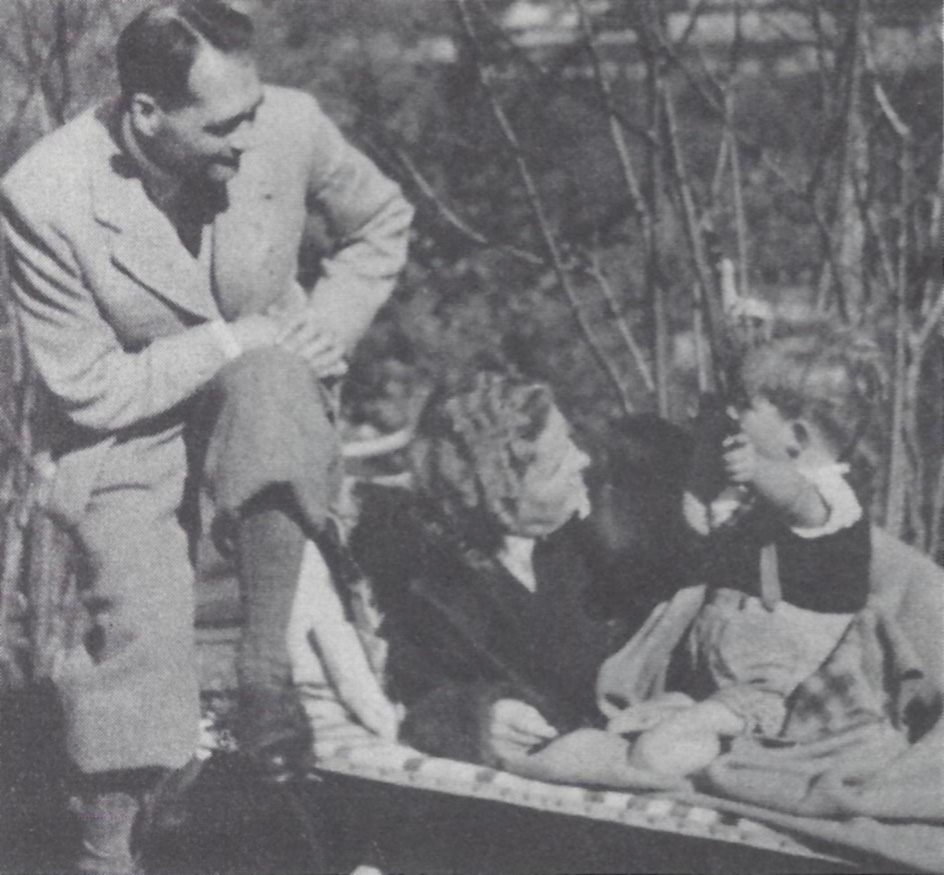
Young Wolf Hess with his parents in happier days, before the May 1941 “peace flight” to Britain.
For Rudolf Hess, though, the grim fate suffered by his fatherland in defeat and revolution weighed more heavily than this private misfortune. In spite of the military armistice, the victorious powers maintained a starvation blockade against Germany until the imposition of the Treaty of Versailles in June 1919. The Treaty itself was little more than a vengeful “peace of annihilation” dictated by the victorious powers and accepted by the German National Assembly only under protest and the threat of further force.
On May 12, 1919, in a moving address that has since become famous, Reich Chancellor Philipp Scheidemann, a Social Democrat, declared:
… Allow me to speak entirely without tactical considerations. What our discussions are concerned with, this thick book in which a hundred paragraphs begin with “Germany renounces, renounces,” this most atrocious and murderous hammer of evil by which a great people is extorted and black mailed into acknowledging its own unworthiness, accepting its merciless dismemberment, consenting to enslavement and serfdom, this book must not become the statute book of the future… I ask you: Who, as an honest man – I will not even say as a German, only as an honest man loyal to the terms of a treaty – can submit to such conditions? What hand that submits itself and us to such shackles would not wither? Moreover, we must exert ourselves, we must toil, work as slaves for international capitalism, work unpaid for the entire world!
… If this treaty is actually signed, it will not be just Germany's corpse that remains on the battlefield of Versailles. Beside it will lie equally noble corpses: the right of self-determination of peoples, the indepence of free nations, belief in all the fine ideals under whose banner the Allies claimed to fight, and, above all, belief in loyalty to the terms of a treaty.
Scheidemann's words leave scarcely any doubt that as a result of the “vae victis” of the governments of the Allied and Associated powers, Germany's very existence as a prosperous and unified nation was brought into question. As far-sighted men of the time correctly observed, the Constitution of the “Weimar Republic” (1919-1933) was, in a real sense, not the one that the German parliament formally adopted on August 11, 1919. It was rather, imposed by the dictated Treaty of Versailles on June 28, 1919. As a result of the Treaty, each of the numerous governments of the “Weimar Republic” was inevitably faced with the same insurmountable problem. Each administration was obliged to carry out the Treaty's countless oppressive and devastating conditions, and thus act as an “agent” of the victorious powers. Each new government thus unavoidably discredited itself in the eyes of the people it represented, and therefore committed a kind of political suicide.
Meeting With Hitler
One political leader, though, defiantly vowed from the outset never to permit himself or his party to be blackmailed. This man was Adolf Hitler, and his party was the National Socialist German Workers' Party. Like many of his fellow citizens, my father was appalled and deeply shocked by the conditions that had developed in Germany, and he resolved to fight against the “Diktat” of Versailles. The catastrophic state of affairs he found in Munich after his return from the front defied his ability to describe them. Like most of his comrades, Hess was drawn into the war in 1914 to fight for a free, strong and proud Germany. Now, in 1919, the 26-year-old had to witness the establishment in Bavaria of a “Soviet republic” headed by communists and Jews. In his eyes, military defeat had given way to national catastrophe.
In a letter written to a cousin some time later, he graphically described his feelings at the time:
You know how I suffer under the situation to which our once proud nation has been brought. I have fought for the honor of our flag where a man of my age had of course to fight, where conditions were at their worst, in dirt and mud, in the hell of Verdun, Artois and elsewhere. I have witnessed the horror of death in all its forms, been hammered for days under heavy bombardment, slept in a dugout in which lay half of a Frenchman's dead body. I have hungered and suffered, as indeed have all frontline soldiers. And is all this to be in vain, the suffering of the good people at home all for nothing? I have learned from you what you women have had to live through! No, if all this has been in vain, I would still today regret that I did not put a bullet through my brain on the day the monstrous armistice conditions and their acceptance were published. I did not do it at the time solely in the hope that in one way or another I might still be able to do something to reverse fate.
From then on, he was consumed by the conviction that he could “reverse fate,” and by the determination to act on this conviction. During the winter of 1918-19, in a humiliated Germany shaken by communist riots, tormented by ad hoc governments of “workers' and soldiers' soviets,” he still recognized – in spite of his discouragement – the possibility of renewal for the people for whom he had been ready to lay down his life.
Now determined to fight against the obvious efforts to subjugate Germany, his feelings of despair turned into burning indignation and motivating rage.
As a result, he was almost inevitably drawn to the one political force that, as he had correctly sensed from the outset, was in a position to break the shackles imposed upon the German people at Versailles. Like millions of other Germans, he followed this movement's leader – but he did so earlier and with greater dedication than most of the others. Along with his fellow citizens, he was convinced of the justice of the cause for which he fought – restortoration of Germany's national rights and standing by breaking the chains of Versailles.
The National Socialist German Workers' Party was founded in Munich in January 1919. Hitler joined a few months later, and quickly became its most prominent speaker. It was sometime in May 1920, at an evening meeting of this small group in a room adjoining the Sternecker brewery in Munich, when Hess first heard Hitler speak. When he returned home that evening to the small guest house where he was living, he enthusiastically told the girl who lived in the adjacent room, Ilse Pröhl – whom he was later to marry:
The day after tomorrow you must come with me to a meeting of the National Socialist Workers' Party. Someone unknown will be speaking; I can't remember his name. But if anyone can free us from Versailles, he is the man. This unknown man will restore our honor.
My father became member number sixteen of the group on July 1, 1920. From that time on he was slowly but steadily drawn to its leader. There were several reasons for his enthusiasm for Hitler. First, there were reasons of practical policy, which Hess formulated in these words in a letter written in 1921:
The core of the matter is that Hitler is convinced that [national] resurrection is possible only if we can succeed in leading the great mass of people, in particular the workers, back to national awareness. But this is possible only in the context of reasonable, honest socialism.
Second, Hess had a personal reason, which was Hitler's eloquence. In a letter to a fri written in 1924, my father described the effect of this gift:
You won't find more than once a man who at a mass meeting can enrapture the most left-wing lathe operator just as much as the right-wing senior executive. This man, within two hours, made the thousand communists who had come to break up [the meeting] stand and join in the national anthem at the [as in Munich in 1921], and this man, within three hours, in a special address to a few hundred industrialists and the Minister President [or provincial governor], who had come more or less to oppose him, secured their full approval or speechless astonishment.
Rudolf Hess was convinced that Hitler could not fail to break the chains of Versailles and then carry out a political change of direction that promised a better future.
In the years before it gained large-scale support from voters, the National Socialist party was a small Bavarian phenomenon, and Hitler's place in national politics was insignificant. Not even Hitler's recognized ability as an speaker was at first able to change this. During the period from 1924 until 1929, when normal conditions seemed to return in Germany, despite Versailles, Hitler was not well known. The only exception was in 1923, when he gained brief notoriety for his role in the November 9th “March on the Feldherrnhalle” in Munich, and the ill-fated attempt to overthrow the government there. In the course of this unsuccessful putsch, my father arrested three ministers of the Bavarian state government. For his role in the coup attempt, Hitler was punished with imprisonment in the Landsberg fortress, where my father later joined him.
Victory in Political Struggle
It was during that time of incarceration that Hitler and my father established the special relationship of trust and mutual confidence that stamped the image of the party's leadership in later years. It was also in Landsberg that Hitler wrote his well-known, seminal work, Mein Kampf. My father edited the pages of the manuscript and checked them for errors. Hitler was released early on December 20, 1924. Four months later, in April 1925 my father became Adolf Hitler's private secretary, at a monthly salary of 500 marks.
In the first years of the 1930s, the impact of the Great Depression and the political disintegration of the Weimar Republic set the stage for Hitler's seizure of power in January 1933. As a result of its well-organized propaganda campaigns, which were in turn due to its quasi-military cohesion and discipline, the National Socialist party gained greater and greater electoral support from ever broader segments of the population. And as employment increased, more and more jobless workers also turned to the National Socialists, many of them defecting directly from Germany's large Communist Party.
During the hectic days of January 1933, my father never left Hitler's side. In a hand-written letter to his wife, dated January 31, 1933 – that is, the day after Hitler became Chancellor – the 38-year-old Rudolf Hess recorded his feelings during this moment of triumph:
Am I dreaming or am I awake – that is the question of the moment! I am sitting in the Chancellor's office in the Wilhelmsplatz. Senior civil servants approach noiselessly on soft carpets to submit documents “for the Reich Chancellor,” who is at the moment chairing a Cabinet meeting and preparing the government's initial measures. Outside, the public stands patiently, packed together and waiting for `him' to drive away – they start to sing the national anthem and shout “Heil” to the “Führer” or to the “Reich Chancellor.” And then I start to shake and I have to clench my teeth – just as I did yesterday when the “Führer” returned from [his meeting with] the Reich President as “Reich Chancellor,” and summoned me to his bedroom in the Kaiserhof hotel from among the mass of leaders waiting in the reception room – when what I had considered impossible right up to the last moment became reality.
I was firmly convinced that everything would, of course, go wrong at the last moment. And the Chief also admitted to me that a few times things were on a knife-edge because of the intransigence of the old weasel in the Cabinet [a reference to Alfred Hugenberg, coalition partner and chairman of the German National People's Party].
The evening torchlight procession marched before the delighted old gentleman [President von Hindenburg], who bore it until the last SA man [stormtrooper] had passed at about midnight… Then came the jubilation directed to the Führer, mixing with that directed to the Reich President. The hours of men and women pushing past, holding up their children facing the Führer, young girls and boys, their faces radiant when they recognized “him” at the window of the Reich Chancellery – how sorry I was that you were not there!
The Chief behaves with incredible assurance. And the punctuality!!!! Always a few minutes ahead of time!!! I have even had to make up my mind to buy a watch. A new era and a new time schedule has dawned!
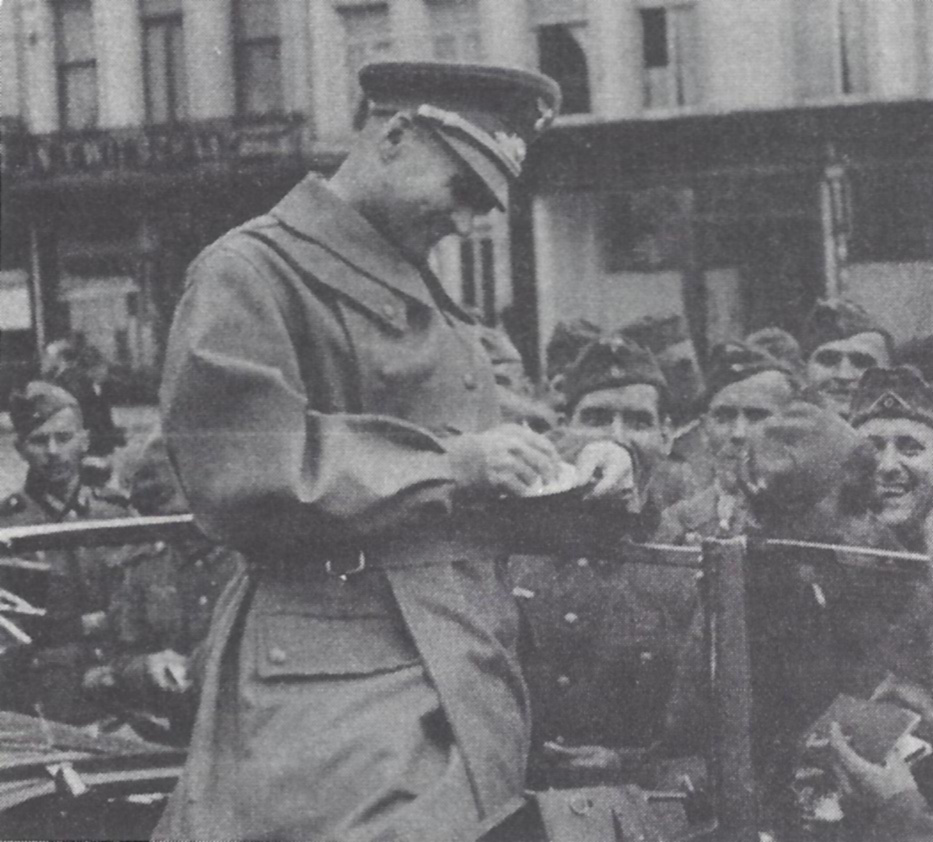
Deputy Führer Hess signs autographs for German soldiers in France.
All this was written on a sheet of paper with a letterhead reading “The Reich Chancellor.” Hess had, however, crossed out the Gothic lettering with his pen. The next day, in a follow up letter dated February 1, he concluded with the words: “One stage towards victory is now, I hope, finally behind us. The second difficult period of the struggle has begun!”
On April 21, 1933, Hitler appointed Hess as Deputy Führer of the National Socialist party. His job was to lead the governing party as Hitler's representative, and to uphold its national and social principles. Eight months later, on December 1, 1933, Reich President Hindenburg – acting on Hitler's proposal – appointed Hess as Reich Minister without Portfolio. At the outbreak of war in September 1939, Hitler named Reich Marshal Hermann Göring as deputy head of state. But this does not alter the fact that Hess remained Hitler's close confidant, and a man he could trust without reservation.
Gathering Clouds of War
The most important result of the European political developments of 1937 and 1938, which reached a climax in the “Sudeten crisis” of 1938, was that Britain continued to strengthen its ties with the United States. As a condition of US assistance in the event of war, President Roosevelt demanded from British premier Chamberlain certain commitments in the field of political stability. It was under this pressure that Britain and France then concluded a military agreement in February 1939. In addition, the two western European democracies, bowing to Roosevelt's claim to lead world policy, gave guarantees to Holland, Switzerland, Poland, Romania, Greece and Turkey – in other words, to all of Germany's neighbors in the West and East – which Hitler considered Germany's rightful domain.
From this point on, Britain, France and Poland – with America behind them – decided which of Hitler's revisions of the conditions imposed by Versailles they would regard as reason for, or even merely a pretext for, war against the German Reich. Even if Hitler refrained from further revisionist policies, from now on the question of war or peace was no longer solely in his own hands.
At the time of Britain's “blank check” guarantee to Poland in March 1939, Hitler had not yet finally resolved to attack Poland. But every western political leader was aware that this fateful guarantee was an significant step closer to war. Indeed, important figures in western circles and among the anti-Hitler opposition in Germany calculated that Hitler would react to this new Polish depence on Britain, France and the USA with military action. It was hoped that this would mean not only war, but Hitler's own downfall. This was confirmed by Chamberlain in his diary entry of September 10, 1939: “My hope is not a military victory – I doubt very much whether that is possible – but a collapse on the German home front.”
On September 1, 1939, the German armed forces commenced the attack against Poland. Two days later, Britain and France declared war against the German Reich. The fact that these governments did not also declare war against Soviet Russia, which invaded Poland on September 17, 1939 (in accord with the provisions of the German-Soviet pact of August 23, 1939), clearly shows that the British guarantee to Poland – like the British-French declaration of war against Germany – was motivated not by concern for Poland but rather was directed against Germany.
Four weeks later, Poland was shattered and the country was divided between Germany and Russia – without a single shot being fired in the West. Britain and France had done nothing for their Polish ally, and now Hitler began to plan an attack against France. At the same time, he hoped that Britain would make peace with him, while accepting the hegemony of a now-powerful Germany in eastern Europe. He believed that Britain would agree to this now that Poland was prostrate, or at the latest after a German victory over France.
After Germany's lightning victory over Poland, and before the German attack on France in May 1940, Hitler made the first of his numerous attempts to the war in the West. His peace offer of September 12, 1939, accompanied by the assurance that under his leadership Germany would never capitulate, was a feeler. It was supported by Stalin, but rejected by Chamberlain and French premier Daladier.
Only after all hopes of peace with France and Britain were dashed did Hitler order an attack against France. It commenced on May 10, 1940, and France collapsed on June 21, 1940. The Franco-German armistice was signed on June 22 in the same railway dining car in Compiègne in which the Germans had signed the humiliating armistice of November 1918.
No one had foreseen such a swift German victory over France. As a result of this stunning achievement, Hitler had made himself ruler of the continent of Europe, from the Atlantic to the Bug river [in Poland], and from the North Cape to Sicily. But Britain still stood in the way of his goal of a free hand on the continent. Accordingly, during his visit in June 1940 to the sites of Germany's successful military campaigns, Hitler once again expressed his desire to reach a comprehensive peace agreement with Britain. It was at that time that his Deputy, Rudolf Hess, decided that – if it became necessary – he would make a personal effort to achieve a vital peace with Britain.
Flight for Peace
What really happened between June 1940 and May 10, 1941, the day my father took off in a Messerschmitt 110 to Scotland, is known only in outline because the relevant British documents still remain classified. The Hess papers that were released in Britain with great fanfare in June 1992 proved to be disappointing. Among these approximately two thousand pages was absolutely nothing of real substance about the secret contacts that existed between Britain and Germany, about the British peace group (which included members of the royal family) and its peace feelers to Germany, or about the role played by the British secret service prior to the flight. In short, these papers contained nothing that would show why my father seriously hoped that his mission might well turn out successfully.
In any case, it can be said with certainty that the still-classified British documents contain nothing that will reflect badly on Rudolf Hess or the policies of the German government of that time. Moreover, it can be stated with certainty that the documents that the British government continues to keep secret will reflect badly on the wartime British government of Winston Churchill. I will go further to say that these suppressed documents confirm that Churchill sought to prolong the war, with all the suffering, destruction and death that implies.
Some may dismiss this statement as unjustified and self-serving. In this regard, I would therefore like to cite the words of a British historian who has carried out extensive research on precisely this aspect of that dreadful conflict. In Ten Days To Destiny: The Secret Story of the Hess Peace Initiative and British Efforts to Strike a Deal with Hitler (New York: W. Morrow, 1991) [available from the IHR], John Costello concludes that it would have been quite possible to bring the European war to an before it turned into a world war, if only the British government had made even the slightest move to do so.
In Ten Days to Destiny [on pages 17 to 19], Costello writes the following revealing sentences:
Until the British government reverses current policy and releases the relevant section of its historic intelligence service archives, it may be impossible to determine whether the clandestine contacts with Germany that evidently played a part in bringing Hess to Scotland on the night of May 10 were a secret service triumph or part of a sinister peace plot that ran out of control. What is now indisputable is that the Hess mission was very far from being the “brainstorm” of Hitler's deluded deputy that it is still being portrayed as by distinguished British historians. The documentary evidence that has now come to light [which, I might add parenthetically, is only the tip of the iceberg] shows that it was the outcome of an interlocking sequence of secret British and German peace manoeuvres that can be tracked right back to the summer of 1940. The pieces of this jigsaw puzzle are now falling into place to show that: […]
- Hitler's order halting the Panzer advance on Dunkirk was a carefully timed stratagem to persuade the British and French governments to seek a compromise peace.
- A majority of the [Churchill] War Cabinet had decided to trade off Gibraltar and Malta in return for keeping control of the Empire.
- An alarmed President Roosevelt secretly sought Canadian help to stop the British accepting a “soft peace” deal with Hitler.
- French leaders believed on May 24, 1940, that Britain would not fight on but accept a joint peace deal brokered by Mussolini at the of May 1940.
- Churchill – and Britain – survived only because the Prime Minister resorted to ruthless Machiavellian intrigue and a high-stakes bluff to stop a wobbly Foreign Secretary talking the War Cabinet into a peace deal engineered by R.A. Butler. When France fell, Lord Halifax's Under-Secretary actually passed a message to Berlin that “common sense and not bravado” dictated that Britain should negotiate, not fight Hitler. […]
- Two days after Churchill had promised “we shall never surrer,” Lord Halifax and R.A. Butler signalled to Berlin via Sweden that a British peace proposal would be made after the French armistice on June 18, 1940.
- Ambassador Kennedy had been in clandestine contact with Hitler's emissaries trying to stop the war while the British government suspected him of illegally profiting from Treasury information to make a killing in international stock and securities dealings. […]
- The Duke of Windsor and other members of the Royal Family encouraged German expectations that peace would eventually be negotiable.
- Hess' plan to fly to Scotland took shape in the final days of the battle for France and was encouraged in September 1940 by his discovery that Britain continued putting out peace feelers via Switzerland and Spain.
- MI5 [the British secret service] intercepted Hess' first peace initiative and then turned it into a “double-cross” operation to snare Hess into a trap baited by the Duke of Hamilton and the British Ambassadors in Switzerland and Madrid.
- Hess' dramatic arrival left Churchill with no choice but to bury the affair in distortion and official silence in order to protect not only the Duke of Hamilton but senior Tory colleagues who even in 1941 remained convinced that an honorable peace could be struck with Hitler.
For more than fifty years the cloak of British secrecy has clouded and distorted the record. The official histories carefully masked the roles played by the key players in the year-long effort to strike a deal with Hitler behind Churchill's back. Just how close this peace plotting came to succeeding has been concealed to protect the reputations of the British politicians and diplomats who had believed that Hitler was less of a menace to the Empire than Stalin…
Churchill also had his own reasons for burying his wartime quarrels with other leading members of the Conservative Party. He did not want any scandal to sully the glory of his leadership during the Battle of Britain and the “white glow, overpowering and sublime, which ran through our Island from to .”2
Britain's “Finest Hour” and Churchill's own role in forging it were enshrined as one of the most illustrious chapters in British history. His visionary courage had created, by words rather than military substance, the British people's belief that, against the overwhelming odds, they could defy Hitler in 1940.
No one knows for sure whether my father undertook his flight with the knowledge and blessing of Adolf Hitler. Both men are now dead. All the available evidence, though, suggests that Hitler knew in advance of the flight:
First: Just a few days before his flight, my father had a private meeting with Hitler that lasted four hours. It is known that the two men raised their voices during portions of their talk, and that when they were finished, Hitler accompanied his Deputy to the ante-room, put his arm soothingly around his shoulder, and said: “Hess, you really are stubborn.”
Second: The relationship between Hitler and Hess was so close and intimate that one can logically assume that Hess would not have undertaken such an important step in the middle of a war without first informing Hitler.
Third: Although Hess' adjutants and secretaries were imprisoned after the flight, Hitler intervened to protect Hess' family. He saw to it that a pension was paid to Hess' wife, and he sent a personal telegram of condolence to Hess' mother when her husband died in October 1941.
Fourth: Among the papers released in June 1992 by the British authorities are two farewell letters my father wrote on June 14, 1941, the day before he tried to commit suicide in Mytchett Place, in England. The letters were written after he realized that his peace mission had definitely failed. One was addressed to Hitler and the other to his family. Both clearly confirm that his close relationship with Hitler still existed. If he had undertaken his now-obviously failed mission without Hitler's prior knowledge, his relationship with Hitler clearly would no longer still have been one of trust.
And, fifth: Gauleiter Ernst Bohle, the Hess confident and high-ranking official who had helped my father to translate some papers into English, remained convinced until his death that all this was done with Hitler's knowledge and approval.
Suppressing Historical Evidence
A general comment on the information available about my father's peace proposals is in order: During the entire forty-year period of his imprisonment in Spandau, he was prohibited from speaking openly about his mission. This “gag order” was obviously imposed because he knew things that, if publicly known, would be highly embarrassing to the British government, and possibly to the US and Soviet governments as well.
As a result, contemporary historical research remains entirely depent on the British documents. British authorities have announced that many important documents from the Hess files will remain under lock and key until the year 2017. The entire matter was handled so secretly that no more than a handful of individuals around Churchill were really in the know. The proposals, plans or offers brought by Hess have remained secret in the archives right up to the present. As long as these documents remain secret, the world will not know the precise nature of the peace proposals that my father brought with him to present to the British government in May 1941. All this must, of course, be taken into consideration in any serious assessment of my father's historic flight.
One indication that Hess said more than is now known is contained in a note prepared on June 3, 1941, by Ralph Murray of the “Political Warfare Executive” – a top secret British government agency – for Sir Reginald Leeper, head of the secret service section of the Foreign Office. This document suggests that Secretary of State Cadogan also had a conversation with Rudolf Hess.
The purpose and context of this conversation still cannot be determined: The available information is still not complete. Nevertheless, it appears that during the course of this conversation the Deputy Führer was even more specific and detailed about his proposals than he was in some later conversations.
These were Hess' proposals:
One: Germany and Britain would reach a compromise on world-wide policy based on the status quo. That is, Germany would not attack Russia to secure German Lebensraum [“living space”].
Two: Germany would drop its claims to its former colonies, and would acknowledge British hegemony at sea. In return, Britain would acknowledge continental Europe as a German sphere of interest.
Three: The then-current relationship of military strength between Germany and Britain in the air and on the sea would be maintained. That is, Britain would not receive any reinforcements from the United States. Although there was no mention of land forces, it can be assumed that this balance of forces would be maintained in this regard as well.
Four: Germany would withdraw from “Metropolitan France” [European France] after the total disarmament of the French army and navy. German commissioners would remain in French North Africa, and German troops would remain in Libya for five years after the conclusion of peace.
Five: Within two years after the conclusion of peace, Germany would establish satellite states in Poland, Denmark, the Netherlands, Belgium and Serbia. However, Germany would withdraw from Norway, Romania, Bulgaria and Greece (except for Crete, which German parachutists had taken at the of May, 1941). After some rounding-off in the East, North, West and South (Austria and Bohemia-Moravia were apparently to remain within the Reich), Germany would thus concede Britain's position in the eastern Mediterranean and the Middle East.
Six: Germany would recognize Ethiopia and the Red Sea as a British sphere of influence.
Seven: The person to whom the Deputy Führer was speaking was somewhat confused about whether Italy had approved Hess' peace proposals. Hess himself said nothing about this, although points four and six would have considerably affected Italian interests.
Eight: Rudolf Hess admitted that Hitler had agreed in advance to the official “cover story” put out in Germany that he was of “unsound mind.”
This peace proposal would indeed have brought peace to the world in 1941. If Britain had negotiated with Germany on this basis, the German attack against Russia – which began less than three weeks later, on June 22, 1941 – would not have taken place, because Hitler would have obtained what he needed for survival: control of the continent. The war would have withered away on all fronts.
Instead, as we know, the war continued – bringing destruction, suffering and death on an almost unimaginable scale – because the outstretched hand of peace was rejected by Churchill and Roosevelt. The peace they sought was a Carthaginian one. Their sole war aim was the destruction of Germany.
After initial interviews with Rudolf Hess conducted by the Duke of Hamilton and Sir Ivone Kirkpatrick in Glasgow, my father was interviewed on June 9, 1941, by Lord Simon, the Lord Chancellor, and on September 9, 1941, by Lord Beaverbrook, Minister for Aircraft Production. A few days later, Beaverbrook flew to Moscow to arrange for military aid to the Soviet Union. These two interviews were motivated not by any desire for peace, but were instead merely to pry out any possible military secrets from Hess.
Nuremberg
After September 1941 my father was completely isolated. On June 25, 1942, he was transferred to Abergavenny in south Wales, where he was kept prisoner until he was flown to Nuremberg on October 8, 1945, to stand trial as a “major war criminal” and as the second-ranking defant in the so-called “International Military Tribunal.”
I will not go into detail here about this shameful “victors' trial of the vanquished,” except to note that even the Tribunal's Allied judges had to exonerate my father of the charges of “war crimes” and “crimes against humanity,” but ruled that he – the one man who had risked his life to secure peace – was guilty of “crimes against peace,” and, on that basis, sentenced him to life imprisonment! The court's treatment of Hess is alone more than enough to dismiss the Nuremberg Tribunal as a vengeful victors' kangaroo court that merely preted to be a genuine forum of justice.
Spandau Prison
Along with six Nuremberg co-defants, my father was transferred on July 18, 1947, to the grim fortress in the Spandau district of Berlin that was designated the Allied Military Prison.
The regulations under which the seven prisoners were held were so severe that even the French prison chaplain, Casalis, protested (in 1948) against their outrageous treatment. He went on to describe Spandau as a place of mental torture. In October 1952, after two years of protracted discussion between the custodial powers, the Soviets agreed to following so-called “special privileges”: One visit of thirty minutes a month. One letter a week of no more than 1,300 words. Medical attention in the prison. And, in the event of death, interment of the ashes in the prison instead of scattering in the wind.
After the release of Albert Speer and Baldur von Schirach on October 1, 1966, Rudolf Hess was the only remaining inmate. For more than twenty years, my father was the sole prisoner in a prison designed for about six hundred.
After a further revision of regulations in the early 1970s, one member of the family was permitted to visit the prisoner for one hour once a month. The prisoner was now also permitted to receive four books each month. As before, visits, letters and books were strictly censored. No reference to the events of the 1933 to 1945 period was permitted. No mention of the Tribunal's sentence, or matters related to it, was permitted. Family visits were monitored by authorities of each of the four powers, as well as by at least two guards. No physical contact – not even a handshake – was permitted. The visits took place in a special “Visitor's Room,” which had a partition with an open “window.'
My father was allowed to receive four daily newspapers, and after the mid-1970s, he was allowed to watch television. However, newspapers and television were censored along the lines mentioned above. My father was not permitted to watch any television news reports.
For many years my father refused visits from members of his family on the grounds that because of the conditions under which such visits were permitted, they were an offense to his honor and dignity, and were more aggravating than pleasurable. He changed his mind in November 1969, when he became severely ill and had to struggle to stay alive. Under these circumstances, and because of new conditions for visits, he agreed to a visit by my mother, Ilse Hess, and myself in the British Military Hospital in Berlin. Thus, on December 24, 1969, my mother and I visited him for the first time since my childhood. This was the only occasion when two persons were permitted to visit him at the same time.
After being returned to the Allied Military Prison in Spandau, he agreed to further visits. In the years that followed, members of the family visited Rudolf Hess 232 times altogether. Only the closest members of his family were allowed to meet with him: that is, his wife, his sister, his niece, his nephew, my wife and myself. It was forbidden to shake hands or embrace. Presents were also forbidden, even on birthdays or at Christmas.
My father's attorney, retired Bavarian state minister Dr. Alfred Seidl, was permitted to meet with his client only six times in all during the forty year period from July 1947 to August 1987. Dr. Seidl was also subjected to the strict censorship regulations: That is, he was warned before each visit that he was not allowed to discuss with his client the trial, the reasons for his imprisonment or the efforts that were being made to secure his release. The custodial Allied Governments had always refused to bear the costs for the prison. After October 1, 1966, when my father became the prison's sole prisoner, the German federal government spent around 40 million marks to run the prison. This included salaries for a staff of more than a hundred persons employed to guard and run this prison for a single elderly man.
Rudolf Hess in his Spandau prison cell. On the wall hang maps of the moon, reflecting his keen interest in astronomy.
Soviet Inklings
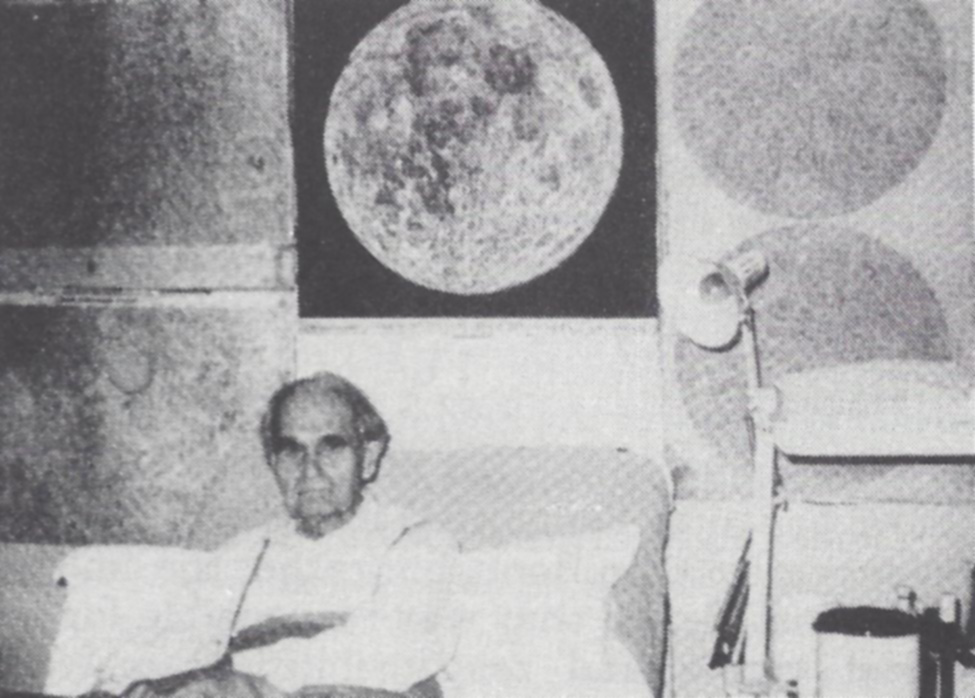
Rudolf Hess in his Spandau prison cell. On the wall hang maps of the moon, reflecting his keen interest in atsronomy.
In 1986, Soviet policy toward the West showed obvious signs of rapprochement and détente. In spite of so many earlier failures, I decided to act on a hint received in December 1986 from the East to directly approach the Soviets to discuss with them my father's release.
In January 1987, I wrote a letter to the Soviet embassy in Bonn. For the first time in 20 years, I received a reply. Officials there suggested that I visit the Soviet embassy in East Berlin for a detailed discussion with Soviet representatives about my father's situation. We finally agreed to a meeting at the Soviet consulate in West Berlin on March 31, 1987, at 2:00 p.m. As the embassy officials were certainly aware, this would be on the same day as my next visit with my father.
That morning, I visited my father in Spandau prison for the very last time. I found him to be mentally alert, quite up to par, but physically very weak. He could walk only when supporting himself with a cane on one side, and with help from a guard on the other. Sitting down with his feet propped on a chair had become a tedious procedure which he could not manage without help. Even though I found the temperature in the visitor's room to be quite normal, he felt cold and asked for his coat and an additional blanket.
My father opened our conversation with an interesting piece of news, the details of which he asked me to set down in writing: He had sent a new application to the heads of state of the four occupation powers, requesting release from his 46 years imprisonment. I was particularly struck by one point. He told me that he had appealed especially to the Soviet head of state to support his request with the other three custodial powers. “Did I get that right?,” I asked. My father nodded. So he knew – obviously from the Russians themselves – that they were considering approving his release.
After our meeting, I drove from Spandau prison directly to the Soviet consulate. Embassy Counselor Grinin, the official I spoke with there, began by explaining that it was not the Soviet embassy in Bonn, but rather the embassy in East Berlin that was responsible for all Soviet rights and responsibilities in West Berlin. One of these responsibilities, he said – and his words deserve to be repeated verbatim – was “the unpleasant legacy of Spandau.” Anyone who had inherited a legacy like the “Allied Military Prison” on German soil, as the Soviet Union had at the of the war, Grinin said, should certainly want to get rid of it.
I had not expected any sensational outcome from this meeting. It had been a mutual sounding-out, and I believe that it came off positively for each side. It also became clear to me during the course of this meeting that there were conflicting views in Moscow about how to deal with the “Hess case.” Those who were sympathetic to us, led by Secretary General Gorbachev, were clearly gaining the upper hand.
This evaluation was confirmed a short time later in a report published in the German news magazine Der Spiegel (April 13, 1987). The article, which appeared under the headline “Will Gorbachev release Hess?,” reported on a fundamental change in the attitude of the Soviet party leader toward the “Hess case.” Gorbachev, it went on, took the view that the
release of Spandau's last prisoner would be an action “that would be accepted worldwide as a gesture of humanity,” and which “could also be justified to the Soviet people.” In this regard, the news weekly also mentioned the forthcoming visit to Moscow by federal German President Weizsäcker, which was planned to take place in mid-May.
Also on April 13, 1987, a private German citizen wrote a letter about the Hess case to the German-language service of Radio Moscow. The letter of reply, dated June 21, 1987, declared: “As can be hoped from the most recent statements of our head of government, M. Gorbachev, your long years of efforts for the release of the war criminal R. Hess will soon be crowned with success.” It can be assumed with certainty that such a letter from Radio Moscow was not written without approval from above.
These three events – my reception in the Soviet consulate in West Berlin on March 31, 1987, the Spiegel magazine report of April 13, 1987, and the reply from Radio Moscow of June 21, 1987 – show unequivocally that the Soviet Union, under the leadership of Secretary General Gorbachev, inted to release Rudolf Hess. This release would not only be entirely consistent with Gorbachev's policy of reconciliation, it would also be essential feature of a settlement of the remaining unresolved consequences of the Second World War, without which the reunification of Germany and Berlin would not be possible.
Death by Suicide?
If the western custodial powers had not already been aware of Gorbachev's intention, they certainly were after the publication of the Spiegel article in April. This undoubtedly set off alarm bells in Britain and the United States, since this new Soviet move would remove the last remaining legal obstacle to my father's release. For many years the British, American and French governments had said that they were ready to agree to Hess' release, but that it was only the Soviet veto that prevented it. Gorbachev's new initiative threatened to call the British and American bluff.
The authorities in London and Washington would have to find some new and more permanent way to deny Hess his freedom and keep him from speaking freely.
On Monday, August 17, 1987, a journalist informed me in my office that my father was dying. Later, at home, I received a telephone call at 6:35 p.m. from Mr. Darold W. Keane, the American director of the Spandau Prison, who informed me officially that my father had died. The official notification, which was in English, read as follows: “I am authorized to inform you that your father expired today at 4:10 p.m. I am not authorized to give you any further details.”
The next morning I was on a plane to Berlin, accompanied by Dr. Seidl. When I arrived at the prison, a fairly large crowd had gathered in front. Berlin police were blocking the entrance, and we were obliged to show identification papers before we were allowed to approach the green-painted iron gate. After ringing the bell, I asked to speak with the American prison director, Mr. Keane. After quite a while, Mr. Keane finally appeared, looking extraordinarily nervous and unsure of himself. He told us that we would not be allowed inside the prison complex, and that I would not be permitted to see my dead father. He also told us that he was not able to provide any further information about details of the death. A new report with details of my father's death was allegedly being prepared, and would be made available at about 4:00 p.m. Then, after we gave him the address and telephone number of a Berlin hotel where we would be waiting for further news, he left us standing in front of the gate.
The long-expected telephone call to the hotel finally came at about 5:30 p.m. Keane said:
I will now read to you the report that we will release immediately afterwards to the press. It reads:
“Initial examination indicated that Rudolf Hess attempted to take his own life. In the afternoon of August 17, 1987, under the customary supervision of a prison guard, Hess went to a summerhouse in the prison garden, where he always used to sit. When the guard looked into the summerhouse a few minutes later, he discovered Hess with an electric cord around his neck. Attempts were made at resuscitation and Hess was taken to the British Military Hospital. After further attempts to revive Hess, he was declared dead at 4:10 p.m. The question of whether this suicide attempt was the cause of his death is the object of an investigation, including a thorough autopsy, which is still in progress.”
Hess was a frail 93-year-old man with no strength left in his hands, who could just barely drag himself from his cell into the garden. How was he supposed to have killed himself in this way? Did he hang himself with the cord from a hook or a window latch? Or did he throttle himself? Those responsible would not immediately provide a detailed explanation about this point. We had to wait a full month for the final official statement about the circumstances of the death. It was published by the Allies on September 17, 1987, and reads as follows:
1. The Four Powers are now in a position to make the final statement on the death of Rudolf Hess.
2. Investigations have confirmed that on August 17 Rudolf Hess hanged himself from a window latch in a small summerhouse in the prison garden, using an electric extension cord which had for some time been kept in the summerhouse for use in connection with a reading lamp. Attempts were made to revive him and he was then rushed to the British Military Hospital where, after further unsuccessful attempts to revive him, he was pronounced dead at 4:10 p.m.
3. A note addressed to Hess' family was found in his pocket. This note was written on the reverse side of a letter from his daughter-in-law dated July 20, 1987. It began with the words “Please would the governors s this home. Written a few minutes before my death.” The senior document examiner from the laboratory of the British government chemist, Mr. Beard, has examined this note, and concluded that he can see no reason to doubt that it was written by Rudolf Hess.
4. A full autopsy was performed on Hess' body on August 19 in the British Military Hospital by Dr. Malcolm Cameron. The autopsy was conducted in the presence of medical representatives of the four powers. The report noted a linear mark on the left side of the neck consistent with a ligature. Dr. Cameron stated that in his opinion death resulted from asphyxia, caused by compression of the neck due to suspension.
5. The investigations confirmed that the routine followed by staff on the day of Hess' suicide was consistent with normal practice. Hess had tried to cut his wrists with a table knife in 1977. Immediately after this incident, warders were placed in his room and he was watched 24 hours a day. This was discontinued after several months as impracticable, unnecessary and an inappropriate invasion of Hess' privacy.
The report of the autopsy carried out by the British pathologist Dr. Cameron on August 19 was later made available to the family. Concluding that my father's death was not due to natural causes, it was consistent with point five of the Allied final official statement.
Autopsy and Burial
On the basis of an 1982 agreement between the family and the Allies, the body of Rudolf Hess would not be burned, but instead would be turned over to the family for burial “in Bavaria quietly in the presence of his immediate family.”
The Allies kept this agreement – something they have most probably since regretted emphatically. Accordingly, my father's body was turned over to the family on the morning of August 20, 1987, at the American military training grounds of Grafenwöhr, where it had arrived earlier that same morning from Berlin in a British military airplane.
The coffin was accompanied by the three Western governors and two Russians, whom I didn't know, as well as a certain Major Gallagher, chief of the so-called “Special Investigation Branch, Royal Military Police.” The turnover was brief and to the point. We then immediately brought the body to the Institute for Forensic Medicine in Munich, where Prof. Dr. Wolfgang Spann was waiting at our family's request to conduct a second autopsy. Throughout the entire journey from the military training grounds in Grafenwöhr to the Institute for Forensic Medicine in Munich, the transport was guarded by a contingent of Bavarian police.
In the conclusion of his report of December 21, 1988, on the second autopsy, the renowned Munich pathologist Professor Spann pointed out the difficulties he encountered because he did not have any information about details of the alleged hanging. In particular, he had no information about details of the condition of my father after the supposed discovery of his body. In spite of these limitations, Dr. Spann nevertheless was able to arrive at the following remarkable conclusions:
Dr. Cameron's further conclusion that this compression was caused by suspension is not necessarily compatible with our findings…
In forensic medicine, the course which the ligature mark takes on the neck is considered a classic indicator for differentiating between forms of hanging and throttling… If Prof. Cameron, in his assessment of the cause of death, comes to the conclusion that the cause of death was asphyxiation caused by compression of the neck due to hanging, he neglects to con-sider the other method of strangulation, that is, throttling… Making this distinction would have required an examination of the course of the ligature mark. The precise course of the mark is not given in Prof. Cameron's autopsy report…
Here, neither the course of the strangulation mark on the neck, as we have described it, nor its course on the throat, nor its position relative to the prominence of the larynx has been described and assessed… Since on the uninjured skin of the neck, where the possibility of distortion through the suture of the dissection incision is ruled out, an almost horizontal course of the strangulation mark could be identified, this finding, as well as the fact that the mark on the throat obviously was not located above the larynx, is more indicative of a case of throttling than of hanging. Under no circumstances can the findings be readily explained by a so-called typical hanging. The burst blood vessels which were observed in the face, caused by blood congestion, are also not compatible with typical hanging.
A Tunisian medical orderly, Abdallah Melaouhi, was a civilian employee of the Spandau prison administration at the time of my father's death. He is not a citizen of one of the four Allied occupation powers, nor, even more to the point, a member of their armed forces. As a result, he could not be silenced or transferred to some remote corner of the world like the others who were present at the scene of the crime.
After the death of my father, Melaouhi got in touch with our family. >From a note that my father wrote to him, it is clear that there was a relationship of personal trust between the two men. The core of Melaouhi's account, which he set down in an affidavit, is as follows:
When I arrived at the garden summerhouse, I found the scene looking as though a wrestling match had taken place. The ground was churned up and the chair on which Hess had usually sat lay on the ground a considerable distance from its usual location. Hess himself lay lifeless on the ground: He reacted to nothing, his respiration, pulse and heartbeat were no longer measurable. Jordan [an American guard] stood near Hess' feet and was obviously quite beside himself.
Melaouhi noticed to his surprise that besides Anthony Jordan, the Black American guard, two strangers in US military uniform were present. This was unusual, since no soldier was normally permitted access to this part of the prison, and above all, because any contact with Rudolf Hess was most strictly forbidden. In Melaouhi's opinion, the two strangers seemed reserved and calm, in sharp contrast to Jordan.
Affidavit from South Africa
In addition to the Tunisian orderly's account, there is a further affidavit regarding the events in Spandau on August 17, 1987. My wife brought it back from South Africa, where she had met with a South African lawyer with contacts to Western secret services. I was able to persuade this man to phrase his testimony in the form of an affidavit prepared for a judge. Dated February 22, 1988, this affidavit reads as follows:
I have been questioned about the details of the death of the former German Reich Minister Rudolf Hess.
Reich Minister Rudolf Hess was killed on the orders of the British Home Office. The murder was committed by two members of the British SAS (22nd SAS Regiment, SAS Depot Bradbury Lines, Hereford, England). The military unit of the SAS [Special Air Service] is subordinated to the British Home Office – not to the Ministry of Defense. The planning of the murder as well as its direction was carried out by MI-5. The secret service action whose aim was the murder of Reich Minister Rudolf Hess was so hastily planned that it was not even given a code name, which is absolutely not customary.
Other secret services which had been privy to the plan were the American, the French and the Israeli. Neither the [Soviet] KGB nor the GRU, nor the German secret services had been informed.
The murder of Reich Minister Rudolf Hess had become necessary because the government of the USSR inted to release the prisoner in July 1987 [in connection with German President von Weizsäcker's forthcoming visit to Moscow], but President von Weizsäcker was able to negotiate an extension with the head of the Soviet government, Gorbachev, until November 1987, the next Soviet period in the guard cycle.
The two SAS men had been in Spandau prison since the night of Saturday-Sunday (August 15-16, 1987). The American CIA gave its consent to the murder on Monday (August 17, 1987).
During Reich Minister Rudolf Hess' afternoon walk, the two SAS men lay in waiting for the prisoner in the prison garden summerhouse and tried to strangle him with a 4 1/2-foot long cable. Afterwards, a “suicide by hanging” was to be faked. But as Reich Minister Rudolf Hess put up a fight and cried for help, which alerted at least one American guard soldier to the attack, the attempt on the prisoner's life was broken off, and an ambulance of the British Military Hospital was summoned. The unconscious Reich Minister Rudolf Hess was taken to the British Hospital in the ambulance.
I was given the above information personally and verbally by an officer of the Israeli service on Tuesday, August 18, 1987, at around 8.00 a.m., South African time. I have known this member of the Israeli service both officially and personallyfor four years. I am completely satisfied that he was sincere and honest and I have no doubt whatsoever as to the truth of his information. The absolutely confidential nature of his conversation with me is also beyond doubt.
Next to Cameron's misleading autopsy report, the British themselves provided the most decisive clue in solving the mysterious death in the garden summerhouse of Spandau prison.
Suicide Note?
As already mentioned, I was told on August 17, 1987, only that my father had died. It wasn't until the next day that I learned that he had supposedly committed suicide. In response to doubts I quickly expressed publicly about this supposed suicide, the Allies were prompted to discover, on August 19, 1987, a supposedly incontrovertible “proof” of suicide. This is the so-called “suicide note.” It is an undated hand-written letter on the back of the family's next-to-the-last letter to Rudolf Hess, dated July 20, 1987. The text of this supposed “suicide note” is as follows:
Please would the Governors s this home. Written a few minutes before my death.
I thank you all, my beloved, for all the dear things you have done for me. Tell Freiburg I am extremely sorry that since the Nuremberg trial I had to act as though I didn't know her. I had no choice, because otherwise all attempts to gain freedom would have been in vain. I had so looked forward to seeing her again. I did get pictures of her, as of you all. Your Eldest.
Wolf R. Hess alone with his father for the first time since 1941.
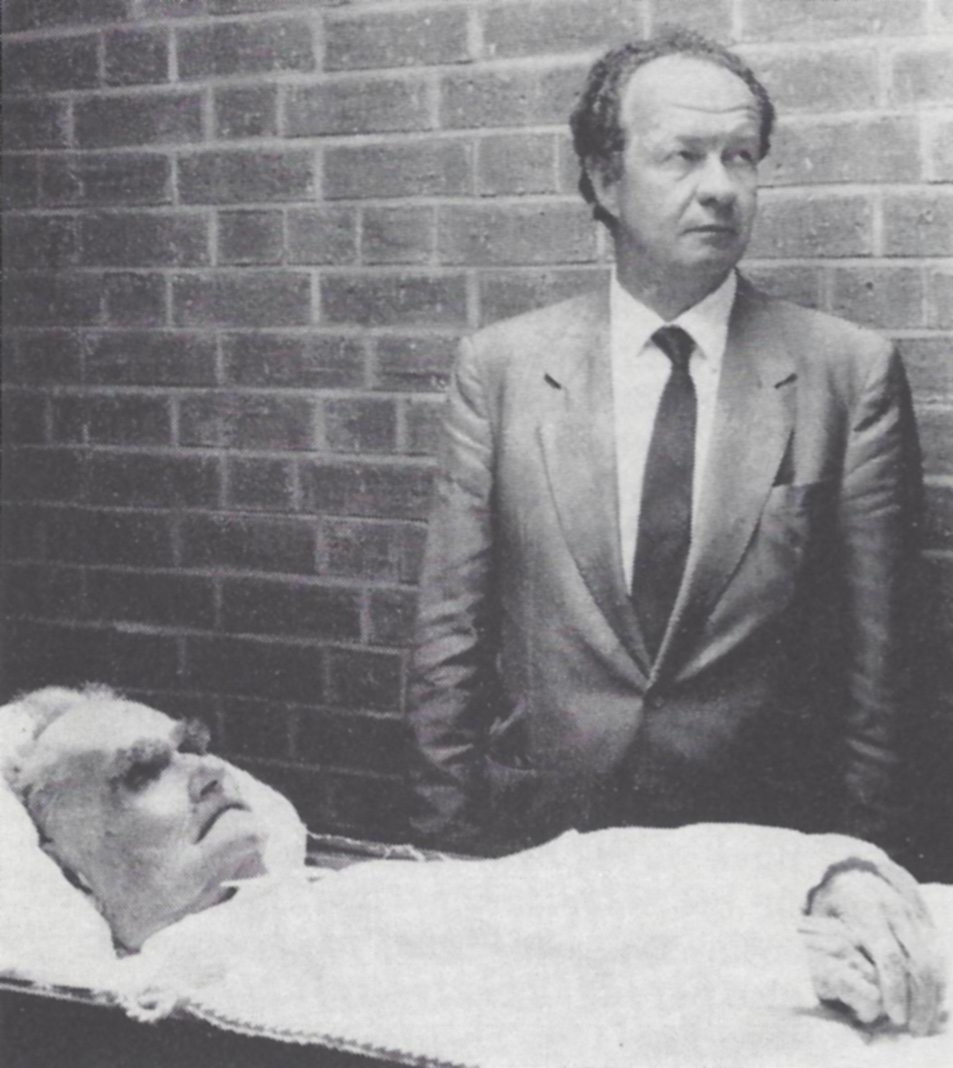
Wolf R. Hess alone with his father for the first time since 1941.
This letter was handed to the family more than a month after the death. We were told that it first had to be examined in a British laboratory.
While it did seem to be my father's handwriting (although considerably distorted, as it was whenever he was suffering as a result of emotional upheaval, health problems or even medication), this “note” did not reflect the thinking of Rudolf Hess in 1987. Rather, it reflected thoughts of his some twenty years earlier. The content mainly concerns “Freiburg,” his one-time private secretary, about whom he had been concerned in 1969 when he had a perforated ulcer in the duodenum and was near death. Moreover, it was signed with an expression, “Your Eldest,” that he not used for about 20 years.
There is another clue in the letter's text that indicates its date. The phrase, “I did get pictures of her, as of you all,” would have made sense only during the period before Christmas 1969, because until that Christmas he received nothing but photographs of “Freiburg” and us. As of Christmas 1969, he was visited by members of his family, and received more pictures from “Freiburg,” who was not allowed to visit him. Considering the precise way my father expressed himself, this sentence can only have been written before December 24, 1969. Written in August 1987, this sentence makes no sense at all.
Finally, the brief letter's opening words, “Written a few minutes before my death,” cannot be reconciled with his precise manner of expressing himself. If he had really written this letter before a planned suicide, he would most certainly have chosen a phrase specifying suicide, such as “shortly before my voluntary withdrawal from life” or something similar, but not the ambiguous word “death,” which leaves open any possible method of death.
We, the members of his family who knew not only my father's handwriting but the writer himself, and who were intimately familiar with his concerns during his final years, know that this supposed “suicide note” is a hoax as crude as it is malicious.
It can now be concluded that a “farewell letter” written by my father almost twenty years earlier in expectation of his death, and which was not handed over to the family at that time, was used to produce this 1987 forgery. For this purpose, the text was transformed by some modern means onto the back of a letter my father had received recently from us. The censorship stamp “Allied Prison Spandau,” which normally appeared, without exception, on every piece of incoming paper he received for more than 40 years, was conspicuously absent from our letter to him of July 20, 1987. Finally, the supposed suicide note bore no date, which was contrary to my father's routine practice of always prefacing whatever he wrote with the date. The original date had obviously been omitted.
Murder, Not Suicide
On the basis of Prof. Spann's autopsy report, the affidavits of the Tunisian medical orderly and the South African attorney, as well as the supposed “suicide letter,” I can only conclude that the death of Rudolf Hess on the afternoon of August 17, 1987, was not suicide. It was murder.
Although US authorities were officially in charge of the Allied Military Prison in Berlin-Spandau in August 1987, it is noteworthy that British citizens played such a major role in the final act of the Hess drama. The American director, Mr. Keane, was permitted by the British merely to call me and inform me of my father's death. After that his only duty was to keep his mouth shut.
To sum up here:
- The two men the Tunisian orderly Melaouhi saw in American uniform, who were most probably Rudolf Hess' murderers, were from a British SAS regiment.
- The death was established in the British Military Hospital, to where my father was brought in a British ambulance.
- The death certificate is signed only by British military personnel.
- The autopsy was carried out by a British Pathologist.
- The British prison director, Mr. Antony Le Tissier, supervised the prompt destruction of all tell-tale evidence, such as the electric cable, the garden house, and so forth.
- The officials of the Special Investigation Branch (SIB) that investigated the death were all British citizens, and were headed by a British major.
- The alleged “suicide note” was supposedly found two days later in the pocket of Hess' jacket by a British officer, and was examined by a British laboratory.
- Mr. Allan Green, the British Director of Public Prosecution, halted an investigation into my father's death begun by Scotland Yard, which had recommed a “full scale murder investigation” after officials there had found many inconsistencies.
Rudolf Hess did not commit suicide on August 17, 1987, as the British government claims. The weight of evidence shows instead that British officials, acting on high-level orders, murdered my father.
A Crime Against Truth
The same government, which tried to make him a scapegoat for its crimes, and which for almost half a century resolutely sought to suppress the truth of the Hess affair, finally did not shrink from murder to silence him. My father's murder was not only a crime against a frail and elderly man, but a crime against historical truth. It was a logical final act of an official British conspiracy that began in 1941, at the outset of the Hess affair.
But I can assure them, and you, that this conspiracy will not succeed. The murder of my father will not, as they hope, forever close the book on the Hess file.
I am convinced that history and justice will absolve my father. His courage in risking his life for peace, the long injustice he ured, and his martyrdom, will not be forgotten. He will be vindicated, and his final words at the Nuremberg trial, “I regret nothing!,” will stand forever.

Bibliographic information about this document: The Journal of Historical Review, vol. 13, no. 1 (January/February 1993), pp. 24-39
Other contributors to this document: n/a
Editor’s comments: n/a