Sophie Scholl: Germany’s Celebrated Woman of the Twentieth Century
Sophie Magdalena Scholl (1921-1943) is one of the most famous members of the German resistance movement during World War II. She and her brother Hans took enormous risks to undermine Adolf Hitler’s power. Gordon Thomas and Greg Lewis write:[1]
“For the Scholls, opposition to Hitler was a moral imperative, a simple question of right versus wrong. No matter what the consequences. In the horrors that Hitler would create in the coming years, the family would pay a terrible price for its desire for a better Germany.”
Hans and Sophie Scholl were dead at ages 24 and 21, respectively, so left behind no careers or life’s work. However, a series of actions over the course of only six or seven months have made them world famous and national heroes in modern Germany.[2]
This article discusses the short life of Sophie Scholl, and why she was so determined to end Hitler’s reign.
Early Years
Sophie Scholl was born May 9, 1921 in the small rural village of Forchtenberg in southern Germany. The residents of the region around Forchtenberg are known as Swabians, and retain a distinct history, identity and recognizable dialect from Bavarians. Swabians have a well-known reputation for non-conformity, a healthy disrespect for authority, and are viewed as frugal and very hard-working.[3]
Sophie’s father Robert Scholl was the lord mayor of Forchtenberg. Sophie began her education at the age of seven at the small village school, which only had room for three classes. She read widely and liberally and excelled in a wide range of subjects at school. Her greatest passion, however, was nature. Like many youngsters in Germany, Sophie had a strong connection with nature, and felt that close proximity to mountains, trees, rivers, flowers and wildlife placed her in close harmony with God.[4]
In the spring of 1930, the calm life of the Scholl family suffered a major upheaval when Robert Scholl was voted out of office. However, Robert Scholl quickly secured a job with a trust company in Stuttgart. The Scholl family moved during the summer of 1930 to the small town of Ludwigsburg, seven miles north of Stuttgart. Sophie studied two years at the local Girls Public School, and greatly enjoyed the local castle and beautiful park near their Ludwigsburg apartment.[5]
The Scholl family moved in the spring of 1932 to the small city of Ulm, where Robert became a partner in a company that specialized in financial services and tax consulting. The hills, caves, green fields and woods surrounding Ulm provided an idyllic place for Sophie to enjoy nature. Sophie lived in Ulm for most of the rest of her life. [6]
Hitler Youth
Sophie was less than 12 years old when Hitler took power in Germany. Unlike most German parents, Robert Scholl loathed the National Socialists with every fiber of his being. He was not a member of a formal political party and did not like the Weimar Republic, but thought that National Socialism was much worse. Robert Scholl would tell his children, often loudly and incautiously, that “The Nazis are wolves, wild beasts; they misuse the German people terribly.”[7]
Despite protests from their father, Sophie and her brother Hans became members of the German youth movement. Sophie was excited to join the Bund Deutscher Mädel (BDM), while Hans enthusiastically joined the Hitler Youth and became a squad leader. Hitler talked about Germany’s “magnificent youngsters,” and, like most German children and teenagers, Sophie and Hans did not find these German youth organizations restrictive. They went hiking and camping, sang songs and waved flags, and felt they were part of something.[8]
Sophie was impressed by the attempt of the BDM to mix all the social classes together, which had not happened in the more middle-class oriented youth groups of the Weimar Republic. Sophie, like her brother Hans, was promoted to the rank of squad leader in 1935. She later admitted that she participated in all of the activities of the BDM with “girlish enthusiasm.”[9]
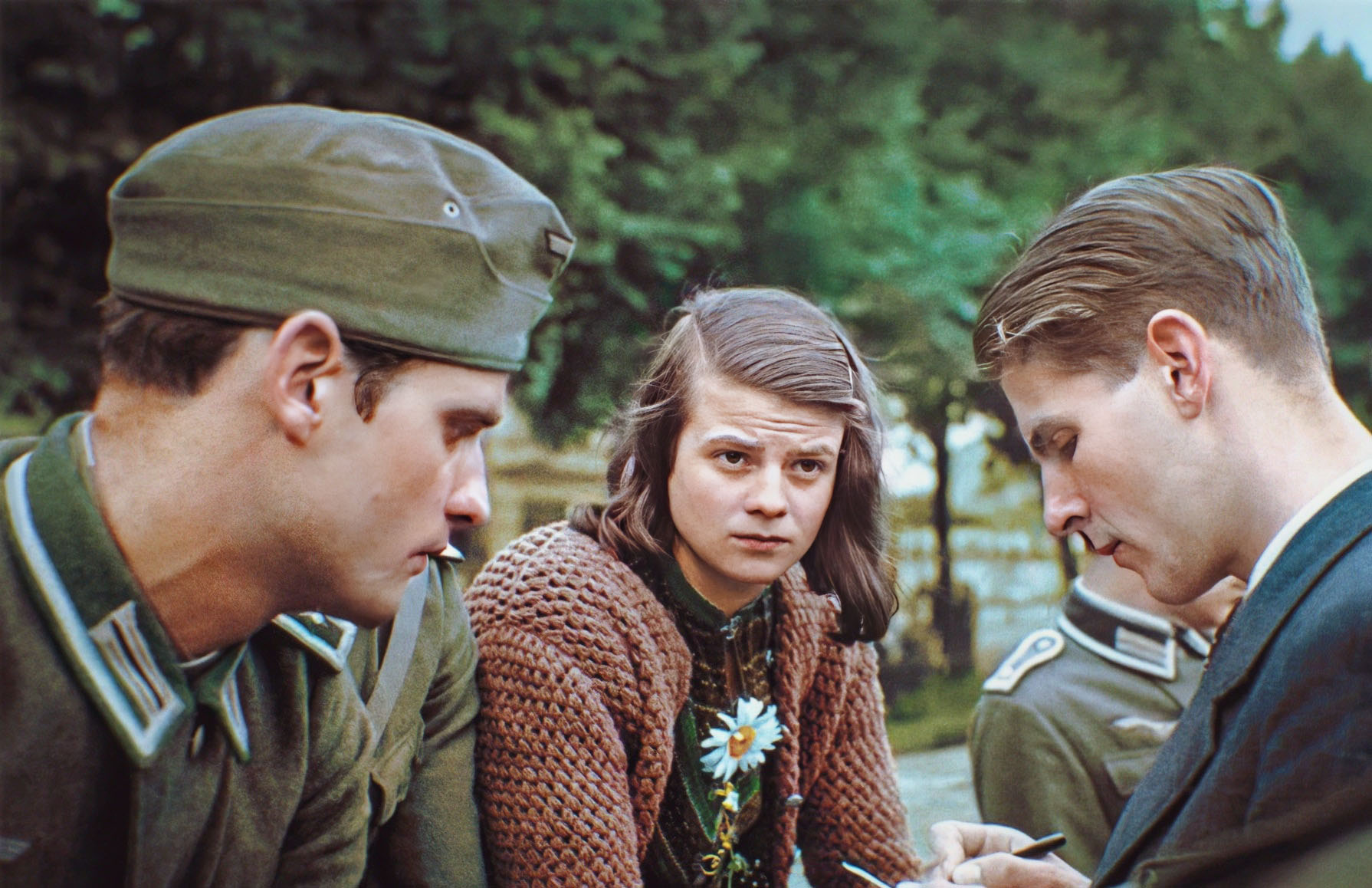
At age 14, Sophie began having doubts about the total submission and conformity demanded by the National-Socialist regime. She was a budding artist who admired many modern artists regarded as degenerate by Hitler. When Sophie read a poem at a BDM meeting written by banned Jewish author Heinrich Heine, an irate BDM leader told her never to read out such a poem again. Sophie told the BDM leader that “whoever did not know Heine did not know German literature.” At home, Sophie also read many other books written by banned authors.[10]
Increasing Disillusionment
In September 1938, 17-year-old Sophie Scholl began studies that would eventually lead to the coveted Abitur—her passport to university. The evidence suggests that most teachers at the Ulm gymnasium Sophie attended tried to keep National-Socialist indoctrination to a bare minimum. Some teachers at her school would not even wear the obligatory National-Socialist Party badge on their lapel.[11]
Sophie’s disillusionment with Hitler and National Socialism increased after the night of November 9-10, 1938, when National-Socialist storm troopers went on a rampage, looting Jewish shops, smashing windows, burning synagogues and beating Jews. Hundreds were assaulted and dozens perished in what came to be known as Kristallnacht, the night of broken glass. Sophie’s sister, Inge Scholl, later wrote:
“What began among us as doubts and misgivings about the Nazis had turned into indignation and outrage.”
Kristallnacht persuaded Sophie that to fight on the side of the National Socialists would be evil.[12]
World War II began on September 1, 1939, when German forces invaded Poland. Sophie expressed her bitterness about this invasion to her German soldier-friend, Fritz Hartnagel:[13]
“Now you’ll surely have enough to do. I can’t grasp that now human beings will constantly be put into mortal danger by other human beings. I can never grasp it, and I find it horrible. Don’t say it’s for the Fatherland.”
The rapid defeat of French forces in 1940 also depressed Sophie. In high school, she felt alienated from most of her classmates, since almost every lesson was permeated with National-Socialist ideology. She wrote:
“Sometimes school seems like a film to me. I look on but, for all intents and purposes, I’m excluded from performing.”
One of Sophie’s teachers seemed to agree, evaluating Sophie’s classroom behavior as “totally uninvolved.” However, Sophie did pay enough attention in class to fulfill the requirements for her Abitur.[14]
Sophie began a training course as a kindergarten teacher at Fröbel Institute in Ulm. She passed her exam in March 1941 and graduated as a qualified kindergarten teacher. To her dismay, however, German authorities refused to recognize her teacher training at the Fröbel Institute as an acceptable substitute for labor service. Sophie was told she must complete six months of proper labor service—all of it away from home.[15]
Sophie began her six months compulsory labor service at the Krauchenwies labor camp, located about 45 miles southwest of Ulm on the upper Danube. She spent six lonely and depressing months there, among girls who were committed National Socialists, and who talked non-stop of their love and devotion to Hitler. Even worse, Sophie was required to work an additional six months as a kindergarten teacher in a nursery school in Blumberg, a small farming town near the Swiss border. Her long period of required labor service finally ended on April 1, 1942. In the first week of May 1942, Sophie traveled to Munich to fulfill her long-cherished ambition of attending Munich University.[16]
White Rose
In Munich, Sophie quickly met with her brother Hans and his friends Alexander Schmorell, Willi Graf and Christoph Probst. Everyone in this group despised the National Socialists, and they quickly began talking about what could be done to show their opposition. They decided to anonymously put their views into leaflets and send them out through the postal system using the name the White Rose. It seemed like a mild form of resistance, but, in wartime Germany, it was a capital crime.[17]
The group’s third leaflet stated:
“At all points we must oppose National Socialism, wherever it is open to attack…The military victory over Bolshevism dare not become the primary concern of the Germans. The defeat of the Nazis must unconditionally be the first order of business.”
For the first time, this group’s leaflet mentioned sabotage against Germany as a way to fight back—a highly provocative proposal at the height of war. Such sabotage included attacks against “armament plants and war industries” and “all gatherings, rallies, public ceremonies, and organizations of the National Socialist Party.”[18]
The fourth leaflet, written by Hans Scholl, warned against celebrating Hitler’s recent successes in North Africa and the Soviet Union. It painted a picture of a state in which the leaders do not “count the dead,” and in which every word that comes out of Hitler’s mouth “is a lie.” Scholl wrote that they were in a Christian battle between Good and the “servants of the Antichrist.” He wrote:[19]
“Has God not given you the strength, the will to fight? We must attack evil where it is strongest, and it is strongest in the power of Hitler.”
The White Rose was disbanded for a number of months when Hans Scholl, Willi Graf and Alexander Schmorell were sent to the Russian Front, while Christoph Probst was sent to Austria. Sophie returned home to Ulm at the end of the semester. During Sophie’s time at home, Robert Scholl was tried in the Special Court in Stuttgart for making outspoken remarks against Hitler. He was sentenced to four months in prison, and lost the legal license he needed to work in financial services. Robert Scholl’s imprisonment left the family struggling for money. Sophie soon thereafter was ordered to fill in her summer with two months’ labor service at a local arms factory.[20]
Hans Scholl returned from the Russian Front in November 1942 and met up with Sophie in Munich. The members of the White Rose concluded that their first leaflets did not have a major impact because they were only distributed to a very small number of people. They decided to build up a network of connections with other resistance groups to expand their propaganda activity.[21]
The group’s fifth leaflet was printed under the name “Resistance movement in Germany” instead of under the name “White Rose.” The leaflet asked the German people to “Dissociate yourself from National Socialist gangsterism.” The majority of the leaflets were left in entrances to apartment blocks and beer halls around Munich, but many were mailed to Cologne, Frankfurt, Augsburg, Salzburg, Stuttgart, Vienna and Innsbruck. Also, without consulting other members of the group, Hans Scholl and Alexander Schmorell decided to paint anti-Nazi graffiti around the streets of Munich.[22]
The group’s sixth and seventh leaflets were written and distributed. Meantime, the Gestapo, alarmed by the leaflets and graffiti operations, ordered the university authorities to watch out for suspicious behavior on the campus. For Sophie, however, there was no question of giving up the fight. The artist Wilhelm Geyer met with Hans and Sophie frequently during this period. He said Sophie had “an absolute fearlessness” about her determination to resist Hitler’s regime.[23]
Final Days
Sophie had been at home in Ulm for the first 10 days in February 1943, helping out her mother and father. She returned to Munich on February 11 to help their group put into envelopes and address between 1,500 to 3,000 copies of a leaflet. Hans Scholl made a trip to a local post office to purchase 1,200 8-pfennig stamps. Since the Gestapo had told local post offices to contact them immediately if someone came in asking for large quantities of stamps, the postal clerk reported this purchase to the Gestapo.[24]
On February 18, 1943, Hans and Sophie arrived at the main Munich University building carrying a large suitcase and a small briefcase containing numerous copies of their sixth leaflet. Working separately, they placed small bundles of leaflets around the building. Sophie impulsively pushed a large stack of leaflets from the third floor. These leaflets fluttered down like confetti at the exact moment students started to pour out of the lecture halls and seminar rooms. Jacob Schmid, a university porter and general handyman, immediately arrested Hans and Sophie, neither of whom made any attempt to escape.[25]
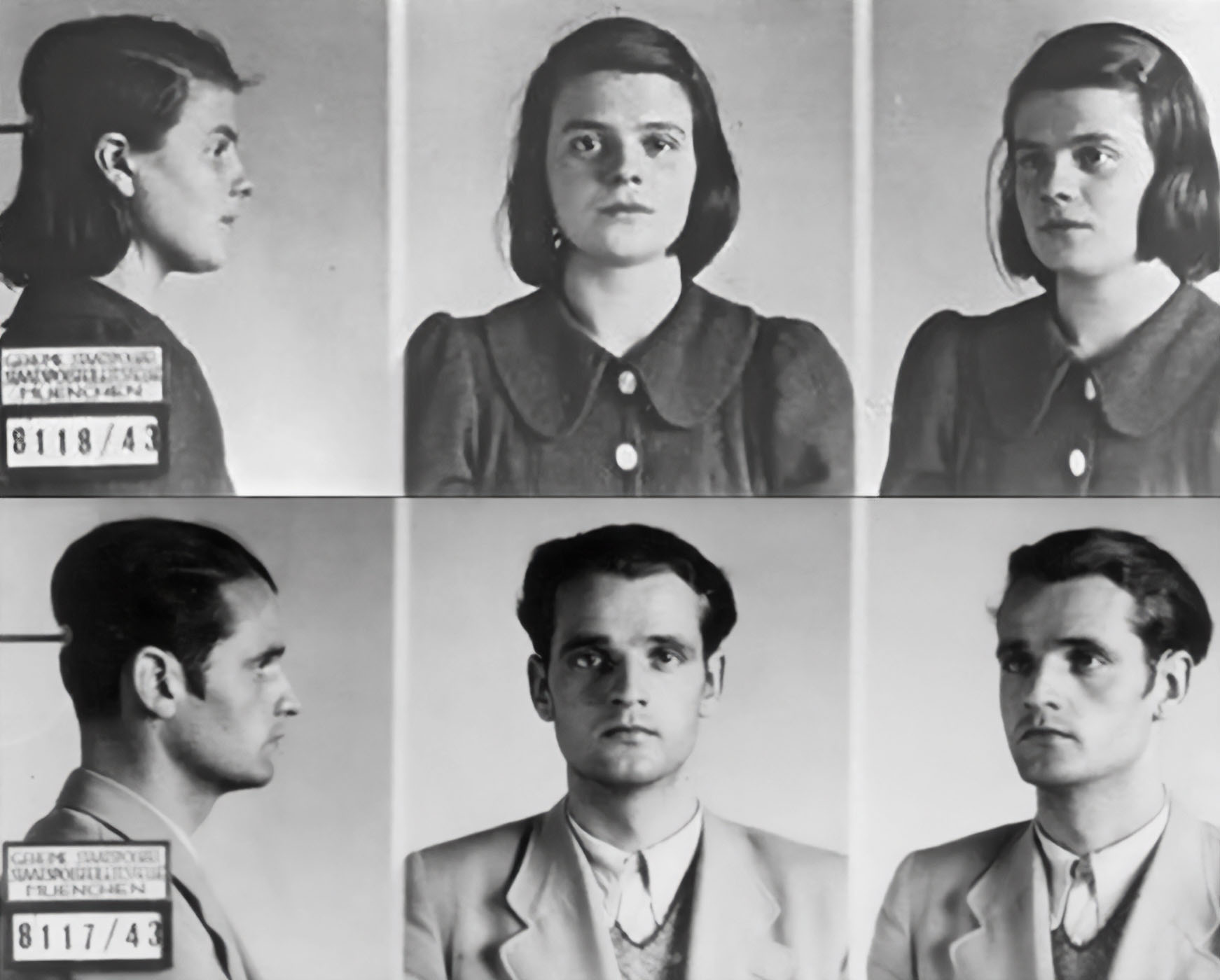
Robert Möhr, a Gestapo officer, quickly arrived at Munich University to interrogate Hans and Sophie. The Scholls were transported in a van to Munich’s Gestapo headquarters at the Wittelsbach Palace for further questioning. After extensive interrogation, Hans decided to take full responsibility in the hope this would save Sophie and his other friends from a similar ordeal. However, incriminating evidence culled from Sophie’s apartment, including the stamps and account notebook, eventually led Sophie to confess to her involvement in the White Rose.[26]
On February 22, 1943, Hans and Sophie Scholl and Christoph Probst were driven to Munich’s Palace of Justice to stand trial. The case against them was based on the written and physical evidence collected by the Gestapo over the previous days. The three were charged with high treason, aiding and abetting the enemy and undermining the armed forces. At the conclusion of the brief proceedings, judge Roland Freisler sentenced the three defendants to death by execution. The verdict was designed to punish the defendants for defying the National Socialist regime, and to discourage other people from considering the dangerous path of open and violent resistance.[27]
Sophie, her brother and Christoph Probst were taken that afternoon by police car to Stadelheim Prison. The Scholl parents were allowed a final interview with their two children in a small visiting room. Hans was brought in first. Robert Scholl prophetically told his son:
“You will go down in history. I am proud of you both.”
Sophie talked to her parents after Hans had left. Sophie said:[28]
“We took everything upon ourselves. What will happen will cause waves.”
The guillotine was used to execute Hans and Sophie Scholl and Christoph Probst because the Germans considered it to be the most humane form of execution, as death came almost instantaneously. This proved to be the case in these executions. The time it took to execute Sophie from when she left her cell to the pronouncement of her death by the prison doctor was 48 seconds. The time of Sophie’s death was noted as 5:01 p.m. on Monday, February 22, 1943.[29]
Conclusion
Sophie Scholl has become a national hero in Germany. Almost 200 schools across Germany and the square outside the main building at Ludwig Maximilian University have been named in her honor. In a poll by a German television network in 2003, she and her brother Hans were voted among the top five greatest Germans of all time.[30] Sophie was the highest ranked German woman in history in this poll. The popular German magazine Brigitte in 1999 voted her “Woman of the Twentieth Century.” A German-language film in 2005 called Sophie Scholl: The Final Days became a major box-office hit..[31]
Annette Dumbach and Jud Newborn write about Sophie Scholl and the White Rose:[32]
“The impact of the White Rose cannot be measured in tyrants destroyed, regimes overthrown, justice restored. A scale with another dimension is needed, and then their significance is deeper; it goes even beyond the Third Reich, beyond Germany: if people like those who formed the White Rose can exist, believe as they believed, act as they acted, maybe it means that this weary, corrupted, and extremely endangered species we belong to has the right to survive, and to keep on trying.”
Sophie unquestionably showed remarkable courage in challenging Adolf Hitler’s regime during wartime. In his speech on December 11, 1941, Hitler said:[33]
“Regardless of the pretext with which an attempt is made to disrupt the German front, undermine the will to resist of our people, weaken the authority of the regime, or sabotage the achievements of the homeland, the guilty person will die.”
Sophie and other members of the White Rose paid the ultimate price for their attempts to sabotage the German war effort.
In this author’s opinion, however, Sophie’s efforts to sabotage Hitler’s regime were misguided. Josef Stalin’s regime in the Soviet Union had committed far more numerous and heinous crimes than were ever committed under Hitler’s reign. Germany’s invasion of the Soviet Union was also made to preempt the Soviet Union’s planned invasion and conquest of all of Europe.[34] Sophie made a fatal mistake in attempting to undermine Hitler’s regime during the war, and should not be regarded as a national hero in Germany. She has been used by historians to demonize National Socialism, and to minimize the heroic efforts of Germany to defend all of Europe against Soviet Communism.
Endnotes
| [1] | Thomas, Gordon and Lewis, Greg, Defying Hitler: The Germans Who Resisted Nazi Law, New York: Caliber, 2019, p. 6. |
| [2] | Inge, Jens, At the Heart of the White Rose: Letters and Diaries of Hans and Sophie Scholl, New York: Harper & Row, 1987, p. ix. |
| [3] | McDonough, Frank, Sophie Scholl: The Real Story of the Woman Who Defied Hitler, Stroud, Gloucestershire: The History Press, 2009, pp. 9-10. |
| [4] | Ibid., pp. 11-15. |
| [5] | Ibid., p. 16. |
| [6] | Ibid., pp. 16-17. |
| [7] | Dumbach, Annette and Newborn, Jud, Sophie Scholl & the White Rose, Oxford, England: Oneworld Publications, 2006, pp. 24, 26. |
| [8] | Thomas, Gordon and Lewis, Greg, Defying Hitler: The Germans Who Resisted Nazi Law, New York: Caliber, 2019, pp. 43-44. |
| [9] | McDonough, Frank, Sophie Scholl: The Real Story of the Woman Who Defied Hitler, Stroud, Gloucestershire: The History Press, 2009, p. 26. |
| [10] | Ibid., pp. 33-34, 39. |
| [11] | Ibid., p. 54. |
| [12] | Thomas, Gordon and Lewis, Greg, Defying Hitler: The Germans Who Resisted Nazi Law, New York: Caliber, 2019, pp. 106-107. |
| [13] | Dumbach, Annette and Newborn, Jud, Sophie Scholl & the White Rose, Oxford, England: Oneworld Publications, 2006, p. 44. |
| [14] | Ibid., p. 45. |
| [15] | McDonough, Frank, Sophie Scholl: The Real Story of the Woman Who Defied Hitler, Stroud, Gloucestershire: The History Press, 2009, pp. 65, 71. |
| [16] | Ibid., pp. 73, 81, 86-87. |
| [17] | Thomas, Gordon and Lewis, Greg, Defying Hitler: The Germans Who Resisted Nazi Law, New York: Caliber, 2019, pp. 247-249. |
| [18] | Ibid., p. 251. See also McDonough, Frank, Sophie Scholl: The Real Story of the Woman Who Defied Hitler, Stroud, Gloucestershire: The History Press, 2009, pp. 189-191. |
| [19] | Ibid. |
| [20] | Ibid., pp. 253-255. |
| [21] | McDonough, Frank, Sophie Scholl: The Real Story of the Woman Who Defied Hitler, Stroud, Gloucestershire: The History Press, 2009, pp. 107-108. |
| [22] | Ibid., pp. 112-114. |
| [23] | Ibid., p. 118. |
| [24] | Thomas, Gordon and Lewis, Greg, Defying Hitler: The Germans Who Resisted Nazi Law, New York: Caliber, 2019, pp. 323, 328. |
| [25] | McDonough, Frank, Sophie Scholl: The Real Story of the Woman Who Defied Hitler, Stroud, Gloucestershire: The History Press, 2009, pp. 121-122. |
| [26] | Ibid., pp. 123-124, 127-132. |
| [27] | Ibid., pp. 139-144. |
| [28] | Ibid., pp. 147-148. |
| [29] | Ibid., pp. 150-151. |
| [30] | Thomas, Gordon and Lewis, Greg, Defying Hitler: The Germans Who Resisted Nazi Law, New York: Caliber, 2019, p. 479. |
| [31] | McDonough, Frank, Sophie Scholl: The Real Story of the Woman Who Defied Hitler, Stroud, Gloucestershire: The History Press, 2009, p. 7. |
| [32] | Dumbach, Annette and Newborn, Jud, Sophie Scholl & the White Rose, Oxford, England: Oneworld Publications, 2006, p. 185. |
| [33] | Weber, Mark, “The Reichstag Speech of 11 December 1941: Hitler’s Declaration of War Against the United States,” The Journal of Historical Review, Vol. 8, No. 4, Winter 1988-1989, p. 414. |
| [34] | See Suvorov, Viktor, The Chief Culprit: Stalin’s Grand Design to Start World War II, Annapolis, Md.: Naval Institute Press, 2008 for more detailed information. |

Bibliographic information about this document: Inconvenient History, 2023, Vol. 15, No. 4; a version of this article was originally published in the March/April 2022 issue of The Barnes Review.
Other contributors to this document: n/a
Editor’s comments: n/a