The Regime-Change Playbook
This is a partially revised version of a program broadcast on 6 January 2026 (Friday) at 9PM New York Time on 5130kHz, on 7 January 2026 (Saturday) at 11PM New York Time on 5130kHz, and then at Midnight on 7490kHz. Download an mp3 file of this show here (right-click, and pick “Save Link As…” from context menu). All broadcasts and podcasts by Hadding Scott’s “Devil’s Advocate Radio” are also accessible on X/Twitter @UnapprovedRadio.
The Failure of Regime Change in Iran
One of the experts that I follow closely is Professor John J. Mearsheimer, a professor of political science at the University of Chicago, who is famous for having co-authored, with Stephen Walt of Harvard University, a book called The Israel Lobby and U.S. Foreign Policy.
Very recently, he was interviewed by Daniel Davis, and in this interview, he talked about what is going on in Iran, and Professor Mearsheimer explained that, what has been happening in Iran, is not an organic reaction to bad government by the mullahs. It is rather the implementation of a four-stage strategy for regime change, which he says is a strategy that has been used repeatedly by Israel and the United States:[1]
“We have basically a four-part strategy, and using the U.S. military is the fourth part of the strategy. But let me just quickly walk you through the first three elements of the strategy.
The first element is that we put sanctions on a country, and we wreck that country’s economy, and we do all sorts of things to make the body populace in that country profoundly unhappy, because they’re suffering enormous costs. We’re punishing them with these sanctions. This is what we did in Venezuela. This is what we did in Iran. So, you want to remember when these people are protesting – right? – they’re protesting because of the terrible economic conditions. But who played the principal role in creating those terrible economic conditions? It is the United States of America. So that’s the first step.
Then the second step is: we decide at some point that we’re going to foment massive protests, and we’re going to fuel those massive protests. And this is what happened in Iran in late December of last year, December 2025. And there’s all sorts of evidence now. There’s a very famous piece that came out in the Jerusalem Post on December 29th that makes it clear that Mossad was deeply involved in what has been happening in Iran. Furthermore, there are comments by President Trump and former Secretary of State Mike Pompeo that make it clear that the United States has been involved from the get-go in terms of fueling this crisis. I would also note to you that when the Iranians turned off the Internet and they shut down phone services, what the protesters then were using were Starlink terminals. And it turns out they had 40,000 Starlink terminals. Who do you think gave them those Starlink terminals? We know the answer to that. So, the second step, again, is to foment and fuel protests, which eventually turn into a revolution and regime change.
The third step in the process is to foment a massive disinformation campaign. That’s to convince everybody in the West that these protests are generated internally, that the United States and Israel have nothing to do with it, and that the protesters are noble patriots, and that we have every incentive to back them. And furthermore, this disinformation campaign sends the message inside of Iran that the regime is finished. The protesters are on a roll. There’s no way the regime can shut this down. This time is different. So, what we’re trying to do is generate momentum with this disinformation campaign inside of Iran.
Then the fourth step in the process is: the United States military, and probably the Israeli military as well, come in, once the protests have reached a certain point, and we attack all sorts of critical infrastructure, all sorts of elites inside of Iran, and we deliver the coup de grace. We finish off the regime.
This is the basic playbook, right? You see it at play in Venezuela, right? It’s regime change of a sort we’ve seen many times before.
Now, one final point: it’s failed.”
That’s Professor John J. Mearsheimer on 15 January 2026.
So, just to review the four stages of the Zionist regime-change strategy:
The first stage is an economic assault. Misery is inflicted on the population of a country for having what somebody in the United States or Tel Aviv thinks is the wrong kind of government.
Second: conversion of the dissatisfaction created by economic sanctions into a movement to overthrow the existing government.
Now, a demand for better economic conditions and a movement to overthrow the government are two entirely different things, and the one doesn’t necessarily, automatically develop into the other. This process has been pushed in Iran through the mobilization of chronically disgruntled elements operating under foreign direction. In Iran, many of the revolutionaries have been Kurds. The Kurds are a disgruntled element in all four of the countries where they exist in significant numbers. Now, I have no particular interest in attacking the Kurds, but the fact that some Kurds hate the Iranian government, really tells us nothing about the Iranian government, since they also hate the Syrian government, the Turkish government and the Iraqi government.
The third stage is propaganda that makes the revolutionaries look like the good guys, while portraying the government as monsters.
And finally, the fourth stage is military intervention, which Professor Mearsheimer describes as a coup de grace.
Now, when Professor Mearsheimer says that the strategy has failed in Iran, he means that, in the case of Iran, the government has successfully suppressed the foreign-sponsored revolutionaries. And it was all over by January 14th. The implication from the fact that the subversion in Iran has failed is that any military action by the United States of America would not be a coup de grace.
To eliminate the Iranian government at this point, U.S. armed forces would have to do essentially all the work. And that’s what concerns many people, because that’s what happened in Iraq.
Failure of the Playbook in Iraq
I remember, in early 1990, seeing on the cover of USA Today the face of Saddam Hussein, and his warning to the State of Israel that the State of Israel must refrain from acts of aggression against Iraq, because Iraq had missiles that could reach the State of Israel, and Iraq could retaliate with binary chemical weapons.[2] And I was struck by what a remarkable challenge to Israeli regional military dominance this was. Consequently, as the year progressed, and trouble began to develop around Iraq that would lead to war, I understood exactly what the fundamental cause of this was likely to be: Iraq, under Saddam Hussein, posed an insurmountable problem for the State of Israel.
And so Iraq was baited into invading Kuwait, and this was used as a pretext for imposing crippling economic sanctions on Iraq that caused the deaths of hundreds of thousands of Iraqi children, from 1991 until 2003.
During that period, Iraq was required to allow United Nations weapons inspection teams into Iraq, to make sure that Iraq didn’t have any weapons that would frighten the State of Israel, like binary chemical weapons that Iraq previously had possessed, or biological or nuclear weapons.
The CIA, however, used those weapons inspection teams as a cover for trying to overthrow Saddam Hussein. This CIA plot to organize a coup against Saddam Hussein’s government was discovered in 1996.[3]
After that, Saddam Hussein’s government began restricting where the inspection team could go, culminating in a total end of Iraqi cooperation in October 1998, followed by the United Nations’ withdrawal of the team from Iraq and a punitive bombing campaign by the United States and Britain in December 1998.[4]
But the provocations that led to Iraq’s refusal to cooperate were not much discussed. Instead, we were told that Saddam Hussein was continuing to develop nuclear and biological weapons, and still possessed chemical weapons. We later found out that none of that was true. But these accusations were used to try to drum up a war against Iraq.
In both Iraq and Iran, the first three stages of the four-stage regime-change playbook failed. Saddam Hussein’s Iraq survived twelve years of artificially imposed misery without coming close to being overthrown, and the Islamic Republic of Iran has survived.
What happened next in the case of Iraq, as we all know, and what we must unfortunately anticipate at this point, is some kind of provoked incident or false-flag attack that will suspend reason and enable the warmongering Zionist propagandists to drag us to war against our better judgment.
The Stampede for Regime-Change in Venezuela
Now I’m going to talk a little bit about Venezuela.
President Trump’s decision to deploy the United-States Navy to the coast of Venezuela starting in September 2025, to sink boats coming out of Venezuela as if they were enemy gunboats during a declared war, was very shocking to me because of how blatantly unreasonable it was. It reminds me of how easily Americans were led to believe falsehoods about Saddam Hussein and Iraq 23 years ago.
The irrational nature of the entire enterprise was flagged by the constant use of the buzzword, narco-terrorist. There was a time and a place when the term narco-terrorist made some sense. The term narco-terrorist was originally used by Peruvian President Fernando Belaúnde Terry in 1982 or 1983, to refer to the Shining Path, a Maoist revolutionary group in Peru that relied partly on cocaine trafficking for its funding. In that special situation, the term narco-terrorist made some sense. As applied to supposed drug smugglers simply crossing the sea, it makes no sense at all. The term narco-terrorist in that context seems to have been used purely for emotional impact.
Also to rouse the emotions and bypass reason, it was constantly either alleged or implied that those boats coming out of Venezuela were all carrying fentanyl. Fentanyl does not come from Venezuela. It is produced in laboratories in Mexico.
In fact, the false premise of the deployment of the United-States Navy to Venezuela was exposed quite early and quite prominently. On the 19th of November 2025, the New York Times published an essay by Julian E. Barnes titled, “Venezuela Doesn’t Produce Fentanyl: Trump Is Targeting It Anyway.” On the 3rd of December 2025, the Cato Institute published an essay by Jeffrey A. Singer titled, “Trump’s Venezuela Gambit: An Incoherent Encore in a Failed Drug War.” Singer says:[5]
“Venezuela likely has nothing to do with smuggling fentanyl into the U.S. The Drug Enforcement Administration’s annual National Drug Threat Assessment, its definitive statement on drug sources and trafficking routes, makes the picture clear. Fentanyl is produced overwhelmingly in Mexico.”
Some of the warmongers in broadcast media subsequently abandoned the fentanyl-accusation, but, rather than admit that the whole campaign had been misguided, they started to blame Venezuela for cocaine instead. Cocaine, however, is nowhere near the scourge that fentanyl has been.
Furthermore, it is also not true what Hugh Hewitt said, that Venezuela makes cocaine. A small amount of cocaine crosses Venezuelan territory to be loaded onto boats – but not to be shipped to the United States. Cocaine destined for the United States is loaded onto boats directly in Colombia, and it comes up the west coast.[6] The purpose in going to the extra trouble of sending some Colombian cocaine overland across Venezuela, is to send it across the Atlantic Ocean.[7]
Another, more serious criticism, of the whole campaign of naval attacks on alleged drug boats, is that a large fraction of the seagoing vessels attacked and sunk by the United-States Navy are likely to have been carrying no harmful substances whatsoever.
The United States Coast Guard interdicts drug traffic as part of its routine activities, and they are experts at identifying what might be a drug smuggling mission. Yet, they are mistaken much of the time. Senator Rand Paul talked about this in an interview with Bloomberg News:[8]
Interviewer: “I want to ask you about what’s going on in the Caribbean, Senator Rand Paul, and specifically when it comes to Venezuela, and you’ve been outspoken about this. You commented around fears of extrajudicial killings following the first boat. We’ve now had four. Your concern about the president’s actions here, is he looking for regime change in Venezuela?”
Senator Rand Paul: “You know, I don’t know, but we did discover today that the Coast Guard, when they interdict boats, it’s a common thing off the coast of Miami and California. About 25% of the time, the boat that they board doesn’t have drugs on it. So, they have made an error, but they don’t kill them. But we’ve blown up four boats now, and if the percentages hold true, did one of those four boats not have drug dealers on it? If they all had drug dealers on it, you know, the first 11 they killed, what were their names? What was the evidence linking them to being part of a gang? So I think there’s a lot of unknowns here, and I don’t think you can have a universal Coast Guard policy of just blowing up boats before they’re interdicted.
There’s, you know, decades-long history of how we board boats. We say, halt, stop, we will board your boat. If they don’t halt and stop, there’s an escalation of use of force. But we don’t just blow ships up. So, there is a real problem.
And yes, I think it might lead to regime change, and some of the more skeptical among us think that maybe this is a provocation to lead to real regime change, a provocation to get the Venezuelans to react so we can then insert the military. I hope that’s not true. […]
But we can’t have a policy where we just blow up ships where we don’t even know the people’s names. It can’t be the policy for drug interdiction either in the country or outside the country. So I will support a war resolution to say the government shouldn’t be doing this.”
Interviewer: “Well, that’s news, Senator, and really interesting that you’re going to put your name on this. Do you have other Republicans who will support that legislation?”
Senator Rand Paul: “There will be people quietly who will say it’s the right thing to do and will respect me for doing the right thing. I think most will be afraid of the response from the White House.”
Thus, it is entirely likely that one quarter of the boats and crews blasted to bits by the United-States Navy in the last months of 2025 were involved in no criminal activity whatsoever. And the wrongness of this policy was understood by legislators, who are supposed to curb abuses of executive power, but Senator Rand Paul has told us that they are too cowardly to do it.
I also agree with the suggestion that the purpose of sending those ships down there to attack boats coming out of Venezuela was to create a provocation that might lead to war. And this would explain why President Trump himself may have been fooled about the question of fentanyl, because President Trump has never wanted to put troops into Venezuela, whereas an actual war would require it. In other words, the idea of sending ships down to Venezuela to sink fentanyl boats was proposed to President Donald Trump insincerely when the real agenda was something else.
That is my surmise of how such an incoherent course of action resulted. But President Maduro didn’t take the bait, and in the end, President Trump, without questioning the misinformation that had been fed to him, decided on a different course of action from what his misinformers had wanted. And instead of invading Venezuela, he simply kidnapped the president.
You may have thought that, in the case of Venezuela, finally, we see at least one example of a military action by the United States of America that was not driven by Israeli interests. I’m sorry to disappoint you.
On the 25th of January 2019, the Washington Free Beacon published a column by Matthew Continetti titled, “Maduro Must Go.”[9] Now, with a name like Matthew Continetti, you may think that the columnist must be an Italian Catholic. Not exactly. He is a convert to Judaism and the son-in-law of the king of all Zionist warmongers, William Kristol.
So, “Maduro Must Go” amounts to an edict issued by a source that cannot be ignored.
Unfortunately for those Zionist warmongers, President Trump interpreted the assigned mission very literally. Instead of removing the entire Chavista government, he removed only Maduro – and brought him to the United States to be put on trial on an extremely dubious legal basis formulated by half-Jew Bill Barr in 1989.
This legal argument was formulated by Bill Barr specifically to enable prosecution of Mañuel Noriega under U.S. law, which is nonsense. Incidentally, it was also Bill Barr who issued the indictments against Nicolás Maduro in 2020.
With the removal of President Maduro and the consequent intimidation of the Chavista government, which still exists, Zionist warmongers have gotten some, but not all, of what they wanted.
The American Jewish Committee on the 21st of January, 2026, recorded a program called “Understanding Venezuela’s Political Crisis,” featuring two guests, Elliott Abrams (who was convicted in 1991 of withholding information from Congress in the Iran-Contra scandal, and later agitated for war against Iraq), and a Zionist propagandist with a degree in political science named Emanuele Ottolenghi.
Ottolenghi explains how the deal imposed on Venezuela harms Iran economically:[10]
“It depended on Venezuela, because Venezuela bought significant amounts of Iranian downstream energy technology and products. It brought in Iranian expertise. It gave Iran one of its refineries that Iran invested heavily into. That’s the Palito refinery. It allowed Iran into the Paranaguá refinery, which is a much bigger project.
All of that is lost, and the trade and the deals that they made over Iranian oil gave Iran access to hard currency in the form mainly of Venezuelan gold. So, all of that is potentially gone now, and that’s very damaging.”
Elliott Abrams makes perfectly clear that the Zionist goal of regime change in Venezuela has not been abandoned:[11]
“The people running this place are a bunch of criminals, Delcy Rodriguez and the others. […] They will do nothing without American pressure. So, I think a transition can work, if the United States backs the opposition and makes our own demands in a process of democratization. If we don’t, if we walk away from it now, or if we think that the regime is somehow going to commit suicide, then we’re heading for a big problem because they’re not going to do it.”
Zionists wanted Trump to remove the Chavistas entirely and to install an absurdly pro-Israel politician like Maria Corina Machado. They have not given up. That is why Maria Corina Machado says that her time will come.
All is not bleak, however, because if President Nicolás Maduro stands trial and is not murdered in his cell before this can happen, it should lead to some very interesting revelations. And unlike Mañuel Noriega in the 1990s, Nicolás Maduro will have a vigorous alternative media on his side.
Jews Supported Regime Change in 1898
Now, Professor Mearsheimer says that this four-stage plan has been implemented many times. As I think back on the USA’s previous foreign interventions, the earliest one in my mind that seems to follow the four stages that he discussed seems to be the Spanish-American War from 1898. The Spanish-American War occupied ten weeks in the first half of 1898, when William McKinley was President of the United States. The Spanish-American War was essentially a war of regime change for Cuba.
There were, in the history of Cuba, in the 19th century, three revolutions, and one revolutionary conspiracy, against Spanish rule.
It is an important fact, and not at all controversial, to say that all of these Cuban movements for independence were led by Freemasons, and even the flag of Cuba that still flies over Cuba today is said to be of Masonic design. What has received much less attention, however, is the role of Jews in overthrowing Spanish rule and establishing the independence of Cuba.
Many participants in the second failed revolution in Cuba, the Ten Years’ War from 1868 to 1878, became exiles in the United States, where they came into contact with the United States’ burgeoning Jewish immigrant population. Exiled Cuban revolutionaries became cigar-rollers in large factories run by Jews.
Arlo Haskell, author of The Jews of Key West, which won a Gold Medal Florida Book Award, spoke in some detail about the quite enormous involvement of wealthy Jews in supporting the revolution against Spanish rule in Cuba before U.S. intervention:[12]
“Cuba, at this time, was one of the last outposts of the Spanish Empire, the same empire that had persecuted Jews throughout the Inquisition. […]
This brings us to Louis Fine, whom you see here in his, uh… Fein was a Mason, and this was his Masonic formal wear, actually. So Louis Fine was among the leaders of the group of Jews who were active supporters of the Revolutionary Party of Cuba. Born in 1866, Fein hailed from a small town near the important Jewish city of Vilna, once known as the Jerusalem of Lithuania. […]
The argument that Cuban liberty deserved the shared sacrifice of Jews was driven home by this man whom you see on the screen. He was a Polish-Jewish veteran of the Cuban Revolutionary Forces named Carlos Roloff Mialofsky.
He’d been born in Warsaw in 1842. […] He fought in the Union Army, and then took up the cause of Cuban independence, ultimately earning a rank of general during the Cuban Ten Years’ War. Mialofsky met informally with Jews in Key West at the home of General Serafin Sanchez, and he helped establish connections between the military leadership of the revolution and the local Jewish community. […]
The revolutionary newspaper published by José Martí called Patria announced the establishment of Club Abrabanel, which was a 50-member Jewish cell of the Cuban Revolutionary Party, operating in Key West, of course.”
The date of the publication of that announcement in José Martí’s newspaper is the 10th of December, 1892. 1892 happened to be the quadricentennial of the expulsion of Jews from Spain, and the name of the Club Abrabanel is a reference to that expulsion. So, it’s implicit in the name of this Jewish faction in the Cuban Revolutionary Movement that this is about Jewish revenge against Spain, for expulsion in 1492.
“Now, with the armed phase of the Cuban Revolution officially underway in January of 1895, Jewish partisans evolved from a role in which they had at first provided indirect financial support to one of direct involvement in the acquisition, storage, and distribution of weapons intended for warring rebels on the front line. […]
So, we’ll probably never know the stories of the smuggling missions that succeeded. You know, any good smuggler gets away with it, and you never hear about it, especially not 100 years later. But accounts of those missions that failed provide us with a general outline of the sort of activities that Key West’s Jewish rebels were involved in. Louis Wolfson was a Russian dry-goods merchant on Whitehead Street, the same Wolfson as the Wolfsonian Museum in Miami is that family.
And he was said to have been involved in armed smuggling missions that were carried out by a ship known as the Three Friends. […] And their plot on the Three Friends, which was intercepted, involved an attempt to transfer a cargo of weaponry from one ship to another. When they were caught, they were carrying six Hotchkiss guns, which were these big rolling cannons that were – they were big, they were rolling, but they were light enough to be used in the mountains of Cuba. They could carry them on horseback up the mountainside. So, six of these kind of mounted rolling cannons, as well as rifles, revolvers, machetes, and a large quantity of dynamite.
So, gun-running ships like that one, the Three Friends, depended upon a network of secret storerooms and warehouses near the coast where caches of guns, ammunition, and dynamite could be held without arousing suspicion. Louis Fine himself maintained one of these weapon-storage depots in the rooms behind his grocery store on Duval Street. The more I learned about Louis Fine, the more I liked him: the rabbi, the gun runner, the weapons storage depot operator. […]
Another plot involved the schooner Competitor, which left Key West for Cuba under cover of darkness one night in April of 1896. That boat carried 48 men, many cases of rifles, dynamite, and some 40,000 cartridges of ammunition. The Competitor was finally overtaken near the Cuban coast by a Spanish gunboat, whose forces killed three men and captured several others. […] Many years later, Joseph Fine would reveal that the Competitor had, in fact, been owned by his father, Louis Fine. […] Furthermore, the younger Fine said that his father had purchased a second ship, also named the Competitor, and that this ship had successfully, and apparently without detection, inflicted significant damage upon Spanish forces over a series of military excursions. […]
So, clandestine activities like these continued, as the war to defeat Spain and Cuba absorbed the attentions of many in Key West’s Jewish community. […]
Louis Fine, for his part, when asked why he had supported the revolution, he explained that he was ‘driven by Jewish vengeance against Spain, the old persecutor of the race’.” (Ibid.)
So, the support of these Jews in the United States for overthrowing Spanish rule in Cuba was an enormous operation. Something like this today would be done by the Mossad or CIA.
I mentioned that revolutionary forces tend to be recruited largely from disgruntled minorities. In the case of the Cuban revolution against Spain, the force consisted largely of Blacks, slavery having been finally abolished in Cuba only as recently as 1886.
Blacks certainly were not the only dissatisfied ethnic group in Cuba. You may have noticed in Arlo Haskell’s talk that some of the Jewish supporters of Cuban independence were Freemasons. An interesting question is how many of the Freemasons in the Cuban Revolutionary Junta were also Jews – although crypto-Jews.
If you find the idea of crypto-Jews surprising, let me just inform you: it’s mainly a phenomenon of the Catholic world, especially Latin America. The main reason for the existence of crypto-Jews is the Alhambra Decree of 1492, which forbade practitioners of the Jewish religion from living anywhere in the Spanish Empire. Because of this, it was not until after Spanish rule was overthrown in Cuba that even one synagogue existed on the island.
And Cuba in particular is known to have had many crypto-Jews. The most famous of them that can be confirmed is Fidel Castro. Castro never admitted this fact publicly, but he did reveal it privately at various times during his life. A close friend of Fidel Castro from his time at a Jesuit boarding school, José Antonio Cubeñas, recalls that the boy Fidel Castro was intrigued with fascism, but declared that he could never be a fascist because he was a Jew, being descended from Jews through his grandmother. That’s on page 288 of The Boys from Dolores by Patrick Symmes. Cuba Confidential, by award-winning investigative journalist Ann Louise Bardach, offers more information along the same lines. On page 64, Armando Castro, supposedly a distant cousin of Fidel, is quoted as saying:
“All the Castros in Oriente [Province] were Jews.”
An illegitimate daughter of Fidel Castro, Alina Fernandez, claims that Fidel Castro’s mother Lina Ruz González was descended from Turkish Jews, but there seems to be no corroboration for that claim. In the mid-1980s however, Castro is supposed to have told a Jewish Cuban exile banker named Bernardo Benes:
“As you know, I have Jewish ancestors.”
That’s on page 65 of Cuba Confidential. Castro also told Benes that he wanted Cuba to be “a second Israel,” whatever that means.
We do know that Fidel Castro regarded himself as walking in the footsteps of José Martí, finishing what José Martí had started.
Regarding José Martí, Marilyn Miller, a professor of Judaica from Tulane University, gives a presentation online in which she adduces some arguments that José Martí may have been a Jew, although there’s no proof of it. But there certainly are some indications. The man was extremely philo-Judaic, and he looked like a Jew. Furthermore, Marilyn Miller displays for her audience at Fordham University a group photo with the Cubans on the left side and the Jews on the right side, and she asks what they notice about that photo.
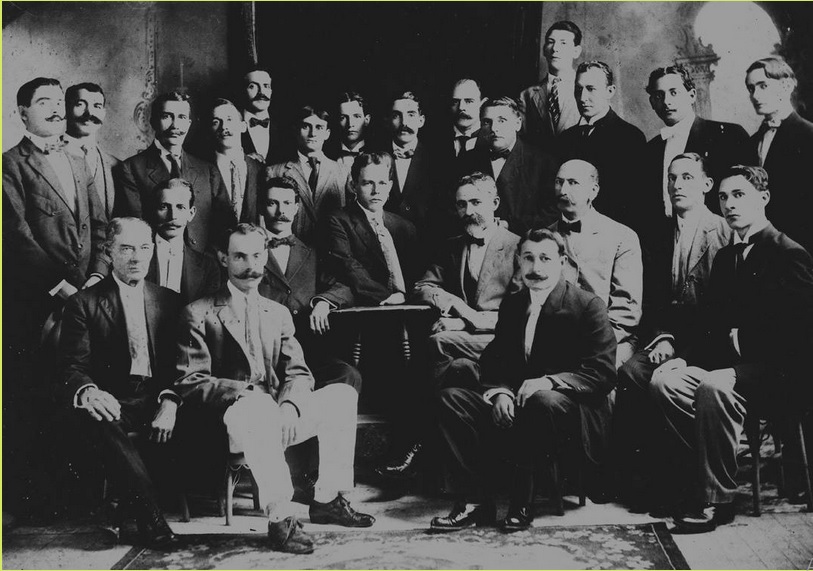
After a pause, she says that there is not much distinction between them.[13] In other words, you couldn’t really tell the Cubans on the left side from the Jews on the right side. I think she was hinting that the Cuban revolutionary junta may have been Jews also.
It’s not a crucial point, but it would add some understanding to what made these people hate Spanish rule. And it would also make the Cuban revolutionary movement look unambiguously Jewish in inspiration.
The four-stage plan for regime change that Professor Mearsheimer describes was apparently accidentally invented in the case of the Spanish-American War. The foundation of the entire four-stage plan is the deliberate infliction of economic distress. It would not be surprising, then, if the regime-change playbook was invented in a period of general economic difficulty.
The United States of America, after 1865, entered a new era with new circumstances and new difficulties that had still not been resolved by the 1890s. There were many problems, especially in the field of economics. The productivity of the United States’ economy greatly exceeded the demand for what it could produce.
An important effect of this new situation was the economic crisis of 1893. After the economic crisis of 1893 came the enactment of protective tariffs in 1894.
The Sugar Trust dominated the refining of sugar in the United States. The kingpin of the Sugar Trust, Mr. Havemeyer, wanted a tariff on imported raw sugar. Consequently, raw sugar from Cuba, which had previously been duty-free, was suddenly faced with a 40% import tariff.[14] This was catastrophic for the Cuban economy. Raw sugar exports were most of the Cuban economy, and 90% of those exports went to the United States.
Today, of course, the use of economic sanctions to inflict misery on people in foreign countries, with the idea of destabilizing their government, has become standard practice. It often doesn’t work, but it is standard practice – and it seems to have been done the first time unintentionally, in the case of Cuba.
The revolutionaries saw economic distress as opportunity. Only five months after the enactment of this tariff, the revolutionary junta in New York City issued an order, and the revolution began nearly one month later on 24 February 1895.[15]
The revolutionaries tried to exacerbate the woes of Cuba’s sugar industry, and to make the colony unworthwhile for Spain, by burning sugarcane fields and destroying sugar mills. The revolutionary general Maximo Gomez stated in a letter of 25 May 1896:
“General Gomez believes, as do his followers, that if the war does not soon end, Cuba will offer to the world a sad picture of utmost misery and strife. Since they realize that Cuba’s wealth is the cause of her bondage they are determined that everything must be destroyed.”
That’s quoted by Grover Flint in his book Marching with Gomez (1898), on page 190.
Regardless of how much misery they may have inflicted on Cuba, however, since they were unable to defeat the Spanish army in a head-on conflict, there was no way that they could take over the island.
Finally, the United States of America got involved, and handed to the Cuban revolutionaries the victory that they had not been able to achieve on their own.
This is, of course, what would also have to happen now in Iran, if the goal of regime change is supposed to be achieved there.
Concentration Camps and Yellow Journalism
Stage three in the regime-change playbook, according to Professor Mearsheimer, is propaganda that makes the revolutionaries look like heroes and the established government look like monsters.
Now, what’s especially useful about the case of the Spanish-American War is that it is widely admitted, and has been admitted for a long time, that the propaganda about so-called Spanish atrocities in Cuba was greatly exaggerated and, in many cases, false. In the decades after the Spanish-American War, what was known as yellow journalism was blamed for getting the United States into that war.
Yellow journalism was originally called Yellow-Kid journalism, and the reason for this was that the two big sensationalist newspapers in New York City that catered especially to a working-class readership were the New York World and the New York Journal. The New York World belonged to a Jew, a Jewish immigrant named Joseph Pulitzer, and the New York Journal belonged to William Randolph Hearst, who was a Presbyterian heir of a mining fortune, who decided to become a newspaper-owner. And when he got into the newspaper business, he copied Joseph Pulitzer’s successful way of gaining a large readership – through sensational reporting. And the reason why it was originally called yellow-kid journalism is that Pulitzer’s newspaper, the New York World, had a cartoon called The Yellow Kid, and William Randolph Hearst hired away the cartoonist who drew The Yellow Kid so that The Yellow Kid would appear in the New York Journal instead of the New York World. Well, Pulitzer didn’t take that lying down. He hired a new cartoonist to draw The Yellow Kid. So both of these newspapers, with their sensational reporting, aimed at the working class, both had this cartoon called The Yellow Kid, drawn by different cartoonists. Consequently, together they became known as Yellow-Kid journalism, and then simply yellow journalism, which today is a label for all reckless, sensational journalism.
But, in order to judge yellow journalism, it is important to compare what yellow journalism reported to what was actually happening in Cuba.
In order to stop the revolution in Cuba, Spain sent to the island General Valeriano Weyler. And an important part of General Weyler’s strategy was to relocate potential guerrillas and their likely supporters in a place where they could not become active. This is widely regarded as the first important implementation of concentration camps. They were called re-concentration camps. The estimate of how many Cubans were re-concentrated ranges from 300,000 to 500,000, which is anywhere from one-fifth to one-third of the island’s population. And a commonly stated estimate of how many died is 170,000. But one has to be wary of exaggeration, and the estimates are all over the board.
Historian Ada Ferrer, in the 1998 PBS documentary Crucible of Empire, said that the number really was not known:[16]
“The aim of the policy is to gather people not involved in the army who were living in the countryside and put them into towns where their services would not be available to the Cuban rebels. […] Nobody really knows how many people died, but they ranged from tens of thousands to hundreds of thousands.”
There are several important facts about this situation that should inform our understanding of later history. First is the fact that concentration camps were used to combat guerrillas. And General Weyler was not the last to do this. The United States of America, very shortly after that war, did the same thing in the Philippines. And the British did it in South Africa. Concentration camps have been used by major powers in numerous efforts to combat or prevent guerrilla warfare.
And another important fact is the danger of disease in such concentrations of people. You can easily have a disease epidemic, if you do not have strict precautions to prevent it, in a concentration camp.
And finally, an important fact to note, is the exploitation of such a situation in enemy propaganda. You had General Weyler portrayed as deliberately killing off Cuban peasants.
Now, certainly General Weyler was not trying to kill off Cuban peasants. But that was exactly how the yellow press in the United States of America portrayed him:
“Weyler is a fiendish despot, a brute, a devastator of haciendas, pitiless, cold, an exterminator of men. There is nothing to prevent his carnal brain from inventing torture and infamies of bloody debauchery.”
Did you catch that? “An exterminator of men”! That’s from the New York Journal’s issue of the 23rd of February, 1896.
What is really remarkable about yellow journalism and its role in instigating the Spanish-American War is the fact that nobody seems to have learned any lessons from it. The same kind of propaganda comes up again and again, and everybody seems to fall for it again and again.
False Flag in 1898?
In 1897, there was a political assassination in Spain that caused a change of government, and General Weyler was recalled. The new liberal government in Spain had ideas of letting people out of the concentration camps, and granting political autonomy to Cuba.
And President William McKinley, who really did not want to go to war, unlike some other people in the United States, told Congress that the Spanish reforms should be given a chance. The expectation of war, therefore, for a time, subsided, but sensational journalism intervened to revive it again.
In January 1898, a salacious and sensationalist newspaper in Havana, published by a man from Mexico named Ricardo Arnautó, printed a defamatory story about the Spanish Army, called “Flight of the Scoundrels.” In reaction to this, Spanish Army officers rioted against El Reconcentrado and two other newspapers in Havana that had become critical of the Spanish government. It all happened essentially on January 12, 1898. The disturbance was completely suppressed, and it had been in no way an anti-American manifestation. There was no threat to U.S. citizens or U.S. interests.
Yellow journalism in the United States however greatly magnified and distorted this essentially unimportant event. And so, because of the false impression of a threat to citizens of the United States, the battleship Maine was ordered to Havana Harbor and arrived on the 25th of January. It sat there in the harbor for three weeks.
Among elected politicians in the United States, the leading warmonger was Senator Henry Cabot Lodge. Through enormous efforts, Senator Lodge had cajoled the anti-war President William McKinley into accepting a fellow warmonger, Theodore Roosevelt, as Assistant Secretary of the Navy.[17] In this respect, Henry Cabot Lodge could be regarded as, in a way, the Lindsey Graham of the 1890s.
On the 31st of January 1898, Henry Cabot Lodge wrote to his friend Henry White:[18]
“There may be an explosion any day in Cuba which would settle a great many things.”
Well, the word explosion there is very interesting. It may or may not mean, however, that Henry Cabot Lodge knew that something was going to happen specifically to the battleship Maine, because you read Henry Cabot Lodge’s letters, and you find out that he has a habit of using the word explosion in a metaphorical sense. So, it might not mean specifically that Henry Cabot Lodge knew that somebody was going to plant a bomb on the battleship Maine in order to get the United States into war.
But it is clear enough, from what he said to his friend, that Henry Cabot Lodge was hoping for some kind of incident that would get the United States into war.
And that wish was granted. The battleship Maine was supposed to leave Havana Harbor no later than the 17th of February 1898, so as to be present for Mardi Gras in New Orleans. The explosion that sank the Maine happened at 9:40PM on the 15th of February.
Whether the battleship Maine really was attacked, and by whom, has been a matter of insoluble controversy. The initial U.S. investigation concluded that the ship had been affected by an explosion underneath it. They said it was a mine.
Spain, however, also conducted an investigation in 1898. They concluded that the ship had experienced a spontaneous combustion of coal dust, which has happened sometimes on other ships, a few times.
Well, in 1976, a study commissioned by the U.S. Navy Admiral Hyman Rickover concluded that the Spanish explanation was most likely correct.
In 1998, however, one century after the battleship Main explosion, National Geographic commissioned another study that made use of computer simulation to explain the damage. National Geographic’s study, based on a computer simulation, revives the conclusion that the ship had been sunk by an external explosion.
Regardless of whether that explosion was man-made or accidental, we can still affirm that the United States of America definitely did not have sufficient evidence for going to war against Spain under the slogan, “Remember the Maine! To Hell with Spain!” Out of all conceivable culprits for blowing up the battleship Maine in Havana Harbor, the Spanish government was least likely to have wanted to provoke a war between herself and the United States. Indeed, Spain quite obviously had everything to lose by that, and it was not hard to foresee.
Among those who did have something to gain by it, of course, were the supporters of Cuban independence and the enthusiasts for U.S. imperialism who, as we have seen, were already hoping at least that something would happen, if not actually plotting.
As many times as we have been stampeded into unnecessary foreign wars based on malicious propaganda and reckless assumptions, you’d think that by now we would be on guard against that. It’s high time that we stopped playing the fool.
Endnotes
Bibliographic information about this document: Inconvenient History, 2026, Vol. 18, No. 1
Other contributors to this document:
Editor’s comments: