Sleuthery in Retrospect
A Review
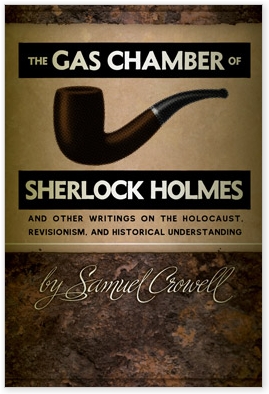
The Gas Chamber of Sherlock Holmes: And Other Writings on the Holocaust, Revisionism, and Historical Understanding by Samuel Crowell, Nine Banded Books, Charleston, W. Va., 2011. 401pp. Indexed.
 The account of the Holocaust that reigns today is itself a historical phenomenon. Many who have given its content close attention and undertaken to verify it against inanimate evidence surviving to later times have concluded that it is antifactual to a degree rivaled only by certain religious myths such as immaculate conception and the divine right of kings.
Author Samuel Crowell, however, refrains absolutely from addressing the factuality of the regnant Holocaust legend, and addresses himself instead to those conditions and antecedents that themselves reigned in the day (years, actually) in which the account was received, bruited about, accepted, and, yes, here and there rejected as it came into being. Taking this entirely novel, scrupulous approach enables Crowell to claim for himself the characterization of “moderate revisionist.” He does not debunk; he merely examines and conveys to later generations, those circumstances that must have given rise to the production and acceptance of accounts of the Holocaust.
One historical matter that he does not address extensively is a very interesting one that he presumably could address with great authority: how has the Holocaust myth been modified, transformed, or appropriated over the sixty-plus years of its strife-torn life to date? Who has from time to time assumed stewardship over its perpetuation and enhancement? Who has undertaken to oppose or even deny it, and to what extent? What legal measures have been enacted and employed by defenders of the mythology, and how have these measures changed in severity and thoroughness of enforcement over the decades leading up to the present moment, in which the contest continues to rage with an intensity quite unanticipated forty years ago? The account of the Holocaust itself undoubtedly has today its own informative history, unknown even to many who have mastered the elusive facts of the original events.
What Crowell does address, thoroughly and with breathtaking credibility, is a related subject quite as fascinating as the history of the Holocaust legend, and that is the history of its origins. This is decidedly not, as is usual, whatever history might lie behind the presentation, modification, or promotion of the events in its content, but rather, the history of those who first received, or obtained, or conveyed, or exploited the material seeping out from various self-appointed “witnesses,” “advocates,” or “interpreters,” ranging all the way from former “inmates” to cryptanalysts working at the legendary decoding laboratories at Bletchley Park in England.
This analysis includes essential exploration of cultural antecedents—notable accounts and mass enfabulations that undeniably conditioned receptions and interpretations to which reports of what now is encompassed under the rubric of “The Holocaust” were subjected. These, in turn, reach back well past the World War that preceded the Second, and are replete with recognizable Numbers (well beyond the Six Million of universal familiarity) that expose the machinations of myth-makers genning headlines and report titles calculated to engage the fears and prejudices of publics long conditioned by the rigors of prolonged war to the most damning interpretations imaginable.
The Gas Chamber of Sherlock Holmes is clarifying, in ways that dry, excrutiatingly thorough analyses of evidence-on-the-ground concerning the originary events cannot possibly be. It illuminates why people would have thought what they seem to have thought upon receiving “information,” and how those in possession of such “information” may have found and exploited opportunities created by it. It is, to greatly simplify, “the Holocaust in context”—the contemporaneous context in which the seminal allegations arose and were received, and the reception that has since been extended, extrapolated, perpetuated, sanctified, and elevated to the status of secular Scripture for at least the entire West, and by intention for the entire world.
The volume is not integrated. The foregoing applies primarily to Part 1 of the book, whose title is that of the book. There are, as a bonus for the fact-seeker, three further parts of value potentially quite as great as that of the first.
Parts 2 and 3 report the author’s recent discoveries concerning the presence in the wreckage of concentration camps of gas-tight doors and related appurtenances that have been interpreted as evidence of “gas chambers” intended for the purpose of killing people. He presents evidence (as always, without arguing it) from which readers may conclude that these “incriminating traces” were intended, like the Zyklon-B insecticide so extensively and humanely used in the camps, to protect the lives and well-being of inmates and guards from aerial gas attacks of the kind universally provided against not only by the beleaguered Germans, but by the Allies as well.
These parts, of course, address originary evidence, and so are of an altogether different type from the contextual/antecedal approach of Part 1.
Part 4 undertakes a retrospective on evidence-based historical revision of the account of the Holocaust. This analysis does not trace the sequence of transmogrifications exhibited by the mainstream account, but rather presents a review of the discoveries continually adding content, and support, to the ongoing revision of the alternative account of the Holocaust understood and generally accepted among the minority of scholars interested in what might constitute the facts of the matter. The reader is left to his own observations as to how these corrections have (and to a large extent have not) filtered down to the canonical account. That some of them have, provides hope, at least to the optimistic, that in future centuries, the (ever-more-sparsely) understood account of the subject might converge with what is supported by objective fact.
Read this book. It is available from Amazon and very few booksellers, at least on open shelves visible to the general public.

Bibliographic information about this document: Inconvenient History, 3(2) (2011)
Other contributors to this document: n/a
Editor’s comments: n/a