Challenging Holocaust Orthodoxy: A German National’s Fight for Free Speech
The Barnes Review Interviews Germar Rudolf
By Germar Rudolf ∙ July 2, 2025
Last updated on
On May 25, 2025, at 6:30pm Eastern Time, José Niño of The Barnes Review (TBR) conducted an audio-only interview with Germar Rudolf. It took a long while for The Barnes review to post this interview on their site, but now it finally happened:
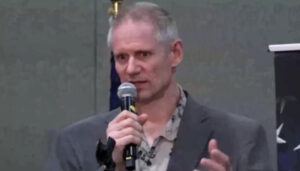
Germar Rudolf lecturing during the 1st JP Conference in Kentucky on June 25, 2024.
On this episode of TBR Radio’s “The TBR History Hour,” host José Niño welcomes a German chemist Germar Rudolf for a provocative discussion about alternative historical narratives surrounding the Holocaust, the academic persecution faced by Holocaust revisionist scholars, and the ongoing battle for intellectual freedom in contemporary Europe and the United States.
This episode explores the controversial terrain of historical revisionism and the institutional pressures that silence dissenting voices. The German scholar shares his personal experiences of professional ostracism, legal challenges, and social isolation that followed his research into alternative interpretations of the Holocaust.
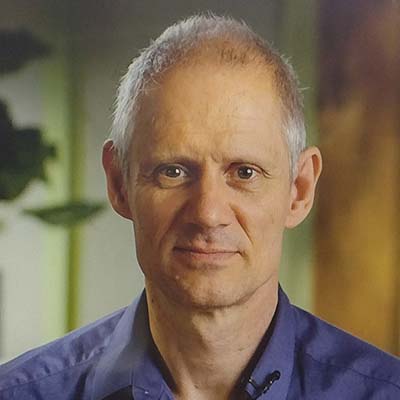
Germar Rudolf was born on October 29, 1964, in Limburg, Germany. He studied chemistry at Bonn University, where he graduated in 1989 as a Diplom-Chemist, which is comparable to a U.S. PhD degree. From 1990-1993 he prepared a German PhD thesis at the Max Planck Institute for Solid State Research in conjunction with the University of Stuttgart, Germany. Parallel to this and in his spare time, Rudolf prepared an expert report on chemical and technical questions of the alleged gas chambers of Auschwitz, The Rudolf Report (now titled The Chemistry of Auschwitz). He conclude in it that "the alleged facilities for mass extermination at Auschwitz and Birkenau were not suited for the purpose as claimed." As a result he had to endure severe measures of persecution in subsequent years. Hence he went into British exile, where he started the small revisionist outlet Castle Hill Publishers. When Germany asked Britain to extradite Rudolf in 1999, he fled to the U.S. There he applied for political asylum, expanded his publishing activities, and in 2004 married a U.S. citizen. In 2005, the U.S. recognized Rudolf's marriage as valid and seconds later arrested and subsequently deported him back to Germany, where he was put in prison for 44 months for his scholarly writings. Some of the writings he got punished for had been published while Rudolf resided in the U.S., where his activities were and are perfectly legal. Since not a criminal under U.S. law, he managed to immigrate permanently to the U.S. in 2011, where he rejoined his U.S. citizen wife and daughter. He currently resides in Upstate New York.
Bradley R Smith, the Holocaust revisionist famous for spouting his views through advertisements in college newspapers, is making waves at Hofstra University. The full-time gadfly has submitted a 24-page booklet portraying death camps as far-fetched sob stories to college newspapers across the country. While Liz Johnson, editor in chief of The Review, refused to publish…
The Internet, perhaps the last truly free means of information exchange in the Western world, may soon be choked by censorship and governmental controls. The circumscribing of the Net may cause the death of what has become the first people-to-people exchange of ideas and information on a world wide basis. The forces behind this effort…
Today, on May 4, 2017, U.S.-American professor of Jewish history and Holocaust studies Deborah Lipstadt will lecture at 7pm at the McCormick Foundation Forum of Northwestern University. CODOH tried to place an ad in the Daily Northwestern, but that was rejected. We tried to find someone to inconspicuously leave several CODOH leaflets at that venue, but…
Embassy of Canada in Washington, D.C. 501 Pennsylvania Ave. NW Washington, D.C. 20001-2111 [email protected] Media Tel: 202-682-7732 May 6, 2016 Dear Neighbor to the North- We are writing to you to support the application for a visa by the French comedian and social critic Dieudonne M’bala M’bala. Mr. M’bala M’bala is an…
Carlo Mattogno Carlo Mattogno, a specialist in text analysis and critique, is Italy’s, if not the world's, foremost Holocaust revisionist scholar. Born in 1951 in Orvieto, Italy, he has carried out advanced linguistic studies in Latin, Greek and Hebrew. He is the author of a vast number of books and papers about the Holocaust. He…
In February, Californian State Senator Dr. Richard Pan (D-Sacramento) introduced Senate Bill 1424; a law which would require the California Attorney General to create a new advisory committee. The advisory committee would be required to study how false information is spread online and come up with a plan for social-media platforms to fix the "problem." The committee would also…