
Jankiel Wiernik Exposed as Communist Propagandist
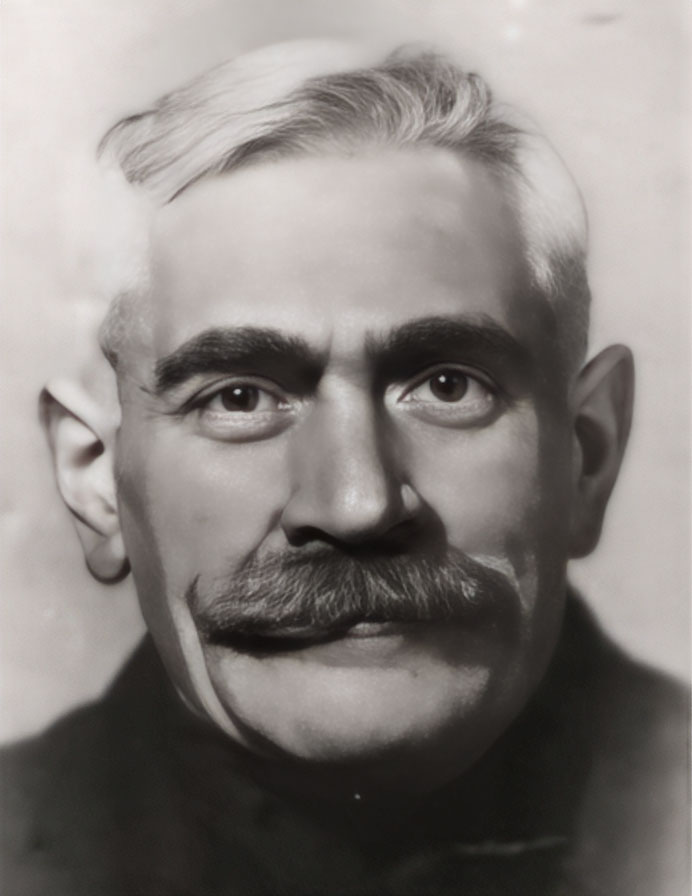
Conventional biographies of Jankiel Wiernik claim that he was a carpenter (or building contractor or cabinetmaker) who had to be persuaded to write down an account of his year at the Treblinka II “extermination camp.” Supposedly, he had difficulty describing his experience at Treblinka, as he was “not a man accustomed to using a pen.”[2] However, several intriguing newspaper articles state that Wiernik was involved in communist underground activities in Warsaw since at least 1935. These sources imply he was literate enough to write communist proclamations, used multiple typewriters, and was in possession of materials used to copy his and other writings.
Early in his adult life, he was already involved in subversive underground activities. From 1904, Wiernik was a member of the Jewish socialist Bund movement.[3] For this, he was sent to Siberia and served a term in the Tsarist Army.[4] Some time after his release, he settled in Warsaw, Poland.[5] What is left out of conventional histories of his life is his continued participation in communist underground activities in the 1930s.
On August 5, 1935, the Polish newspaper Expres Zagłębia reported on the Warsaw police investigation office discovering a secret communist printing press operating out of the basement of a local Jewish shoemaker’s shop. According to the police, the operation was sophisticated, with the conspirators even stealing electricity. At the scene, three people involved with the printing operation were immediately arrested: Mendel Flank, Aron Cukiernia, and Lejb Erdpel. The owner of the shoe shop, Mordka Rosenberg, was also arrested.[6]
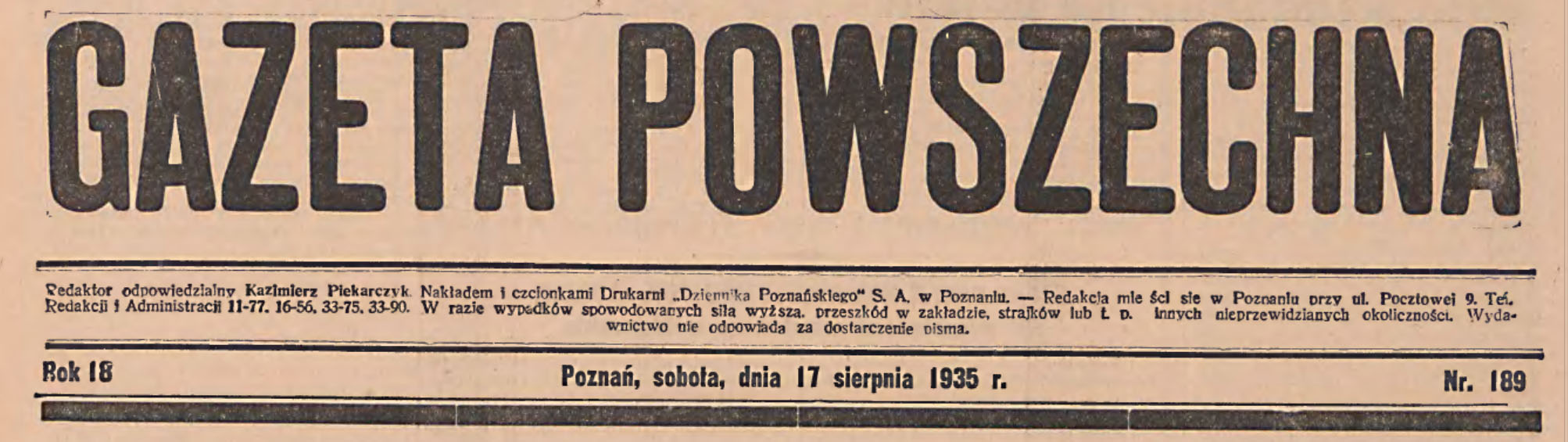
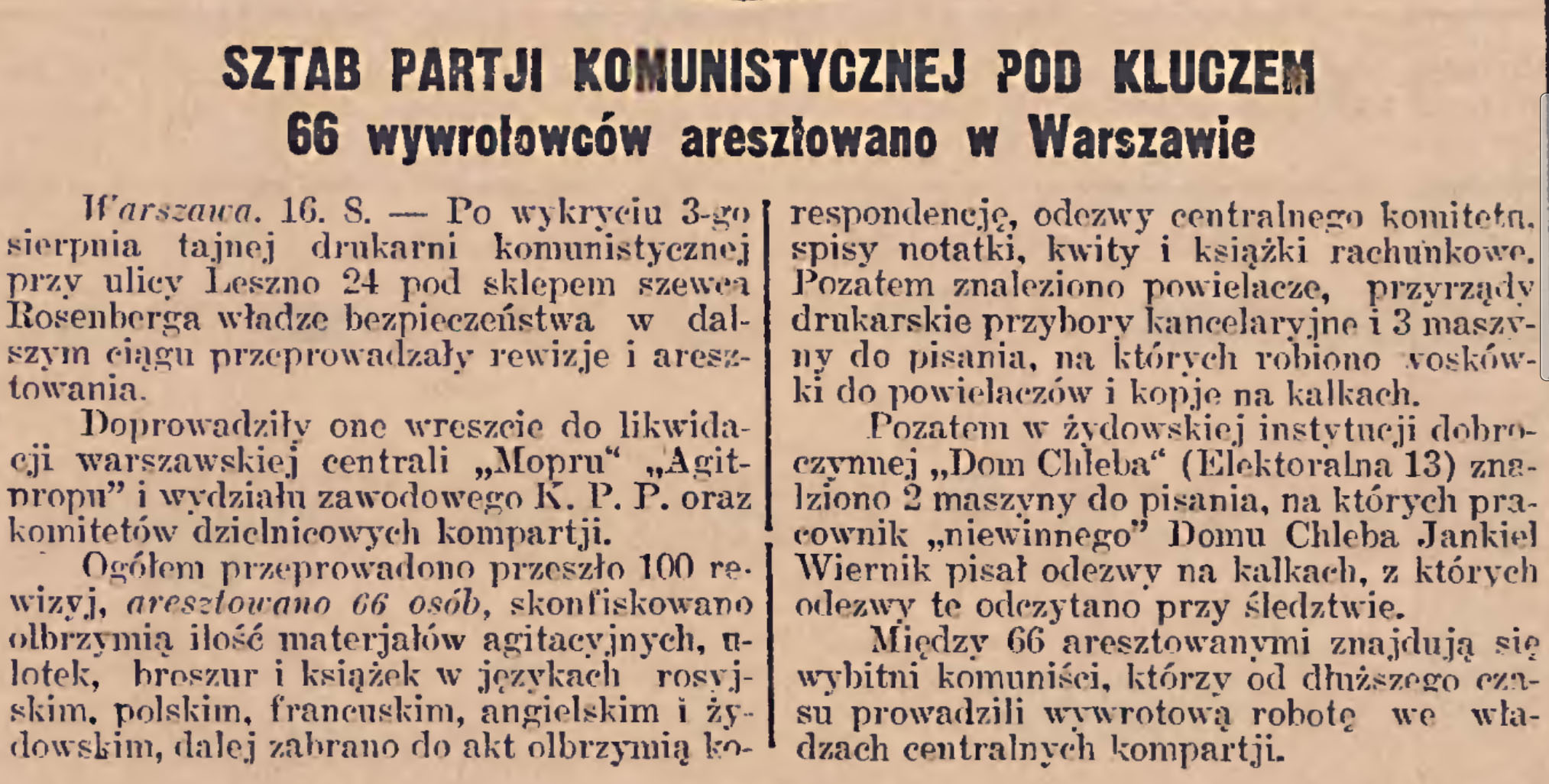 Gazeta Powszechna (Poznan), August 17, 1935, p. 2:
COMMUNIST PARTY HEADQUARTERS UNDER LOCK AND KEY
66 subversives arrested in Warsaw
Warsaw. 16. 8. – After the discovery on August 3 of a secret Communist printing house at 24 Leszno Street under the store of the shoemaker Rosenberg, the security authorities continued to carry out searches and arrests.
They finally led to the liquidation of the Warsaw headquarters of the “Mopru” [Russian] “Agitprop” and the professional department of the K. P. P. (Communist Party of Poland), as well as the district committees of the communist party.
In all, more than 100 searches were carried out, 66 people were arrested, a huge amount of agitational material, leaflets, pamphlets and books in Russian, Polish, French, English and Jiddish languages were confiscated, and a large amount of correspondence, proclamations of the central committee, lists of notes, receipts and account books were further taken for the files. In addition, duplicators, printing equipment, office supplies and 3 typewriters were found, used to make wax rolls for the duplicators and carbon copies.
Besides, in the Jewish charitable institution “House of Bread” (Elektoralna 13) 2 typewriters were found, on which an employee of the “innocent” House of Bread, Jankiel Wiernik, wrote proclamations on carbon paper, which were read during the investigation.
Among the 66 arrested are prominent communists who had been carrying out subversive work in the communist party’s central authorities for a long time.
One of the locations searched in furtherance of the investigation was the Jewish Dom Chleba charitable society. According to Gazeta Robotnicza (August 16, 1935):[9]
“Two typewriters were found in the premises of the ‘Dom Chleba’ Charitable Society at Elektoralna Street No. 13, apartment 6. Communist proclamations were written on these machines by a certain Jankel Wiernik.”
The next day, Glos Narodu added the further detail that Wiernik was in possession of carbon copies with the text of “subversive proclamations, as well as letters sent to the PPS, CKW, [10] and the Bund regarding a unified front.”[11] Kurier Poznanski, in an article on August 20, 2935, detailed the types of materials being written, published and reproduced:[12]
“During the searches, manuscripts, typescripts and recent reports from the 7th Congress of the Comintern, printed in Polish, Russian and French, were found. Furthermore, three typewriters with carbon paper inserted, ready for operation, were discovered as well as publications of the Central Committee of the Communist Party of Poland in Yiddish and Polish.”
Several newspapers covering the full investigation listed over a dozen names of people who were arrested, although none state all 66, and even the papers that mention Jankiel Wiernik by name do not specifically identify him as one of those arrested. Hence, while we can say that the investigators concluded Wiernik was writing and copying communist materials on two typewriters at the Dom Chleba[13] charity organization, it would be speculation to say he was actually arrested at this time for his role.
So far in this article, it is also not confirmed that this is the same Jankiel Wiernik who surfaced years later, also in Warsaw, and wrote One Year in Treblinka in late 1943. After all, there could be multiple people named “Jankiel Wiernik” in a city as large as Warsaw.
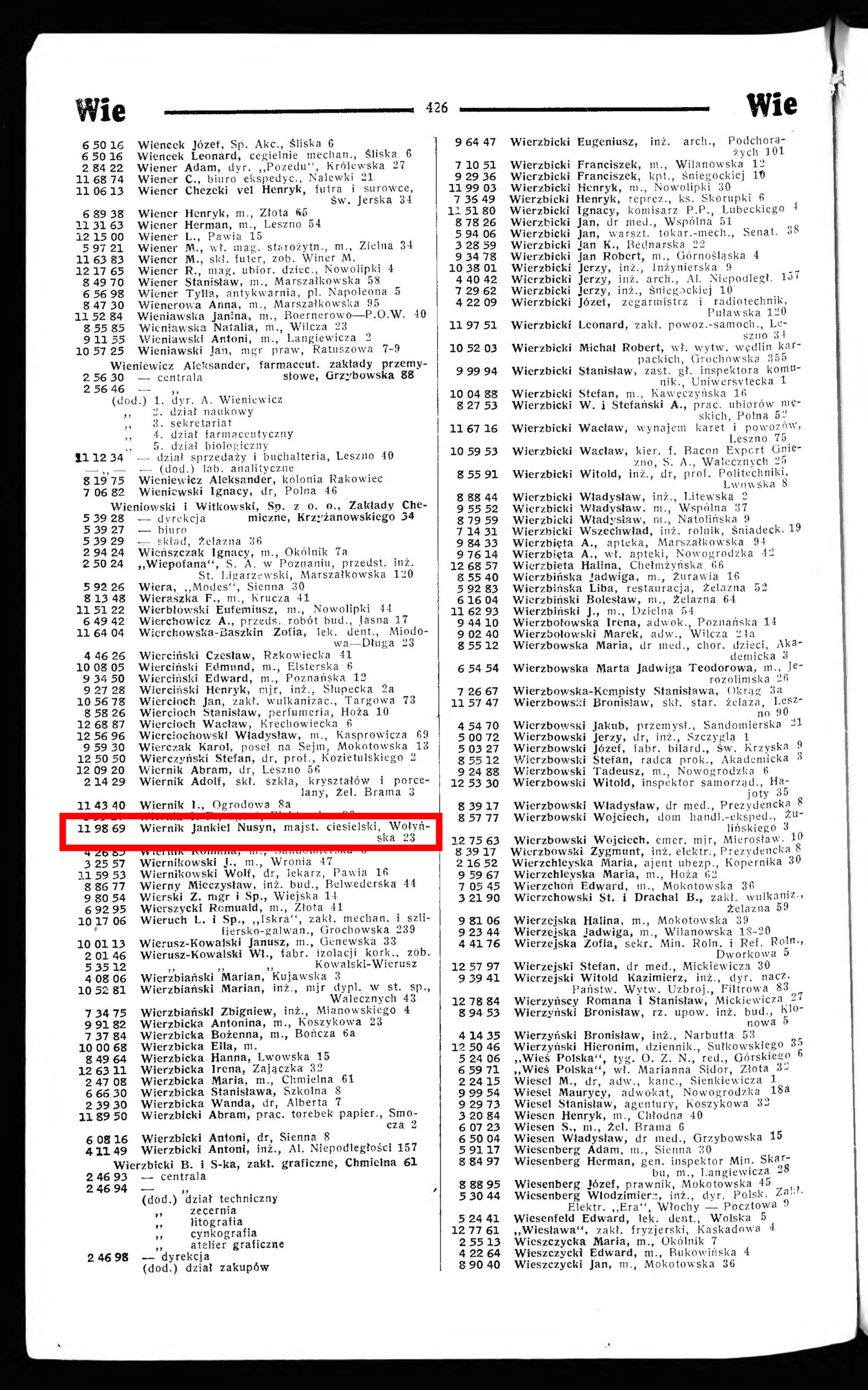
However, evidence from a series of Warsaw telephone books suggests that this is one and the same Jankiel Wiernik. For the years 1935 through 1939, there is only one entry for a “Wiernik Jankiel Nusyn” with a profession of “majst. ciesielski” (master carpenter) living at 23 Wolynska Street.[14]
Wiernik himself confirms that he lived on this street. In the book Walls around: The Plunder of Warsaw Jewry during World War II and Its Aftermath, author Itamar Levin quotes from a “small book written secretly and published after [Wiernik] arrived in Israel”. Wiernik stated in this book:[15]
“I stood in line opposite my house on Wolynska Street. From there we were taken to Zamenhof Street. Before my eyes, I saw Ukrainians dividing up the spoils. They were fighting amongst themselves, tallying up and sorting through the loot.”
In all of Warsaw’s telephone directories covering the years 1935-1939, no other “Jankiel Wiernik” or person with a similar first and last name are listed, and he maintained the same address for the entire period. By 1940, after the German occupation, Wiernik’s name (or any of his later assumed names) can no longer be located in the Telefonverzeichnis der Stadt Warschau (Telephone List of the City of Warsaw) or the Amtliches Fernsprechbuch für das Generalgouvernement (Official Telephone Directory for the General Government) of 1942. His address of 23 Wolynska was located inside the boundaries of the Jewish ghetto the National Socialists established.[16]
Interestingly, the address listed on his Generalgouvernmement Kennkarte (ID Card; issued June 1, 1943 in Warsaw) of Towarowa 28 is located outside of the Jewish ghetto’s boundaries. This document identifies Wiernik as “Jan Smarzynski,” an unemployed clerk of the Roman Catholic religion.[17] “Jan Smarzynski” is an assumed name, so the rest of the document may be a partial or complete forgery, including the June 1 date, when Wiernik was supposedly still in Treblinka and thus would have been unavailable to be issued an ID card in Warsaw.[18] The card, though, has his photograph and was in his possession, eventually being turned over by his estate to the Ghetto Fighters House Archives.
Participation in subversive communist movements was a theme throughout Wiernik’s life, starting from the age of 24, when he joined the Bund movement. After his release from military service under the Tsar, he settled in Warsaw, where he was caught up in the investigation of a sophisticated communist underground printing operation which was writing, copying and distributing material in a variety of languages. Far from being nearly illiterate and unfamiliar with writing, he was the only person mentioned in newspaper articles as actually writing the communist proclamations, in addition to being in possession of common copying supplies like carbon paper. Finally, according to various telephone directories covering the years 1935-1939, no other person named “Jankiel Wiernik” ever registered an address or telephone in Warsaw, so we can rule out a separate subversive underground communist with the same name.
Bibliography
- Amtliches Fernsprechbuch für das Generalgouvernement. Urzędowa Książka Telefoniczna dla Generalnego Gubernatorstwa (Official Telephone Directory for the General Government). Deutschen Post Osten, 1942, p. 314. Radomska Biblioteka Cyfrowa. https://bc.radom.pl/dlibra/docmetadata?id=1230.
- Bartoszewski, Władysław. “Historia Jankiela Wiernika (I).”, Polska (Warsaw), No. 8, August 1964, p. 54; archived at https://web.archive.org/web/20140509083502/http://wladyslawbartoszewski.blox.pl/2006/10/Historia-Jankiela-Wiernika-I.html (May 9, 2014.).
- Bartoszewski, Władysław. “Historia Jankiela Wiernika (II).” Polska (Warsaw), No. 8, August 1964; archived at: https://web.archive.org/web/20140509104421/http://wladyslawbartoszewski.blox.pl/2006/10/Historia-Jankiela-Wiernika-II.html (May 9, 2014).
- Dzwon Niedzielny (Krakow). “Z Polski” (“From Poland”), August 25, 1935. Yr. 11, No. 35, pp. 571f. Jagiellonska Biblioteka Cyfrowa. https://jbc.bj.uj.edu.pl/dlibra/publication/331167/edition/316603.
- “Ein Flüchtling aus Treblinka schildert vor dem 28. September 1943 die Zustände im Lager und seine Flucht während des Häftlingsaufstands.” In: Klaus-Peter Friedrich (ed.), Die Verfolgung und Ermordung der europäischen Juden durch das nationalsozialistische Deutschland 1933 – 1945. Band 9. Polen: Generalgouvernement August 1941 – 1945, vol. 9. Oldenbourg Verlag, Munich, 2014, pp. 734-736.
- Expres Zagłębia (Sosnowiec). “Wykrycie wielkiej tajnej drukarni komunistycznej w Warszawie.” (“Discovery of a large secret communist printing house in Warsaw”), August 5, 1935. Yr. 10, No. 211, p. 1. Slaska Biblioteka Cyfrowa. https://sbc.org.pl/dlibra/publication/546612/edition/513207.
- Gazeta Narodowa (Częstochowa). “Z KRAJU I ZE SWIATA” (“From the Country and the World”), August 11, 1935. Yr. 4, No. 40 (222), p. 2. Slaska Biblioteka Cyfrowa. https://sbc.org.pl/dlibra/publication/489992/edition/459080.
- Gazeta Polska (Koscian). “Tajna drukarnia komunistyczna w Warszawie” (“The communist printing house in Warsaw”), August 8, 1935. Yr. 39, No. 182, p. 2. Wielkopolska Biblioteka Cyfrowa. https://www.wbc.poznan.pl/dlibra/publication/500323/edition/407621.
- Gazeta Powszechna (Poznan). “Sztab partji komunistycznej pod kluczem: 66 wywrotowców aresztowano w Warszawie” (“Communist Party Headquarters Under Lock and Key: 66 Subversives Arrested in Warsaw”), August 17, 1935. Yr. 18, No. 189, p. 2. Wielkopolska Biblioteka Cyfrowa; https://www.wbc.poznan.pl/dlibra/publication/540304/edition/448297.
- Gazeta Robotnicza (Katowice). “Aresztowania” (“Arrests”), August 16, 1935. Yr. 40, No. 217, p. 3. Slaska Biblioteka Cyfrowa. https://sbc.org.pl/dlibra/publication/153127/edition/143856.
- Gazeta Robotnicza (Katowice). “Kronika sądowa” (“Court Chronicle”), June 9, 1936. Yr. 41, No. 165, p. 3. Slaska Biblioteka Cyfrowa. https://sbc.org.pl/dlibra/publication/155772/edition/146358.
- Glos Narodu (Krakow). “Likwidowanie ruchu komunistycznego w stolicy” (“Liquidation of the communist movement in the capital”), August 16, 1935. Yr. 42, No. 222, p. 1. Jagiellonska Biblioteka Cyfrowa. https://jbc.bj.uj.edu.pl/dlibra/publication/176938/edition/168423.
- Gordon-Levy, Yael, ed. “Personal documents, letters, and testimonies from the estate of Yaakov Wiernik.” 1943. Ghetto Fighters House Archives. https://www.infocenters.co.il/gfh/notebook_ext.asp?item=114833&site=gfh&lang=ENG&menu=1.
- Itamar, Levin. Walls around: The Plunder of Warsaw Jewry during World War II and Its Aftermath. Translated by Rachel Neiman. Praeger, Westport, CT, 2004. https://archive.org/details/wallsaroundplund0000levi.
- Kurier Poznanski (Poznan). “Żydzi przy… robocie” (“Jews at… Work”), August 20, 1935. Yr. 30, No. 377, p. 4. Wielkopolska Biblioteka Cyfrowa. https://www.wbc.poznan.pl/dlibra/publication/575468/edition/488194.
- Mattogno, Carlo. The “Operation Reinhardt” Camps Treblinka, Sobibór, Bełżec: Black Propaganda, Archeological Research, Expected Material Evidence. 1st ed. Holocaust Handbooks 28. Academic Research Media Review Education Group Ltd, 2024. https://holocausthandbooks.com/book/the-operation-reinhardt-camps-treblinka-sobibor-belzec/.
- Nasza Chodzież (Chodziez). “Tajna drukarnia w piwnicy” (“Secret printing house in the basement”), August 7, 1935. Yr. 6, No. 180, p. 1. Wielkopolska Biblioteka Cyfrowa. https://www.wbc.poznan.pl/dlibra/publication/522045/edition/428326.
- “On the ban on living in four provinces of the country for Adam Bardziński and Jankiel Wiernik, who were found to be members of political organizations in the Petrograd Governorate.” 1913. Archiwum Główne Akt Dawnych. https://www.szukajwarchiwach.gov.pl/en/jednostka/-/jednostka/17795797.
- Shtokfish, D, ed. Sefer Wyszków. (Wyszków Memorial Book). Wyszków Association of Former Residents in Israel and Abroad, 1964. https://www.jewishgen.org/yizkor/ybip/YBIP_Wyszkow.html.
- Spis abonenntów warszawskiej sieci telefonów polskiej akcyjnej spółki telefonicznej, rok 1935/36 (List of Subscribers of the Warsaw Telephone Network of the Polish Joint-Stock Telephone Company, 1935-1936). ZAKŁ. GRAF. „NOWOCZESNA SPÓŁKA WYDAWNICZA” S. A. MARSZAŁKOWSKA 3-5-7, 1935. Mazowiecka Biblioteka Cyfrowa. https://mbc.cyfrowemazowsze.pl/dlibra/publication/edition/9883/.
- Spis abonenntów warszawskiej sieci telefonów polskiej akcyjnej spółki telefonicznej, rok 1937/38 (as before). GRAPHIC PRINTING STUDIO “DOM PRASY” S. A. MARSZAŁKOWSKA 3-5-7, 1937. Mazowiecka Biblioteka Cyfrowa. https://mbc.cyfrowemazowsze.pl/dlibra/publication/edition/9884/.
- Spis abonenntów warszawskiej sieci telefonów polskiej akcyjnej spółki telefonicznej, rok 1938/39 (as before). GRAPHIC PRINTING STUDIO “DOM PRASY” S.A. MARSZAŁKOWSKA 3-5-Ï, 1938. Mazowiecka Biblioteka Cyfrowa. https://mbc.cyfrowemazowsze.pl/dlibra/publication/edition/9885/.
- Spis abonenntów warszawskiej sieci telefonów polskiej akcyjnej spółki telefonicznej, rok 1939/40 (as before). GRAPHIC PRINTING STUDIO “DOM PRASY” S.A., MARSZAŁKOWSKA 3/5/7, 1939. Mazowiecka Biblioteka Cyfrowa. https://mbc.cyfrowemazowsze.pl/dlibra/publication/11896/edition/9887.
- Telefonverzeichnis der Stadt Warschau / Wykaz Czynnych Telefonów Warszawskiej Sieci 1940 (List of Active Telephones of the Warsaw Network 1940). Biuro Nowoczesnej Reklamy, 1940, p. 80. Mazowiecka Biblioteka Cyfrowa. https://mbc.cyfrowemazowsze.pl/dlibra/publication/10871/edition/9821/.
- Tygodnik Polityczny (Warsaw). “Co komunista – to zyd” (“What is a communist is a Jew”), August 25, 1935. Yr. 1, No. 13, p. 7. Jagiellonska Biblioteka Cyfrowa. https://jbc.bj.uj.edu.pl/dlibra/publication/281292/edition/268849.
Endnotes
| [1] | General Jewish Labour Bund in Poland, a Jewish socialist party. |
| [2] | Bartoszewski, “Historia Jankiela Wiernika (I).” |
| [3] | Gordon-Levy, “Personal documents, letters, and testimonies from the estate of Yaakov Wiernik.” |
| [4] | Shtokfish, Sefer Wyszków. p. 128. |
| [5] | Although not confirmed to be the same person as of the time of writing, a non-digitized record from 1913 of the Archiwum Główne Akt Dawnych refers to the “residence ban in four provinces of the country for Adam Bardziński and Jankiel Wiernik who were found to be members of political organizations in the Petrograd Governorate.” |
| [6] | Expres Zagłębia, “Discovery of a large secret communist printing house in Warsaw.” In a short “Court Chronicle,” Gazeta Robotnicza (June 9, 1936) reported that these four conspirators were sentenced to prison terms of four to nine years. Two of them were claimed to be illiterate and one was in charge of repairs for the printing press machines. |
| [7] | Gazeta Powszechna, “Communist Party Headquarters Under Lock and Key.” |
| [8] | Tygodnik Polityczny, “What is a communist is a Jew,” (“the MOPR headquarters and the Warsaw ‘Agitprop’ headquarters”). Dzwon Niedzielny, “From Poland,” (“headquarters of the communist movement”). |
| [9] | Gazeta Robotnicza, “Arrests.” |
| [10] | PPS. CKW. Central Executive Committee of the Polish Socialist Party. (Centralny Komitet Wykonawczy Polska Partia Socjalistyczna). |
| [11] | Glos Narodu, “Liquidation of the communist movement in the capital.” |
| [12] | Kurier Poznanski, “Jews at… Work.” |
| [13] | Based on yearly financial summaries throughout the 1920s, Dom Chleba was a charity organization and soup kitchen, with over 80% of its yearly expenses going towards monetary and food support in the community. It was not itself a secret front for subversive communist activities. |
| [14] | Spis abonenntów… 1935-1936, p. 302; 1937-1938, p. 339; 1938-1939, p. 377; 1939-1940, p. 426. |
| [15] | Itamar, Walls Around. p. 145. |
| [16] | Online Warsaw Ghetto Map and Database. |
| [17] | Gordon-Levy, “Personal documents, letters, and testimonies from the estate of Yaakov Wiernik.” |
| [18] | However, this June 1 date corresponds to an earlier “version” of the escape from Treblinka by an anonymous author. In this account, it is claimed the breakout took place at the end of May, which would give Wiernik enough time to return to Warsaw to obtain a real ID under a false name on June 1, 1943. See Mattogno, The “Operation Reinhardt” Camps, p. 126, and “Ein Flüchtling aus Treblinka…”. Both acknowledge the writer of this report is likely Wiernik. |

Bibliographic information about this document: Inconvenient History, 2025, Vol. 17, No. 3
Other contributors to this document:
Editor’s comments: