
Jazz in Concentration Camps:
A Lively Musical Life in German Concentration Camps
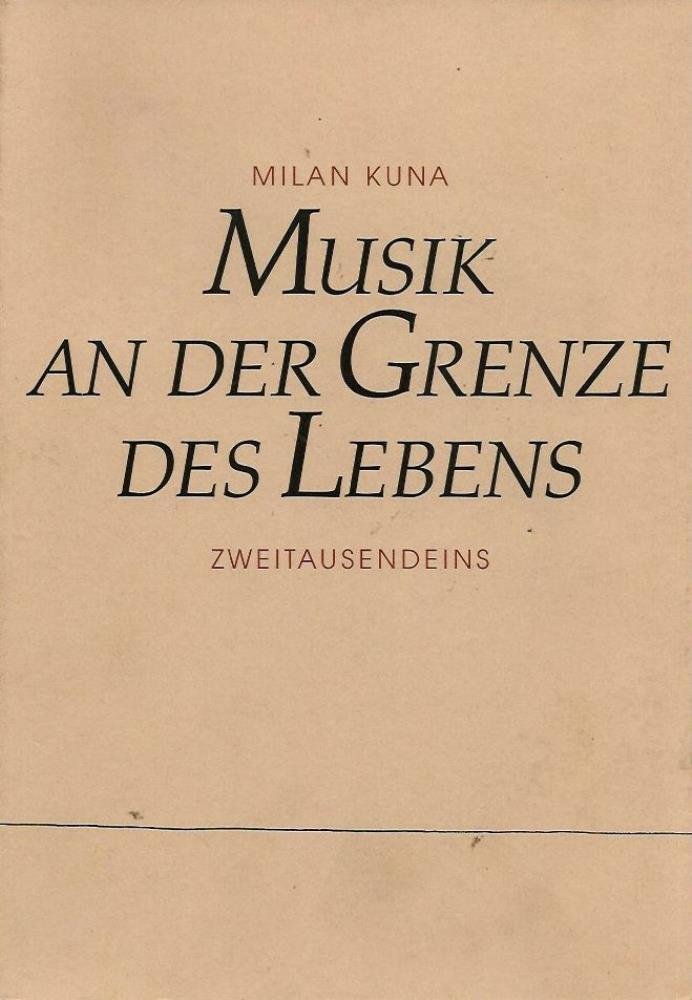
Milan Kuna, Musik an der Grenze des Lebens: Musikerinnen und Musiker aus böhmischen Ländern in nationalsozialistischen Konzentrationslagern und Gefängnissen (Music at the Edge of Life: Musicians from Bohemia in Nazi Concentration Camps and Prisons), 2nd ed., Zweitausendeins, Frankfurt on Main 1998, 407 pages, numerous illustrations.
Against the wildly romantic granite backdrop of the quarry in the decommissioned Mauthausen Concentration Camp,[1] which nevertheless has been lavishly preserved at taxpayers’ expense, spectacular concert events took place in the early 2000s – notably, the Vienna Philharmonic Orchestra under Sir Simon Rattle performed Beethoven’s Ninth as a way of coping with Austria’s Nazi past. The gimmicky jazz musician Joe Zawinul (“It would be completely presumptuous to try to create authenticity”) had his politically correct but musically gruesome Mauthausen Cantata created with massive technical and multimedia amplification to mark the 60th anniversary of the start of construction of the concentration camp. But none of the onlookers who turned up for the loud Zawinul magic had the slightest idea that music had long been in the air when the camp was still full of prisoners six decades ago. The following review of a report compiled by the Czech jazz fan and internationally recognized musicologist Professor Milan Kuna, based on a conscientious evaluation of extensive authentic records, refers exclusively to the musical part of camp life.[2] It therefore cannot deal with the inhuman aspects of the concentration camps, which are already well-known.
Concentration camp music was mostly made by Czechs, and sounded much more harmonious than Zawinul’s cacophony’.[3] “The occasions and opportunities on which music was played were just as varied as the music that was made,” Professor Kuna notes in his valuable contribution to establishing the truth. “The fact that so many inmates were so often involved with music is surprising and has hardly been noticed until now,” the music professor marvels (p. 351). So even in the concentration camp, there were moments of humanity, such as those provided by music. Musical life in the camps, about which there is a wealth of literature,[4] strengthened the prisoners’ morale, and therefore made a significant contribution to helping them overcome the misery of internment.
In August 1942, “Gestapo-Müller” from the Reich Security Main Office ordered all concentration camp commanders to organize a musical band in each main camp. The prisoners who volunteered for this were allowed to choose their instruments from camp stocks, or have them sent to them by their relatives. The concentration camp inmate Kunc, who owned a music shop in Moravian Ostrava, wrote home when a missing instrument was needed, which his wife promptly sent to Buchenwald (p. 269). What was missing elsewhere was bought[5] or, as was sometimes the case in Mauthausen, made by the prisoners themselves (p. 40). In Flossenbürg, the enterprising violin virtuoso Karel Volšanský was able to finance the purchase by “reselling, in the inmate blocks at a mark-up, tinned black pudding, which had expired and which he had acquired from the SS” (p. 68).
At first, it was mostly gypsies who volunteered to play music in the camps. Soon, however, Czechs gradually infiltrated the orchestras, who, as members of a people who were not only hard-working but also musical, managed to outplay the vagrants, and then hold the music book firmly in their fists until the end.
The orchestras gave public concerts on the roll-call square. They accompanied the prisoners with their melodious music, as they marched in columns through the camp gates to work early in the morning, and returned to the camp at the end of the day. However, the bands also performed for higher and highest-ranking visitors: Himmler was welcomed to Mauthausen in January 1945 with Wagner’s Wedding March from Lohengrin and Julius Fučik’s Florentine March, and at an even later visitation with Suppé’s Leichte Kavallerie and Schubert’s Unvollendeter, both of which were favorite melodies of Mauthausen’s camp commander Franz Ziereis (p. 87). The camp celebration of the 60th birthday of the later CSSR president Antonin Zápotocký in Sachsenhausen was accompanied by music (p. 124, note 16 on p. 364), as was the funeral service for Ernst Thälmann, the former leader of Germany’s erstwhile Communist Party, on August 18, 1944 in Buchenwald (pp. 263ff.).
“Being recognized as a musician in the camp brought small advantages,” Kuna announces. Although the orchestras were organized as work detachments, they were always assigned to lighter work when they weren’t making music. Not only did they entertain their members’ fellow inmates, but they also basked in the favor of the hierarchy:
“At Auschwitz, camp commandant Kramer could burst into tears when the orchestra sang Schumann’s Träumerei.”
The artistic camp commandant Maria Mendel, on the other hand, preferred to melt away to passages from Puccini’s Madame Butterfly:[6]
“And when the conductor of her orchestra, Alma Rosé, died of blood poisoning, she laid flowers on her grave – the Jewess.”
The commandant of the Flossenbürg Camp mutated into a gentle lamb when the camp music delighted him with his favorite song Warum hat die Eule so geheult? (Why Did the Owl Howl so Much?, p. 70). In Sachsenhausen, on the other hand, the camp commandant attached great importance to the fact that the citizens living near the camp could also hear the prisoners’ choir (p. 24):
“This was to prove that the camps were not as cruel and harsh as the enemy propaganda tried to make the German population believe.”
The bands ranged from vocal and instrumental music to classical music, bar music, jazz and twelve-tone music (p. 351):
“Pop music was sung, operas were performed, and even an opera was composed in a prison cell.”
The Buchenwald song composed by the Viennese cabaret artist Hermann Leopoldi before his release into exile in the US, to which Fritz “Beda” Löhner, the author of many Lehár libretti, wrote the lyrics, was written at the request of the camp administration and, despite its anti-fascist appeal, also appealed to the SS.[7]
The Buchenwald band, originally made up of gypsies and Jehovah’s Witnesses, was revamped by the Czech virtuoso Vlastimil Louda (1890-1971). With the approval of the highest authorities, the bandleader ordered sheet music from Bohemian music dealers for pieces that were not allowed to be played in the Protectorate (p. 54). No fewer than 27 concerts took place in the cinema hall with its 1,000 seats in 1943/44. They not only indulged in Memories of Buchenwald, a camp composition by Ondřej Volráb; the program also included cabaret performances and short satirical theatrical sketches, folk dances and acrobatic interludes, pantomimes and recitations, Parisian revue scenes and potpourris of well-known opera, operetta and pop tunes. However, loyal leftists preferred to march to the Marxist “May Devotion” in the washroom (p. 155):
“The writer Bruno Apitz and a French comrade first played the revolutionary song Brüder, zur Sonne, zur Freiheit (Brothers, to the sun, to freedom) on a violin and a cello. Above them hung a banner with the slogan ‘Der Kampfmai 1944 – Allen zum Trotz’ (‘Battle May 1944 – Despite everything’). The communist Robert Siewert gave a speech, and at the end, the Internationale rang out from 72 throats and in various languages.”
The pantomimes of the “Bohema” showed risky exuberance during the variety show on New Year’s Eve 1944: they let a decrepit grey head, representing the past year, plunge into the pit. On the stroke of twelve, however, a lively boy in a Russian costume jumped onto the stage. He was supposed to symbolize the new year with the longed-for liberation by the approaching Soviets. The SS in the hall, however, behaved passively and put on a good face (pp. 61f.).
In Dachau, the oldest German concentration camp of all times, the music band was even a separate work detachment. The members rehearsed every day, received a bread allowance for this, and delighted visitors from outside with German marches and light music. Standard pieces included Franz Liszt’s Second Hungarian Rhapsody and the overtures to Offenbach’s Orpheus in the Underworld, Rossini’s Thieving Magpie and Suppé’s Poet and Peasant. Strauss waltzes were also played. The inmate Josef Ulc had composed several dances in the camp, including a tango and two polkas, which were usually played as encores. A German, a Yugoslavian and a Czech choir coexisted in Dachau. The German choir was conducted by the Pole Kaczmarek, had two Czech members, and otherwise consisted mainly of inmate foremen.
Church music in Dachau, where the prisoners of clerical rank were concentrated,[8] was cultivated by a 40-strong choir. It had been set up by the Reverend Josef Moosbauer from the Linz diocese, but he then handed over the leadership to Karl Schammel, the former director of the seminary of the Olomouc diocese in Freudenthal. At Christmas 1944, Father Josef Plojhar read mass, whose sermons already had a recognizable anti-fascist touch in the camp (p. 135), and who later prostituted himself to the Prague Communists as a CSR minister and “peace priest” against the will of the Vatican. Christmas carols were sung in several European languages in front of the crib in the Dachau chapel. There was less piety in the Kaufering subcamp “when men from all over Europe began to sing – French, Dutch, Germans, Poles, Yugoslavs, Greeks, we Czechs and who knows, everyone sang the Internationale in their mother tongue…”, reports Fryd (p. 154).
Things were more peaceful in Mauthausen, where gypsies would hang out when an inmate foreman was celebrating his birthday or the SS were having fun. The virtuoso king from the Mathias Cellar in Budapest was the prima donna for the celebrities. He made music based on Csárdás rhythms. The most popular orchestra was that of Frantisek Šnábt from Kladno, who played the Mauthausen March Four Pairs of White Horses, but whose repertoire also included German pieces such as the popular Engelland song, Herms Riet’s no less popular Erika, and international pieces such as the Olivieri earworm Komm zurück, ich warte auf dich (Come back, I’m awaiting you; Italian “Tornerai”, French “J’attendrai”), which was circulating on the continent at the time, and Vejvoda’s well-known polka Rosamunde, which is still ’popular today in Germany.
A large camp orchestra, formed in September 1942 under Georg Streitwolf, performed Prussian Gloria and other marches. The Big Band’s open-air concerts were of a popular nature, while classical music was performed in closed blocks. While Lehar’s Merry Widow was performed on stage in 1943, the following year the White Horse Inn was given a new twist: “Rudolf Dudak took on the role of the landlady. He played her so convincingly that the SS suspected a woman in the camp.” At the New Year’s Eve Fair in 1944, the musicians blowing from the tower of the camp gate risked their lips freezing and cracking on the mouthpieces of the fanfares in the severe night frost. Nina Jirsiková’s dance interludes, which were “among the most moving performances” that “took place in the Nazi concentration camps”, were highly entertaining. The Prague artist danced to the humming melodies of a choir led by Anna Kvapilová in the Czech blocks of the Ravensbrück women’s camp. A Dutch student, who looked like an alabaster statue, “danced with burning candles on the palm of her hand and held the lights evenly vertically, however she moved her limbs and body” (pp. 108ff.).
A highlight of self-organized camp life in Ravensbrück was the musically accompanied performance of the epic poem The May (‘Maj’) by Karel Hynek Mácha (1810-1836), the text of which the skillful Anna Kvapilová had sent to her in an original way (p. 109):
“When it was permitted to receive parcels from relatives, she hinted to her relatives in a letter what she needed, and found in the next consignments that arrived for her all the foodstuffs packed into the pages of Mácha’s work. […] After six months, the complete text was smuggled into the camp.”
But the female prisoners did not only indulge in fine art (p. 111):
“From around the middle of 1944, the international committee of imprisoned women was already active in Ravensbrück, providing political training for all left-wing forces, and organizing celebrations to mark the anniversary of the October Revolution […].”
Under the watchful eye of the concentration camp commandant, five hundred Russian partisan women marched in rows of five, a Red Army battle song on their red lips (pp. 111f.):
“Everyone froze, but the women marched on as if they were on Red Square in Moscow and not in a Nazi concentration camp […]. The Soviet girls marched past the trellis of the other imprisoned women. Thousands of heads cocked up, thousands of hands applauded. The Red Army women sang the partisan song. The whole camp street sang along, in all the languages of the subjugated peoples of Europe.”
One of the most astonishing chapters in the real-life concentration camp was jazz. As is well known, the Nazis had banned what they called “nigger jazz” as “alien to the race”.[9] “It seems all the more incredible that jazz music could be made in German concentration camps, as if the SS men and camp administration knew nothing of the racist and chauvinistic maxims of Nazi cultural policy,” marvels Kuna, who was made an honorary citizen of New Orleans, the birthplace of jazz (p. 266). In fact, prisoner jazz was not only tolerated, but appreciated by SS men. The guards were unperturbed by the brown boycott, and the inmates were therefore able to play whatever hot music their saxophones could produce to their hearts’ content. In Buchenwald, too, they jazzed as hard as they could. The combo there was called Rhythmus and consisted of 14 men. The French communist Lours “Marco” Markovitch also set the tone musically and mastered the tenor saxophone and clarinet, while his compatriot Ives Dariet, known under the stage name Jean Roland, wrote the arrangements. Finn Jacobsen from Denmark and Lena from the Netherlands played the trumpet. These rhythm boys with John Verden on drums, the Russian Nikolaj on guitar and Herbert Goldschmied on piano practiced “Etudes” by Duke Ellington, Cole Porter, Glenn Miller (“In the Mood”), W.C. Handy and Irving Berlin. In addition, there were the most popular tunes by jazz geniuses from Louis Armstrong to Artie Shaw and Fats Waller (pp. 270f.). Apart from larger entertainment concerts in the cinema hall, the jazz musicians wandered from block to block in small, changing line-ups (p. 272):
“On such occasions, for example, they were able to play Glenn Miller’s In the Mood, which had not yet been heard almost anywhere in occupied Europe.”
“In order for the Buchenwald jazz orchestra to make music, influential inmates had to provide talented musicians with jobs that gave them the time and energy to make music,” Kuna reconstructs. Professor Herbert Weidlich, who had been imprisoned in Buchenwald since 1942 and who rendered outstanding services to the cultivation of jazz in the concentration camp, was responsible for organizing the work in a manner appropriate to jazz. Weidlich made full use of his function and held a protective hand over the gifted performers. As he emphasizes, his “Arbeitseinteilungskommando” (labor assignment unit) also played “a significant part in the anti-fascist resistance” (p. 268).
There were young Czechs in Sachsenhausen who had taken part in banned student demonstrations. These Sing-Sing-Boys sang pop songs by Jaroslav Ježek, which were banned in the Third Reich because of their lyrics (pp. 122ff.). However, the choir disbanded without replacement when the boys were allowed to return home in the course of 1942.
There was cultivated Czech jazz in Mauthausen: Dr. Jaroslav Tobiašek, a barber with a doctorate, who belonged to the large camp orchestra but was also the driving force behind the mini-jazz band, successfully defended himself against the rivalry of the conductor Rumbauer, who regarded the combo as competition and had repeatedly thrown obstacles in the way of the ensemble. The members of the jazz band came from all over Europe; the saxophonist was Rudolf Dudak.
Jazz was even celebrated in Bistritz near Beneschau, a small concentration camp southwest of Prague: Pianists Kopecký, Manci and Zschok strummed Gershwin’s Rhapsody in Blue and An American in Paris, while Fischer’s dance orchestra performed compositions by Cole Porter, Duke Ellington, Charlie Chaplin and Irving Berlin. There were also all kinds of songs, sung by Pospíšil, Sobešký or the camp caruso Kabourek (p. 278).
Even in the ominous Auschwitz, several ensembles competed in jazz, including the swing combo “The Merry Five”[10] and the legendary girls’ orchestra, to which the vocalist Fania Fénélon has set a literary monument.[11] The saxophonist Henryk Eisenman from Lodz and other musicians, who were well versed in jazz, kept close contact with SS Unterscharführer Pery Broad, employed at the camp’s political department, the camp Gestapo: The 24-year-old son of a German mother and a Brazilian merchant took part in the sessions himself, “swinging with expert ease on a multi-register accordion”.[12]
In the jazz sector in Theresienstadt, the Weiss quintet competed with Erich Vogel’s Dixieland orchestra. Bedřich Weiss, known as Fricek, had already attracted the attention of Prague audiences in the 1930s as one of the most distinguished jazz musicians, and was now completing his Doctor Swing in the camp. Not only did he outwardly resemble Benny Goodman, who was denigrated by the National Socialists as a “swing Jew”,[13] he also played in this style. Under the aegis of the talented German-Jewish pianist Martin Roman, the two existing bands merged to reach top form as the Ghetto Swingers. The renowned Roman, a Goodman fan like Weiss, had emigrated from Berlin to Amsterdam for racial reasons, and had accompanied the famous Americans Coleman Hawkins, Lionel Hampton and Louis Armstrong on tour before 1940. Roman also toured with the Parisian Gypsy baron Django Reinhardt (today he would be politically correct to call him a Roma baron). Taken from the Dutch concentration camp Westerbork to Theresienstadt, he took over the artistic direction, and arranged around thirty new compositions with Weiss. Gershwin’s I Got Rhythm became the signature tune. The tenor Fredy Haber and a feminine trio in the style of the Andrews Sisters acted as vocalists.[14]
The Ghetto Swingers, who performed in the Café am Marktplatz, also played jazz in the film Der Führer schenkt den Juden eine Stadt (The Führer Gifts a City to the Jews), in which the brilliant Kurt Gerron captured the showcase concentration camp on celluloid for PR purposes.[15] The band members, who warmed up the film sequence with a swing arrangement of the Bugle Call Rag, wore a blue blazer decorated with the Star of David. A subsequent scene featured the Karel Ančerl String Chamber Orchestra playing tried and tested classics.[16]
Art and culture flourished at the highest level under Jewish self-administration: Smetana’s Bartered Bride was the first opera to be performed after the camp was established, and another work by the composer was The Kiss. This was followed by Mozart’s Marriage of Figaro, Bastien and Bastienne and The Magic Flute. The children’s opera Brundibár, composed by Hans Krása, was wonderful.[17] The performance of Verdi’s Requiem, often repeated by conductor Rafael Schächter, was religiously controversial and a thorn in the side of the orthodox (pp. 196ff.). The nightclub pianist Carlo S. Taube processed his feelings into a symphony. This culminated in the alienation of the Song of the Germans, which he maliciously allowed to disintegrate into appalling dissonances (pp. 215f.). The city orchestra of Theresienstadt was conducted by Peter Deutsch, who had previously conducted the Royal Danish Orchestra. Highlights included various waltzes by Strauss, several marches by Kmoch, a song potpourri by Karel Vacek, and finally the Bohemian folk tune Schaffers Annerl, also known as Andulka Šafářová (p. 224).
“Isn’t all this a miracle?” asked the musical Willi Mahler in his diary under the impression of the Great Festival Concert of June 25, 1944.
“The German soldier is losing the battle for his existence in the west, south and in Eastern Europe, and the Jews, enclosed in the quiet atmosphere of Terezín, have the opportunity to listen to promenade concerts of their band, and on top of that on the orders of the German leadership of our settlement?” (p. 225)
But the closer the Red Army came, the more cheekily the Czechs wrote (p. 292):
“[…] in the end we will all laugh when everyone shits on Germany.”
However, the Prague musician Karel Hašler (Our Czech Song) never got the chance: he was murdered in Mauthausen by one or more of his fellow prisoners (pp. 286f.). Only his instrument saved the life of saxophonist Rudolf Dudák when a US perpetrator shot at victims of fascism in flight (note 11 on p. 357):
“The attack took place in broad daylight, while the camp band was playing music on the roll-call square. The musicians scattered to seek cover from the ricochets. Luckily, Rudolf Dudák was carrying his saxophone on a strap around his neck so that the instrument covered his stomach. A bullet grazed the metal, slid off like from a steel helmet, and Dudak escaped with his life.”
Emil František Burian, a Marxist music maker from Prague, was one of the prisoners who was evacuated from Neuengamme to the luxury steamer Gap Arcona just before the end of the war, to be handed over to the British conquerors at sea. Looking back on the conditions in the concentration camp on the outskirts of Hamburg, Kuna says (pp. 308f.):
“Amazingly, Christmas was always celebrated at Neuengamme. There was a large Christmas tree in the roll-call area, decorated with colorful light bulbs. What a paradox: the symbol of a peaceful and contemplative Advent season in the concentration camp! In the stone block opposite the kitchen, Christmas events were held in the large hall, which could seat 500 people, and was attended by prisoners from all over Europe. From 1941, Jaromir Erben sang Dvorák’s Durch die Fremde sind wir gezogen (We have traveled through foreign lands) here at Christmas – Burian premiered his own work for the Christmas celebrations, […] the Song from the Hollow.”
While still on board, Burian composed loyal songs in which he praised the Reds by the score. Although the Allies already had victory in their pockets, on the afternoon of May 3, 1945, at the behest of Harris, British aircrew attacked with bombs and on-board weapons the Cap Arcona and its sister ships Deutschland and Thielbeck, which were also overcrowded with non-combatant prisoners:[18]
“The ships went up in flames and were sunk within an hour. People jumped into the water, and the airmen shot at anything that moved with machine guns. Those who were not burned or shot were in danger of being swept away by the sinking ships. Out of 7500 people, only 500 were able to save themselves, who had not lost their orientation in the shock of the icy cold water […].”
Burian’s effusions also disappeared in the floods, but their author was one of the few who managed to stay afloat and finally landed, exhausted and hypothermic, on the Baltic Sea coast, on the Low German beach, after hours of struggling and straining.
Endnotes
| [1] | According to Parliamentary Inquiry Response No. 2582/AB to 2666/J of the XVIII. Legislative Period, the Republic of Austria spent no less than 73,255,261 schillings (some 7 million dollars at that time) on the “Mauthausen Public Memorial and Museum” from 1980 to 1992. According to the current Minister of the Interior, Ernst Strasser (Austrian People’s Party ÖVP), the current annual budget for the Nazi relic under his responsibility will be increased from 10 to 14 million schillings. In January 2002, however, the memorial is spun off from the state administration to become a public-law institution. The aim is to generate profits from the 200,000 annual visitors to the concentration camp through “more service and customer orientation” and to raise money from sponsors. The institution will also have a supervisory board. The mandates can be used to curry favors and lure patrons. The minister wants to invest a total of 60 million schillings on the concentration camp by 2003. Half of this will already be spent in 2001 to develop Mauthausen into the “Austrian Center for Prevention of Nazi Recidivism”. The buildings, many of which are still authentic, are to be preserved and the museum refurbished in order to turn Mauthausen into a “vaccination against all forms of right-wing radicalism and man-hating”. The “vaccine” comes from the communist-contaminated “Documentation Archive of Austrian Resistance” in Vienna, from the “Yad Vashem Holocaust Memorial” in Jerusalem and from similar institutions around the world. A generous contemporary witness program with concentration camp veterans from all over Europe is also planned. As only a few of these contemporary witnesses are still alive, the “Mauthausen Camp Community” says that the utmost haste is required. The young association “Mauthausen aktiv Österreich” is dedicated to the future maintenance of the concentration camp tradition, with the motto: “Never forget. Never again”. It was founded in December 1997 on the joint initiative of the trade union youth and the Catholic youth by the Austrian Trade Union Federation and the Austrian Bishops’ Conference with the cooperation of the Jewish Community. “Particular importance is attached to the preservation of the camp – especially the gas chamber, the only one that has survived”, according to the Austrian daily newpaper Oberösterreichische Nachrichten of December 27, 2000. |
| [2] | Milan Kuna, Musik an der Grenze des Lebens. Musikerinnen und Musiker aus böhmischen Ländern in nationalsozialistischen Konzentrationslagern und Gefängnissen, 2nd ed., Zweitausendeins, Frankfurt on Main 1998, 407 pages, numerous illustrations. The author was involved in the preparation of the exhibition “Art in Theresienstadt 1941-1945”, which took place in 1972/73 at the memorial there, and also designed the later exhibition “Music in Concentration Camps” in Courtyard IV of the “Small Fortress of Theresienstadt” in 1982, including a catalog (pp. 13, 38f.). Another exhibition on this subject was held in Beraun in Bohemia in 1985. |
| [3] | The “music collage” by Zawinul, which is also available on CD, contains the barking of dogs and the sound of trains, scraps of Hitler speeches, military marching steps and electronically distorted cries for help. At the performance in Mauthausen, the various noise elements, accompanied by a colorful staccato of light from spotlights, were amplified with 30,000 watts and presented to the visitors via individually controlled sound columns, which were attached to a 150 by 150 meter structure, which let the sound “sweep across the quarry like waves, and spill over the heads of the audience”. The concept for this techno memorial opus was invented, according to Zawinul himself, “around a fictitious inmate” (Der Standard, 10 Aug. 1998, p. 5; News No. 32/1998, pp. 104f.), who was both politically correct and extremely skillful in his secondary exploitation of the suffering of the Nazi victims. |
| [4] | Guido Fackler, Martin Weinman, Musik und bildende Kunst in nationalsozialistischen Lagern, which is an annotated bibliography; see esp. Sect. II: Sources and documents, with information on song collections, memoir literature, biographies, documentation, Sect. III: Historiography, Sect. IV: Discography, and Sect. V: Archives/Initiatives with information on institutions with relevant special archives and collections as well as new contact addresses of initiatives dealing with the subject, as an appendix to the book by Milan Kuna, Musik an der Grenze des Lebens, pp. 385-400. |
| [5] | Invoice for musical instruments from the company Hermann Müller from Halle a.d. Saale for the Buchenwald Commandant’s Office dated February 20, 1941 in the amount of RM 2,693.85, paid by check from the Thuringian State Bank in Weimar, on p. 50. |
| [6] | Alma Rosé, violinist of world renown, daughter of the leader of the Vienna Rosé Quartet and niece of the composer Gustav Mahler, was married to the Czech violin virtuoso Váša Přihoda (pp. 98, 101). |
| [7] | Notes on pp. 65f. Both Leopoldi and Löhner were Jews. So as not to risk rejection by the SS on racial grounds, the Buchenwald song was passed off to the camp administration as a composition by the head of the camp’s post office, an Aryan conférencier. After his return from exile in the US, Hermann Leopoldi acknowledged the joint authorship of the Buchenwald hymn on the occasion of Fritz Löhner’s 100th birthday (Franz Janiczek, Von “Ausgerechnet Bananen” bis zum Buchenwald-Lied, Österr. Tagebuch, June 1983, cited in Kuna, p. 359). |
| [8] | The Holy See had diplomatically pushed through with the Reich government that the concentration camp prisoners of clerical rank were to be assembled in Dachau, where they were to be kept busy with light work only, and allowed to have church services daily “as they had done recently in the Sachsenhausen Concentration Camp”, with the necessary service accoutrements and accessories at their disposal (Cardinal Secretary of State Maglione on February 18, 1941, in: Biet/Martini/Graham/ Schneider (ed. ), Le Saint Siège et la Guerre en Europe, Juin 1940 – Juin 1941, Vatican City 1967 [Actes et Documents du Saint Siège relatifs à la Seconde Guerre Mondiale = ADSS 4], Doc. 265, p. 396, Nuncio Orsenigo to Cardinal Secretary of State Maglione on 13 Nov. 1940, including verbal note from the Foreign Office, in: idem (ed.), Le Saint Siège et la Situation religieuse en Pologne et dans les Pays Baltes 1939-1945, Premiere Partie 1939-1941, Vatican City 1967 [ADSS 3], Doc. 223, pp. 328f, illustration of the altar cross of the “Priesterblock” chapel with Auxiliary Bishop Johann Neuhäusler, Zwischen Kreuz und Hakenkreuz. Der Kampf des Nationalsozialismus gegen die katholische Kirche und der kirchliche Widerstand II, Munich 1946, p. 439). In camp jargon, this benefit was called the “little concordat” (see Georg May, Kirche und Nationalsozialismus, Kollaboration oder Widerstand? Siebnach 2000 [Schriften des lnitiativkreises katholischer Laien und Priester in der Diözese Augsburg 27], p. 84). According to a list as of March 15, 1945, there were 1497 Catholic clergy in the Dachau Concentration Camp, 791 of whom were of Polish nationality (Johann Neuhäusler, Zwischen Kreuz und Hakenkreuz I, p. 349). |
| [9] | The “ban on nigger jazz” was announced by Reich broadcasting director Eugen Hadamovsky at the directors’ conference in Munich on October 12, 1935, but only applied internally for the radio stations. The “nigger jazz”, it was said, was “finally eliminated from German radio as of today” (Völkischer Beobachter of October 13, 1935, reprinted in: Das Dritte Reich, Hamburg 1975, p. 387). But the Frankfurt sociologist and music critic Theodor Wiesengrund-Adorno (1903-1969) was also a fanatical jazz despiser who, despite his Jewish descent, hoped in vain that the Nazi regime would ban the music he hated before he emigrated to England in 1934 (Michael H. Kater, Different Drummers. Jazz in the Culture of Nazi Germany; German: Jazz im Nationalsozialismus, Munich 1998 [dtv 30666], p. 72). |
| [10] | Michael H. Kater, Gewagtes Spiel, p. 326. |
| [11] | Fania Fénéton, Sursis pour l’orchestre. Temoignage recueilli par Marcelle Routier, Paris 1976, German: Das Mädchenorchester von Auschwitz, Frankfurt a. Main 1980; paperback, 5th ed., Munich 1986 (dtv 1706). However, the author accuses Fania Fénélon of doing injustice to the virtuoso Arma Rosé, who delighted the Czech women at a farewell evening with a Bach sonata for violin as well as Monti’s Csárdás and Sarasate’s Zigeunerweisen, and ascribing unpleasant characteristics to her after her death. Furthermore, Fania Fénéton simply ignored two other musicians from Bohemia, namely the singer Lotte Lebedová, who enjoyed singing operetta melodies, chansons and various hits with her good, trained soubrette voice, as well as the communist guitarist and lyricist Margot Anzenbacherová, or distorted their image in an almost insulting way (pp. 98ff.). |
| [12] | During the Frankfurt Auschwitz Trial of 1964/65, the jazz fan who, as a member of the SS, had made contact with Werner Daniels’ illegal Wehrmacht jazz information circle in the fall of 1941 and had contributed a story about the Jewish musicians Benny Goodman and Artie Shaw (recte Arthur Arshawsky) to its forbidden mailings, was labeled a killer and sadist and sentenced to four years in prison for “aiding and abetting murder” (Michael H. Kater, Gewagtes Spiel, p. 327 Hans Laternser, Die andere Seite im Auschwitz-Prozeß 1963/65. Reden eines Verteidigers, Stuttgart 1966, pp. 436f. and passim). |
| [13] | Illustrierter Beobachter No. 26/1944, quoted in Michael H. Kater, Gewagtes Spiel, p. 330 and note 100 on p. 434. |
| [14] | Milan Kuna, Musik an der Grenze des Lebens, pp. 274ff. Michael H. Kater, Gewagtes Spiel, pp. 322ff. |
| [15] | On the Theresienstadt film, see Milan Kuna, Musik an der Grenze des Lebens, pp. 276ff. The film was sent to Berlin for editing, but it was never completed. Czech and Israeli archives have copies (Michael H. Kater, Gewagtes Spiel, p. 325f.). |
| [16] | Michael H. Kater, Gewagtes Spiel, p. 325. |
| [17] | The plot of the children’s opera contains a hidden polemic against Adolf Hitler: in the role of the organ grinder Brundibár, the villain, who was born in Braunau am Inn, steals the show and money from two poor children who try their luck as street singers, but is then defeated by his initially powerless victims, who had allied themselves against him with each and everyone in the happy ending of the war of the singers (pp. 208f.). |
| [18] | See pp. 308ff. Burian turned his experience into a “novelistic report”: Trosečníci z Gap Arcony [The Shipwrecked of Cap Arcona], Prague 1945, and his fellow sufferer and survivor Ladislav Vozábal in the book Prezil jsem Cap Arconu [I Survived Cap Arcona], Budweis 1980. Cf. also Günter Schwarberg: Angriffsziel “Cap Arcona”, Göttingen 1998 (Steidl TB 116), and book review in AULA 9/2000, pp. 44. Persons and the media, who only apply a “proper employment policy” when it comes to coming to terms with the past when it is a matter of publicizing German atrocities, lapse into morbid mourning shyness in the face of the Cap Arcona victims, since the massacre cannot be exploited to the detriment of Germany. Kuna’s attempt to place the blame for this crime on the German side as well, on the grounds that the Nazis had “crammed all the prisoners of this camp who could have betrayed their crimes” onto ships that were “ideal targets for air raids” (p. 309), does not appear to hold water. It would have been up to the noble Allies alone to refuse the hypothetical favor to the evil Nazis and let the prisoners live, especially on the eve of the partial surrender in the northwest, when there could no longer have been any military necessity for air raids on whatever targets. What prompted the German authorities to embark the prisoners can only be guessed at and is beyond the reviewer’s knowledge. It is possible that the measure was motivated by the desire to prevent anarchic excesses against the civilian population, which were feared in the event that thousands of prisoners were suddenly released by the Allies. It should never be forgotten that not only political and racial persecutees were imprisoned in the concentration camps, but also many professional criminals and other dangerous criminal elements for the protection of the general public. |

Bibliographic information about this document: Inconvenient History, 2025, Vol. 17, No. 3; the original typescript was submitted in 2004 or 2005 to the revisionist periodicals Vierteljahreshefte für freie Geschichtsforschung and The Revisionist. Due to Germar Rudolf's arrest (who published both periodicals) and his subsequent deportation in late 2005, the paper did not get published back then. It was rediscovered in my attic-stored paperwork recently.
Other contributors to this document:
Editor’s comments: