
Soviet Photos of the Klooga Camp Revisited
In the summer of 1999, Dr. Miroslav Dragan submitted a paper to me, in English, on a series of Soviet photos claiming to have been taken toward the end of World War Two at the Klooga Camp in Estonia, near the city of Tallinn. These photos are said to show pyres with dead people stacked in between wooden logs, ready to be incinerated. In his paper published under the pen name “Jan Kuras,” Dr. Dragan posited that these photos were staged. He argued that several features indicate that the people between the wooden logs were actually pretty much alive, and were thus mere actors staging a scene for a propaganda op. His paper was published by me in a German translation in my German periodical Quarterly Journal of Free Historical Research (Vierteljahreshefte für freie Geschichtsforschung, Vol. 3, No. 3, 1999, pp. 278-283). As far as I know, the English original was never published anywhere. A few weeks ago, it was pointed out to me that one section of a Soviet propaganda movie shown during the IMT that deals with the Klooga Camp contains scenes that are very similar to the ones shown in the photos reproduced by Dr. Dragan. Since the Soviet film footage shows much more than the few photos located by Dr. Dragan, a reassessment of the issue is due.
Instead of summarizing Dr. Dragan’s German article, I will publish here an English translation of his German paper (I have long since deleted the English original).
Soviet Image Forgeries
An Analysis of Soviet Photographs from the Klooga Camp in Estonia
By Jan Kuras
Introduction
Forging evidence, and especially photographic evidence, is a method that is far older than the Soviet Union. One example of this is the forged “photos” of alleged victims of anti-Jewish pogroms in Tsarist Russia, as published in the press in the USA and Europe.
Since its establishment, the Propaganda Ministry of the USSR was traditionally in Jewish hands, and the falsification of photographic documents continued. During the Second World War, the so-called Sovinform Bureau, headed by Salomon Lozovsky, was responsible for disseminating fictitious Holocaust news and photographs to the Western media. The most famous piece of evidence, but now considered a fake even by Jewish scholars, was the introduction of a few bars of soap by Colonel Smirnoff during the Nuremberg Tribunal as alleged proof of the Germans’ use of Jewish corpses to make soap.[1] The last known example concerns the forgery of four German military identity cards from the Trawniki Camp as part of the Jerusalem criminal proceedings against John Demjanjuk. These were leaked to the Jerusalem court in the 1980s by the Jewish-American billionaire Armand Hammer, who received them from previously unknown persons in Moscow.[2]
This article proves that atrocity photos taken by the Soviets after the “liberation” of the first German camp called Klooga are in fact merely posed photographs with no evidential value. These first pictures circulated at the time are still regarded as genuine worldwide today and are printed or exhibited in various books and exhibitions on the Holocaust
A Short History of the Klooga Camp
Klooga was a large German labor camp near Tallinn (Reval), Estonia. It was established in the summer of 1943 and housed about 3,000 Jewish men and about the same number of Jewish women from the Vilnius and Kovno area, as well as several hundred prisoners of war. The men’s and women’s sections of the camp were about 600 meters apart. The camp was guarded by German and Estonian members of the SS. The inmates of the camp worked in three shifts in cement, brick and timber factories as well as in the construction of fortifications for the Wehrmacht.
As usual, the survivors of this camp claim to have starved and worked themselves to death while receiving “200-250 g of bread, a cup of soup and a limited amount of water”. What is forgotten is that these prisoners could not possibly have done strenuous work if they had not been properly nourished, as this requires a minimum amount of calories. The most important and probably correct assertion of the survivors is that the Klooga Camp was filled with the former inmates of the Kovno and Vilna ghettos. However, the standard historiography about these ghettos states that their inmates were all sent to the extermination camps and “gassed” there.
The Klooga Camp was “liberated” by the Soviets on September 28, 1944. Eighty-five inmates are said to have successfully hidden shortly before the liberation and thus escaped the alleged massacre by the Germans, in which they are said to have killed all the other inmates a few days before the “liberation” of the camp. They told the Soviet inquisitors that the German and Estonian SS had begun to lead groups of inmates from the camp into a nearby forest for execution around noon on September 19, starting with the men’s camp. Around 2,400 Jews and one hundred Soviet prisoners of war were killed in this massacre. A few days later, on September 28, when the Red Army “liberated” Klooga, they found the bodies of the murdered men piled up on pyres, ready for cremation.[3]
Photographic Material
Not one of the photographs shown so far shows a pyre being lit. The photographs we have received of these pyres are numbered below in the order in which we received them.
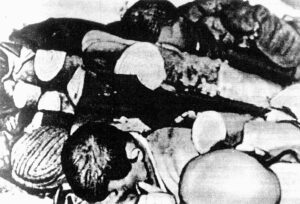
Photo No. 1 originally measures about 30 × 40 cm and was seen in 1989 on an information board at the entrance to the Treblinka II camp. It bore the following inscription:[4]
“Burning of bodies of murdered victims on a pyre. The bodies of the murdered victims were cremated in Treblinka in a similar manner.”
Despite the size of the picture, its resolution was quite poor. Nevertheless, at least six people can be seen lying between piles of firewood. They are all, without exception, lying face down. One young man is pressing his thumb against his cheek and another next to him has a cap on his head.
It must be considered extremely unusual that a man who has been shot or gassed and then placed on a funeral pyre still has his cap on his head. Secondly, one has to wonder why everyone is lying face down instead of in a random arrangement, such as on the pyres of Dresden after the Allied terror attacks in mid-February 1945.
Puzzled by the origin of this photo, we made further inquiries. It turned out that the Polish photographer Henryk Rosochecki from 19 Swierkowa Street in the nearby town of Sokolow Podlaski owns the copyright to this photo, according to the stamp on the back of the picture, Figure 2. He told us that the photo depicts a funeral pyre at the Klooga Camp in Estonia.
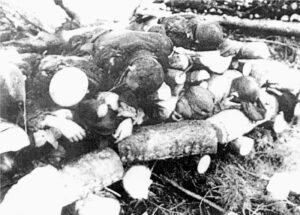
In 1990, the four-volume Encyclopedia of the Holocaust was published in New York and Jerusalem. On page 897 there is a similar photo (No. 2) with the subtitle:
“Bodies of murdered prisoners in the Klooga Camp, piled up for cremation, found by Soviet troops in September 1944.”
This photo is also suspicious. It shows five people, all with their heads facing the camera. Here, too, they are all lying face down. One has laid his face on his cap on a log, apparently to make himself a little more comfortable. He is also holding the cap to his face. Another person in the bottom row is still wearing his cap on his head, as is the person to his left. Furthermore, neither the hands nor the fingers of these men show the slightest sign of rigor mortis (the victims are said to have been dead for nine days!) or, conversely, relaxation due to lack of muscle activity (if freshly murdered or successfully pretending to be dead). On closer inspection, it becomes apparent that the fingers and hands of the persons in question show tense muscles, a sure sign that these persons are alive and merely pretending to be dead for the camera. It appears that this photo depicts the same scene as photo no. 1, only from a different perspective.
Deeply unsettled by this, we contacted the Israeli archive Yad Vashem in 1991 and received further copies of similar photos from the Klooga Camp, all of moderate resolution.
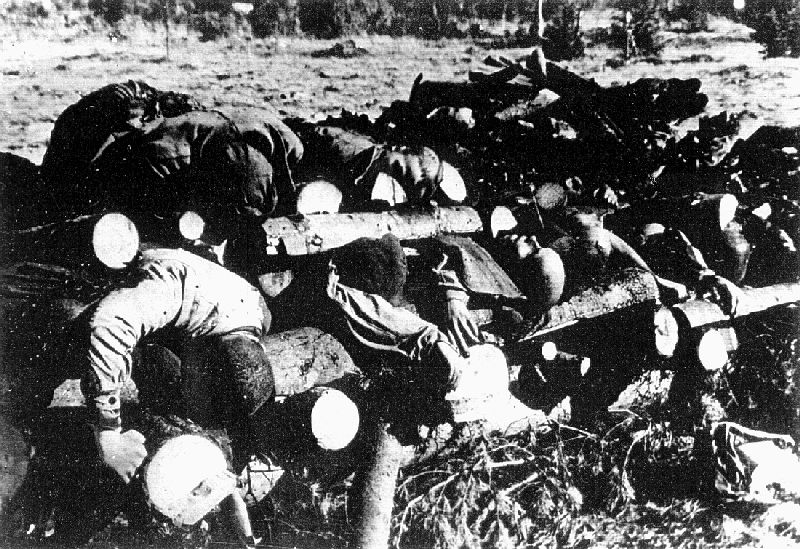
Photo No. 3 shows six people in two layers. It should be remembered that it is highly ineffective to burn corpses on such a low pyre, especially since the utilization of the heat from the burning increases with the size of the pyre. In Dresden, the six- to seven-layer pyres burned for days. In the case of the Klooga Camp, the alleged pyres had only two layers of “corpses” because otherwise it would have been difficult for the actors in the lower layers to breathe, and because the risk of injury naturally increases with increasing load. In this picture, two people are lying on their backs, but their faces cannot be seen. Two people lying face down still have their caps on. One person (far right) is supporting himself with his right fist on a tree trunk to better bear the weight of the upper layer. His right arm clearly shows deliberate muscle tension. On the back of this picture is the stamp of the Vad Yashem Museum, but without an archive number.
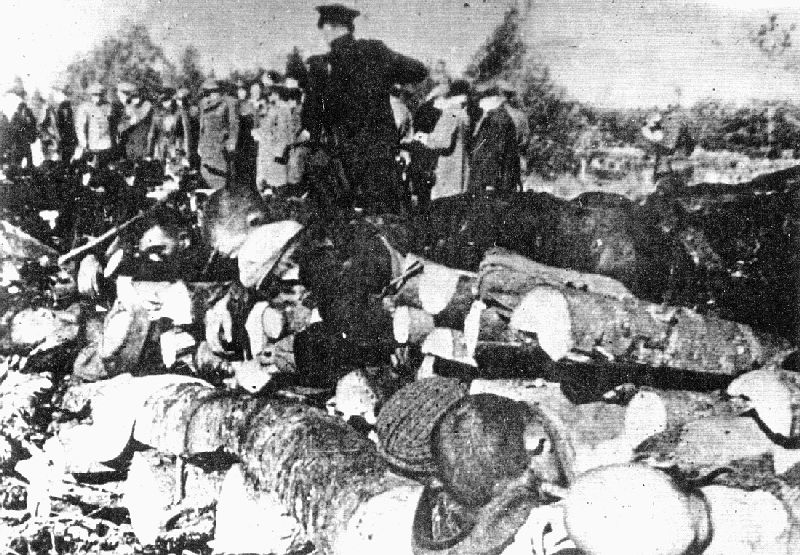
Photo no. 1 appears to be a section of a photo that is very similar to photo no. 4. In the latter, a group of people can also be seen behind the pyre. Due to the poor resolution, no further details about these people can be provided. At least six heads of the people lying on the pyre can be seen. They are all lying face down. The second man from the right has placed a cap between his face and the tree trunk to cushion himself and is holding it with his left hand, but probably with both hands, cf. photo no. 2, which appears to show the same pyre from a different perspective.
The head of the man to his left is covered by a striped cap.
The head of the person further to the left in the upper position is covered by a light-colored cap. The thumb of his right hand is in opposition, which indicates muscle tension, i.e., that this person is alive. Here, too, the visible hands and fingers show no signs of rigor mortis. Rather, they are slender and adapt to their respective positions. Yad Vashem identifies this photo with archive number 16F01.
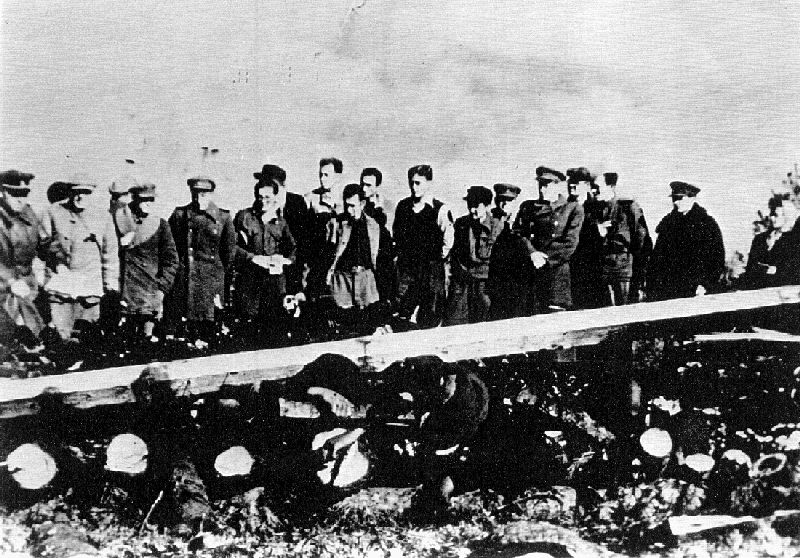
Photo No. 5 (Yad Vashem no. 19B07) shows a section of a pyre consisting of only one layer of “corpses”. The resolution of the foreground is quite poor, but that of the background with the group of standing persons is reasonably good. It appears that the 2nd, 6th and 12th person counted from the left is smiling. The body language and facial expressions of the others are neutral. No one seems to be overwhelmed by the gruesome sight they are there to see. This smile and neutral demeanor of these men is in stark contrast to the famous image of Omar Bradley and David Eisenhower looking at a pyre of partially cremated corpses in the Ohrdruf labor camp.[5]
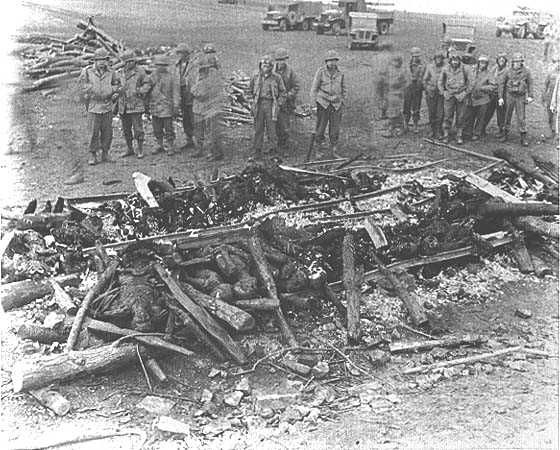
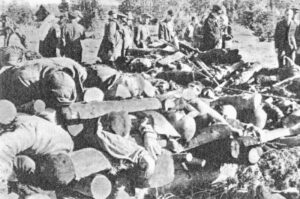
In 1988 Ernst Klee and Willi Dreßen published the book Schöne Zeiten.[6] On page 158 we found another photo of a “pyre” in the Klooga Camp, Photo No. 6, which is similar to photo no. 3, but shows a number of people standing in the background.[7] The resolution is poor. The authors did not respond to our inquiry about the origin and authenticity of the picture. We are therefore unable to say whether these authors are fundamentally dishonest or simply afraid of being prosecuted for doubting the extent of the Holocaust in Germany.
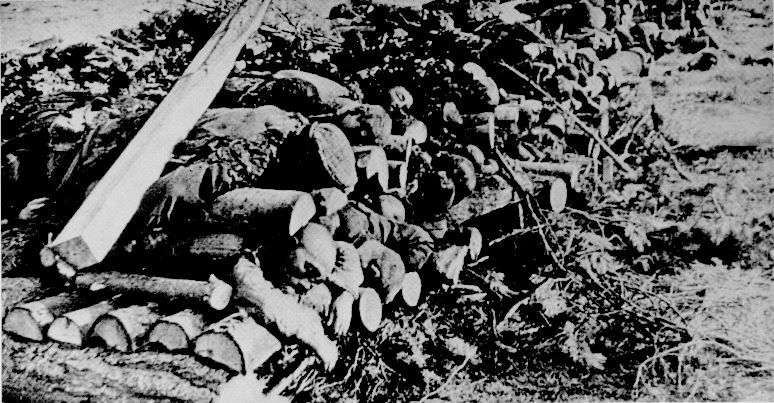
We found photo no. 7 on the Internet.[8] From the trunk lying across the “pyre”, this appears to be a variation of photo no. 5, although this time the “pyre” is clearly in two layers. The first person from the left in the upper layer is wearing a cap on his head. The arms and hands of the first person in the lower layer show no traces of rigor mortis.
Comments
The impressive photo of O. Bradley and D. Eisenhower has become a kind of Holocaust icon. Every visitor to the US Holocaust Museum in Washington is greeted in the entrance hall by a gigantic enlargement of this picture. Nobody is smiling in this picture. Everyone present looks disgusted, if not by the horrific sight, then at least by the numbing stench of burnt flesh.
The situation is quite different in the Klooga Camp or even at the mass grave allegedly opened by the Soviets in Babi Yar at the end of the war.
During the occupation, the Soviet underground reported extensively on the events in the Ukrainian capital Kiev, for example in Krasnaya Zvezda on November 21, 1941, and in September 1942, but Babi Yar was never mentioned. On August 8, 1943, this name appeared for the first time in the newspaper Krasnaya Zvezda, at a time when the Soviets feared that the Germans, after their revelations about the Soviet mass graves in Katyn and Vinnytsa, would also open other mass graves in Ukraine containing political prisoners executed by the Soviets in the 1930s. When the Red Army finally “liberated” Kiev in November 1943, Western reporters were invited and told the most fantastic stories by Jewish survivors about alleged massacres. However, the New York Times reporter, W. Lawrence, rejected these stories at the time due to a lack of material evidence. He may have been presented with faked photos of this “massacre”, but to no avail. The Associated Press reporters at the time completely ignored the stories about the massacres in the Babi Yar ravine.[9]
Consistently, Sovinform then later released only a few authentic photos of the Majdanek camp (of which they claimed a victim count of 1,500,000) and not a single one of the Treblinka camp “liberated” in August 1944, for which they claimed 3,500,000 victims.
Apparently, the Soviets did not allow any Western journalists to enter the Klooga Camp, which was liberated in September 1944, and see the “pyres” for themselves. Moreover, as far as we know, the Soviet pictures taken there were not published by any Western newspaper or printed in any Western book for decades.
It is therefore all the more galling that an archive as prestigious as the one at Yad Vashem has allowed these falsified pictures to be published even in encyclopedias for about a decade.
Critical Remarks Added in 2025
The photos reproduced by Dr. Dragan – all of them in rather poor quality resulting from the digitization process of low-quality photocopies of the published prints of already dubitable quality… – are either stills from Soviet film footage taken at that camp, which was later incorporated in the documentary submitted to and shown at the IMT.[10] Or these are separate photos taken by photographers evidently observing the same scenes as the filming crew.
The footage covering the Klooga section of this documentary has plenty of scenes with evidently real dead bodies. Some scenes even show evidently partly burned corpses on partially burned pyres. If these scenes are genuinely showing scenes from inside the Klooga Camp as found by the Soviets when they captured the camp – and that may be a big IF – then the pyres shown in the photos analyzed by Dr. Dragan seem to contain dead bodies, indeed.
Photos 8-12 show stills from Reel 6 of IMT Document USSR-81, with time stamps in min:sec. Photo 8 (6:36) shows a close-up scene from Photo 2. Photo 9 (6:49) shows a scene presumably from the center of the pyre. Photo 10 shows in the far end of the pyre, in front of the group of people in the background, a large beam at the top. This large beam can be seen in Photo 13 on top of the people showing a similar section as Photo 8, only in frontal view (note the person holding a cap beneath his face). Photos 11 and 12 show scenes just prior to Photo 13, as the camera man pans the entire length of the pyre.
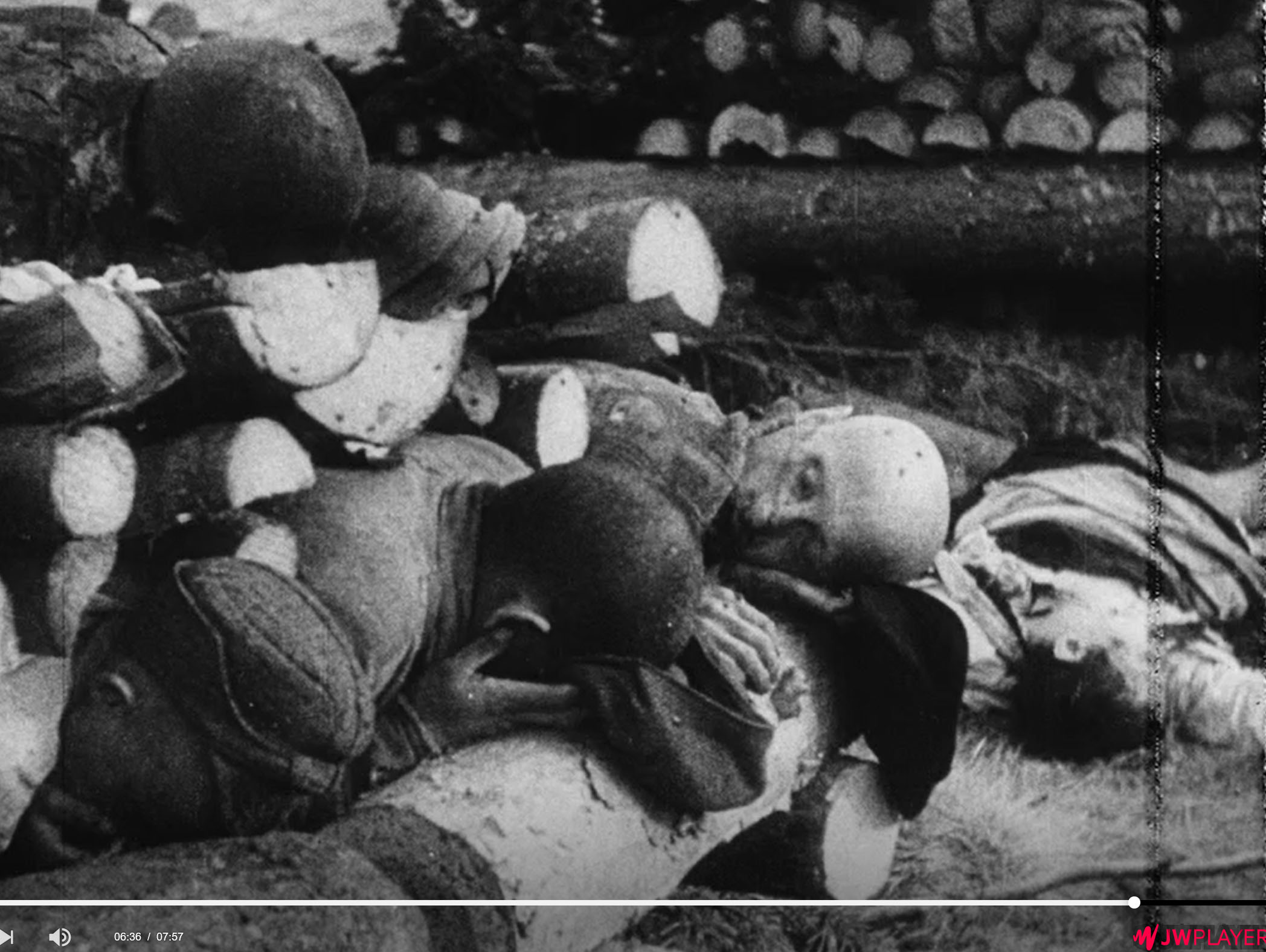
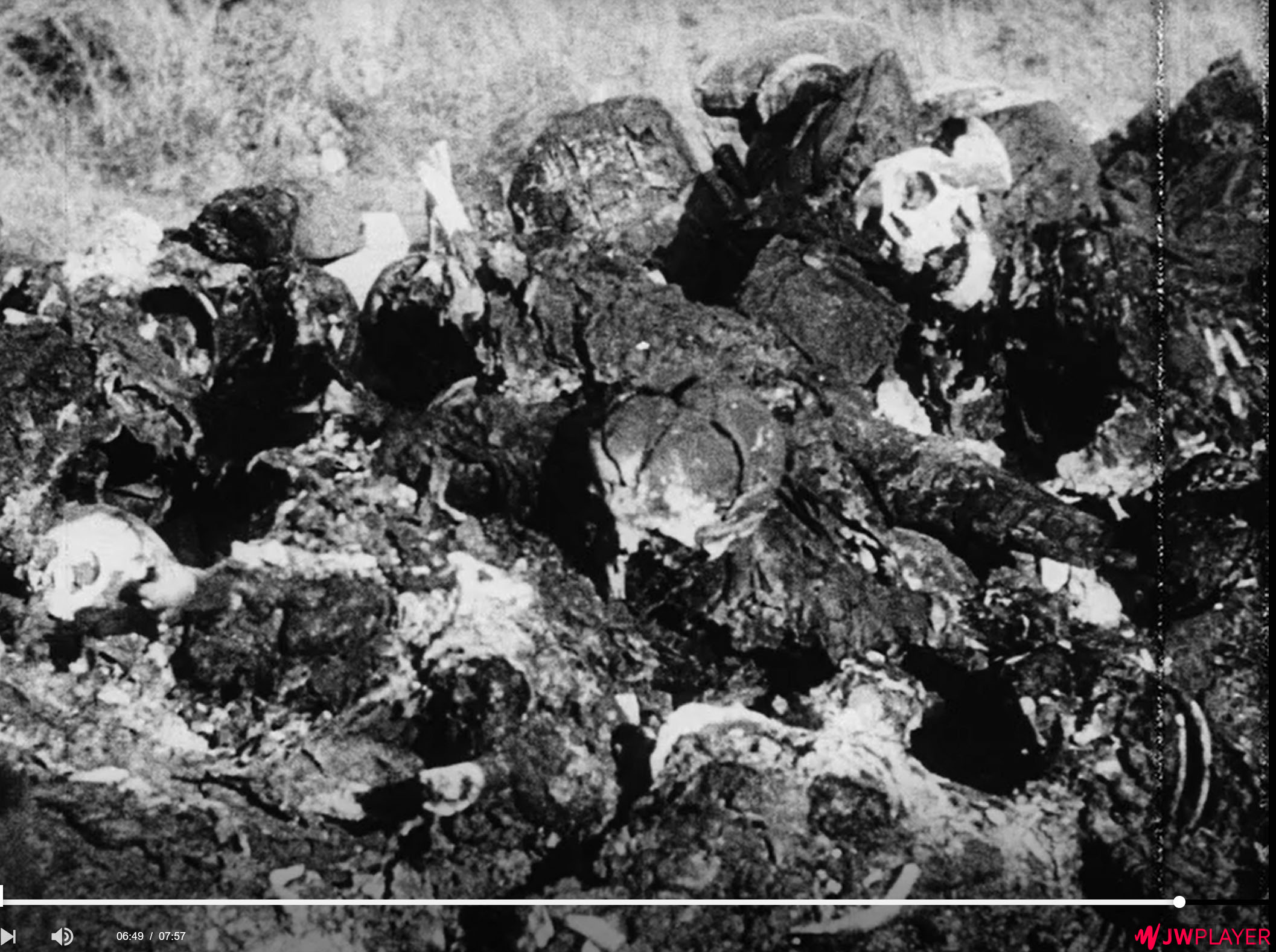
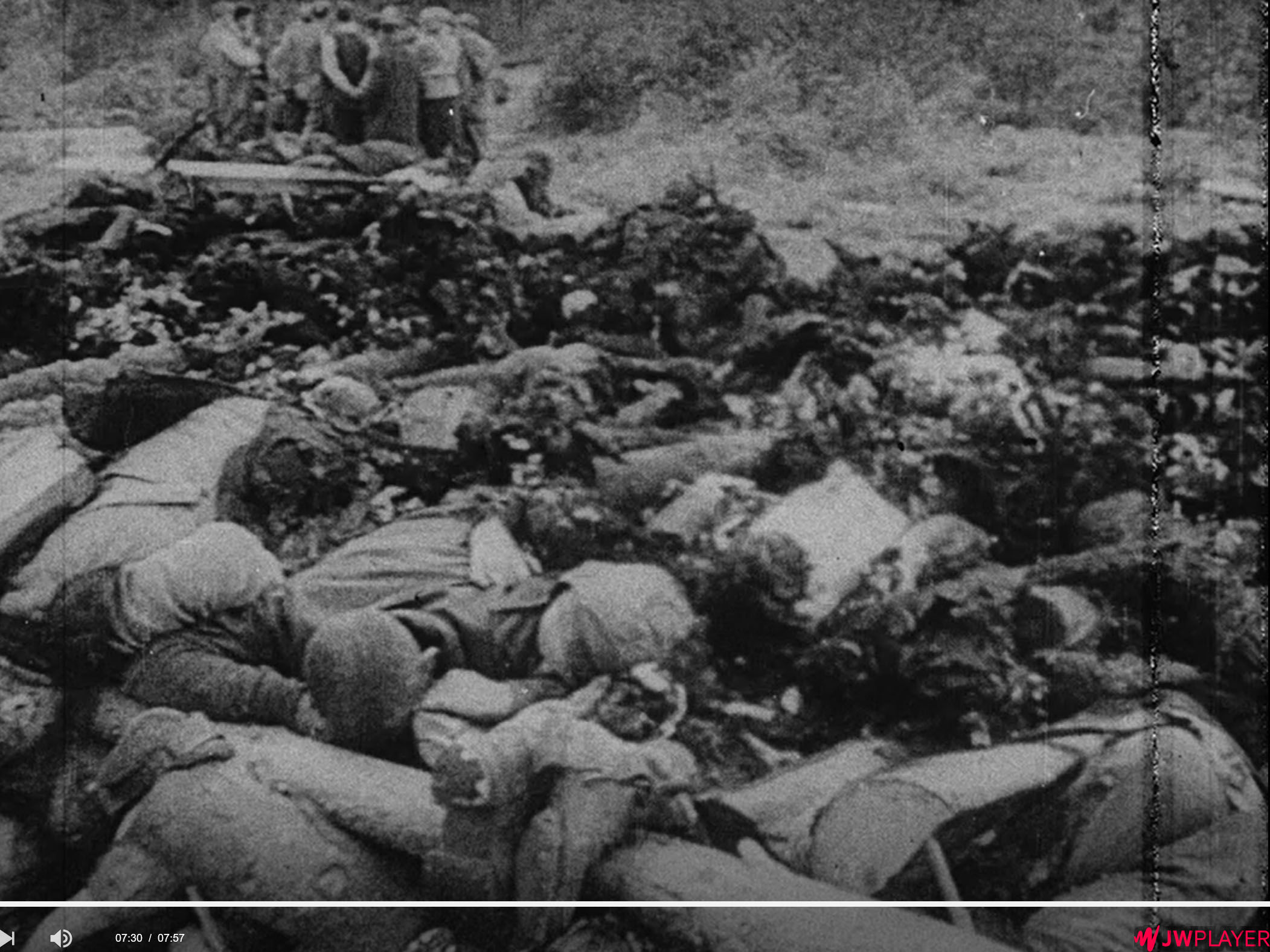
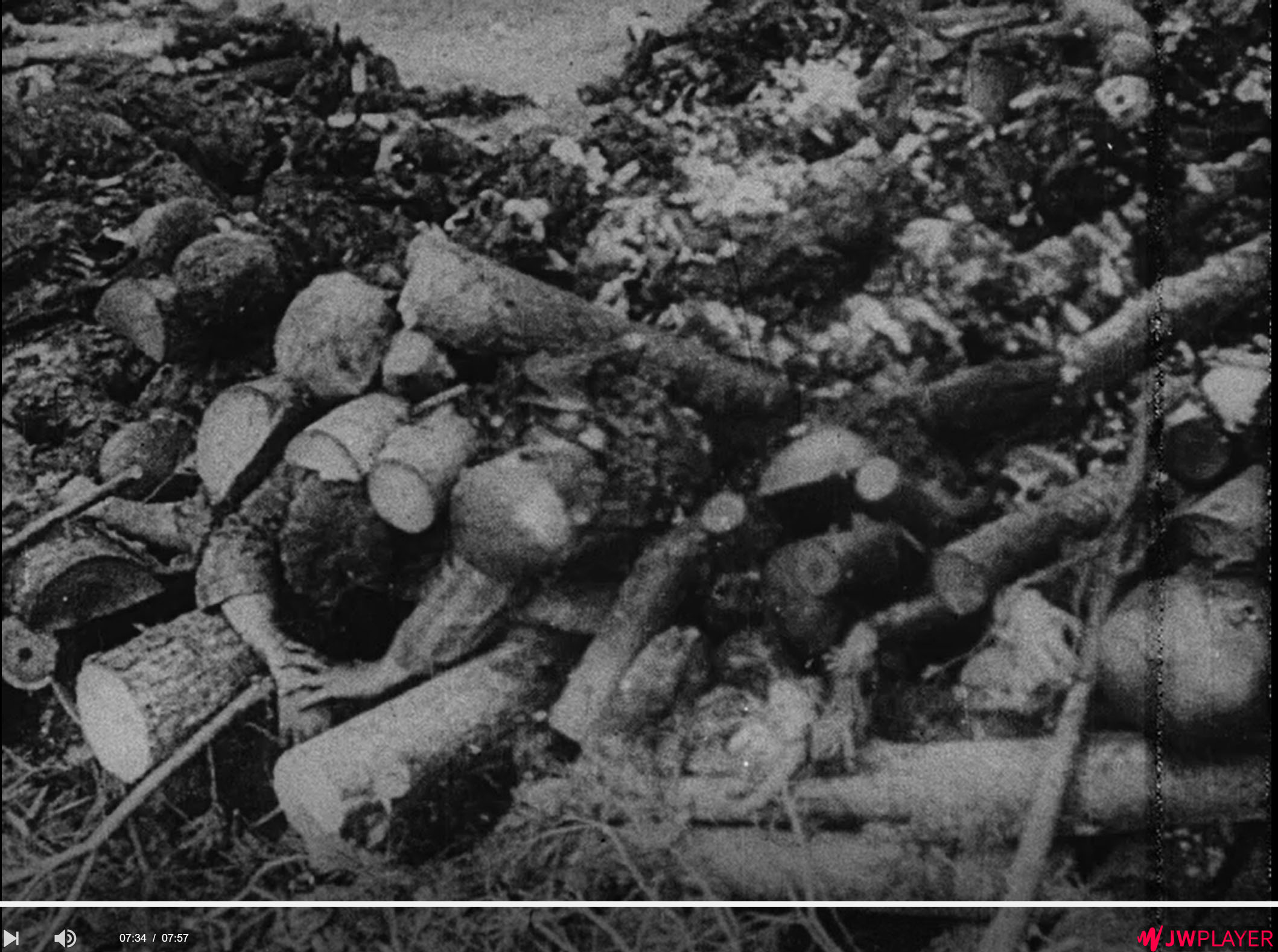
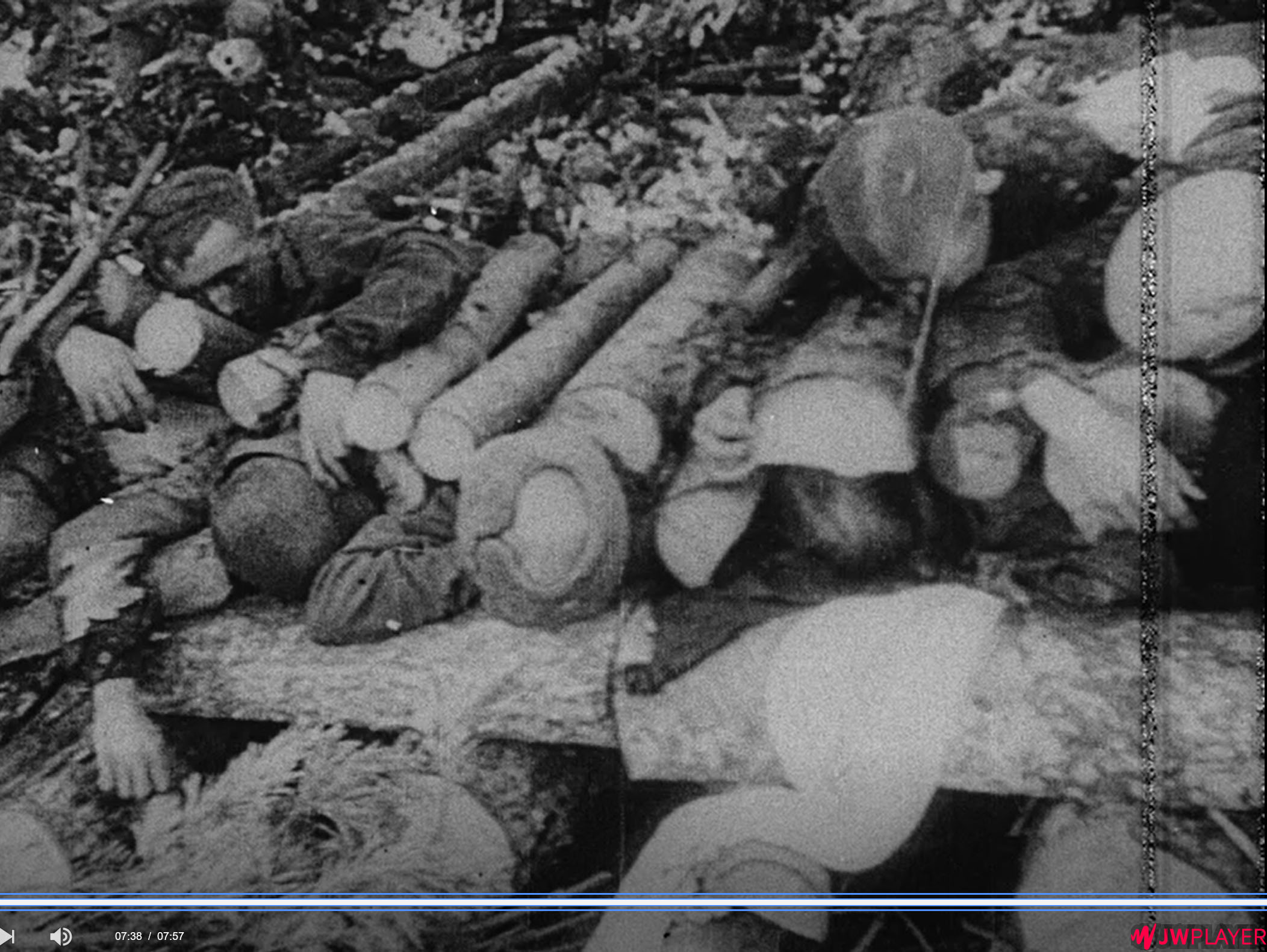
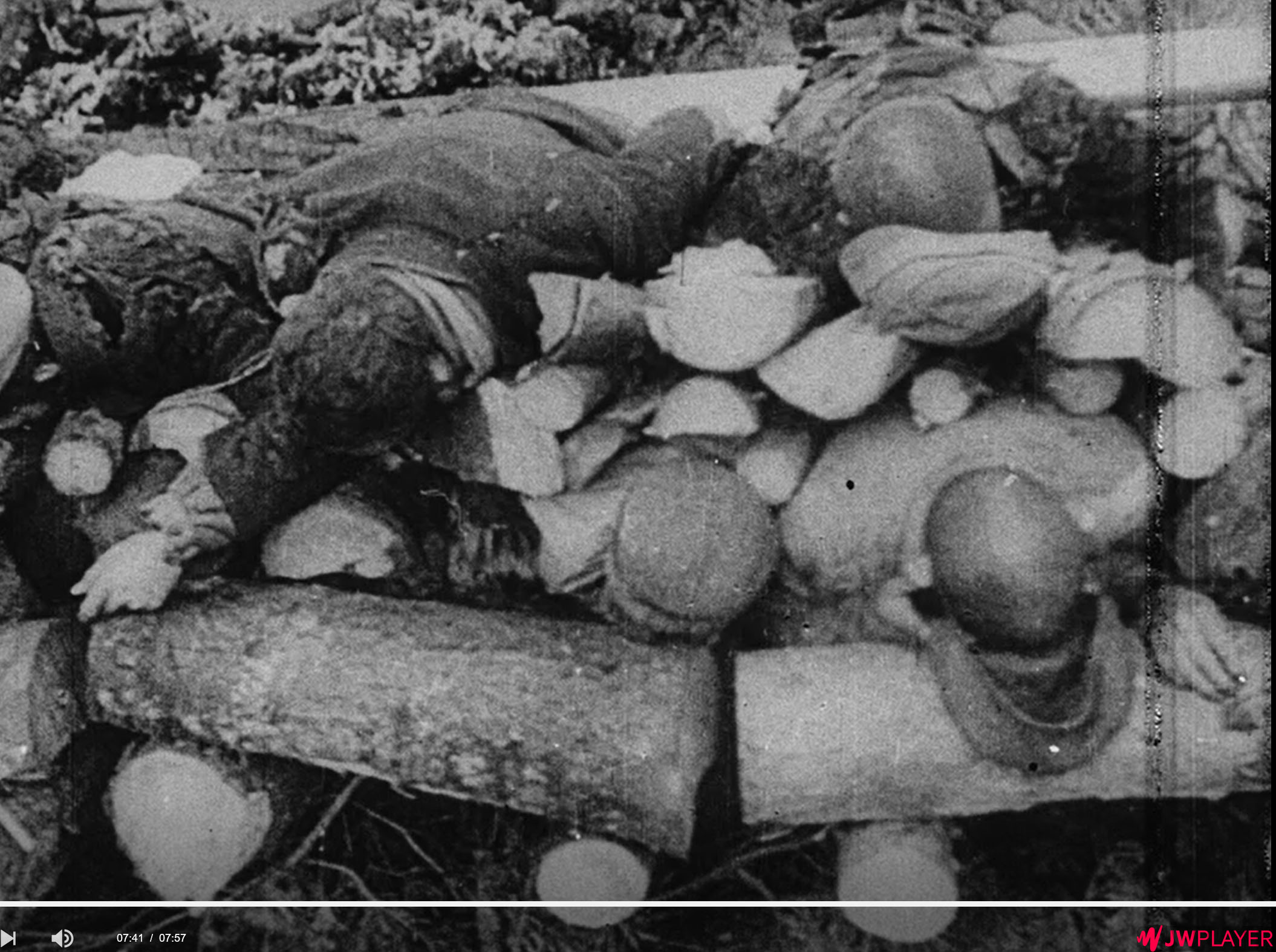 Photos 8-13: Stills from Document USSR-81, Reel 6: 6:36, 6:49, 7:30, 7:34, 7:38, 7:41.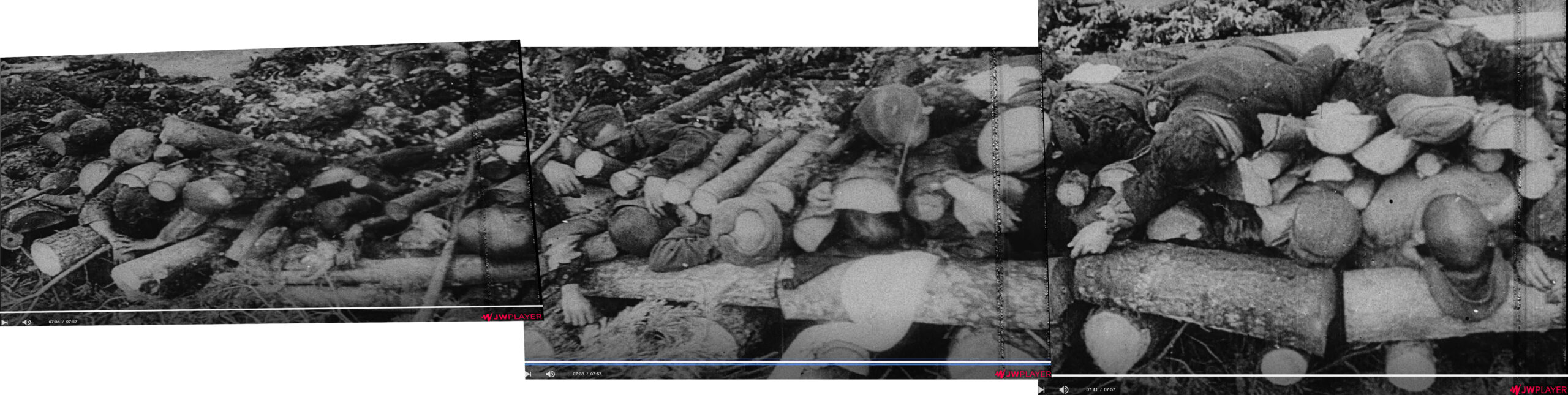
The screenshots have been chosen in such a way that they can be stitched together to show the entire width of the pyre, Photo 14 (with some perspective adjustments/distortions needed to make it fit). The pyre evidently burned down to a large degree in the center, but not on the sides where the cameraman is.
In other words, this is a real pyre that has burned down to a large degree in the center and some sides, but evidently not at one side. If nothing else, this also shows that such pyres burn unevenly and inefficiently, and thus were totally impractical for the consumption of thousands of bodies per day, as is claimed at some of the death camps.
There was no shortage of dead bodies in the entire area where Germans and their allies fought against the Soviets. Millions if not tens of millions died at the Eastern Front. Many of these bodies were left behind during the last phase of the, at times, chaotic German retreat. There was moreover no shortage of deceased inmates in any German wartime camp toward the end of the conflict, mainly due to diseases and lack of food, water and medicine. Hence, it seems unreasonable to assume that the Soviets had to resort to living people when trying to film a pyre with dead bodies, ready for incineration. We can therefore safely reject Dr. Dragan’s hypothesis of a staged scene with living people.
However, dead people rarely keep their hats on when dying, and they most certainly wouldn’t stay on a corpse when it gets hauled to a pyre. It remains a fact that there are several persons visible who most definitely wear a hat or cap, as they lie on the stack of logs. This requires either living people, which can be ruled out here, or someone having taken great care to put those caps and hats on the heads or beneath the faces of these dead inmates, which isn’t likely, or that the persons were still alive when they arranged themselves on the wooden logs, but were then executed on the spot, and then burned. That would also explain why their limbs are adjusted to the situation they are in.
I cannot understand the Russian narrative, but in one scene, we see a person demonstrating something by lying down on a stack of logs, possibly as if to show how the victims had to arrange themselves, and were then shot (see Photo 15).
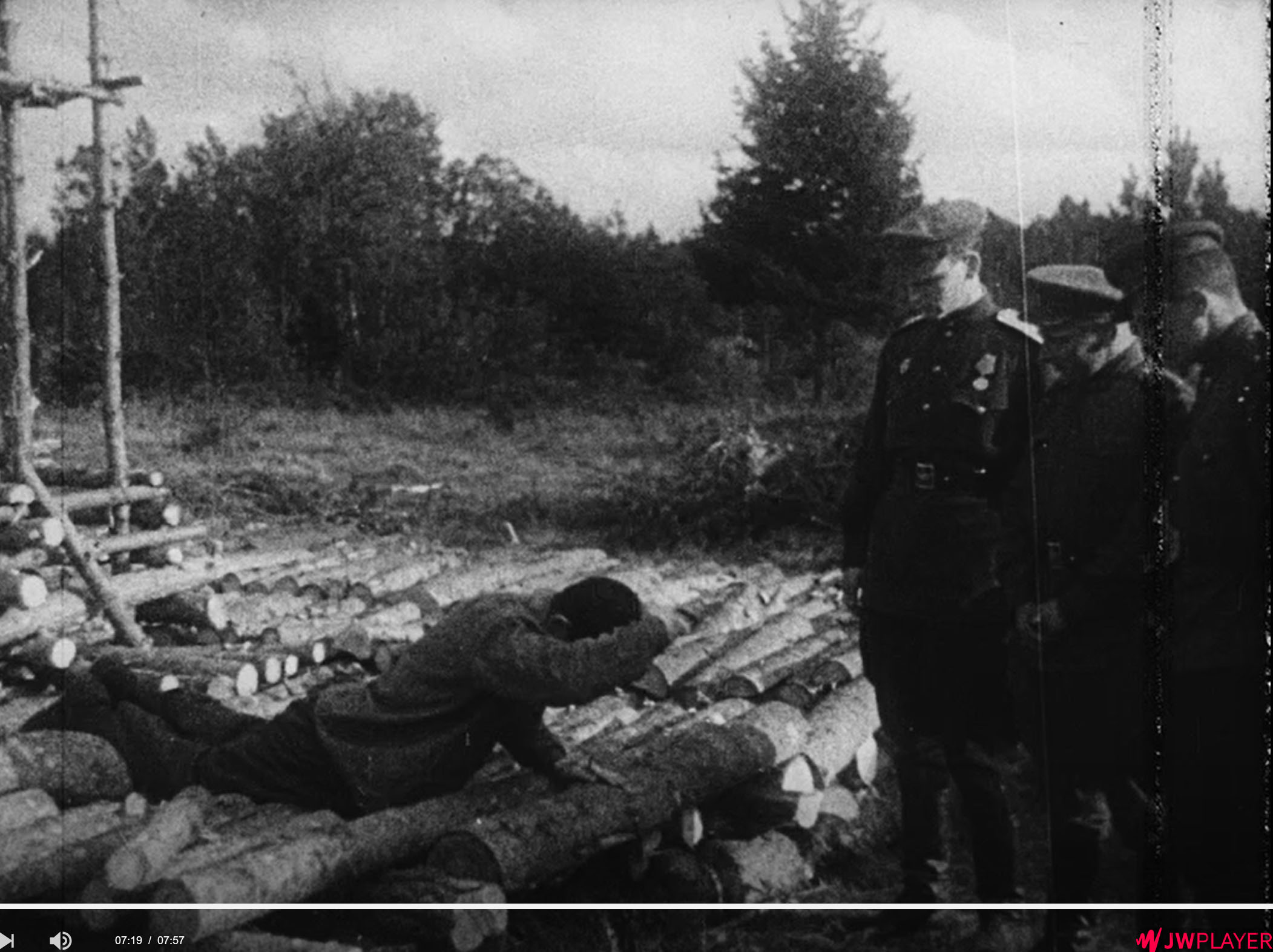
However, the theory that the victims were shot while lying on the pyre contradicts the mainstream narrative, according to which the inmates remaining shortly before the German retreat were shot in the surrounding woods, then placed on pyres and burned.[11] Those hats, caps and limbs tell a different story, though.
Either way, Dr. Dragan’s thesis that the photos he analyzed were staged by living people and are therefore a forgery is evidently untenable. This misinterpretation was understandable, considering the scant imagery of low quality at his disposal.
Endnotes
| [1] | Cf. Mark Weber, “‘Jewish soap’”, The Journal of Historical Review, Vol. 11, No. 2, 1991, pp. 217-227. |
| [2] | Cf. on this Dieter Lehner, Du sollst nicht falsch Zeugnis geben, Vohwinckel, Berg am See, undated. |
| [3] | On the “history” of the Klooga Camp, see the corresponding entry in E. Jäckel, P. Longerich, J.H. Schoeps (eds.), Enzyklopädie des Holocaust, Argon, Berlin 1993. |
| [4] | Polish: “Palenie na stosach zwlok pomordowanych. Podobnie palono zwloki pomordowanych w Treblinka.” |
| [5] | Michael Berenbaum, The World Must Know: The History of the Holocaust as Told in the United States Holocaust Museum, ISBN O-316-09135-9, 11993, p. 7. Caption: “American soldiers in front of calcinated corpses of Ohrdruf concentration camp inmates. Ohrdruf, Germany, April 1945.” National Archives, Washington, D.C. from: www2.ca.nizkor.org/ftp.cgi/camps/ohrdruf/images/ohrdruf-pyre.jpg (now inactive). |
| [6] | S. Fischer, Frankfurt; English: The Good Old Days, Free Press, New York 1991. |
| [7] | The authors also reproduce Photo No. 4 on the same page. |
| [8] | http://www.nizkor.org/ftp.cgi/orgs/german/einsatzgruppen/images/eg-06.jpg (now inactive); from: George St. George, The Road to Babyi-Yar, pp. 64f. |
| [9] | See in more detail Marek Wolski (=Miroslav Dragan), “Le massacre de Babi Yar”, Revue d’Historie Révisionniste, Vol. 6, 1992, pp. 47-58; see also Herbert Tiedemann, “Babi Jar: Kritische Fragen und Anmerkungen”, in: Ernst Gauss (ed.), Grundlagen zur Zeitgeschichte, Grabert, Tübingen 1994, pp. 375-399; English as “Babi Yar: Critical Questions and Comments” in Germar Rudolf, Dissecting the Holocaust, 4th ed., Armreg Ltd, London 2024, pp. 497-525. |
| [10] | USSR-81, IMT, Vol. 7, p. 601; the narration is in Russian; that’s probably the reason why no transcript was included in the IMT documentation. The footage is available online at https://collections.ushmm.org/search/catalog/irn616417; (USHMM record ID: RG-60.6951; Reel 4); the Klooga scene is on Reel 4, starting at 6 minutes 2 seconds. |
| [11] | See the references cited in https://en.wikipedia.org/wiki/Klooga_concentration_camp. |


Bibliographic information about this document: Inconvenient History, 2025, Vol. 17, No. 3
Other contributors to this document:
Editor’s comments: