
The Soviet Black Book: Truth or Black Propaganda?
Introduction
Immediately after the October-7 Hamas attack on Israel, both the Israeli government and the Israeli media reported the horrific, ghastly story that 40 Israeli babies had been decapitated by the attackers. But the truth, as we now know, is that none were. Thanks to the internet, the story was quickly debunked and abandoned. What should be surprising, though, is the fact that the Israeli propaganda apparatus had the nerve to put out such a bald-faced lie. Had they been lying like this for a long time? Was this type of fabricated atrocity story a tried-and-true, go-to strategy of Zionists? Was this just the latest example of Zionists engaging in over-the-top atrocity tales to get the international community to aid and abet their own atrocities, like we’ve just witnessed in Gaza?
A significant element of how the modern State of Israel came into existence is based on the claimed greatest atrocity in the history of mankind: the Holocaust. Most people today mistakenly believe that Zionism, the movement to create a Jewish state in Palestine, began with the Holocaust. That’s not actually the case. Zionists had been lobbying to get international support for a Jewish State in Palestine for a half century by then. It was, however, only after the horror stories about a Jewish genocide came out after WWII that the international community felt compelled to lend their support. Could it be that the Holocaust is the 40-beheaded-babies atrocity story writ large at a time when the Big Lie was a lot easier to pull off?
Professor Dr. Robert Faurisson once wrote the following:[1]
“Three of the best-known works on the Second World War are General Eisenhower’s Crusade in Europe (Doubleday [Country Life Press], New York 1948), Winston Churchill’s The Second World War (6 vol., Cassell, London 1948-1954), and the Mémoires de guerre of General de Gaulle (3 vol., Plon, Paris 1954-1959). In these three works not the least mention of the Nazi gas chambers is to be found[1].”
And in his footnote:
“Crusade in Europe by Eisenhower (1948) is a book of 559 pages; the six volumes of The Second World War by Churchill (1948-1954) total 4,448 pages, and de Gaulle’s Mémoires de guerre (three volumes, 1954-1959), 2,054, making for an overall mass of 7,061 pages (not including the introductory parts) published from 1948 to 1959, in which one will find no mention either of Nazi ‘gas chambers’, a ‘genocide’ of the Jews or the ‘six million’ Jewish victims of the war.”
If this is true, it should make one wonder, did these bigger-than-life champions who defeated Hitler not believe in the Holocaust themselves back then? And if so, why not?
Jewish Princeton historian Dr. Arno Mayer, who began his academic career in 1952, lamented in the late 1980s: [2]
“Sources for the study of the gas chambers are at once rare and unreliable.”
This is surprising, considering there are few historical “facts” more believed in than the Nazi gas chambers of WWII. How can it be, if we believe Professor Mayer, that their universally unquestioned existence has so little evidence to back it up?
Second, why did it take this noted Holocaust historian, who started his academic career seven years after the war, another 30 some years to make this observation? The answer to these questions can be found in the fact that the Holocaust, if there was one, took place behind the “Iron Curtain.”
There appears to be a split among orthodox Holocaust historians as to whether or not any of the Nazi concentration camps inside Germany and Austria had homicidal gas chambers, but even so, the number of Jews alleged to have been killed in them is negligible when compared to the number of Jews alleged to have been gassed in camps on Polish soil. The alleged gassing of Jews in six camps in Poland accounts for the vast, vast majority of alleged Jewish gassing deaths. Also, the alleged mass shootings of Jews, which supposedly happened mostly in Ukraine and Russia, account for the vast, vast majority of alleged executions of Jews by means other than gassing. For the geographically and historically challenged, this means that nobody from the West – no American, no Brit and no Frenchman – ever saw any first-hand evidence of the Holocaust or its aftermath; at least not until some 40 years after the war. At war’s end, all of Poland was in the hands of the Soviets, and no Western historian or scientist was able to freely and independently investigate the six so-called death camps in Poland: Auschwitz, Bełżec, Chełmno, Majdanek, Sobibór and Treblinka. And nobody from the West was able to investigate the alleged mass-execution sites in Ukraine and Russia. By the time the Western Allies finally did get a chance to critically examine these camps and alleged mass shooting sites decades later, there was apparently little interest in doing so. By then, the Holocaust was so thoroughly ensconced in our common knowledge by books like the Diary of Anne Frank and movies like Schindler’s List that no one dared to investigate it further, at least not critically. By then, discovering facts that didn’t line up with the established Holocaust narrative would have been considered, at best, in poor taste and, at worst, anti-Jewish. Contesting this narrative eventually became illegal in most Western countries, punishable by fines and imprisonment. This includes our neighbor Canada.
As for the camps liberated by the British and Americans inside Germany – such as Bergen-Belsen and Buchenwald, two of the more notorious – the Western Allies were able to thoroughly investigate them, and come to the conclusion that the gassing stories weren’t true. Dr. Charles Larson, a leading forensic pathologist assigned to the US Army’s Judge Advocate General’s Department as part of a U.S. War Crimes Investigation Team, after doing thousands of autopsies in 20 different camps, concluded that the vast majority of the deaths in the camps were due to disease, in particular typhus, and that not one of them was due to poison gas.[3] Therefore, it would seem the Holocaust story is primarily one of Soviet origin.
Already before war’s end, in November 1944 the Soviets announced in a press release that they were about to publish a large book containing predominantly witness accounts presumably proving “the German massacre of approximately six million European Jews” mainly in the Soviet Union and Poland.[4] Some of the evidence contained in it was presented by Soviet prosecutors during the Nuremberg International Military Tribunal after the war. Early excerpts were published since late 1944, with a Yiddish edition appearing in New York in 1946. The Russian and English editions, however, were suppressed by Stalin due to his increasing anti-Zionist and anti-Jewish stance after the war. Stalin evidently did not want to see the Jewish role as primary victims of war atrocities emphasized. The first complete English edition, titled The Black Book, was published only in 1981. The following is a critical look at this book. Just how believable are its eyewitness accounts?
But before we get started, let’s take a look at the authors. The primary authors/editors of The Black Book were Ilya Ehrenburg and Vasily Grossman. These two gentlemen just happened to be the number one and number two highest-ranking and most-prolific Soviet propagandists during the war. They also happened to be Jewish. In fact, over 80% of the contributors to the book were Jewish, twenty-four out of the twenty-nine. Here is a complete list of them with their occupations:
- Ilya Ehrenburg – top Soviet war-time propagandist – Jewish
- Vasily Grossman – top Soviet war-time propagandist – Jewish
- Margarita Aliger – Soviet poet and journalist – Jewish
- Abraham Derman – Soviet writer – Jewish
- Vera Inber – Soviet writer and poet related to Leon Trotsky – Jewish
- Pavel Antokolsky – Soviet poet and theater director – Jewish
- Vagram Apresian – Russian correspondent and novelist – Armenian
- Osip Cherny – Soviet writer, musicologist and conductor – Jewish
- Ruvim Frayerman – Soviet writer, poet, essayist and journalist – Jewish
- Yefim Gekhtman – Soviet war correspondent for the newspaper Krasnaya Zvezda – Jewish
- Valery Gerasimov – Soviet writer married to Jewish writer Boris M. Levin – likely Jewish
- Vasily Ilyenkov – award winning novelist and teacher – Russian
- Leyb Goldberg – writer, publisher and member of the Jewish Anti-Fascist Committee – Jewish
- Yakov Iosade – Soviet, profession unknown – Jewish
- Vsevolod Ivanov – writer, dramatist, journalist and war correspondent – Russian
- Veniamin Kaverin – dramatist and screenwriter – Russian
- Leyb/Lev Kvitko – Yiddish poet and member of the Jewish Anti-Fascist Committee – Jewish
- Rakhil Kovnator – Soviet writer – Jewish
- Vladimir Lidin (Gomberg) – Soviet fiction writer and memoirist – Jewish
- Bernard Mark – worked for the Jewish Anti-Fascist Committee – Jewish
- Georgy Munblit – Soviet writer and literary critic – Jewish
- Girsh/Hirsh Osherovich – Yiddish writer – Jewish
- Lev Ozerov – Soviet poet, translator and essayist – Jewish
- Ovady Savich – Foreign correspondent and translator – Jewish
- Lidia Seifullen – journalist, playwright, novelist, and short story writer – Russian
- Viktor Shklovsky – Soviet literary theorist, critic, writer, and pamphleteer – half Jewish
- Abraham Sutzkever – Acclaimed Yiddish Poet – Jewish
- lya Trainin – Soviet jurist – Jewish
- Meyer Yelin – Soviet writer – Jewish
Ostensibly, the contributors to the book simply transcribed the accounts of eyewitnesses, nothing more. But it’s possible, perhaps likely, that the contributors’ anti-German bias, both as Soviets and as Jews, led them to embellish the accounts significantly, if not make them up out of whole cloth. On top of that, there was the Zionist movement which was coming close to achieving its ultimate goal with the help of the British. A Jewish proto-state already existed in Palestine under the protection of the British Mandate, and all it needed to become a full-fledged state was international recognition and a larger Jewish population. What better way to obtain both than to make the claim that the Jewish population of Europe had just been nearly annihilated?
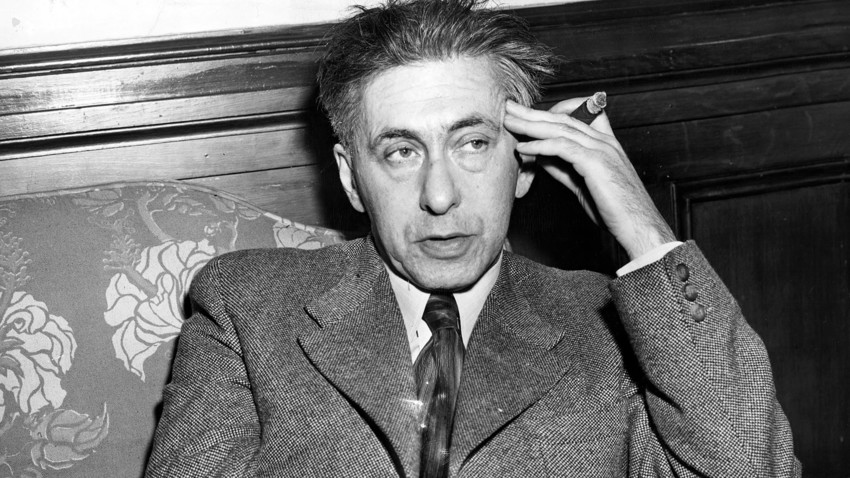
Ilya Ehrenburg, shown on the right, who either wrote or edited a third of the book himself, was the most prominent and prolific Soviet writer of anti-German propaganda during the war. Among his many talents was stirring up hate for the Germans and feelings of patriotism in the soldiers of the Red Army. Here’s an example of his work:[5]
“From now on, the word ‘German’ is the worst curse. From now on, the word ‘German’ will only cause us to empty the magazine of our weapon. We have nothing to discuss. We will not get excited. We will kill. If you have not killed at least one German in the course of a day, then that day has been wasted for you. If you believe your neighbor will kill the German instead of you, then you have not recognized the danger. If you fail to kill a German, he will kill you. He will arrest your family, and torture them in his cursed Germany. If you cannot kill a German with a bullet, then kill him with your bayonet. If your section is quiet and there is no fighting, then kill a German before battle. If you permit the Germans to live, the Germans will hang the Russian men and rape the Russian women. If you have already killed a German, then kill a second one—to us, there is nothing more joyous than German corpses. Don’t count the days. Don’t count the kilometers. Count only one thing: the Germans you have killed! Kill the Germans! Your aged mother begs this of you. Kill the Germans! Your children beg this of you. Kill the Germans! The earth of your homeland calls out to you. Don’t fail! Don’t make a mistake! Kill!”
This isn’t my idea of great writing; among other things, it indicates a peculiar naiveté about the nature of combat. He suggests killing a German while “there is no fighting,” hence “before the battle.” Was he suggesting Russian soldiers just wander off en masse looking for a German to kill rather than manning their posts? By the way, the word “kill” can be found no less than fifteen times in the above quote. But as outrageous as this passage is, he nonetheless managed to top it with the following racist, hate-filled rant where he encouraged Soviet soldiers to rape and kill German women and not spare the pregnant: [6]
“Kill! Kill! In the German race there is nothing but evil; not one among the living, not one among the yet unborn but is evil! Follow the precepts of Comrade Stalin. Stamp out the fascist beast once and for all in its lair! Use force and break the racial pride of these German women. Take them as your lawful booty. Kill! As you storm onward, kill, you gallant soldiers of the Red Army.”
And this is the guy – a guy who, when he was 23 years old, didn’t take up arms to defend his country during WWI, yet bravely exhorted the next generation of Russian males to commit war crimes in WWII – who is primarily responsible for the contents of the book upon which much of our belief in the Holocaust is based. In addition to being the top Soviet propagandist, Ehrenburg was a Zionist. In a book of verses titled “I Am Alive” (1911) he wrote an explicitly Zionist poem titled “To the Jewish People” which urged European Jews to return to the “Land of Israel.” He also wrote an article in Pravda on September 21, 1948, in which he asserted that the Jews had a moral and political right to a state of their own.[7] Lastly, upon retirement, he had his private archives transferred to Israel’s Yad Vashem Holocaust Remembrance Center.
One more piece of background before getting into the book. The words “partisan” or “partisans” can be found in The Black Book 175 times. This is so, because a very important and bloody war within a war took place behind the German lines on the Eastern Front. Over half a million partisans, including some 20,000 to 30,000 Jews, were involved. These irregular forces raised from the local populations in German-occupied Eastern Europe derailed trains, raided arms depots, disrupted communications, ambushed convoys, and in a myriad of other ways sabotaged German supply lines and weakened the German war effort. They were brave patriotic citizens of Poland, Russia, Yugoslavia and many other German-occupied countries in Eastern Europe who did their part to defeat Nazi Germany.
To help deal with these partisans as well as to administrate civilian life in the areas conquered by the German army, the Germans formed four small specialized units called Einsatzgruppen. All the units combined totaled approximately 3,000 men (including drivers, interpreters, clerical staff and administrators), and the region they were responsible for was almost as large as the United States east of the Mississippi. Mainstream Holocaust historians claim that these German units served no military or governing function, but rather were formed for the sole purpose of rounding up, executing and disposing of as many Jews as they could. Revisionist historians, on the other hand, believe Soviet propagandists used the German executions of tens of thousands of partisans, including Jews, to create a myth about a “Holocaust by Bullets.”[8]
If I may make one final comment regarding the Holocaust itself. The German government, the Nazis, did believe that Jews, on the whole, had a detrimental impact on German society, and that some had betrayed Germany at the end of WWI. So, the Nazis instituted a plan to expel them not just from Germany but from all of Europe. In the process, the Germans put a large number of Jews in concentration camps after the war with the Soviet Union had broken out, and a large number of them perished in those camps, especially toward the end of the war, when Allied bombing and strafing made supplying the camps with food, medicine and other necessities extremely difficult. It was unquestionably a major human tragedy and unquestionably the fault of the Germans. However, for Soviet Jews like Ehrenberg and his crew, who doubtless despised Hitler and the Nazis for their anti-Jewish policies and wanted to see them utterly discredited and destroyed, and for those with Zionist sympathies like Ehrenberg, who may have seen the fog of war and Hitler’s camps as a perfect opportunity to garner sympathy for their people – the Jews, not the Russians – and to prove the necessity for a Jewish homeland, there may have been an irresistible temptation to exaggerate the story of what happened to the Jews during the war. Maybe they felt what they needed was, as one of the contributors writes on page 168 of The Black Book, “the most fantastic slaughter in world history” – the Holocaust.
Now to the book. The following are excerpts taken from The Black Book, followed by my own take on them. By the way, I’ve been told that it is a fool’s errand trying to change the minds of people who’ve been indoctrinated into a particular belief from an early age. That may well be. Nonetheless, in the face of the genocide that just took place in Gaza, I believe one must try.
The Black Book
1. Alleged German Atrocities Behind the Eastern Front & the “Holocaust by Bullets”
Page 3: “On September 22 an enormously powerful explosion awakened Kievans. Smoke and a smell of burning were coming from the direction of Kreshchatik Street. People on the streets abutting Kreshchatik Street were driven by the Germans to move straight into the fire.”
Is this even possible? People will do anything to avoid fire, including jumping out of a high-rise office building. So if you tried to push them individually into a fire you’d have quite a fight on your hands, not to mention you’d very likely get burned yourself. So, to actually get the people to enter the fire the Germans would have to have rounded up and contained somehow hundreds of Jews creating a tightly packed crowd where the ones in the back, driven on by bayonets, perhaps, could have pushed those in the front into the fire. Even then, how realistic is this? Would the people in the back being prodded on by bayonets have been able to push the rest of the crowd forward, a crowd not particularly interested in getting any closer to the fire? Or would those in the back have just fallen from their bayonet wounds? And even if the crowd was moved forward, wouldn’t those in the front as they neared the fire have reacted to the heat by dropping to the ground or something to avoid being pushed any closer? And wouldn’t that have created a pileup as those behind them fell over them, a pileup that would have prevented any further movement in the direction of the fire? Or, assuming there were other homes or businesses on Kreshchatik Street, a fair assumption, wouldn’t those toward the front, those nearest the fire, have attempted to escape by breaking a window or kicking in a door and entering one of them? There wouldn’t have been any Germans in the front to stop them.
The “witness’ makes it sound so easy, but I can’t imagine a harder way to kill people than trying to herd them into a blazing inferno. Even if it were possible, why would the Germans have bothered? Why expend all that time and energy when there’s a war on? Why not just shoot them? Could it be the author was looking for something a bit more sensational?
If we look at real history, here is what happened in Kiev after the German occupation:[9]
“On September 24, the Hotel Continental was blown up, along with the headquarters of the rear area of the German 6th Army. On September 25, a conflagration of the downtown area of Kiev, around Khreshchatyk Street, continued to spread. Mines had destroyed almost all public buildings – after the German forces had moved in. By the end of September, a Soviet mining map had been found which showed about 50 objects readied for remote-controlled detonation. In addition, an enormous quantity of mines, explosives and ‘Molotov Cocktails’ had also been discovered. Most of the city center had burned down and some 50,000 persons were homeless. Hundreds of German soldiers had been killed fighting the fires. Many organized saboteurs and partisans were left behind in the city abandoned by the Soviets; Kiev was still a battlefield.”
The subsequent retaliatory massacre of more than 33,000 local Jews in a ravine called Babi Yar at Kiev’s outskirts is said to have happened at the end of September 1941. There, Jews are said to have been simply shot, not driven into a fire, if we believe today’s mainstream narrative.[10] Today’s mainstream narrative knows nothing of Kiev residents having been driven into the city center’s conflagration.
* * *
Page 8: “The man picked up the boy. Mikhasev walked up to them, and the man looked at her and asked: ‘Are you a Jew?’ ‘My husband is Jewish.’ ‘You should leave if you’re not Jewish,’ he said. ‘Wait here and we’ll leave together.’ He picked up the boy again, kissed his eyes, and said farewell to his wife and mother-in-law. Then he said something abrupt and commanding in German, and the guard moved aside the board. The man was a Russified German and had accompanied his wife, son and mother-in-law to Babi Yar. Mrs. Mikhasev left with him.”
This passage is a bit confusing without some context. Babi Yar is the site of the largest and most famous alleged mass shooting. “The man” referred to here is not Jewish but is married to a Jewish woman, and “Mikhasev” is not Jewish but is married to a Jewish man. They have both accompanied their Jewish spouses and children to the alleged mass-murder site. The man somehow senses that Mikhasev is in the same situation he’s in, a non-Jew with Jewish family members, warns her and then leaves with her. So, this man just dropped off his Jewish wife and half-Jewish son to be shot and buried in a mass grave by the Germans, and then simply leaves with another woman who did the same to her Jewish family members. Does this sound at all likely to you that a mother and a father would be more concerned about their own survival than that of their spouses and especially their children?
* * *
Page 8: “From the direction of Babi Yar could be heard the barking of many dogs, the crackle of automatic-rifle fire, and the cries of the dying. The crowd moved toward them, and the road was packed. Loud speakers bellowed dance melodies which drowned out the screams of the victims.”
Considering automatic-rifle fire is significantly louder than screams, 160 decibels vs 100, why would the Germans have focused on drowning out the screams? Anyone who had actually witnessed such an event would have referenced the loud gunfire, not the screams.
* * *
Page 8: “The following is the testimony of those who miraculously escaped: Nesya Elgort (40 Saksagansky Street) was moving toward the ravine pressing her trembling son Ilya to her naked body. Carrying her son in her arms, she walked up to the edge of the ravine. In only partial control of her senses, she heard the shooting and the death cries, and she fell. Untouched by the bullets, she lay under a heap of warm bloody bodies. All around hundreds and thousands of bodies lay piled on top of each other. The bodies of old men rested on the bodies of children who lay on the bodies of their dead mothers. ‘It is now difficult for me to understand how I got out of that ravine of death,’ Nesya Elgort recalled, ‘but I crawled out, driven by an instinct for self-preservation. That evening I found myself in the Podol district with my son Ilya beside me. Truly, I cannot understand what miracle saved my son. It was as if he became part of me and didn’t leave me for one second.”
This is a typical Holocaust survivor tale. It’s very dramatic, inspiring even, but very short on details. And the word miracle is invariably employed, as it is in this story, to make up for the lack of a sensical explanation for their escape.
* * *
Page 11: “On August 18, 1943, the Germans took three hundred prisoners from the Syrets Camp and shackled them in leg irons. Everyone in camp realized that some particularly important job lay ahead. […] On August 19 the prisoners were led from the bunkers and taken under heavy guard to Babi Yar. There they were issued shovels. It was only then that the prisoners realized that they had been assigned the terrible job of digging up the bodies of the Jews shot by the Germans at the end of September, 1941.”
According to establishment history, the Germans allegedly massacred 100,000 Jews, more than 33,000 of them in September 1941, by shooting them at Babi Yar. The main problem with this story is the total lack of physical evidence at the scene. The Germans allegedly buried all the victims in a mass grave, came back two years later, when the front was close to Kiev once more, and exhumed and cremated the alleged victims, and lastly somehow hid the ashes and inevitably only partially burned remains of bodies and firewood, amounting to millions of pounds. In other words, when the Red Army arrived at the scene, it supposedly looked as if nothing untoward had happened there.
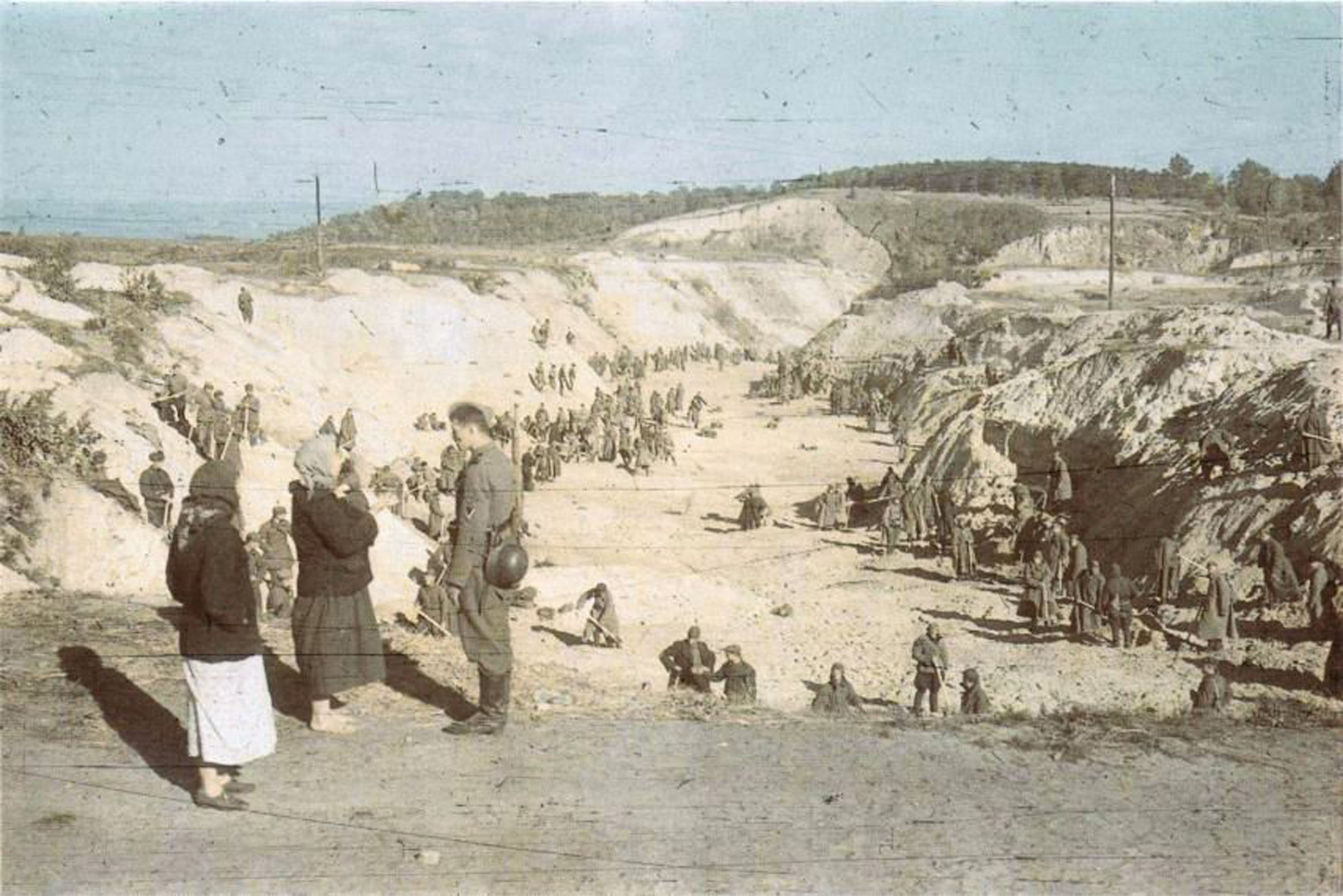 This is a picture of the supposed massacre found on Wikipedia’s Babi Yar page. It’s a picture of a German soldier casually chatting with two local women, one of them holding a child. In the background, dozens of men work in a huge ravine with shovels. This ravine, by the way, is a natural feature of the landscape caused by erosion, not man-made. Now, since this picture must have been taken by the Germans – the Wikipedia entry identifies the workers as Soviet POWs – was it the Germans’ intention to document their own war crime with this photo? That seems to me to be an odd thing for them to do. But even if that was their intention, they couldn’t have done a worse job. Not much incriminating evidence to see here. Where are the ashes? Where is the mass grave?
Contrast this picture with the pictures below taken by the Germans of a Russian massacre. When the Germans invaded Russia locals took them to a mass grave in the Katyn Forest where several years before the Soviet NKVD had shot and buried over 22,000 Polish officers and members of the Polish intelligentsia. Here we see decaying bodies in a mass grave and others laid out on the ground. Above, all we saw was Russian POWs mucking about in a gully.
 |
 |
|
|
Katyn mass graves |
||
* * *
Page 11: “Since the bodies had been lying in the ground for a long time, they had fused together and had to be separated with poles. From 4:00 A.M. till late at night Vladimir Davydov and his comrades labored in Babi Yar. The Germans forced the prisoners to burn what was left of the bodies.”
If you’re in a hurry to get rid of evidence of a war crime before the Red Army arrives, why bother to separate the bodies, with poles of all things, and exhume them one at a time? If the Germans had been in such a hurry and the task was “particularly important,” wouldn’t they have employed steam shovels or bulldozers? Poles? Incidentally, this story was related by Lev Ozerov, a poet, who probably didn’t have a clue about such things.
The excavation with subsequent cremation on huge pyres is said to have happened in September of 1943, when the Red Army was closing in on Kiev. The Germans were losing the war. They ran short of men, trucks, food, arms, munitions and fuel, and they were under constant bombardment by the Red Army. How did they manage to collect the gigantic quantities of wood required to burn 100,000 bodies – up to 25,000 metric tons of it!?! And with which vehicles and fuel did they manage to transport this all to Babi Yar?[11]
Monitoring the front, a German aircraft took a high-resolution photo of the area at the trailing end of this alleged burning frenzy, with Babi Yar in full view. It shows … nothing noteworthy.[12]

* * *
Page 12: “At dawn on September 29, 1943 — exactly two years after the mass murder of Kiev’s Jews — Germany’s new victims rushed from their earthen bunkers toward the cemetery wall with a shout of ‘Hurrah!’ Caught totally by surprise by the sudden escape, the SS men failed to open fire immediately with their machine guns. They did kill 280 persons. Vladimir Davydov and eleven other persons managed to climb the wall and escape.”
Is it just me, or does it make no sense whatsoever to shout “Hurrah!” when trying to escape at dawn while most of your captors are presumably still asleep? Maybe if the escapees hadn’t shouted “Hurrah!” more than 4% of them would have made it out alive. Or maybe this is just another example of poor storytelling where theatrics took precedence over common sense.
* * *
Page 18: “The terrible wails of women and the crying of children wakened the entire town. People living on the most distant streets woke up and listened in horror to the groans of thousands of people — groans that fused into a single wail and shook the soul.”
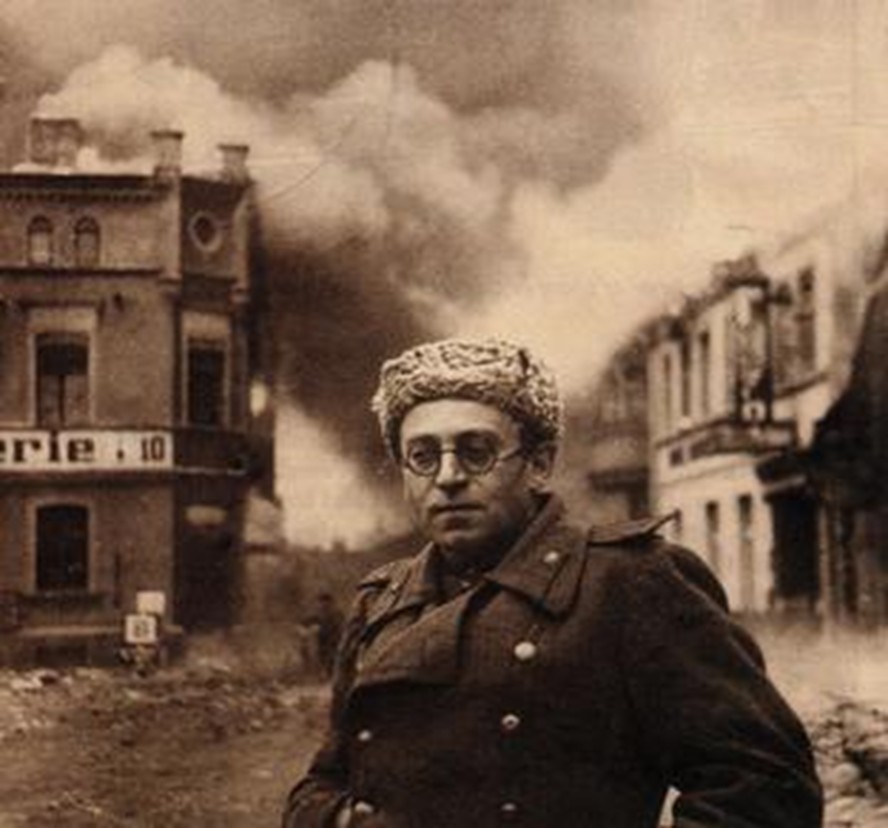
Does this sound like a factual account of an actual event or a blatant propaganda appeal to emotion? We owe this bit of poetic genius – “groans that fused into a single wail” – to Peter Sellers look-a-like, Vasily Grossman, pictured below in all his Red Army uniformed splendor.
* * *
Page 21: “We have information about two children who actually stood at the edge of these open graves and were miraculously saved.
One of them was a ten-year-old boy by the name of Garik; he was the son of the engineer Nuzhny. His father, mother, and six-year-old sister were executed. When Garik was brought together with his mother and sister to the edge of the pit, his mother, wanting to save him, shouted:
‘This boy is Russian. He’s my neighbor’s son. He’s Russian, Russian!’ An SS man shoved the boy aside, and he lay hiding in the bushes until darkness.”
First of all, had the Germans actually been engaged in mass murder, had they been as vile as the alleged eyewitnesses portray them, what are the odds they would have bothered to listen to this woman, much less have believed her story? Second, German soldiers during the war didn’t care much for Russians either. The Red Army fought under the black flag, meaning no quarter was given. The Soviet Union was not a signatory to any convention related to the conduct of armies toward prisoners of war and civilians. Suffice it to say, claiming her son was Russian probably wouldn’t have made any difference. I wonder what would have been going through the daughter’s mind had this actually happened. What am I, chopped liver?
* * *
Page 22: “The second person to leave the place of execution was ten-year-old Khaim Roitman. His father, mother, and younger brother, Boris, were killed before his very eyes. When the German raised his submachine gun, Khaim, who was already standing at the edge of the pit, said to him: ‘Look, a watch!’ He pointed at a piece of glass that was glistening not far away. When the German bent down to pick up the object, Khaim took off at a run.”
Taken in by the oldest trick in the book: made you look! If this really happened, this German was the most gullible soldier ever, and this kid the fastest ever. What are the odds?
* * *
Page 26: “One SS man attempted to pick up by the ear a boy with ringworm on his head. The trick did not work, and the boy fell to the ground. The German ripped off the boy’s pants, and in his hatred crushed his genitals with his heel. ‘Try reproducing now,’ he said to the laughter of the other soldiers.”
Trust me, no man could possibly have laughed at that. Any man who saw that would have his face fixed in a permanent wince. This story was “prepared for publication” by Vladimir Lidin, a Jewish fiction writer. This was, no doubt, some of his best, if cringiest, work.
* * *
Page 33: “The men were led away, and the women, children, and elderly were put on trucks and taken to the forest. It was a clear sunny day. […] On that bloody Friday, 360 people were murdered. The German-Hungarian bandits tore the children to shreds and threw them into the pit.”
“Tore the children to shreds”? What does that mean? How do you do that? Are Jewish children made of paper mâché? And how could this supposed eyewitness have known the exact number of victims? Three hundred and sixty is rather specific for such a large number.
* * *
Page 37: “In the spring of 1942 all the Jews were killed. The Germans took them just outside the village, stripped them, and shot them. The children were put in cages and hauled away on carts. They were buried alive.”
Burying children alive seems to be a major theme with these Soviet writers. Could the Germans have really been that heartless? So heartless they’d rather bury screaming children alive than simply shoot them? According to establishment Holocaust historians, the reason the German higher-ups came up with the idea of using gas chambers for the “final solution” in the first place was that mass shootings on the Eastern Front were destroying German troop morale. So, according to orthodox historians, shooting people really got to German soldiers but, according to this witness, burying children alive didn’t? The homicidal-gas-chamber solution to flagging German troop morale is itself Soviet propaganda, as you’ll see.
* * *
Page 38: “The Germans were economizing on bullets; they stood people four deep and then shot. The living were buried alive. Before being thrown into the pit, small children were ripped to shreds. That’s how they killed my little Niusenka.”
There are online debates about whether a 9-mm round can pass clean through a person. The consensus is that it can, but not always. So, the odds that the smaller German Mauser 8-mm round could have passed through two people, much less three and entered a fourth, would be virtually nil. Especially when you consider that the bullet needs to go in a straight line, and bullets that enter bodies have a tendency to hit bone and ricochet.
Now, if you’re thinking the Germans might not have cared about killing or even wounding the people in the back rows, that they were OK with burying them alive, how would that have worked exactly? Imagine you’re in the pit, but unwounded or barely wounded, and the Germans are shooting more people into the pit and shoveling dirt on them. What would you do? You’d do your best to wiggle out to avoid being smothered, of course. And to avoid being smothered, you’d have to keep moving until the Germans stopped. Then you would wait for the Germans to go home and either run, walk or limp away. Now, imagine a quarter or more of the people in the pit with you are doing the same thing. Does this seem like the way the efficient Germans would have operated, playing a macabre version of Whac-A-Mole?
* * *
Page 80: “The Rumanians and Germans tried out the strength of their bayonets on small children. A mother was breast feeding her baby when a Rumanian soldier ripped it away from her with his bayonet and flung it into the pit of the dead.”
This is a ripoff of a WWI anti-German atrocity story that was debunked after that war.

The truth is Romanians like most East Europeans – Hungarians, Ukrainians, Latvians and Finns – were more afraid of the Soviets than they were of the Germans, as evidenced by the roughly two million who fought with or for the German army against the Russians. The Nazis were considered the lesser of two evils by many in Eastern Europe, and for good reason. The map on the right shows the countries in red that the Russians took over at the end of the war. The map does not include: Ukraine, Moldova, Latvia, Lithuania and Estonia, which the Soviets took over at the outset of the war. All told, the Soviets took over 13 Eastern European countries.
Great Britain, also fearing further Soviet expansion, came up with a plan called “Operation Unthinkable” that involved Great Britain, the United States and France attacking the Red Army after the defeat of Germany. It was only shelved when they realized the Soviet troops outnumbered them three to one. Oops!
* * *
Page 85: “The next day we were all thrown in the river. By giving our tormentors our last things, we bought ourselves the right to come out of the water. Many died later from pneumonia.”
So, to get Jews to hand over their valuables, the Germans and Romanians threw them into a river. That makes sense. They couldn’t have just pointed a gun at them. You’ll note as you read on how fond the Germans were, apparently, of throwing Jews.
* * *
Page 87: “No lead was wasted on the children. Their heads were crushed against posts and trees, and they were thrown alive into the bonfires which had been prepared specifically for this purpose. The mothers were not killed immediately but were pushed aside so that their maternal hearts could bleed at the sight of their children dying.”
Reading atrocity stories like this one, especially as sick as this one, one after another, it’s easy to start believing there has to be some truth to them, despite how gratuitous the violence is and how contrived the circumstances described are. To avoid falling into this trap, it helps to keep reminding yourself that the source was Ilya Ehrenberg, the top propagandist in Soviet Russia, who promoted the raping and killing of German women, and his handpicked staff of writers, each no doubt trying to outdo the others with the utter gruesomeness of their tales to please their editor.
* * *
Page 88: “The village of Gradovka is located in the steppes of the Odessa oblast, not far from the railroad station Koiosovka. […] At the edge of the village he saw three ovens used by the peasants to burn limestone. […]
People were stripped naked before the ovens, lined up at the very edge of the shaft, and shot at point-blank range with submachine guns. […] The bodies fell into the oven shafts.
When a shaft was full to the brim, kerosene was poured into it. Bundles of straw had been placed in the corners in advance. Fat melted from the bodies and fed the flame.”
This would not have worked; at least, not as described. Bodies don’t burn on their own. You can’t tuck in some straw, douse the bodies with an accelerant and expect human fat to do the rest. Human bodies are two thirds water. It requires a lot of energy to burn them to ashes. An amount of coke, coal or wood exceeding the weight of the claimed victims would have to have been placed in the furnace. The “eyewitness” claim that mere bundles of straw in the corners sufficed is totally absurd. This account was prepared by poet Vera Inber, who likely knew nothing about such matters and banked on her readers not knowing either. [13]
* * *
Page 109: “The Fascists tormented and beat people until blood flowed and forced them to lick the floor with their tongues and clean windows with a chicken feather.”
I can understand beating, even floor licking, maybe, but cleaning windows with a chicken feather? Is the idea that the Germans were so diabolically sadistic they gave the Jewish inmates a tool so totally inadequate for the task they were given that it drove them mad with frustration? Or did the Soviet propagandists decide to have a laugh and test the limits of our gullibility.
* * *
Page 109: “The Jews were lined up in a row and forced to beat each other.”
These early stories have nothing to do with genocide. They seem mainly intended to establish how mean the Germans were. But I’m not buying this one; sounds like a Monty-Python skit.
* * *
Page 114: “Under the direct supervision of Katzmann, Himmler’s pupils practiced particular refinements of torture in addition to the normal program. Among these unusual measures were ‘races’ and ‘boards,’ which were normally conducted on Sundays.
‘Races’ consisted of making victims run 300-400 meters nonstop while SS men on both sides attempted to trip the runner by sticking out their feet. If the runner tripped, he was taken ‘beyond the wire’ and shot. There were many of these victims, since the camp prisoners were barely able to drag their swollen tortured feet.
The torture called ‘boards’ consisted of the following: on Sundays, exhausted from heavy daily work, the Jews were made to carry logs intended for barracks construction from one site to another. Each person was required to carry 150 kilograms (330 pounds) on his shoulders. Anyone who could not hold up under that weight was killed by an SS bullet.”
The “witness” says the prisoners were barely able to walk, “drag their swollen tortured feet.” So, how would it have been possible for them to run the length of three to four football fields, with people on either side of them trying to trip them? I’m thinking it wouldn’t. How would it have been possible for them, “exhausted from heavy daily work,” to carry 330 pounds – the weight of two average adult men back then – any distance at all? I’m thinking here as well, it wouldn’t have been possible. So, the eyewitness’s claim that many of the inmates failed these tests and were shot has to be the understatement of the century. Were this a true story, everyone would have been shot.
The lesson here is, when you’re making up an atrocity story, exaggeration is not always your friend. A more recent example of this sort of exaggeration backfiring was a study done by US Holocaust Memorial Museum (USHMM) researchers who claimed to have cataloged some 42,500 Nazi ghettos and camps in which Jews were held against their will during the war. The March 1, 2013 headline in the New York Times about the study proclaimed, “The Holocaust Just Got More Shocking.” No doubt, that’s what they were going for. But I’m thinking it just got more ludicrous. In the United States, which imprisons more people than any other country in the world, there are around 6,100 correctional facilities: 98 federal prisons, 1,566 state prisons, 3,116 local jails and 1,323 juvenile correctional facilities. Yet the USHMM would have us believe the Germans, in the middle of fighting a war on two fronts, found the time and the manpower to confine Jews to seven times that number of different sites. On top of how crazy this claim is, it goes completely against the extermination narrative. If the German plan was to exterminate the Jews, what would have been the point of scattering them all over the place? Wasn’t the idea to concentrate the Jews in ghettos and concentration camps?
* * *
Page 127: “At night we come out of our hiding place to look through the cracks in the roof at blazing Lokietek Street.
The voice of a dying boy can be heard at the far end of the street:
‘Ple-e-e-ease, one more bullet, ple-e-e-ease!’”
The story of a dying Jewish boy pleading with the Germans to put him out of his misery is powerful stuff, but how likely is it? Would a boy in severe pain ask for death rather than help? Would a boy understand his circumstance well enough to know not to expect help, to know that death was his only relief? They say that, when young soldiers are severely injured or out of their minds with fear, they cry for their mothers, not a bullet.
* * *
Page 168: “In the center sat Richter, the head of the ghetto, who had been rewarded by Hitler with the Iron Cross. […] Not far from this devilish throne stood a specially constructed speaker’s platform. The Fascists forced Ioffe, the composer who had been a member of the Jewish ghetto committee, to speak from this platform. Deceived by Richter, Ioffe began to calm the frantic crowd, saying that today the Germans would only conduct a registration and exchange identity badges. He had hardly finished talking when covered trucks with gassing equipment drove into the square from all directions. Ioffe immediately realized what this meant and shouted ‘gassing trucks’; the terrible phrase passed like lightning through the frantic crowd:
‘Comrades! I was deceived. They’re going to kill you. This is a pogrom!’
The insane crowd scattered, seeking salvation from the terrible death. Confusion reigned, people rushed back and forth, and an infinity of six-pointed stars flashed by.”
The Soviets began working on The Black Book no later than late 1944, some five or six months before the war ended. Yet this witness/contributor had already determined that what was done to the Jews during the war was “the most fantastic slaughter in world history.” How could he possibly have known that? Maybe he just slipped up and said out loud the conclusion the readers of the book were supposed to draw from all its horror stories.
“Devilish throne,” check. Over-the-top poetic license, “an infinity of six-pointed stars,” referring to the Jewish Star of David, check.
It’s ironic that the Soviets included “gassing trucks,” usually called gas vans, in their Holocaust atrocity stories, because it was they who invented them. In fact, according to Wikipedia, it was a Soviet Jew by the name of Isai Davidovich Berg who was the first to employ them in 1937. Talk about projection. The following quote comes from Wikipedia, not exactly a bastion of alternative historical perspectives:[14]
“During the Great Purge in the Soviet Union, NKVD officer Isaj D. Berg used a specially adapted airtight van for gassing prisoners to death on an experimental basis. The prisoners were gassed on the way to Butovo, a phony firing range, where the NKVD executed its prisoners and buried them. According to testimony given by NKVD officer Nikolai Kharitonov in 1956, Isaj Berg had been instrumental in the production of gas vans. Berg had become chief of the administrative economic department in Moscow’s NKVD in the summer of 1937. In October 1937 he was charged with the supervision of the Butovo firing range. Berg had to prepare Butovo for the mass execution of people from greater Moscow and to ensure that these executions would take place smoothly. According to testimony given by Fjodor Tschesnokov, a member of Berg’s execution team, in 1956, trucks were used, which were equipped with valves through which the gas could be directed inside the vehicles.”
* * *
Page 199: “In the square the doomed people were forced to strip naked and were then driven out into a field. There was a large barn there which the Germans set on fire. The people were driven into the flames. The sight of children burning alive was terrible!
Twelve-year-old Sarra Katsovich struggled with all her might for her life; the girl had a great thirst for life. The dying child ran out of the burning barn, and the policemen pushed her back into the flame and shouted to her: ‘Well, my beauty, you got your savior, Stalin!’”
This passage makes no sense. Why would the Germans set a barn on fire, and only afterwards attempt to drive the Jews into its flames? It’s ridiculous. If they’d been so inclined, the Germans would have driven the Jews into the barn first, locked it, and then set the barn on fire. And how could the policemen in the story have gotten close enough to the flames of the barn to push the Jews, including the girl who supposedly tried to run away, into them? Not only that, I would think it’s not enough just to push someone into a fire, you would have to hold them there as well. Pushing people into flames isn’t a thing, unless you want to get severely burned yourself. It sure paints a horrific picture, though. Did you note the Stalin plug?
* * *
Page 203: “A young German was walking down Romashev-Rov Lane. He was carrying a year-old baby pinioned on his bayonet. The baby was still crying weakly. And the German was singing.”
Classic atrocity propaganda reminiscent of that used against the Germans in WWI, as false as it is disturbing.
* * *
Page 204: “There were about two hundred of them. Bearded, bent-over old men were walking in front, followed by boys of 12-15 years; then several men who were dragging cripples and the ill. […] They were led to the steep face of the mountain and were forced to crawl up it. The old men lost their grip and fell down. They were urged on with bayonets. Later I heard bursts of machine-gun fire. A half hour later the Germans left the mountain; they were singing.”
More of the same; this time with a perverse Seven Dwarfs theme.
* * *
Page 205: “I witnessed many things. I saw the ghetto in Orsha. It was even more terrible than that of Minsk. Freezing old women rummaged among the corpses. Girls, bruised and swollen from hunger, asked: ‘When will they come for us?’ Death seemed a relief to them. Twenty old Jewish carpenters who did not wish to surrender themselves into the hands of the executioners gathered at the home of Eli Gofstein on Pushkin Street, poured kerosene on the house, and burned themselves alive. Their charred bodies lay there unburied […].”
Even if these old carpenters were suicidal, how likely is it they would have chosen such a gruesome way to die? I understand that members of trade unions can develop close ties, but 20 members all agreeing to commit suicide together by fire? And would they all have just abandoned their wives to the “executioners”? I’m also thinking the fact that it’s carpenters choosing to die by the destruction of a house, the very thing they spent their lives building, is meant to make us feel an additional measure of angst.
* * *
Page 210: “The Story of Doctor Olga Goldfayn – At the last minute, just before the [railroad] car was to be sealed, I jumped out onto the tracks. My ‘badge’ was covered with a large kerchief. I walked quickly down a street, came to a garden, and walked along a fence into a field. After that I walked only through fields, since there were Gestapo men on the road.”

I have to give this story three raised eyebrows. If you look closely at the picture of a boxcar (above), you’ll notice that it’s a bit of a drop from the floor of the boxcar to the ground. Jumping from a railroad car is no easy feat. If the doctor was lucky enough to jump just when all the Germans had their backs turned, she would have hit the ground fairly hard, rolled probably and had to pick herself up and dust herself off, all without anyone noticing. And what are the odds that all the Germans had their backs turned, of all times, just before the car was to be sealed? Then there’s the large kerchief. If a large kerchief is all it took for a Jew to hide from the Germans, how did the Germans manage to catch so many? Maybe it’s another Holocaust miracle.
* * *
Page 213: “In the July heat the people were not given water or bread for five days; then they were all shot. One Jew survived and he said that, when he crawled out of the grave, there were many living and half-living people left, since only the first rows had been struck by the bullets. When the Germans began to fill in the graves with earth and hot lime, many were still alive.”
This story is pretty much the same as the one we saw on page 38, except that this time the Germans weren’t trying to save on bullets, they were just sloppy. I’m thinking now that this is an attempt by the writer to explain how witnesses could possibly have survived a mass shooting.
When the Soviets, as mentioned above, conducted their mass shooting of thousands of Poles in the Katyn Forest and elsewhere in 1940, not one slipped through their fingers. There were no survivors to tell the tale. Rather, it was local peasants who exposed the massacre. The very controlled manner in which mass shootings are conducted doesn’t result in survivors. So, to make sense of a surviving witness, the writer here improvises by claiming that the victims were lined up by the Germans in rows, and that some in the back weren’t even shot.
I think we’re supposed to infer that, when the people in the front row were shot, they were propelled backward into the people behind them, who in turn fell into the pit before they could be shot as well. But would this have happened? The problem with this claim is that people don’t get knocked backward when they’re shot. That’s a Hollywood thing. The following is a quote from a medical forensics website:[15]
“However, if the bullet strikes another body part such as the chest, abdomen, head, arms, etc., would the person fall down or be catapulted backwards Terminator style? Most likely they would not.
In 2005, a TV show called Myth Busters put this theory to the test. They fired a .50 caliber sniper rifle, which is a really big gun, at a dummy that was similar in size to the average adult male. When they shot the dummy, it was only knocked back 2.5 inches, not several feet.”
So, had the Germans opened fire on rows of people with their smaller 8-mm Mauser bullets, the first row would have simply dropped to the ground exposing the second, still standing row to gunfire, and so on. I’m not saying mass shootings didn’t occur. The war between the Germans and the partisans was a dirty one: I merely say that, if anyone did actually survive a mass shooting, it couldn’t have happened like this. Therefore, it’s safe to assume that this story was made up by someone claiming to be an eyewitness or by the Soviet writer/contributor himself.
* * *
Page 217: “In order to conceal all traces of the crimes committed in the Bronnaya Gora region, the Germans shot the entire civilian population inhabiting the territory of the military supply depots (more than 1,000 persons).”
The strange thing about these massacre claims is how eager we were and still are to believe them, despite the lack of any corroborative physical evidence, and despite the fact that at that time we didn’t trust the Soviets to give us the correct time of day. Despite our grave distrust of the Soviets back then, they could point at any field, gully, street or building and claim the Germans committed all manner of heinous crimes there, and we just took their word for it.[16] Well, maybe not Churchill, Eisenhower and de Gaulle.
* * *
Page 222: “People were put in trucks and taken away to Kartus-Bereza. There enormous pits had been dug in the clay. The children were thrown in alive and killed with grenades; the adults were buried alive.”
This is a bit of a twist. The stories are usually that the Germans buried the children alive because they didn’t want to waste ammunition on them. Here they supposedly used ammunition, grenades no less, on the children while they buried the adults alive. I’m hard-pressed to find the logic in this story. Why would the Germans have bothered to segregate the adults and children? Why would they have used grenades on the children rather than cheaper bullets? And how exactly did the Germans manage to bury the adults alive? Did they shoot each one in the leg so they couldn’t climb out? If you’re going to do that, why not just shoot them in the head? It doesn’t take any longer. Or maybe they went through the time-consuming task of tying them all up first. The stories apparently don’t have to make sense as long as they’re sensational.
* * *
Page 254: “Two days later four old Jews came to the [German] police station. They had tried to escape death but had not found refuge. Shmuilo, who was seventy years old, said: ‘You can kill us.’ The old men were led to a barn and beaten with an iron rod. When they lost consciousness, they were rubbed with snow to revive them. Then a rope was attached to the right foot of each of them, and the end was thrown across a rafter. Upon command, the policemen lifted the old men two meters above the ground and dropped them. Finally, they were shot.”
This is part of a story told by a Jewish woman named Fanya. She told of how, after surviving a mass shooting in the town of Shamova, she walked all night and reached a group of partisans. Well, here she’s back where she started somehow, in Shamova, and inside the very barn chosen by the Germans, just in time to bear witness to the pointlessly extravagant murder of four old Jews who, incidentally, asked to be murdered? I’d say you can’t make this stuff up, but apparently you can.
By the way, why the specificity with regard to which foot the rope was attached to? It may have something to do with the propaganda axiom that detail adds to a story’s credibility.
* * *
Page 275: “We were pressed up to the very edge of the pit and fell into it. At that moment shots rang out, and those who had fallen immediately began to be covered with earth. I said good-bye to my wife. As we stood, embracing each other, a bullet struck her in the head, and the blood spurted in my face. I picked her up and began to look for a place to lay her down. At that moment, however, I myself was knocked off my feet, and other people fell on top of me.
I lay unconscious for a long time. My first sensation was that the hot mass on which I lay was swaying. I did not understand where I was or what had happened. I was being crushed by the weight on top of me. I wanted to wipe off my face, but I did not know where my hand was. Suddenly I opened my eyes and saw the stars gleaming very high above me. I recalled everything, gathered up my strength, and pushed away the earth that was covering me.”
A few things strike me as odd about this story. Despite falling onto a swaying “hot mass” and people being shot and falling into the pit behind them, this man and his wife still managed to stand up and embrace? That’s a strange thing to do when bullets are flying all around. He says he felt a crushing weight on top of him, which I think it’s fair to assume are the bodies that allegedly fell on top of him and knocked him unconscious. But then he says that all he had to do to escape the pit was to push away some soil. Really? And with bodies and earth crushing him, how was it that the first thing he saw when he opened his eyes was the stars in the night sky? Finally, after laying “unconscious for a long time” with the Germans presumably continuing to shoot people and shovel dirt into the pit, how is it that he didn’t suffocate?
This story was “prepared” by Lev Kvitko, a writer of Yiddish poetry for children. I’m thinking you’d have to be a child to believe it.
There are over 100 more pages of stories related to the alleged mass shootings, but they’re no more convincing. So, let’s skip ahead to the eyewitness accounts of events that are said to have occurred inside German camps.
2. The Camps
Page 83: “A youth, little more than a boy, he had been in many death camps, and he described them in detail. His essays give us a clear picture of the hell of this chain of camps that stretched from the Black Sea to the Bug River: Sortirovochnaya, Berezovka, Sirotskoye, Domanevka, and Bogdanovka. Rozhetsky wrote: ‘I want each letter of these names to be burned into our brains. These names must not be forgotten. These were death camps, where the Fascists destroyed innocent people simply because they were Jews.’”
A youth, presumably Jewish, “had been in many death camps.” Wait, what?
This author refers to these five camps as “death camps,” but it isn’t claimed that any of them had homicidal gas chambers like the so-called death camps in Poland. For these camps, the claimed method of execution was hanging from gallows or shooting. Perhaps it’s because the method of killing claimed for these camps is so pedestrian that we’ve never heard of them. Everyone has heard of Auschwitz. Whoever heard of Domanevka?
* * *
Page 84: “In Berezovka the doors opened with a squeak, and we were blinded by the bonfires. I saw people running, engulfed in flame. There was a distinct smell of gasoline; they were burning people alive.”
I take it back. They allegedly also did this, if you can believe it. I’m surprised this story didn’t put Berezovka on the map. By the way, you won’t find this story in Yad Vashem or the US Holocaust Memorial Museum, or anywhere else. Could it be establishment historians don’t buy this story either?
* * *
Page 131: “In the fall of 1942 Yakov found himself in a concentration camp near Lvov [probably the Janowska-Road Labor Camp]. The commandant of this camp never sent any Jews to be shot. He would approach the doomed person, speak of planned improvements and the humanity of the Fuhrer and, when the person began to believe that he would be saved, the commandant would strangle him. He was nicknamed “the strangler.” He had a special glass booth built on a tower so that Jews could die in it before everyone’s eyes.”
Now we’re getting into serious super-villain territory. A glass booth on top of a prison tower built by a homicidal exhibitionist. I think we have a winner for the most creatively outlandish atrocity tale of the Holocaust. It gets my vote anyway.
* * *
Page 386: “In the Khorol [PoW] camp. […] At five o’clock in the morning we were awakened for breakfast. Thousands of people immediately lined up in rows. The putrid liquid swill (in comparison with it the thin camp soup seemed tasty) was given out slowly. As a result, many had to eat ‘breakfast’ late at night.”
Nutrition in the camps was bad enough, especially toward the end of the war when the German population had very little to eat themselves. There was no need to make up an absurd story like this. The breakfast line was so long and so slow that “many” of the prisoners didn’t get served until late at night? Does this make sense to anyone? A lot of prisoners did nothing but stand in line all day, getting their meal just in time to eat it and go back to bed?
This story gets even more bizarre when you consider that the meal in question is referred to as breakfast, implying there was either a lunch and or a dinner served as well. It is known that at Auschwitz and the other now infamous so-called “death camps,” prisoners were served three meals a day. So, if this camp was no different, why would anyone still be standing in the breakfast line at night when they could have just moved over and stood in front of the lunch line and been served much sooner? It’s comical.
I think this absurd tale is an example of a Holocaust-style atrocity story being applied to the mundane, Germans making inmates suffer by having them stand in a chow line longer than any people has ever had to in human history. It doesn’t quite translate. It’s also another example of how exaggeration can be a fickle mistress for propagandists.
* * *
Page 386: “Almost every day, and sometimes several times a day, the camp commandant came to watch the food being dispensed. He would spur his horse and cut into the line. Many people were killed under the hooves of his horse.”
No Nazi camp story would be complete without a psychopathic commandant. I would think that the prisoners would have caught on to his game after a while, and would have been prepared to scatter at a moment’s notice. Fool me once, shame on you. Fool me twice, shame on me. Fool me “several times a day,” I’m a moron. We know this didn’t happen, because people simply aren’t this stupid.
Bełżec
Page 117: “The railroad personnel who worked on the trains carrying the doomed victims, however, told their friends and relatives of how the Jews were being massacred in Belzec.
Jews were led into an enormous hall which held up to one thousand persons. The floors and walls of the hall were electrically wired and without insulation. As soon as the hall was filled with naked people, the Germans switched on a strong electrical current.
This was an enormous electric chair — something that no criminal imagination could ever have invented.”
No, but a Soviet propagandist could. This one didn’t make it past the orthodox Holocaust censors either. According to the current orthodox Holocaust historiography, the method of mass killing at Belzec was, of course, gas chambers, like all the other so-called “death camps” in Poland. Despite it having been entered into evidence by the Soviet prosecutors at Nuremberg, no historian today stands by this electrified-floor story. It gets an A+ for creativity, though.[17]
* * *
Page 117: “In a different area of the Belzec camp was a soap works. The Germans selected the plumpest individuals, killed them, and boiled them down for soap. ‘Jewish soap’ was printed on the labels. Izraelevich Rozenstrauch, a bank clerk from Lvov, actually held a bar in his hands, and he was one of the witnesses who provided us with this testimony.
The Gestapo thugs never denied the existence of this ‘production process.’ Whenever they wanted to frighten a Jew, they would say to him: ‘We’ll make soap out of you.’”
Another wartime atrocity story that, although people continue to repeat it to this day, is no longer part of the orthodox Holocaust story. It was too absurd a claim for even the most ardent guardians of Holocaust lore to defend. The bars of soap used in the camps had the letters RIF stamped on them. The propagandist storytellers claimed RIF stood for Rein Jüdisches Fett (Pure Jewish Fat). The truth is that RIF stood for Reichsstelle für Industrielle Fette und Waschmittel (Reich Office for Industrial Fats and Detergents). Ironically, it was a poor grade soap with little fat of any kind in it.[18]
Treblinka
Page 402: “We know Svidersky, the one-eyed German from Odessa, known as the ‘hammer expert,’ because of his consummate skill at killing without firearms. Within the space of a few minutes, he hammered to death fifteen children between the ages of eight and thirteen declared unfit for work. We know the skinny SS man known as ‘old Preifi,’ a gloomy and morose individual who looked like a Gypsy. ‘Old Preifi’ amused himself by hunting down camp inmates who would steal to the garbage dump to pick up potato peelings. He would pounce on his victim and force his jaws apart so that he could shoot him in the mouth.”
There actually was a guard named Franz Swidersky at Treblinka I, a labor camp just south of the so-called death camp, Treblinka II, and he was accused of killing prisoners with a mallet. But considering what he’s accused of here, I find it rather strange he wasn’t brought to trial until 1971, 26 years after the war was over and 25 years after his crime was published in a book. Also, nobody currently claims he did what this author says he did. But even supposing he did, it wouldn’t be evidence of a German plan of genocide. As mentioned above, he was a guard in the labor camp, not the “death camp.”
As for “Old Preifi,” he’s not mentioned anywhere in either the US Holocaust Memorial Museum website or Israel’s Yad Vashem website. But, again, even if the story were true, it wouldn’t be relevant in terms of proving there was a Nazi program of genocide.
* * *
Page 402: “We know the names of the professional murderers Schwarz and Ledecke who relieved the monotony of their existence by shooting at prisoners returning from work.
They killed twenty to forty people every day.”
This also supposedly happened in Treblinka 1, the labor camp. So, if these two guys were picking off that many workers, around 900 a month, I’m thinking the commandant, villainous though he may have been, wouldn’t have been too happy about it. You can’t get much work out of dead people. And which guards would have been stuck with the task of disposing of the bodies every day? Disposing of twenty to forty bodies a day would have been a lot of work for someone. I’m thinking they also would have had a bone to pick with these two. Lastly, the prisoners, would they have been demoralized to the point that they lost all sense of self-preservation and would just walk into gunfire every day like zombies?
* * *
Page 404: “No less than 150 persons, and in most cases, 180 to 200, were crowded into each car. They were given nothing to drink throughout the journey, which sometimes lasted two or three days. People suffered so from thirst that many were reduced to drinking their own urine.”
There are several big problems with this story about the train that took the Jews to the alleged Treblinka “death camp.” One, it is difficult to pee when you’re dehydrated because your tissues soak up and hold onto any available water like a sponge. And two, drinking it would only further dehydrate you and possibly make you nauseous. Your urine contains salt and urea, a waste product produced by your kidneys. And the urine of a dehydrated person is going to have much higher concentrations of both. So, it’s highly doubtful that any, much less “many,” of the inmates engaged in this behavior. By the way, urine has 85 species of bacteria in it, including some that cause nausea.
* * *
Page 407: “As many as 20,000 people passed through Treblinka every day. Days when only six or seven thousand left the station building were rare.”
Between 6,000 and 20,000 is quite a spread. It doesn’t give us much to work with in terms of calculating the average number of people this “witness” claims the Germans gassed per day in Treblinka. But I think it’s safe to assume, since he said up to twenty thousand and six or seven thousand was rare, that the so-called witness wanted us to believe the average was at least 10,000 a day. Well, the Treblinka gassing operation allegedly started on July 23, 1942 and didn’t end until sometime in early October of the following year. That’s around 440 days. If we subtract 40 days to account for the Germans taking time to get up to speed and another 40 for the operation to wind down, I think that’s reasonable, that leaves us with around 360 days of gassing 10,000 Jews per day. That comes to 3,600,000 victims. That’s nearly three million more than the current official estimates of between 750,000 and 850,000. Looking at the numbers from another perspective, if we start with the official total, let’s split the difference, 800,000, then divide by the number of days the camp operated at full capacity, 360, the number of people gassed per day would have been 2,222, not 10,000 or more.
This huge discrepancy is concerning, considering the only reason we have an “official” estimate of the number of Treblinka deaths, any deaths at all for that matter, is because there were witnesses, or people claiming to be. There was virtually no physical evidence whatsoever found after the war because, unlike the German excavation of the mass graves in the Katyn Forest in 1943, the Russians suspiciously never bothered to gather any evidence at all at the time, and Western researchers decades later found precious little.[19] So, absent any significant supporting physical evidence, why should we believe in an atrocity story where the historians and a major alleged eyewitness aren’t on the same page, not even the same book.
* * *
Page 411: “Inside the women’s bathhouse was a hairdressers’ department. As soon as they were undressed the women lined up to have their hair clipped off. Old women lost their wigs. For some inexplicable, psychological reason their final haircut, according to the testimony of the hairdressers themselves, had a reassuring effect on the women; it seemed to convince them that they really were about to take a bath.”
A famous Treblinka “eyewitness” named Abraham Bomba claims to have worked as a barber there. He says they used scissors to cut the women’s hair in under two minutes. Putting aside the questionable reassurance value of being given a quickie haircut while seated stark naked in a crowded barracks, why would Treblinka be the only “death camp” that thought it necessary? In all the other concentration camps, so-called death camp or not, both the men and the women had their heads shaved, a much easier and faster procedure. Also, this story is contradicted by another “survivor” who says he “shaved” heads at Treblinka. See him interviewed as part of the USC Survivors of the Shoah Visual History Foundation in the documentary, “The Jewish Gas Chamber Hoax” on Rumble.[20] Incidentally, heads were shaved in all camps to reduce the incidence of typhus-carrying head lice, not to humiliate the inmates as we’ve been led to infer. So, shaving the inmates’ hair would have been consistent with the belief that Treblinka was just a transit camp where the Jews were showered and deloused before being transited on to labor camps. This would have been necessary, because there was a typhus epidemic raging in Europe during the war.
* * *
Page 411: “The women usually calmed down after the haircut. Nearly all of them passed out of the dressing-room carrying a piece of soap and a folded towel.”
As you’ll see, this statement and the one that follows present a problem for the “witness.” Also, wouldn’t the ingenious Germans have found a less onerous and cheaper way to keep the shower ruse going than supplying everyone with a bar of soap and a clean “folded” towel?
* * *
Page 411: “The next stage in the procedure began. The naked people were lined up at a window through which they were told to hand over their documents and valuables. […] When the final act of robbing the living corpses was over, the attitude of the Germans to their victims underwent a sharp change. Rings were torn off unwilling fingers, and earrings wrenched out of ears […] switching over suddenly to senseless and inexplicable brutality. These naked men and women who had been stripped of everything. […] Suddenly the soap and towel were knocked out of their hands […].”
The window spoken of here was to a booth. Problem, where is the booth? It’s nowhere to be found. The witness’s description makes it sound like the booth was encountered by the prisoners after they left the barracks, soap and towel in hand. But if you look at the layout of the camp below, you won’t find it anywhere. In fact, you won’t find it on any known drawing or model of the Treblinka camp. The outline of the camp shown below shows the undressing barracks, 25 and 26, the pathway, 27, to the alleged gas chamber building, 28, but no booth.

Maybe the booth was inside the undressing barracks. A directory of the camp below, taken from a Harvard history course webpage, indicates that was the case. Feature 25 is described as, “Barracks Where Women Undressed, Surrendered Valuables, and had Heads Shaved.”
Notice it says “Heads Shaved,” not haircut. Also notice feature 26 which says, “Barracks where men undressed.” I guess Jewish men weren’t entrusted with valuables. By the way, the men would have had their heads shaved too.

If you’re tempted to think this solves the mystery, it doesn’t. It leads to a contradiction on the part of the “witness.” The witness said the women left the barracks with soap and towel in hand, but also said the soap and towels were “knocked out of their hands” at the booth. If the booth was inside the barracks, these two statements are contradictory.
Let’s examine it a little further. If the booth was inside the women’s barracks and if, as the author claims, it was at the booth where the Germans became abusive and took back the soap and towel, wouldn’t that have been the end for the shower ruse? And not just for the people who’d gone past the booth, but for all those still waiting in line who would have been able to clearly see and hear what was happening at the booth. So, the jig would have been up for quite some time, depending on how long it took for all the prisoners to be processed past the booth. Imagine you’re standing in line to turn in your valuables behind several hundred other women. And every woman in front of you gets manhandled by the guards at the booth. How would that not have instilled fear bordering on panic? The Germans took the time to give all the women a haircut, supposedly to calm them down, and then minutes later provided them with a show guaranteed to scare the crap out of them? It doesn’t make any sense.
The logic behind the shower-ruse story was to explain how it was possible that millions of Jews supposedly walked with their children into homicidal gas chambers without the slightest fuss. So, for the German ruse to have worked, it would have to have been maintained right up to the last second, right up until the prisoners walked into the gas chamber and stood under the alleged fake shower heads. Otherwise, what would have been the point of the fake shower heads? But in this witness’s account of Treblinka, the victims would have known well in advance that they weren’t being taken to a shower.
* * *
Page 411: “The journey from the booth to the place of execution [the alleged gas chambers] took between 120 and 180 seconds. Hurried forward by blows, deafened by shouts…”
According to the “witness,” the abuse of the inmates intensified the moment they left the barracks. He refers to there being a two-to-three-minute journey to the gas chambers, “hurried forward by blows, deafened by shouts…”
The storytellers love to comment on how fiendishly clever the Germans were. Does this story support that assessment? My guess is this is a case of conflicting themes. The propagandists wanted their readers to come away with two major impressions of the Holocaust: one, that the Germans callously, violently and relentlessly tormented their Jewish prisoners; and two, that the Germans cleverly and fiendishly tricked their Jewish prisoners into walking passively to their deaths. The problem is that they simply don’t work together. You can have one or the other, but not both. Here, the propagandists were trying to have their cake and eat it too. So far, they’ve gotten away with it.
* * *
Page 412: “Experience has shown that when stripped a man loses his power of resistance and ceases to resist his fate; having lost his clothes, he seems to lose his instinct of self-preservation and accepts what happens to him as the inevitable. He who a moment before wished passionately to live becomes passive and apathetic. In order to make doubly sure, however, the SS employed at the last stage of their gruesome death conveyor a monstrous method of stunning their victims, of reducing them to a state of complete mental paralysis.”
Here, the Soviet propagandist has found a sinister explanation for why the prisoners were made to undress at the camp. It was to rob the men of their will to resist. Maybe. Or perhaps the reason was that Treblinka was a transit camp where prisoners were sent to be cleaned up and deloused, have their lice-infested clothing exchanged for a clean prison uniform, and were assigned and transported on to one of the many labor camps the Germans created in Poland. Again, go to Rumble and watch the documentary, “The Jewish Gas Chamber Hoax,” to see actual Jewish “survivors” describing their very brief stays in Treblinka before being sent on to other camps. By the way, they all say they were given a shower – with water.
* * *
Page 413: “Smirking and grimacing, a fiend in human shape whose name was Sukhomil ran alongside shouting in deliberately distorted German: ‘Now then, lads, faster, faster! Your bath water is cooling. Schneller, Kinder, schneller!’ And bursting into loud guffaws, the creature danced in a frenzy of delight. The victims moved on in silence with upraised arms between the two rows of guards, who beat them with rifle butts and rubber truncheons as they went by.”
Once again, the Germans, if you believe the storyteller, made their utter hostility toward the prisoners glaringly obvious at this point. The events claimed here allegedly took place on the pathway from the undressing barracks to the alleged gas-chamber building. After claiming that the Germans gave the female deportees haircuts to keep them calm, the Germans now supposedly made them run a gauntlet of guards who brutally attacked them? By the way, I would doubt the prisoners, who supposedly were fending off or absorbing blows from the guards as they ran to the alleged gas chamber, would have taken any notice whatsoever of a “fiend in human shape” taunting them. It lends a surreal touch to the story, but, once again, doesn’t make a lot of sense.
This is atrocity propaganda. Treblinka did exist. Jews were taken there against their will. And they did have their possessions taken from them. But I suggest the rest is fabricated. And I’m simply pointing out the internal inconsistencies and obvious flaws in the stories that demonstrate this. Remember, these stories are the only evidence we have of the Holocaust.
* * *
Page 414: “The tall one held a massive piece of gas piping about a meter long and a whip. The second carried a saber. At this moment the SS men released the dogs who in obedience to careful training threw themselves on the crowd and dug their teeth into the bare flesh of the doomed people. With savage cries the SS men brought their rifle butts down on the women who stood rooted to the spot with terror. Inside the building Schmidt’s men drove the victims into the gas chambers.”
Why would the Germans supposedly have relied on a shower ruse at all, if the plan all along was to sic dogs on the prisoners and bludgeon them into the gas chambers? Again, what was the point of the fake shower heads? It doesn’t make any sense whatsoever.
* * *
Page 415: “There are stories of little girls of ten who comforted their sobbing parents, of a little boy who on entering the gas chamber shouted: “The Russians will avenge us, mama, don’t cry!”
This is hearsay, “There are stories…” The person who told this story was not claiming to be an eyewitness. That aside, it’s been my experience that the sobbing and comforting works the other way around. And I seriously doubt a little boy would face his imminent demise with such aplomb and political awareness. Also, according to Israel’s Holocaust museum, Yad Vashem, there were no Russian Jews in Treblinka. So why would a little boy from some other country, it would most likely have been Poland, have called for the Russians to avenge his family, when the Russians had invaded Poland only a few years before? Sounds more like Russian propaganda to me.
* * *
Page 415: “Inhabitants of the village of Wulka [Wólka Okrąglik], the settlement nearest to Treblinka, say that sometimes the shrieks of the women being murdered were so terrible that the whole village would run for miles into the forest to get away from the piercing cries that rent the air. Presently the screaming would subside only to break out again as terrible and soul-searing as before. […] This was repeated three or four times a day.”
Does this story sound plausible? For one thing, this, too, would have to be hearsay, because an “eyewitness” interned in Treblinka couldn’t also attest to what went on in Wólka Okrąglik. Secondly, why wouldn’t the residents of that village have put cotton in their ears or found some other solution less disruptive to their daily lives? The story of a whole village running for miles into the woods three or four times a day is absurd on its face.
* * *
Page 416: “In the beginning there were three small gas chambers. While these were under construction several trainloads of victims arrived and the killing was done with axes, hammers and truncheons. This was done to prevent the surrounding population from suspecting the nature of the Treblinka work.”
I assume he means they beat them to death rather than shot them so the neighbors wouldn’t hear the gun shots. As mentioned before, gun shots are significantly louder than screams. However, the “witness” just got done mentioning the terrible effect “the piercing cries” had on the poor residents of Wólka Okrąglik. Hence, it would seem the cat was already out of the bag in terms of hiding “the nature of the Treblinka work.”
Putting aside the fact that the strategy clearly wouldn’t have worked according to the “witness’s” own testimony, how difficult would it have been for the Germans to do this? With roughly 100 camp guards, they would have been outnumbered by around 20 or 30 to 1 by the people coming off each train. And since, in the witness’s story, the alleged gas chambers weren’t finished, the Germans would have to have done it somewhere else. If we take a look at the drawing of the camp below, there are four possibilities: in the square just outside the camp gate, between the undressing barracks, inside the barracks, or in the area where the deportees’ belongings were stored.

The square outside the camp gate would have been unworkable, because the deportees would have scattered in all directions as soon as the carnage commenced, and it likely would have taken days for the guards to round them all up. And while contained, the area where people’s belongings were allegedly stored appears too roomy. The guards would have become completely exhausted chasing the prisoners around in circles in an area with so much room to run. Then there’s the area between the undressing barracks. It’s a much smaller area and appears in the drawing to be contained. But beyond what is shown in the drawing was a path that led to the alleged killing area, which was quite large. Therefore, outside the barracks would have been problematic as well. This means that we are left with inside the barracks as the place where the guards could reasonably have committed such an atrocity.
What would that have looked like: fifty guards and somewhere around 1,500 prisoners packed in each barracks? Ordinarily, according to the story, all the women and children went into the barracks on the left, and all the men into the barracks on the right. But, if this is a true story, the Germans would probably not have done it that way in this case. Fifty guards against over 1,000 men, admittedly of all ages and unarmed, still probably would not have ended well for the guards. Even if the guards somehow emerged victorious, some would have undoubtedly been killed, and all the others would have come out battered, bruised and completely spent. So, let’s assume they kept the men, women and children together, putting half the men in one barracks and half in the other. But even then, 50 guards beating around 1,500 people to death would be a daunting task, to say the least. And in defense of their wives, mothers and children, the male prisoners in this scenario would probably have fought back with even greater ferocity.
And what about the cleanup afterwards? After killing all these people by hand, the bruised and exhausted guards who still remained standing would have had to drag roughly 3,000 bodies, including those of some of their comrades, from the barracks to the burial pits some three quarters of a mile away. And, finally, they would have to have mopped up all the blood left behind in both barracks, which, incidentally, would have to have been huge to accommodate up to 2,000 prisoners at a time. Do you really think the Germans would have put themselves through such an ordeal for “several trainloads of victims,” just to prevent a few nearby farmers from hearing gunfire?
Lastly, considering the size and barbarity of such an event, doesn’t it seem strange that the author of this chapter, none other than Vasily Grossman himself, offers it as a mere aside with none of the gory details that we’re used to seeing in the book? The average contributor to the book, much less the number two propagandist in Russia, could have had a field day with this story: babies and mothers being chopped up with axes, screaming and blood everywhere.
* * *
Page 416: “The new gas chambers, of which there were ten in all, were symmetrically placed on the two sides of a wide concrete-floored corridor. Like the old three, they each had two doors, one from the corridor for the live victims, and another in the back wall to provide an outlet for the corpses. The latter led to platforms running on both sides of the building. Narrow-gauge tracks led up to the platforms. The corpses were first emptied out on the platforms and then loaded into waggonettes to be carried to the huge burial pits the excavators dug day and night.”
Orthodox Holocaust historians decided not to go with waggonettes at Treblinka. The official story is that two workers at a time dragged each body to the burial pits. The waggonettes actually make more sense, but other “eyewitnesses” say the scientifically advanced Germans chose the far less efficient, pre-invention-of-the-wheel method of dragging. And according to an alleged eyewitness, some of the burial pits were up to a quarter of a mile away! Again, there is no evidence that these burial pits even existed. It’s purely a matter of eyewitness credibility. How likely or even possible are the claims they made? Taking two workers to drag one body a quarter of a mile would have been way too slow a process to keep up with the thousands of prisoners claimed to have been gassed to death at the camp each day.
* * *
Page 417: “Various means were employed to effect this mass slaughter. One of them was by forcing the exhaust fumes from the engine of a heavy tank that served as the Treblinka power station into the chambers. These fumes contained two to three per cent of carbon-monoxide […].”
The orthodox Holocaust story is that the Germans employed a captured Russian tank to gas the Jews at Treblinka. The claim is that the carbon monoxide in the tank’s diesel exhaust did the job. That the exhaust fumes in the witness’s story would have been diesel can be shown not just by the fact that most WWII Russian tanks ran on diesel, but also by the fact that the electric generators of all German camp “power stations” were driven by diesel motors as well. Once again, here you have the propagandist taking advantage of an unsophisticated readership. The propagandist puts diesel fuel in his story due to the fact that people are more likely to think it’s deadly because it’s smellier and smokier than gasoline-engine exhaust. And he claims it came from a tank, because a tank is a big scary machine associated with death and destruction. The only problem is that there’s too much oxygen and not enough carbon monoxide in diesel exhaust to kill in the manner described. The exhaust from a regular gasoline combustion engine has 28 times more carbon monoxide in it than diesel-engine exhaust. Hence, if the Germans had wanted to use an engine to gas Jews to death, they wouldn’t have used a diesel one, especially not a Russian one that they wouldn’t have had spare parts for.
Actually, had the Germans really gassed Jews at Treblinka, they wouldn’t have used a gasoline engine either. Due to the shortage of gasoline during the war, many cars and trucks in continental Europe were converted to run on wood, believe it or not. Here is a diagram of one:

The moist wood smoldered with very little oxygen, creating what was called producer gas. This gas was very rich in carbon monoxide. It was well known in Europe during the war as a particularly dangerous fuel. This gas, before it was fed into the engine of a vehicle, had 100 times more carbon monoxide in it than diesel exhaust, and was thus 100 times deadlier.
Had they actually wanted to gas the Jews at Treblinka, the Germans would have used a simple producer-gas device, not a diesel or a gasoline engine. The Soviet propagandists were writers, not engineers.
* * *
Page 418: “The second method, and one that was the most widely used, was pumping air out of the chambers with suction pumps until the victims were dead. As in the case of the first method, death was caused by depriving the victims of oxygen.”
This is not part of the current orthodox story either. No historian currently claims this was done, much less “widely.” The storytellers, not being engineers or scientists, weren’t aware, apparently, that wooden or brick-and-mortar structures implode when you attempt to create a vacuum in them.
* * *
Page 418: “The third method, used less but nevertheless used, was murder with steam. This method, too, aimed at depriving the organism of oxygen, for the steam was used to expel the air from the chambers.”
Again, this is not part of the current orthodox story. Nobody now claims the Germans did this. But during the war, it was all the rage. The Polish government in exile in London published a report, allegedly based on eyewitness accounts, which described the steaming process in detail. The Poles even submitted an expert report to that effect to the Soviet prosecutors at the Nuremberg International Military Tribunal, who promptly introduced it as evidence,[21] although when doing so, they didn’t mention the murder method, because claims in this regard were simply too contradictory.
* * *
Page 419: “People who worked here told me that the faces of the corpses had turned yellow and that about 70% bled slightly at the nose and the mouth. Physiologists can no doubt explain this.”
Actually, a physiologist would not be able to explain that, because people who die from carbon-monoxide poisoning turn cherry red, not yellow. The picture below shows an example.

Also, carbon-monoxide poisoning does not cause bleeding from the nose and mouth. However, bleeding from the nose and mouth was caused by several war gases deployed during the First World War, which is the most probable source of these tales.
* * *
Page 420: “Himmler ordered all the buried corpses to be burned, every single one of them, and the ashes and residue to be carried out of the camp and strewn over the fields and roads. Inasmuch as there were already millions of corpses in the ground this seemed an incredibly difficult task.”
This would have been an absurdly difficult task, had it actually happened. On all the drawings and models of Treblinka based on supposed eyewitness descriptions, the burial pits appear too small and too few in number to account for all the space that would have been required for the approximately 700,000 bodies that orthodox historians currently claim were buried in the camp. But even if we grant that they were sufficient, just try to imagine the immensity of this task. The alleged burial pits were described as 33 ft deep. Imagine raising to the surface hundreds of thousands of bodies from each pit. And after accomplishing that feat, where would they have gotten enough dirt to fill in the graves? The dirt that would have been excavated to create the pits would have been exposed to wind and rain for several years. Much of it would have been washed or blown away. Yet somehow the Germans allegedly managed to refill the pits so perfectly, even defying the inevitable settling of the soil, that the Russians couldn’t even make out the pits’ outlines?
Then there is the fantastic amount of wood that would have been required. According to empirical research, it takes roughly ten times the mass of freshly chopped wood to burn a certain amount of body mass on open-air pyres,[22] and that’s only if the body is placed directly on top of the wood, so it doesn’t lose contact with the source of the heat. It takes considerably more when the body is placed like a piece of barbecue meat on a fixed grate – as is claimed for Treblinka, Bełżec and Sobibór – that doesn’t move with the pile of wood as it shrinks. But let’s put that aside. If taking into account that possibly a third of the alleged bodies would have been children, and that most bodies had been buried for several months before being exhumed and burned, hence losing some of their body mass, then we can assume an average body mass of, say, 80 pounds. This means a requirement of freshly chopped wood of some 800 pounds for an open-air pyre cremation. At 800,000 victims in total – according to the story, 100,000 victims were never buried – that’s 640 million pounds of fresh wood cut down, transported, and arranged beneath the pyres. It would also have meant the dispersal (vanishing) of roughly 50 million pounds of wood ash and over 4 million pounds of human ashes. Curiously, the Russian army never found any sign of ashes when they arrived, at least none that they bothered to save as evidence. And as for the few Western scientists who went there more recently, specifically to find evidence to defend the orthodox narrative, they found very little in the way of human remains, and found some of them in areas of the camp where they shouldn’t have been, based on eyewitness accounts. For more info, watch the documentary “The Treblinka Archeological Hoax” on BitChute or Rumble.[23] It’s no longer available on Google-owned YouTube.
* * *
Page 420: “True, it was observed that the bodies of the women burned better, whereupon efforts were made to burn the male corpses by throwing them in with the women.”
That women burn better than men is a myth based on the slightly higher percentage of body fat women naturally have on average compared to men. But according to modern commercial cremation web pages, there’s no significant difference between the sexes in terms of how fast their bodies burn. This is just another example of a storyteller adding detail to his story to make it sound more authentic and getting burned, no pun intended. By the way, since when did the Germans allegedly burn the men separately from the women? There is no mention of the alleged victims being buried separately. Did the Germans somehow exhume them separately? Anybody see the point of segregating the genders after death? Keep in mind I’m talking about the dead in the fake story. In real life, the people who were sent to Treblinka were not gassed and cremated, but rather were deloused and shipped out to labor camps.
* * *
Page 421: “[…] the largest crematorium in the world could never have handled such a gigantic number of corpses in so short a time as was required at Treblinka. The excavator dug a pit 250-300 meters long, 20-25 meters wide and 5 meters deep. Three rows of reinforced concrete pillars 100-20 cm. high were installed lengthwise in the pit to support steel beams that were laid along them. Rails were then laid crosswise across these beams at intervals of five to seven centimeters. The result was the grating of a titanic firebox. A new narrow-gauge railway was laid from the burial pits to the furnace pit. Soon afterwards a second and then a third furnace of like dimensions were set up.”
Below is a picture of a model of Treblinka that was made after the war with the help of alleged eyewitnesses. It sits in a Holocaust museum in Israel. Note the two cremation pyres just behind the guard tower in the center of the picture. They are clearly above ground and, although it doesn’t look like it, another witness claimed they were around 100 feet long. Perhaps the model isn’t exactly to scale. The orthodox story is that these were the only pyres at Treblinka.

Does this model remotely match the description given by the “eyewitness” in the above account? The “eyewitness” claimed there were three pyres placed in three pits each five meters deep and each approximately as long as three football fields. It also refers to a narrow-gauge railway from the burial pits to the pyres. I’m not seeing any of this. The big squarish pits in the picture are the alleged burial pits.
Aside from the fact that this “eyewitness’” description doesn’t remotely coincide with the museum model, it also couldn’t possibly have worked. The “eyewitness” described the pits as being 5 meters deep. That’s a little over 16 feet deep. The concrete pillars sunk in the bottom of the pits are described as a little under four feet high. If you add another foot or so for the beams and the cross rails, the cremation pyre is still more than 10 feet below ground. He further claims the pits were 20-25 meters (between 65 and 82 feet) wide. Both the depth and the width of the pits would have made them unworkable for cremation.
Starting with the width, according to the story, workers had to place the bodies on the pyres by hand. But, according to this witness’s story, that would have been impractical, if not impossible. How would the workers have managed in any reasonable time frame to carry bodies some 40 feet across a grid of rails? In other words, how could they have managed to place bodies at the center of a pit “20-25 meters wide” without stumbling or turning an ankle traversing rails placed only slightly less far apart than the width of the human foot?
And, as for the depth of the pit, how would they have removed the tons of human and wood ash left over after each cremation? The pyre itself, the lattice of beams and rails, and the dimensions of the pit would have precluded the use of heavy machinery, such as an excavator. Therefore, they would have to have lowered workers with shovels into the pit. How many hours would it have taken for the ashes left over in the pit and the rails to cool down enough after a cremation for the workers to enter? How efficient would the workers have been toiling beneath a grid of rails only four feet off the floor of the pit, while inhaling all the ash dust they would have stirred up? Also, how would they have managed to get the hundreds of tons of wood needed for each cremation under the grid and piled up evenly across the roughly 24,000 square foot floor of each pit? The workers would have had to distribute hundreds of tons of wood for each cremation while crawling on all fours and navigating around “[t]hree rows of reinforced concrete pillars.” Lastly, why didn’t the Soviet writer who prepared this story for the book ask the “eyewitness” these fairly obvious and troubling questions? Could it be that there never was an eyewitness to begin with?
* * *
Page 422: “They picked out the women and children and took them not to the gas chambers but to the cremation ovens. They forced the mothers, half crazed with terror, to lead their children between the red-hot bars on which thousands of dead bodies writhed and squirmed from the heat, twisting and turning as though alive; where the bellies of dead women with child burst open from the heat and still-born infants burned up inside rent wombs. This spectacle was enough to rob the strongest man of his reason, but the Germans knew that its effect on a mother would be a thousand times worse.”
Here the Germans are apparently taking precious time out of their day to go the extra-sadistic mile to scare the hell out of Jewish children and their mothers before killing them. And for some reason, the pyres in this story are no longer below ground level. I wonder if they are still three football fields long. Could anyone walk that distance between “red-hot bars” without fainting? Self-proclaimed survivor Chil Rajchman (Yechiel Reichman) wrote in his book Treblinka: A Survivor’s Memory that the flames coming from the pyres were so hot that you couldn’t come within 50 meters of them. Yet this witness claimed that mothers with their children managed to walk between them.
* * *
Page 430: “Millions of people had been murdered here by the Germans. This dreadful black road cut through the Treblinka field. It was black because, for three kilometers, it was covered with human ashes. Tons of ashes had been brought here in carts. Eleven thirteen-year-old prisoners shoveled the ashes along the road. They were called ‘the children from the black road.’”
Why 13-year-olds rather than adults? Weren’t all the young immediately gassed? And why would anyone take note of the exact number? Eleven? And why scatter ashes “along the road”? Why not spread the ashes somewhere they wouldn’t be so easily discovered, like in the “Treblinka field” or in the forest next to the camp? Could it be because the term “Black Forest” was already taken?
Auschwitz
Page 477: “As we neared Auschwitz-Oswiecim, we saw a number of people working on the road. This raised our spirits a little: it meant that this was not a death factory and that people were living here. We had not yet learned that the Germans made special use of prisoners on back-breaking jobs, making conditions unbearable so that they would die faster.”
Die faster than in a gas chamber? Auschwitz was not just a huge concentration camp it was a huge industrial park. The camp was surrounded by dozens of factories where the prisoners of the camp worked making munitions, artificial rubber and many other products for the German war effort. The Germans needed these workers and would not have wanted them dead.
* * *
Page 479: “At the same time many people were dying. The death rate was as high as 300-350 people a day. Epidemics of typhus and dysentery raged, and lice swarmed over us.”
This was the real Holocaust. Most people believe in the orthodox Holocaust story, in the gas chambers, because they’ve watched the ghastly films taken by the Allies at the end of the war showing hundreds of emaciated bodies being bulldozed into mass graves by British liberators. But it’s these very films that disprove the orthodox Holocaust narrative. Both typhus and dysentery, which were big problems in the camps, caused their victims to waste away as evidenced by the emaciated bodies of the dead we’ve all seen in the films. Gassing people to death, on the other hand, doesn’t. So the poor souls in the Allied films were victims of disease, not victims of homicidal gas chambers. These films weren’t even taken at a concentration camp where homicidal gas chambers are alleged to have been present. They were taken at Bergen-Belsen where, as mentioned before, orthodox historians now say there were no homicidal gas chambers.
It was diseases, typhus in particular, that killed the vast majority of concentration camp inmates, particularly toward the end of the war when Germany was out of medicine and nearly out of food. Typhus is spread by lice that infest clothing and bedding, which is the real reason there were gas chambers in the camps – delousing gas chambers! They were for exterminating lice, not people. Lice also like to infest the human scalp, which is why all the inmates had their heads shaved regularly. It wasn’t to dehumanize the inmates, as we’ve been led to believe, but rather to keep them alive, healthy and working for the German war effort.
* * *
Page 480: “They did not like the fact that we had too little to keep us occupied, so it was decided to use us for hard labor. Four and five times a day we had to walk a distance of three kilometers and bring back heavy rocks which were used by the other women’s units to pave the camp. […] Women from all the blocks who were not working in specific places were gathered together. […] We were herded to the place where the rocks were.”
This is interesting. The orthodox story is that, if the Germans didn’t need an inmate’s labor, the inmate was sent straight to the gas chamber. But here we have a supposed instance where rather than exterminate excess laborers, the Germans found make-work for them to do: sending women on a trek to retrieve what few small rocks they could carry back. So, this story, surely intended to make the Germans look wicked, actually makes them appear less so.
* * *
Page 483: “The new arrivals could hardly understand where they were being taken. Meanwhile, they were taken to the crematorium. There they were undressed in a large hall, given a piece of soap and a towel and, although told they were going to the bathhouse, they were, in fact, herded into the gas chamber.”
This, in a nutshell, is the orthodox story of the Holocaust. There is no physical evidence that this ever happened. And as you’ve already seen, the so-called eyewitness accounts leave much to be desired.
* * *
Page 489: “Hunger and typhus raged in the camp. There was not a dugout in which several people would not die in a single day; they would die at work, too. And even now it makes me shudder to think of the so-called hospital, that is, the dugout into which the typhus victims were thrown. None of the sick people who landed there could even hope to survive, despite all the efforts of Doctor Gordon, a most noble man who did everything he could to save the sick, doomed people.”
The first part of this account is true, as discussed above. But that’s all that is. According to the most-famous survivor of Auschwitz, Elie Wiesel, both he and his father were successfully treated in “the so-called hospital.”
Wiesel, who was the Johnny Appleseed of Holocaust propaganda during his life, criss-crossing the United States lecturing on his time in Auschwitz, once made the following rather curious comment about the truthfulness of his writings in an exchange he had in Tel Aviv with the Hasidic teacher of his childhood, twenty years after he had last seen him in Hungary during the war: [24]
“‘What are you writing?’ the Rebbe asked. ‘Stories,’ I said. He wanted to know what kind of stories: true stories. ‘About people you knew?’ Yes, about people I might have known. ‘About things that happened?’ Yes, about things that happened or could have happened. ‘But they did not?’ No, not all of them did. In fact, some were invented from almost the beginning to almost the end. The Rebbe leaned forward as if to measure me up and said with more sorrow than anger: ‘That means that you are writing lies!’ I did not answer immediately. The scolded child within me had nothing to say in his defense. Yet, I had to justify myself. ‘Things are not that simple, Rebbe. Some events do take place but are not true; others are—although they never occurred.’”
That sounds to me like an admission that he played fast and loose with the facts when he wrote his books. By the way, in his most-famous book, Night” written shortly after the war, Wiesel failed to mention anything about gas chambers in Auschwitz. He did, however, describe German guards throwing Jewish babies alive into a pit of fire right next to the railway ramp. For some reason, his bestselling book has been able to exist, unchallenged by mainstream historians, up to this very day despite the fact that no orthodox Holocaust historian apparently believes his pit-of-fire story.[25] Maybe this is one of those events that are true “though they never occurred.” It’s the Holocaust. It’s all good.
One more comment regarding the ever-suffering Mr. Wiesel: he was apparently a racist and a hater. In his 1968 book Legends of Our Time, he had the following to say about the Germans: [26]
“Every Jew, somewhere in his being, should set apart a zone of hate – healthy, virile hate – for what the German personifies and for what persists in the Germans. To do otherwise would be a betrayal of the dead.”
This is literally hate speech.
* * *
Page 491: “The selection began. The sick and the weak were led off to where the bodies of the dead were. The men who looked healthy were put into a special group. All the rest — the women, the elderly, the children — were put into vehicles and taken away. That is the way I parted with my wife and children forever, without saying good-bye, without realizing that they were being taken to their deaths”
Thanks to eyewitness accounts taken by Steven Spielberg’s USC Shoah Foundation, we know that women and children that arrived at Auschwitz were not sent to homicidal gas chambers, but rather survived the camp. Many of the “survivors” interviewed by the foundation were in fact women, and some had even been small children during the war. The most famous victim of the Holocaust, Anne Frank, and her sister, Margot, two girls in their early teens, both survived Auschwitz, only to die at the very end of the war from typhus after being transferred to Bergen-Belsen.
Interesting side note: In an interview on occasion of the 75th anniversary of the occupation of Auschwitz by the Red Army on January 27, 1945, Anne Frank’s stepsister Eva Schloss revealed that the footage later shown by the Soviets, claimed to be about the liberation of Auschwitz, had nothing to do with it. What had puzzled her is the fact that no snow can be seen in any of the Soviet film footage or photos, while she remembers that the snow on the ground at that time was several feet high. Using her connections with the Russian embassy, she got them to admit that the footage and pictures shown were taken much later, and not even at Auschwitz.[27]
* * *
Page 492: “Roll call (Appell) lasted two-three hours in the morning, before work, and the same amount of time in the evening.”
Here’s another example of how the Soviet authors of these stories often went overboard in an effort to make every aspect of concentration-camp life look absolutely miserable. Do you really think the Germans would have tied up their laborers for up to six hours a day like this? That’s up to six hours a day that the inmates of Auschwitz could have been in the factories that surrounded the camp, manufacturing desperately needed ammunition and other war materials for the Germans.
* * *
Page 496: “In June, 1945, I was assigned as a mechanic to a factory located seven-eight kilometers from Auschwitz. All together, there were two thousand six hundred prisoners working at the factory, and of them approximately one thousand three hundred were men; the rest were women.”
This is a roundabout way of saying half the workers in the factory were women. As mentioned before, Auschwitz was surrounded by factories in which the concentration camp inmates, including women, were put to work by the Germans.
Below is an aerial photo of Auschwitz-Birkenau taken by the Allies in September of 1944. Note the dozens of long rows of dark rectangles in the picture. Those were the barracks the inmates lived in. Ask yourself, if Auschwitz-Birkenau was an extermination camp, why so many barracks?

* * *
Page 498: “The gas chambers at that time [July 1944] ‘processed’ between twenty and twenty-six thousand people every day.”
Even if we take the smaller number of 20,000, this is an absurd claim within the orthodox Holocaust narrative. According to orthodox Holocaust historians, the alleged homicidal gas chambers in Auschwitz were in operation for 20 months, give or take. If the Germans gassed 20,000 people a day for just the month of July 1944, it would have amounted to 620,000 people. And since the historians claim approximately 1.1 million people total died in Auschwitz during the war, including from disease, this means that during the other 19 months of operation, Auschwitz only gassed a little over 25,000 people per month. So, what got into the Germans in July of 1944 that they gassed nearly 25 times more people than they normally did?
So-called witnesses – there were a number of them[28] – who made claims of specific numbers of Jews being gassed, are inherently suspect. They would have had no way of making even remotely accurate estimates of the number. On the other hand, if you’re making the whole thing up, why not go for it? Most people won’t think to question you. By the way, the official numbers aren’t to be trusted either, because, once again, there is no physical evidence whatsoever that anyone at all was gassed to death in a German concentration camp.
* * *
Page 502: “I am discharged now. I am home in Ostrino. […] I’ve decided to live in another town. The Soviet motherland has given me this opportunity. I am not a bad craftsman, I’ll work. One must live! We will live!”
Aaand cut! That’s a wrap. Good job, everybody! Vodka’s on me!
By the way, the orthodox Holocaust story is that Russian Jews were rounded up and shot into mass graves. So why would this survivor of a concentration camp refer to the Soviet Union as the “motherland?”
Full disclosure: The Black Book wasn’t the only source of concentration-camp horror stories. After the war, many more Jewish “eyewitnesses” came forward to testify at a number of trials of the Germans, the most famous being the trials conducted at Nuremberg. They told similar harrowing stories about gassings at the six “death camps” in Poland, and mass shootings in Russia and Ukraine. These stories were consistent with those we’ve just reviewed, hundreds of thousands of Jews gassed to death in gas chambers disguised as shower rooms, and thousands shot and buried in mass graves. And like the stories you’ve just seen, these stories were fraught with contradictions, lack of corroborative evidence and plenty of outright absurdities as well – such as, Jews being gassed in a gas chamber with a row of large, easily breakable glass windows at Majdanek, as was claimed during the immediate postwar time. Here’s a picture of it.

For obvious reasons, orthodox historians no longer say this room was anything other than what it appears to be, a simple shower room. They’ve come to similar conclusion about four other alleged gas chambers at Majdanek. So, over the decades since war’s end, the official or orthodox number of gas chambers in Majdanek has been reduced from seven to just two. In other words, orthodox historians today believe that either the Soviets or the survivors of the camp lied about five of them. My question is, if they lied about five of them, why would historians today not think they lied about all of them?
But the strangest testimony came from Jewish “eyewitnesses” who were liberated from camps in Germany that were known from the start not to have had a gas chamber in them, such as Bergen-Belsen and Flossenbürg. Curiously, these “survivors” told the exact same gassing story.
Lastly, in his book Resistance in Auschwitz, Jewish-communist organizer Bruno Baum wrote:[29]
“I believe it is no exaggeration if I say that the biggest part of Auschwitz propaganda, which was spread in the world around that time, has been written by us in the camp.”
Enough said.
Endnotes
| [1] | https://robert-faurisson.com/history/the-detail-of-jean-marie-le-pen/ |
| [2] | Arno J. Mayer Why Did the Heavens Not Darken?, Pantheon, New York, 1988/1990, p. 362. |
| [3] | John D. McCallum, Crime Doctor: Dr. Charles P. Larson, World’s Foremost Medical-Detective, Reports from His Crime File, Writing Works, Mercer Island, Wash., 1978; Jane Floerchinger, “Concentration Camp Conditions Killed Most Inmates, Doctor Says,” The Wichita Eagle, 1 April 1980, p. 4C. |
| [4] | Henry Shapiro, “Prints Volume on Atrocities against Jews”, Youngstown Vindicator (Ohio), Nov. 27, 1944. |
| [5] | Ilya Ehrenburg, “Ubej!,” 1942, quoted from Joachim Hoffman, Stalin’s War of Extermination 1941-1945: Planning, Realization and Documentation, Castle Hill Publishers, Uckfield, 2015, pp. 235f. |
| [6] | I. Ehrenburg, leaflet distributed to Red Army, October 1944; quoted acc. to. Prit Buttar, Battleground Prussia: The Assault on Germany’s Eastern Front 1944–45, Osprey Publishing, Oxford, 2010, p. 110. |
| [7] | See https://encyclopedia.yivo.org/article/1303. |
| [8] | For a skeptical review of extant evidence on the Einsatzgruppen’s activities, see Mattogno, Carlo 2022c. The Einsatzgruppen in the Occupied Eastern Territories, 2 vols., 2nd ed., Castle Hill Publishers, Uckfield, 2022. |
| [9] | G. Rudolf (ed.), Dissecting the Holocaust, 4th ed., Armreg Ltd, London, 2024, p. 497. |
| [10] | However, that narrative stands on very shaky foundations; see the entry on “Babi Yar” in the Holocaust Encyclopedia: https://holocaustencyclopedia.com/location/other-crime-scene/babi-yar. |
| [11] | See the entry on “Lumberjacks” in the Holocaust Encyclopedia: https://holocaustencyclopedia.com/technology/lumberjacks/. |
| [12] | See G. Rudolf (ed.), Air-Photo Evidence: World-War-Two Photos of Alleged Mass-Murder Sites Analyzed, 6th ed., Castle Hill Publishers, Uckfield, 2020, pp. 153-156. |
| [13] | Since the features of the claimed limestone kilns are unknown, any attempt to calculate or estimate the fuel needed would be futile. But basically no fuel at all, just some straw kindling and starter liquid, wouldn’t have done the trick. |
| [14] | https://en.wikipedia.org/wiki/Gas_van |
| [15] | https://godoymedical.net/falling-when-shot-factual-or-fiction/, referring to the MythBusters episode “Brown Note” (February 16, 2005) and revisited in “MythBusters Revisited” (October 12, 2005). |
| [16] | On the lack of any tangible evidence regarding the claimed massacres at Bronnaya Gora, see the respective entry in the Holocaust Encyclopedia at https://holocaustencyclopedia.com/location/other-crime-scene/bronnaya-gora/. |
| [17] | On the evolution of the Bełżec narrative, see the respective entry in the Holocaust Encyclopedia at https://holocaustencyclopedia.com/instruments/camp/pure-extermination-camp/belzec/. |
| [18] | See the entry on “Soap, from Jewish Corpses” in the Holocaust Encyclopedia at https://holocaustencyclopedia.com/absurdities/soap-from-jewish-corpses/. |
| [19] | See the section on “Forensic Findings” in the entry on Treblinka in the Holocaust Encyclopedia at https://holocaustencyclopedia.com/instruments/camp/pure-extermination-camp/treblinka#Forensic. |
| [20] | It’s posted multiple times by various users, e.g., https://rumble.com/v56jhky; https://rumble.com/v5joam9; https://rumble.com/v6t2syz; https://rumble.com/v4syrv2. |
| [21] | Document PS-3311, IMT, Vol. 32, pp. 154-158. |
| [22] | Germar Rudolf, “Open-Air Pyre Cremations Revisited,” Inconvenient History, 2024, Vol. 16, No. 3, pp. 261-270; https://codoh.com/library/document/open-air-pyre-cremations-revisited/. See also the entry on “Open-Air Incinerations” in the Holocaust Encyclopedia at https://holocaustencyclopedia.com/instruments/tool/open-air-incinerations/ |
| [23] | Apart from the sources mentioned in the previous footnote, see also the entries on Treblinka in the Holocaust Encyclopedia at https://holocaustencyclopedia.com/instruments/camp/pure-extermination-camp/treblinka/. |
| [24] | Elie Wiesel in Legends of Our Time, Schocken Books, New York, 1982, p. viii (Introduction). |
| [25] | For a critical biography of Wiesel, including his various tall tales, see Warren B. Routledge, Elie Wiesel: Saint of the Holocaust, 3rd ed., Castle Hill Publishers, Uckfield, 2020. |
| [26] | Elie Wiesel, “An Appointment with Hate,” Commentary, December 1962. This article was later reprinted as Chapter 12, “Appointment with Hate,”in Legends of Our Time, op. cit., starting on p. 142. |
| [27] | Eva Schloss, Piers Morgen, “Good Morning Britain,” 27 January 2020; https://youtu.be/4-JM6ChF-Fw?t=280s. |
| [28] | On Auschwitz, see in particular volumes 35, 37, 41, 44, 45 and 46 of the series Holocaust Handbooks (www.HolocaustHadündbooks.com) where many of these witness account are cited and scrutinized. |
| [29] | Bruno Baum, Widerstand in Auschwitz, VVN-Verlag, Berlin/Potsdam, 1949, p. 34. |

Bibliographic information about this document: Inconvenient History, 2025, Vol. 17, No. 4
Other contributors to this document:
Editor’s comments: