BREAKTHROUGH: CODOH Makes International News
…but NPR’s Tom Dreisbach Merely Exhibits Incompetence
On January 27, 2026, we reported about the appearance of three CODOH associates at the New-Hampshire legislature 13 days earlier, to propose adding a CODOH member to that state’s Commission on Holocaust and Genocide Education.[1] We called it a breakthrough, but it didn’t really make much of a ripple in the greater pond of world politics.
That changed only after NPR’s journalist Tom Dreisbach posted a story about this on April 29, 2026.[2] Following NPR’s publication – which was noticeably meager on facts – several Jewish outlets reported in much more detail – and much fairer – about what happened in mid-January in New Hampshire. For example, the day after the NPR news piece was released, The Times of Israel[3] and The Jewish Telegraphic Agency[4] both featured a long article written by Andrew Lapin.
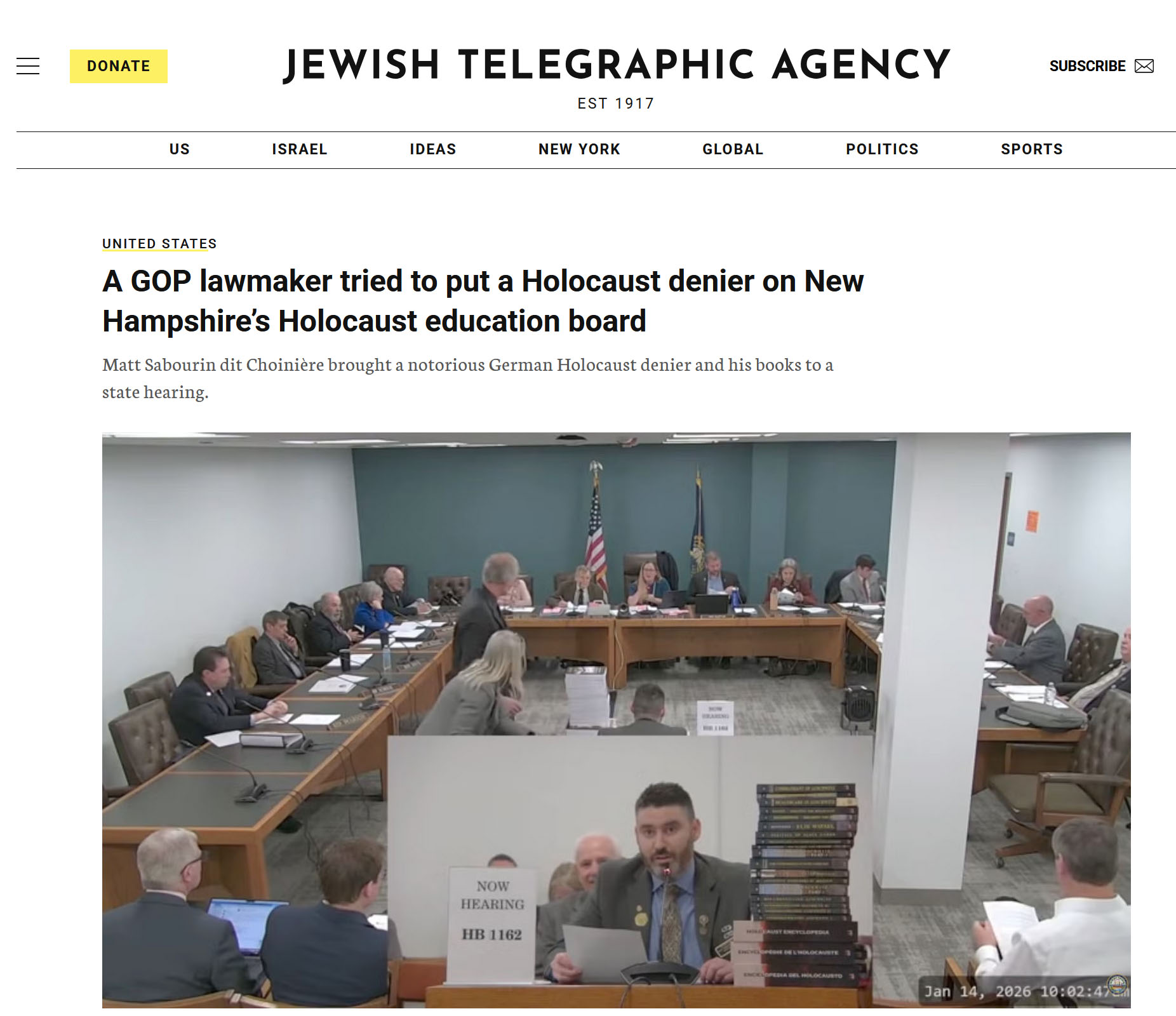
In his news report, Lapin quotes in length from the testimonies our group managed to give in New Hampshire that Wednesday morning. He mentions the Committee for Open Debate on the Holocaust, and the fact that we have “produced a 54-volume set of books,” which we “offered to the committee”. Appearing this prominently in outlets of such a high renown (in the eyes of the mainstream) has given Holocaust skepticism in general and CODOH in particular a public prominence it has not enjoyed for a long time. Anyone curious what this fuzz is all about can now enter “Committee for Open Debate on the Holocaust” in a search engine, and will find CODOH’s website prominently listed.
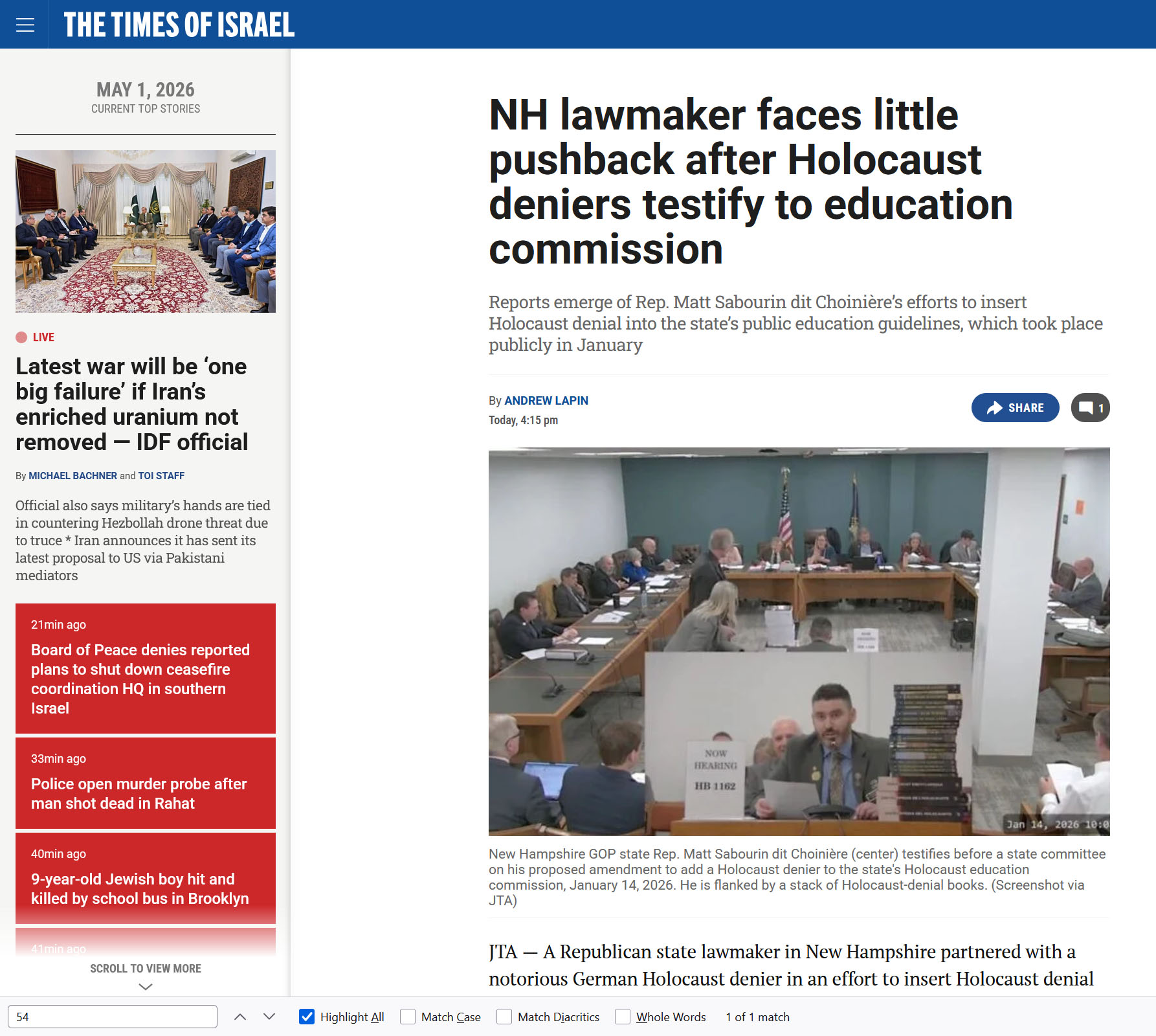
While our appearance at New Hampshire’s state legislature in mid-January was noteworthy for sure, the real breakthrough only happens now, that the wider media pick up the news and give it the coverage we had hoped for and haven’t seen in a long time!
In the alternative media space, CODOH’s activities and its repercussions in mainstream media were also noticed. José Niño had both Representative Sabourin dit Choinière and Germar Rudolf on his podcast show “José Niño Unfiltered”, with an episode titled “El Niño Speaks 204: Breaking the Holocaust Taboo,” which went public on May 1, 2026.
Having said all this, we are of course aware that NPR did not mean to help us out with this news piece – quite the opposite. While their intentions of maligning us certainly backfired, that doesn’t mean we are happy about the way NPR reported on all this. In contrast to Lapin’s follow-up report for Jewish media, NPR’s article on the event is disappointingly superficial. With the many profound errors made by Dreisbach, his article reveals incompetence on many levels. To explain this, let’s deconstruct his online article step by step.
Conspiracy Theory
Dreisbach claimed that we proposed during that hearing “that the state’s public schools incorporate a conspiracy theory when developing their lesson plans: namely, that the Nazis’ murder of six million Jews during the Holocaust was a hoax.” Watch what we said during that hearing, and you will find no such statement of ours. But let’s discuss this claim. Is what Holocaust skeptics consider to be true a conspiracy theory? Or is what the Holocaust orthodoxy claims a conspiracy theory? To answer this, we need to define what a conspiracy theory is. I asked Google AI for a concise definition, and here is what it came up with:
“A conspiracy theory is an explanation of an event or situation that alleges a secret, often sinister, plot by powerful actors, rather than relying on mainstream evidence or more probable explanations. These theories simplify complex events, often claiming they were orchestrated by a small group with harmful intent.
Key Characteristics:
- Oppositional: They contradict established facts, expert consensus, or official accounts.
- Secretive Actors: They allege covert, coordinated plans by powerful individuals or groups.
- Implausible Scope: They often assume perfectly executed secrets (no accidents or chance events).
- Emotional Need: They frequently arise during times of crisis to provide a sense of order or control.
- Resistant to Evidence: They are difficult to disprove, as evidence against them is often viewed as part of the cover-up.
They are often, though not always, unfounded beliefs that diverge from evidence-based understanding.”
Let’s address each of this bullet points:
Contradicting Established Facts
Most claims made by witnesses of claimed Holocaust events contradict established facts:
- bodies do not burn without fuel, as many witnesses claimed;
- flames do not shoot out of coke-fired crematorium chimneys, as many witnesses claimed;
- fat does not accumulate at the bottom of cremation pyres, as many witnesses claimed;
- Zyklon-B gas cannot be fed through showers, as many witnesses claimed;
- Diesel-exhaust gas is unsuited for the claimed mass murder, as many witnesses claimed;
- soap was not produced out of murdered victims, as many witnesses claimed;
- Jews were not killed in vacuum chambers, as many witnesses claimed;
- Jews were not killed in electrocution chambers, as many witnesses claimed;
- Jews were not killed with chlorinated lime, as many witnesses claimed;
- Jews were not killed in chambers whose floors opened, dropping the victims into carts beneath, as many witnesses claimed;
- the sky over Auschwitz-Birkenau was not covered in smoke from cremation pyres in the summer of 1944, as many witnesses claimed;
- dead people do not remain standing, as many witnesses claimed;
- victims of carbon-monoxide or Zyklon-B poisoning do not look greenish or purple, as many witnesses claimed;
- a human body cannot be cremated in a cremation furnace within mere minutes, as many witnesses claimed;
- multi-million death tolls did not occur in German wartime camps, as many witnesses claimed;
Many more points could be added to this list, and each could be elaborated on further, filling an entire book in the process. The fact is that established facts, recognized by mainstream scholars, completely undermine their Holocaust narrative, which is based on cherry-picked, evidently unreliable anecdotal evidence. Mainstream scholars usually hide this fact. When this is brought up by skeptics – as we did during the hearing – scholars and other representatives of the mainstream, such as the members of New Hampshire’s Commission on Holocaust and Genocide Education, commonly brush it off with some cheap rhetoric, or they resort to ad hominem attacks instead, as Dreisbach did.
The problem starts already with what we accept as an “established fact.” For example, cremating a (non-overweight) human corpse in a furnace or on a pyre requires a lot of fuel. That’s an established fact in the world of cremation experts. But when it comes to the Holocaust, the rules suddenly change. The Nazis, they say, had some black SS magic that allowed them to burn people without or with only very little fuel. Since the majority of Holocaust historians agrees on that to maintain the “credibility” of their sources, it’s suddenly an “established fact.”
Or take the hundreds of thousands of documents proving that the Auschwitz camp authorities tried everything in their power to improve the inmates’ survival chances. It’s a documented fact, but since it flies in the face of undocumented mass-murder claims, attested to only by untrustworthy “witnesses,” mainstream scholars turn a blind eye to it. Thus, this fact doesn’t become “established.”
Ask yourself: If thousands of medieval witnesses claimed that witches rode on broomsticks through the air and had sex with the devil (not necessarily at the same time, though), and almost all medieval scholars and judges believed them that, turning it into an “established fact,” does that make witches fly on broomsticks through the air, and the devil become a real sex partner?
Secretive Actors
One main dogma of the mainstream Holocaust narrative is that the Nazis planned and executed their genocide against the Jews in secrecy, using all kinds of euphemisms and code words to hide from the outside world what they were doing. (Although we are told on the other hand that Hitler and Goebbels announced the genocide publicly on occasion.) That’s how orthodox scholars get around hundreds of thousands of documents telling a very different story of ghettoization, forced labor and resettlement: They declare these documents to have been written using a secret “code” only mainstream scholars can decipher and understand. This way, every document having innocuous or even benign contents can and is being turned into evidence for mass murder, or into an alleged smokescreen created to confuse historians and hide the ugly truth.
It is mainstream historians who insist that the planning for the Holocaust was kept so secret that no evidence for it was created in terms of a plan, an organization, a blueprint or a budget. Here is what famous mainstream historian Raul Hilberg said about this in 1983:[5]
“But what began in 1941 was a process of destruction [of the Jews] not planned in advance, not organized centrally by any agency. There was no blueprint and there was no budget for destructive measures. They [these measures] were taken step by step, one step at a time. Thus came about not so much a plan being carried out, but an incredible meeting of minds, a consensus mind reading by a far-flung [German] bureaucracy.”
Do you believe him that secretive conspiracy theory?
Implausible Scope
I don’t think either side in this debate makes a claim of “perfectly executed secrets.” We skeptics have a perfectly plausible explanation of how the current, highly flawed narrative evolved over the years. There is no need to take recourse to plots implausibly executed in perfect secrecy. Rudolf has summarized it in his two books Nazi Gas Chambers: The Roots of the Story,[6] and The Holocaust: Proven at Nuremberg?[7] Read them at the links given, accessible free of charge as ebooks.
Emotional Need
Could it be that Driesbach and like-minded people are emotionally and ideologically desperate to keep anyone from becoming critical and suspicious about the mainstream Holocaust narrative, because if confidence in that historical dogma crumbles, no one knows what else is safe of critical (and uncritical) scrutiny? In the end, emotional investment in either side of the debate is irrelevant to the validity of a theory, so this item shouldn’t even be on the list.
Resistant to Evidence
This is an extension of the first point discussed – “established facts.” Facts should be considered “established” only, if they are supported by incontrovertible or at least highly reliable evidence. Claims are not evidence. Claims require evidence to be accepted as correct. Witness statements are claims, not evidence. They require evidence to be accepted as correct. To put it bluntly: if six million Jews claim that pigs can fly, and all Holocaust historians obsequiously applaud, that does NOT make pigs fly! Replace the pigs and their flying with anything you like. The logic doesn’t change. Holocaust skeptics have accumulated 54 volumes of evidence in the prestigious Holocaust Handbooks substantiating the claim that the mainstream Holocaust narrative, thoroughly discussed in them, is profoundly flawed (www.HolocaustHandbooks.com) – although not a “hoax.” The mainstream consistently, in all their effusions on the topic, ignore this evidence. AI engines are programmed to exclude this knowledge. Twenty-eight governments around the globe confiscate and burn these books. Book sellers refuse to offer them for sale. Social media ban advertisements for them. So, which side in this debate is resistant – in fact, making themselves impervious to evidence?
Conclusion
The mainstream narrative on the Holocaust is a conspiracy theory which can be upheld only because it is propped up by governmental force and social persecution.
Extremism
Dreisbach describes our presence at the New-Hampshire hearing as “the latest example of antisemitic extremism.” In the same vein, Lapin described CODOH as an “extremist group.” This raises the question: What exactly is extreme about insisting on an open debate? on free speech? on a free marketplace of ideas? on freedom of science and research? on the free flow of information? and on the right to be heard? This is the core of CODOH’s mission. Nothing about it is extreme. In fact, it should be the standard every civilized society can agree upon. In contrast to this, calling these ideals in any way “extreme” is outlandish, to say the least.
Extremism is an ideological stance that accepts the violation of laws in pursuit of political ends. That definition fits perfectly for all those who persecute historical dissidents, including Holocaust skeptics, in violation of the Universal Declaration of Human Rights, as enshrined in the Preamble and Article 19 of the UN Charta. In 2011, the UN Office of Human Rights stated on this the following:[8]
“No person may be subject to the impairment of any rights under the Covenant on the basis of his or her actual, perceived or supposed opinions. All forms of opinion are protected, including opinions of a political, scientific, historic, moral or religious nature. It is incompatible with paragraph 1 to criminalise the holding of an opinion. The harassment, intimidation or stigmatisation of a person, including arrest, detention, trial or imprisonment for reasons of the opinions they may hold, constitutes a violation of article 19, paragraph 1. […]
Laws that penalise the expression of opinions about historical facts are incompatible with the obligations that the Covenant imposes on States parties in relation to the respect for freedom of opinion and expression. The Covenant does not permit general prohibition of expressions of an erroneous opinion or an incorrect interpretation of past events.”
If it were otherwise, what should be done if the claims and opinions of mainstream scholars were to be considered erroneous or incorrect? Should they all be prosecuted and put in prison? No! Freedom also includes the freedom to be wrong. If humans aren’t allowed to err, they are no longer free to think.
Hence, the 28 western countries that have outlawed Holocaust skepticism are by definition extremist countries violating the UN Charta. Those aligning themselves with such countries, such as Dreisbach and Lapin, align themselves with extremists, or are themselves extremists. Just because extremism in the shape of stigmatization, censorship, book burning and jailing of dissidents has become the norm with regard to this field of study doesn’t make it any less extreme. Mainstreaming extremism makes it only more worrisome and dangerous.
Antisemitism
By this, Dreisbach means anti-Judaism. Using the term “antisemitism” is an insult to all Arabs, who make up 95% of all Semites on the planet. If Holocaust Skepticism is anti-Jewish, then Holocaust conformism is anti-German. Both statements are wrong, however, because historical research results are neither anti-Jewish, nor anti-German nor anti-whatsoever. They are either correct or incorrect, accurate or inaccurate. Putting stigmatizing labels on them is itself a form of social persecution.
Deborah Lipstadt
Dreisbach’s reference to Dr. Lipstadt is delicious. He does that because of her “authority” as an alleged “expert on Holocaust denial” and a “special envoy” under the Biden administration. However, referring to someone’s alleged “authority” is not a replacement for factual arguments. In fact, it usually reveals a lack of arguments.
In Rudolf’s book-size review of Deborah Lipstadt’s claim to fame, her iconic book Denying the Holocaust, – which is titled Bungled: “Denying the Holocaust”[9] – Rudolf have demonstrated in minute detail that she clearly has neither understood what the principles and methods of science and scholarship are, nor has she any clue about the historical topics she is writing about. She misquotes, mistranslates, misrepresents, misinterprets, and makes a plethora of wild claims without backing them up with anything. Among other things, she utterly fails to use generally recognized standards of evidence. Given the way she handles documents and data, it is clear that she has no interest in scholarship or reason. In fact, truth has been the antithesis of her enterprise. Rather than dealing thoroughly with factual arguments, Lipstadt’s book is full of ad hominem attacks on her opponents. It is an exercise in anti-intellectual pseudo-scientific arguments, an exhibition of ideological radicalism that rejects anything which contradicts its preset conclusions.
Lipstadt’s book induced British historian David Irving to sue her for libel. That courtroom drama unfolded in London in the years 1999 and 2000. On the trial, Dreisbach stated in his radio broadcast (with the transcript here):
“Irving had relied on and cited Germar Rudolf’s report to prove his case. Lipstadt’s team of lawyers and historians ripped it apart.”
Rudolf’s study on The Chemistry of Auschwitz did not exist in the English language back in 1999/2000, hence could not be introduced by Irving and assessed by the court. The judge even said as much in the verdict. Therefore, it was never discussed, let alone “ripped apart” by anyone. Irving tried to have Rudolf testify during his appeal, but that failed as well, because by that time Rudolf had applied for political asylum in the U.S. and could not leave the country to testify in London. (The first English edition of Rudolf’s forensic study on Auschwitz appeared only in 2003.)
Debunked Claims
Dreisbach contends that Germar Rudolf’s “claims have been repeatedly debunked,” with a link to the website documenting the Irving-Lipstadt trial of 1999/2000.[10] But as just mentioned, Rudolf’s claims weren’t discussed during that trial. In fact, most of the 54 volumes of the aforementioned Holocaust Handbooks, and all of the seven Holocaust Pocketbooks[11] as well as Rudolf’s Holocaust Encyclopedia – which should all be seen as what Rudolf claims – appeared after the conclusion of this trial. Hence, this trial documentation cannot be a debunking of Rudolf’s claims by any stretch of the imagination. If Dreisbach had been a little less resistant to evidence and instead had paid attention to evidence offered, he would have noticed that Holocaust skeptics have published an entire book addressing the evidence for gas-chamber murders at Auschwitz as presented during the Irving/Lipstadt trial by the defense (hence Lipstadt and her publishers). It demonstrated the vacuity of that evidence: Volume 22, The Real Case for Auschwitz: Robert van Pelt’s Evidence from the Irving Trial Critically Reviewed, 696 pages.[12] Therefore, the mainstream side of the debate is the one finding itself thoroughly debunked.
Overwhelming Evidence
Dreisbach continues by saying:
“Rudolf contends — despite overwhelming evidence — that the Nazis never used gas chambers to commit mass murder.”
His link goes to a web page of the U.S. Holocaust Memorial Museum’s online encyclopedia.[13] While this page has a lot of text, it may have eluded Dreisbach that it has not a single reference to even one single source, let alone scientific or forensic investigation of the issue of homicidal gas chambers. Hence, this site has NO evidence at all – just hot air! The revisionist Holocaust Encyclopedia, on the contrary, comes with plenty of source references about all topics covered, most of which are accessible online.[14]
Murder Most Foul
In his radio broadcast, Dreisbach plays three clips reporting about murderous attacks on Jews that have occurred after October 7, 2023. We must ask: where is the link to CODOH’s lobbying for free speech, open debate and civilized discourse? There isn’t any. But by forcing this association, Dreisbach is trying the foulest method possible to delegitimize organizations lobbying for free speech where it is most threatened. We could retaliate in kind and refer to tens, hundreds, thousands, tens of thousands, maybe even hundreds of thousands of cases where Jews have killed, murdered, butchered innocent unarmed civilians in Gaza, the West Bank, Lebanon and Iran. These murders are the root cause for the killings Dreisbach inserted in his report, not our lobbying for civil rights. Murder is a heinous crime, no matter who commits it against whom for which purpose. CODOH refuses to instrumentalize such incidents, and condemns any such attempt by others.
In this context, we repeat our guiding principles, as laid out in the “About Us” page on this website.
Our guiding principle is that freedom of speech is unlimited, as long as it does not advocate, promote, justify or condone the violation of anyone’s civil rights and right to self-determination in the past, present or future – for those who work to deny others their civil rights or right to self-determination cannot expect to have their own civil rights or and right to self-determination protected. We also reject any criminal action, as defined by the criminal codes of the United States, for any purpose.
These principles exclude any endorsement of extremism of any kind.
Ad Hominem Attacks
Dreisbach dedicated about 30% of his story for ad-hominem attacks on Rudolf. Such attacks are illegitimate in a discourse on any scholarly issue, let alone an allegedly “intellectual” news source like NPR. These attacks are meant to distract from the real issues, which always seem to remain undiscussed.
Rudolf has written an entire book about the incidences referred to by Dreisbach: Up Close and Personal, or the Legal Hazards of Maintaining Physical Fitness.[15] It centers on his long history of involvement in endurance sports. In the book’s appendix, Rudolf reproduces the transcripts both of the preliminary hearing and of the trial itself that led to his conviction. They reveal that the only witness who claims to have seen anything – a policeman – made two profoundly different and contradictory statements in either of the hearings. Changing the main storyline is by itself proof of perjury. This police officer lied through his teeth, and got away with it, as many policemen do. There is no defense against this, if police officers don’t wear active body cams, as in this case. Police officers in this country have the license to lie. Rudolf told Dreisbach this in his interview, but Dreisbach keeps silent about it. He is well-advised to investigate that societal problem, rather than attacking a person who has been doing triathlons in the early morning hours for years, and got sentenced to the maximum term possible for that activity (two years in prison on probation).
Anyone genuinely interested in Rudolf’s side of the story is invited to read the book, downloadable free of charge at the link given.
And anyone interested in the actual pros and cons about the mainstream Holocaust narrative will not get any answers from NPR; instead, it is to serious revisionists that they must turn. This fact alone is highly revealing.
Endnotes

Bibliographic information about this document: Inconvenient History, 2026, Vol. 18, No. 2
Other contributors to this document:
Editor’s comments: