
Chil Rajchman vs. Common Sense
If you want to get and keep the world on your side, victimization stories are a great strategy. The greater the victimization story, the better. When Hamas attacked Israel two years ago and killed hundreds of people and took hostages, many Americans strongly sympathized with the Israelis. The US government, for the most part without objection, immediately began sending tens of billions of dollars in military aid to Israel. Still, considering what the Israelis were planning to do in Gaza, the Israelis apparently decided they had better enhance the story of the Hamas attack to ensure that international sympathy didn’t wane once their all-out assault on the population of Gaza began. So, they falsely claimed that Hamas had beheaded 40 Israeli babies in the attack and tied Israeli women to trees and raped them.
This raises the following question in my mind: Could this be a public-relations strategy the Zionists have employed before? Is it possible the story of the Holocaust, the ultimate victimization story, which led directly to the creation of Israel itself in 1948, was similarly enhanced? Just as Israel never produced evidence of 40 beheaded babies, no physical evidence has ever been produced of the now-legendary Nazi gas chambers. The claim that the Germans killed millions of Jews in gas chambers disguised as shower rooms, and disposed of their bodies in furnaces and on cremation pyres is just that, a claim made by a number of individuals who say they witnessed it. Here are passages taken from a book written by one of them. Do you believe him?
Treblinka: A Survivor’s Memory by Chil Rajchman
Page 19: “I realize that we are lost. Alas, it is hopeless. After a short while the door of the freight waggon is abruptly thrown open to the accompaniment of fiendish screams: – Raus! Raus! (Get out! Get out!) I no longer have any doubts about our misfortune. […] Blows begin raining down on us from all sides. The murderers drive us in rows into an open space and scream at us to surrender our gold, money and valuables immediately. Anyone who tries to conceal anything will be shot. Nearly all of us part with what we still have. Then we are ordered to undress quickly and tie our shoes together by the laces. Everyone undresses as quickly as possible, because the whips are flying over our heads. Whoever undresses a bit more slowly is savagely beaten.”
Here, Rajchman is describing his arrival at the Treblinka “death camp.” There are two significant issues with his account. First, it contradicts alleged eyewitness accounts contained in The Black Book, a book published by the Soviets at the end of the war that contained supposed eyewitness accounts of what happened to the Jews during the war under German occupation. According to the “eyewitnesses” in that book, the Jews at Treblinka were made to turn in their valuables at a booth as they exited the undressing barracks, and after all the women had been given a haircut.[1] Rajchman, on the other hand, has them being ordered to relinquish their valuables after being driven from the train “in rows into an open space.” There are two open spaces he could be referring to. Looking at the drawing of Treblinka below, the first open space is between the men’s and women’s undressing barracks, the two long parallel buildings on the left just inside the gates. And the second is the large area to the right of the barracks where the inmates belongings were sorted and stored. In either case, the place where Rajchman says the prisoners’ valuables were taken was before they entered the undressing barracks, not as they left it, as others have claimed. Is it reasonable to believe that real eyewitnesses could disagree on when and where they had everything they owned taken from them?
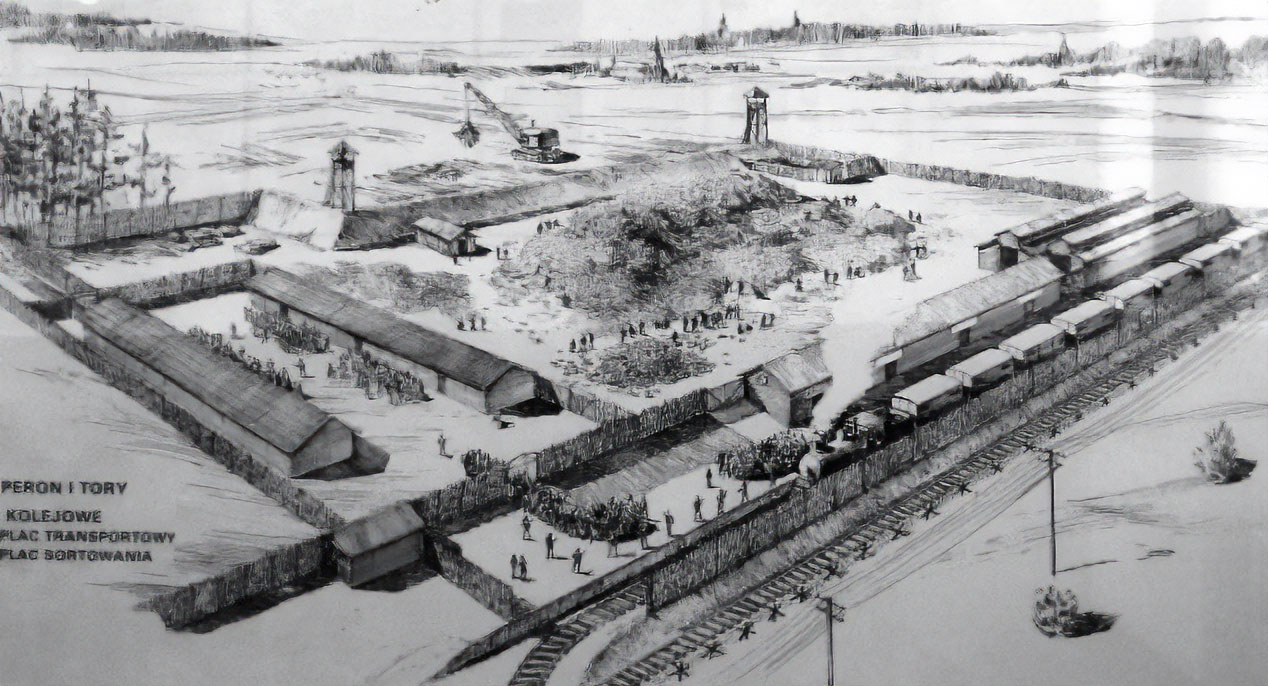
Second, Rajchman’s account goes contrary to the orthodox Holocaust historiography that the Germans made things easier for themselves by tricking their Jewish victims into thinking the alleged homicidal gas chambers were just shower rooms. According to orthodox Holocaust historiography, all the alleged “death camps,” with the exception of Chelmno, which allegedly employed gas vans, had gas chambers made to look like shower rooms, complete with fake showerheads, and the Jews entered them voluntarily completely unaware of the danger. So ask yourself, would the brutal reception described here by Rajchman have helped the Germans with their shower-room ruse? Wouldn’t it have made more sense for the Germans to have made the Jews feel safe when they arrived to avoid arousing suspicion?
The USC Survivors of the Shoah (Holocaust) Visual Histories Foundation has over 50,000 taped interviews of Holocaust survivors. Snippets of these interviews can be viewed on Rumble in the documentary, The Jewish Gas Chamber Hoax.[2] In two such snippets, Jewish gentlemen make the following comments about their arrival at Treblinka. The first one said he was only at Treblinka for four hours before being put back on the same train he arrived in and transited on to the Majdanek Concentration Camp. After describing some train station signs he saw upon arriving at Treblinka, he says:
“Eventually, I look at the sunshine over the trees, some birds were around.”
Does that sound like something a person would comment on or even remember about their arrival at the camp, if they’d been subjected to the kind of brutality described by Rajchman?
The second gentleman interviewed was asked, “What did they [the Germans] make you do first?” to which he replied:
“Nothing, they made me comfortable, gave us to eat.”
They made me comfortable!?! Were the guards the day Rajchman arrived at the camp just in a particularly bad mood?
By the way, the survivor testimonies in the above-mentioned documentary present a major problem for mainstream Holocaust historians. Both Treblinka and Majdanek were “death camps” according to orthodox historiography. And these survivors – there were over a dozen of them in the documentary, women as well as men – say they were sent from one to the other. In other words, they were sent from one “death camp” to another “death camp.” What would have been the point? Perhaps a more troubling question: if they’d been in not just one, but two death camps, how is it they were still around decades later to talk about it? By the way, none of them claimed to have actually seen people gassed in either “death camp.”
Page 20: “Opposite the platform where the barracks stand begins the road to the gas chambers, known as the Schlauch (feeder tube). The road is planted with small trees and looks like a garden path. Down this road, which is covered with a layer of white sand, all must run naked. No-one returns from this road. People driven down this road are beaten mercilessly and stabbed with bayonets, so that after they have been driven down it, the road is covered in blood.
A special commando, known as the Schlauch-Kolonne, cleans the road after every transport. They spread fresh sand so that the next victims will be unaware.”
Given what Rajchman says about how the Jews were treated on the path to the gas chambers, what would have been the point of the Schlauch-Kolonne? If the Jews were “beaten mercilessly and stabbed with bayonets” on the path, what difference would it have been to them whether the path had “fresh sand” on it or not? One possible explanation is that the Germans were concerned that, if the Jews saw blood on the path ahead of them, they would stop and refuse to go any further. That sounds plausible. But consider this: each transport allegedly carried thousands of Jews, and given what Rajchman said about what happened to the Jews on the path – “beaten mercilessly and stabbed with bayonets” – wouldn’t the cries and screams of the first few dozen to enter the path have alerted the thousands behind them as to what was in store for them? Would the condition of the sand have really mattered at that point? Wouldn’t the rest of the Jewish prisoners have been tipped off before even seeing the condition of the sand and run the other way?
One other thing, with all this beating and stabbing going on, wouldn’t the old people, at least, have ended up falling to the ground? And wouldn’t that have slowed the operation down considerably? Is it possible the German reputation for efficiency is undeserved?
Page 20: “The Schlauch road is not long. In a few minutes you find your self in a white structure, on which a Star of David is painted. On the steps of the structure stands a German, who points to the entrance and smiles: – Bitte, bitte! The steps lead to a corridor lined with flowers and with long towels hanging on the walls.”
In The Black Book, we are told that at Treblinka the Jews were handed towels and soap entering the undressing barrack.[3] And that the towels were rudely taken away from them just before they exited the barrack.[4] But here, Rajchman seems to be implying that the shower ruse was perpetuated by “long towels hanging on the walls” of the gas chamber itself. How can the stories of supposed eyewitnesses differ over something so easily observable? And what’s with the flowers? Did the Germans really think that the flowers would make the Jews feel any better about entering the gas chambers after they had just been beaten and stabbed? And given how the Jews were allegedly crammed into the narrow corridor of the gas chamber, how long would those now superfluous flowers have lasted?
Page 22: “We are ordered to retrieve the pairs of shoes which each of us had tied by the laces. We grab the shoes and are driven back to the big open space to a second stack, which is about four storeys high and which consists of nothing but shoes, tens of thousands of pairs of shoes.”
Here’s a picture of a four-story office building under construction. For scale, note on the right the worker on the ground and directly above him the worker bent over on top of the building. Is it believable that prisoners could have thrown their shoes anywhere near that high? It’s possible the Germans created the pile with a crane, but none of the alleged eyewitnesses, including Rajchman, mention the presence of a crane, nor is one depicted in any of the drawings or models of the camp made after the war.
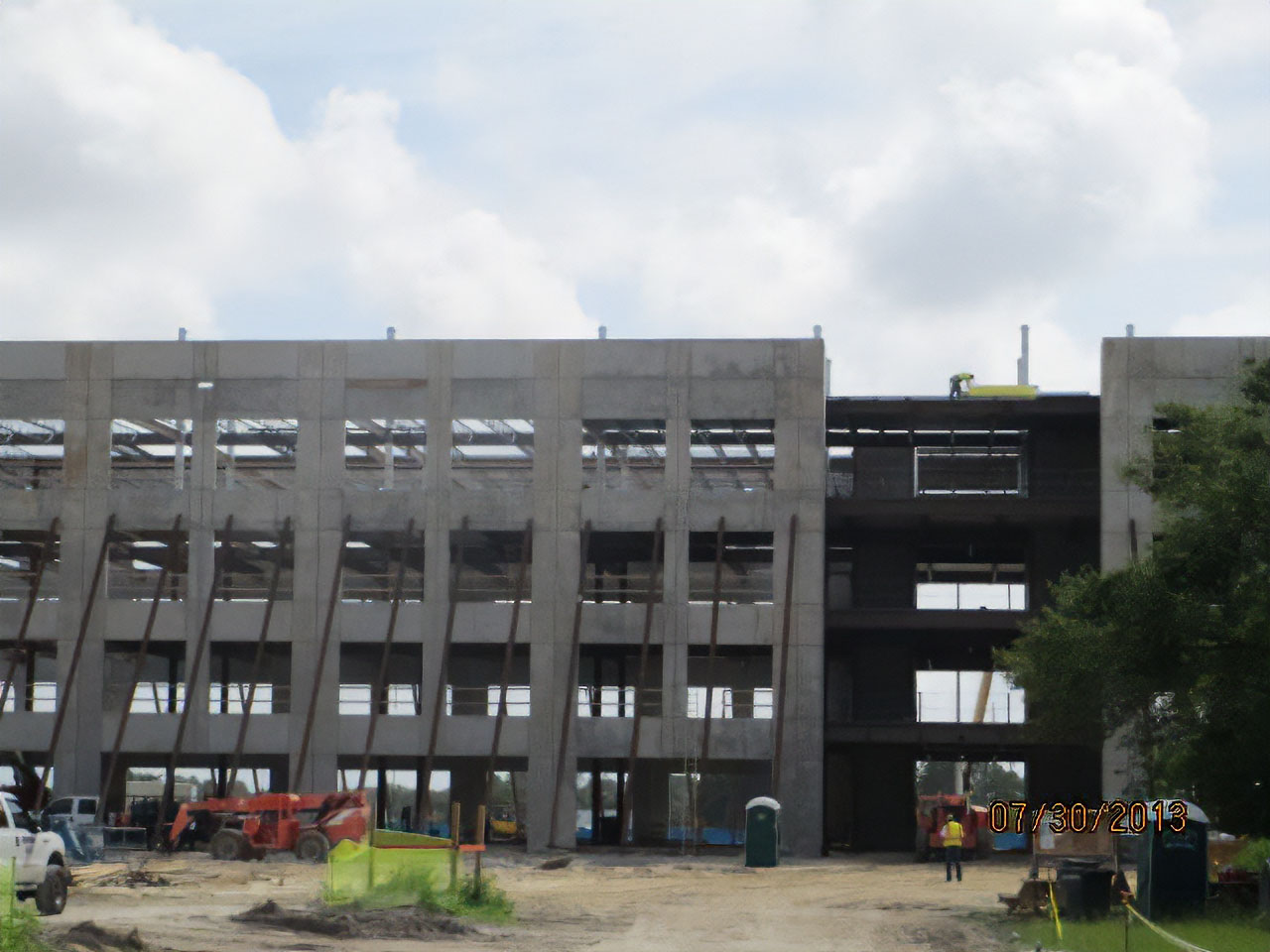
Even back then, there may have been a few cranes that could reach that high, but would the Germans have dedicated such a valuable piece of equipment to perform such a menial task? And considering Rajchman states on page 35 – “The belongings of the new arrivals are being sorted out and appraised. […] Everything of value is to be sent to Germany” – would the Germans have left so many shoes out in the elements for such a presumably long time where rain and humidity would have caused them to rot?
Incidentally, either Rajchman’s calculations of the height of the alleged stack or of the number of pairs of shoes it contained is way off. Keeping in mind that the shoes would have been somewhat squashed, and that, according to the story, roughly a third to a fourth of the shoes would have been children’s shoes, if we use two inches as the average height of a shoe, 3.5 inches as the average width, and eight inches as the average length (10 inches for men, eight inches for women and six inches for children), the average shoe would have taken up approximately 56 cubic inches. Then, if we add another two cubic inches to account for any tiny air pockets inside and between the shoes, we get 58 cubic inches per shoe or 116 cubic inches per pair of shoes. If we then divide 116 into the cubic inches contained in a conically shaped pile four stories (40 feet) high with a 45 degree slope, which comes to 173,717,508, we get just shy of 1.5 million pairs of shoes in the stack, not “tens of thousands.”
Page 30: “As we stand there, we notice a friend, Moyshe Ettinger, from our town. He falls on us sobbing. After he has calmed down a bit, he tells us that yesterday he was running naked to the gas chamber. Along the way he happened upon a pile of clothing and crawled into the middle of it. He grabbed a pair of trousers and a jacket from the pile and put them on. […] In that way he saved himself from death.”
No other so-called eyewitness account of the path that led from the undressing barracks to the alleged gas chamber mentions a pile of clothes. The path is described by Rajchman himself as only two meters (6’6”) wide and bordered by barbed wire. And the path is described as lined by guards who beat the naked prisoners as they went by. Based on this description, the path seems a highly unlikely place to stumble across clothing, much less a pile of it big enough to hide in. This path, as we read above, was, according to Rajchman, resurfaced between every transport. Why would the Germans have left a large pile of clothing sitting on it? Where would the clothing have come from? Weren’t all the prisoners ordered to drop all their luggage before they entered the camp? Weren’t they all ordered to remove their clothes in the undressing barracks? And considering how narrow the path was, wouldn’t a large pile of clothes have been an obstruction? Wouldn’t the people running to the gas chamber have stumbled over and scattered it? Wouldn’t those who followed poor Moyshe have trampled him? Further, since it is alleged that there were guards all along the path driving the victims forward, doesn’t it seem like a highly unlikely environment for one to be able to stop, much less go unnoticed jumping into a big pile of clothes? So, my guess is, either Moyshe made the story up, or Rajchman did.
Page 33: “We stand as if paralyzed. A few minutes pass and we hear pitiful screams. Naked women appear. In the corridor [of the gas chamber building] stands a murderer who tells them to run into the room [one of 10 gas chambers] where we are. They are beaten murderously and driven with cries of “Faster, faster!” I stare wide-eyed at the victims and cannot believe my eyes. Each woman sits down opposite a barber. A young woman sits down opposite me. My hands are paralyzed and I cannot move my fingers. The women sit opposite us and wait for us to cut off their beautiful hair, and their weeping is pitiful and terrible.”
Continuing on page 34:
“Before I have time to turn around, a second woman is already sitting down [for a haircut]. She takes my hand and wants to kiss me: – I beg you, tell me, what do they do with us? Is this already the end? She weeps and begs me to tell her if it is a difficult death, if it takes long, if people are gassed or electrocuted… One victim after the other sits down and the shears cut and cut the hair without stopping. Weeping and screaming can be heard. Many women tear off pieces of their own living flesh and we have to look on and are forbidden to say anything.”
Let’s compare Rajchman’s account with those of three other supposed Treblinka-barber eyewitnesses: Abraham Bomba, one of the more famous Holocaust survivors, having been featured in the documentary Shoah, directed by Claude Lanzmann; anonymous barbers whose accounts were described by Soviet propagandist Vasily Grossman in The Black Book; and the second gentleman I mentioned earlier – the one who said he was made comfortable by the Germans when he arrived at the camp.
In the documentary Shoah, Bomba had the following to say (in somewhat broken English) about his work as a barber at Treblinka:[5]
“But like I mentioned before, when we came in [to the gas chamber], we didn’t know what we gonna do. And then one of the capos came in and they said, ‘Barbers, you have to do a job – to make to believe all those women that came in that they just taking a haircut and going in to take a shower.’ […] No, we did not shave them. We just cut their hair to make them believe that they getting a nice haircut.”
Is Bomba’s account consistent with Rajchman’s claim that the women were “beaten murderously” from the corridor into the gas chamber? Does trying to make the women think they’re getting a nice haircut fit with “women tear off pieces of their own living flesh”? Would “taking a haircut” – which would have been a hatchet job, by the way – have had any impact on their expectations regarding what was coming next after having just been “beaten mercilessly”?
In The Black Book, Soviet propagandist Vasily Grossman gave the following account based on unnamed supposed eyewitnesses:[6]
“For some inexplicable, psychological reason their final haircut, according to the testimony of the hairdressers themselves, had a reassuring effect on the women; it seemed to convince them that they really were about to take a bath. Young girls felt their close-cropped heads critically and asked the barber if he wouldn’t please smooth out some of the uneven spots. The women usually calmed down after the haircut.”
Again, does this fit at all with Rajchman’s account? Would Rajchman’s women have “calmed down”?
In addition, these unnamed barbers in The Black Book claimed the haircuts were given in the undressing barrack, not the gas chamber. They supposedly claimed:[7]
“Inside the women’s bathhouse [barrack] was a hairdressers’ department. As soon as they were undressed, the women lined up to have their hair clipped off.”
Lastly, we have a very short statement by the second gentleman I keep referring to from the Survivors of the Shoah Visual Histories Foundation videos. He also claimed to have worked in the camp as a barber. After explaining to the interviewer that the people had to take their clothes off, an indication that he worked in the undressing barrack, not the gas chamber as Rajchman claimed, he says in broken English:[8]
“I just shaved them with a machine and then close them, spray it.”
So, unlike Rajchman and Bomba, this barber claims he shaved the women’s hair “with a machine,” as opposed to giving them a more time-consuming haircut with scissors. This makes sense, considering the number of people being processed through the camp. And, yes, they did have electric shavers back then. According to Wikipedia, “The first working electric razor was invented in 1915 by German engineer Johann Bruecker.”[9] Getting back to the witness, when he makes his ambiguous “close them, spray it” comment, he makes a waving gesture like he’s pointing a sprayer of some sort at someone. So, it’s very likely he’s describing a delousing process where the women stepped into a little enclosure – “close them” – to be sprayed with insecticide – “spray it.” It is well known that disease spreading lice were a major hygiene issue in Europe during the war. This raises an additional question: Why would the Germans be concerned with the hygiene of people they were about to gas to death?
Page 45: “Suddenly a new murderer appears. He tells us to put down our barrows and leads us to a different job. He tells us to take hold of what looks like ladder-shaped litters. The litters are bloody. Two of us grab a litter and are driven to a distant building. In it are scattered piles of stiff bodies to a height of one storey. These are the people who were gassed.”
This short passage from the book is a complete mess in terms of its lack of adherence to the orthodox history of Treblinka. To put it in context, Rajchman claims he was part of a detail carrying sand in wheelbarrows to the burial pits to cover the bodies of gassing victims, before being redirected by the “new murderer” and “driven to a distant building” with more bodies in it. The reason he was given a litter [=stretcher] was because he claimed he was joining other workers carrying bodies to the burial pits.
Looking at the map of Treblinka below,[10] the alleged killing operation is said to have taken place in the closed-off area shown in the lower right. The grey rectangle designated with the number 28 is the alleged gas chamber, and the beige rectangles of various sizes and shapes, not including number 20, which is outside the alleged killing area, are the alleged burial pits.
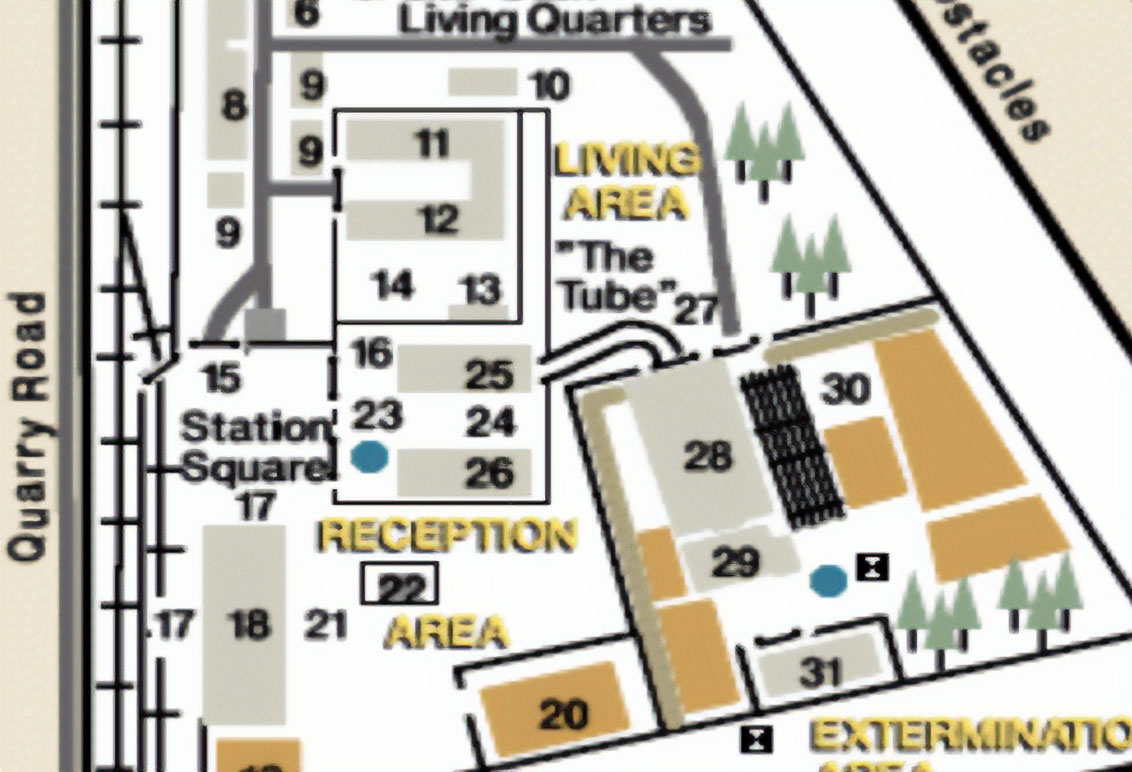
If you look at the map above, you can see that there were, according to the orthodox story, only three buildings in the alleged killing area: 28 is the main alleged gas chamber, 29 is the original smaller alleged gas chamber, and 31 is the alleged workers’ barrack. Since there is no separate building that could have stored bodies, it’s safe to assume the “distant building” Rajchman refers to is one of the two alleged gas chambers. If we take the main gas chamber, which is the furthest from the alleged burial pits, just how distant would it have been from where Rajchman claimed he was delivering sand?
Below is another map of Treblinka with a distance key.[11]
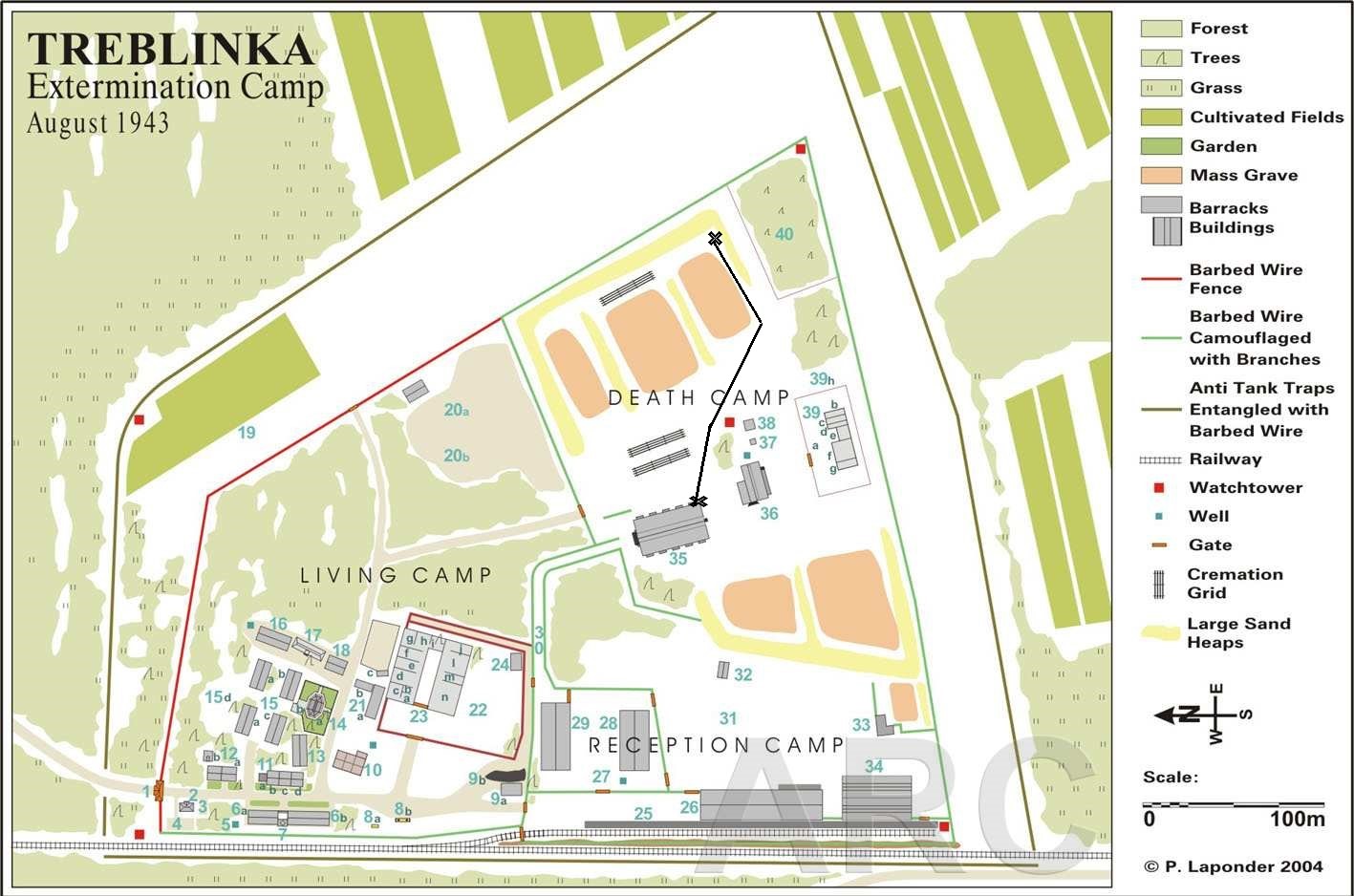
According to this map, the furthest Rajchman could have been “driven” is a mere 150 meters, less than a tenth of a mile. (See the brown line zigzagging through the “Death Camp.”) Sparing you the mathematical calculations, this is less than a two-minute walk at a normal pace, shorter if, as Rajchman says, he was “driven,” meaning hurried there. So, doesn’t it seem odd that Rajchman would refer to the building as distant? Did he have a penchant for gross exaggeration, or did he simply not know what he was talking about?
By the way, the above maps are not proof of a gas chamber or burial pits. They simply represent the descriptions provided by “witnesses” like Rajchman. There was no physical evidence at the end of the war to corroborate their stories. According to the United States Holocaust Memorial Museum website, the camp was completely dismantled in November 1943, and the Red Army didn’t overrun the site until the last week of July 1944, some eight months later.[12]
Then there’s the problem with what he says about what he found there. He says, “In it are scattered piles of stiff bodies to a height of one storey.” Crammed into this one short sentence are three major problems. According to the orthodox story, after the victims were gassed to death, their bodies were immediately removed from the chamber, supposedly within a few minutes according to some “witnesses.” In the documentary Shoah mentioned earlier, barber Abraham Bomba claimed the bodies were removed in just two minutes, to make room for the next group of victims. This is an absurd claim, given the number of bodies that are alleged to have been gassed at a time, but regardless, what would have been the point of stacking bodies inside the gas chamber, if you plan to use it again in short order? Besides, there apparently wouldn’t have been any room inside the gas chamber for piles. According to another “eyewitness,” the victims were jammed into the gas chambers so tightly they didn’t fall to the floor when they died.[13]
Which brings us to the second problem, the height of the piles he mentions. It would have been impossible for the alleged workers who removed the bodies from the gas chamber to pile them up “to a height of one storey.” That’s 10 feet! Anyone who has ever tried to jump up and touch the rim of a basketball hoop knows how high that is. Probably less than 10 percent of young men can manage it with a running start. So how could underfed and overworked Jews, a population not known for either their height or athletic prowess, have possibly managed to stack bodies that high? It’s absurd, not to mention pointless. On top of that, wouldn’t a pile of bodies that high have been unstable and prone to tipping over?
Lastly, the bodies would not have been, as Rajchman describes them, “stiff.” The bodies Rajchman was talking about had allegedly just been gassed to death. So, they would have been dead for less than an hour. Rigor mortis of the torso, arms and legs doesn’t kick in for some six to 12 hours after death.[14] And in cases of death from carbon-monoxide poisoning, the method allegedly used at Treblinka, rigor mortis is “delayed.”[15]
As an aside, why would the technologically advanced Germans have chosen a means to move hundreds of thousands of bodies that predates the invention of the wheel? Litters?
Page 46: “Along the way stand the ‘dentists’ who inspect every corpse to see if it has any gold teeth. Not knowing about this, I don’t stop, because I’m afraid of being beaten. A dentist sees that the corpse I am carrying has gold teeth. He stops me and won’t let me go any further since he has to extract the teeth.”
According to official or orthodox history, upwards of 800,000 Jews are said to have been gassed between July of 1942 and October of 1943. That’s roughly 450 days. This means the average number of Jews gassed per day would have been around 1,800. Yet supposedly, the Germans had the time to have dentists check the mouth of each victim as it went by, and do oral surgery on the ones with gold teeth.
Yitzak Arad, who was the director of Israel’s holocaust museum Yad Vashem for 20 years, has a passage about the Treblinka gas chambers on page 121 of his book Belzec, Sobibor, Treblinka: The Operation Reinhard Death Camps, that reads:
“When the work lasted for about fourteen hours, 12,000 to 15,000 people were annihilated.”
That’s six to eight times more than the average daily figure I just came up with. If Arad is to be believed, the claim that dentists were deployed to check the mouths of every gassing victim appears even less plausible.
Page 52: “After them comes the Schlauch (feeder tube) group. Their job consists of removing the blood of the victims spilled on the way to the gas chambers. Everything is covered with sand so no trace will remain. After cleaning the road they enter the gas chambers and wash the walls and floors. There must be no trace of blood. The entrances to the gas chambers are opened and a painter gives the walls a fresh coat of paint. Everything must be spotless before receiving new contingents in the cells.”
Here, in addition to the absurd path-refreshing story I’ve already commented on, there is a cleaning and painting story. While that would possibly have been consistent with the story that the Jews walked willingly into the gas chambers thinking they were shower rooms, that’s not what Rajchman says happened. According to Rajchman, the Jews didn’t voluntarily walk into the gas chambers at all, but rather were brutally forced into them. On page 39, Rajchman describes the scene when the Jews arrived at the alleged gas chamber, where he is cutting the hair of the women as follows:
“The woman [whose hair he just cut] has not had time to get up when a murderer walking between the benches lashes her head with his whip. Blood shows on her shorn head. She jumps up and runs where all are running.”
By the way, doesn’t he seem to be talking about a shaved head here? Then on the same page he writes:
“We finish our work and remain standing at our places for a while, because the way out is filled with naked men being driven to the gas chambers. They run through a chain of murderers who stand on both sides and beat them.”
Rajchman’s book was actually published together with a long article written by Soviet propagandist Vasily Grossman, titled The Hell of Treblinka, which started on page 115. On page 147, Grossman offers an even more violent account of how the Jews entered the gas chambers:[16]
“Then the S.S. men would unleash their well-trained dogs, who would throw themselves into the crowd and tear with their teeth at the naked bodies of the doomed people. At the same time the S.S. men would beat people with submachine-gun butts, urging on petrified women with wild shouts of ‘Schneller! Schneller!’ Other assistants to Schmidt were inside the building, driving people through the wide-open doors of the chambers.”
If we are to believe either of these accounts, how would a fresh coat of paint on the gas chambers’ walls, not to mention the presence of dummy shower heads inside the chamber, have served any purpose whatsoever?
Page 60: “The pits were dug by a bulldozer (later on there were three of them). The pits were enormous, about 50 metres long, about 30 wide and several storeys deep. I estimate that the pits could contain about four storeys.”
While bulldozers can be used to dig relatively shallow, sloping holes, like for an artificial pond, they are not well suited for digging. That is usually the job of an excavator. Every other “eyewitness” account of how the mass graves at Treblinka were dug said it was done by excavators. Not exactly a “gotcha” moment, but it’s rather odd that someone who claimed to work in the so-called killing operation for months didn’t know the difference between a bulldozer and an excavator, which look nothing alike.
A related mystery is the fact that none of the Treblinka “eyewitnesses” ever mentioned shoring. A hole the size Rajchman describes would need significant shoring up. Imagine a wall of earth four stories high and 162 feet long. Then imagine two of them. To keep these massive walls from collapsing in on the Jews that allegedly worked in the pits, German engineers would have had to drive dozens of huge steel pilings deep into the earth to hold in place thick wooden planks that would have covered 21,000 square feet of earthen wall. It would have looked something like this:
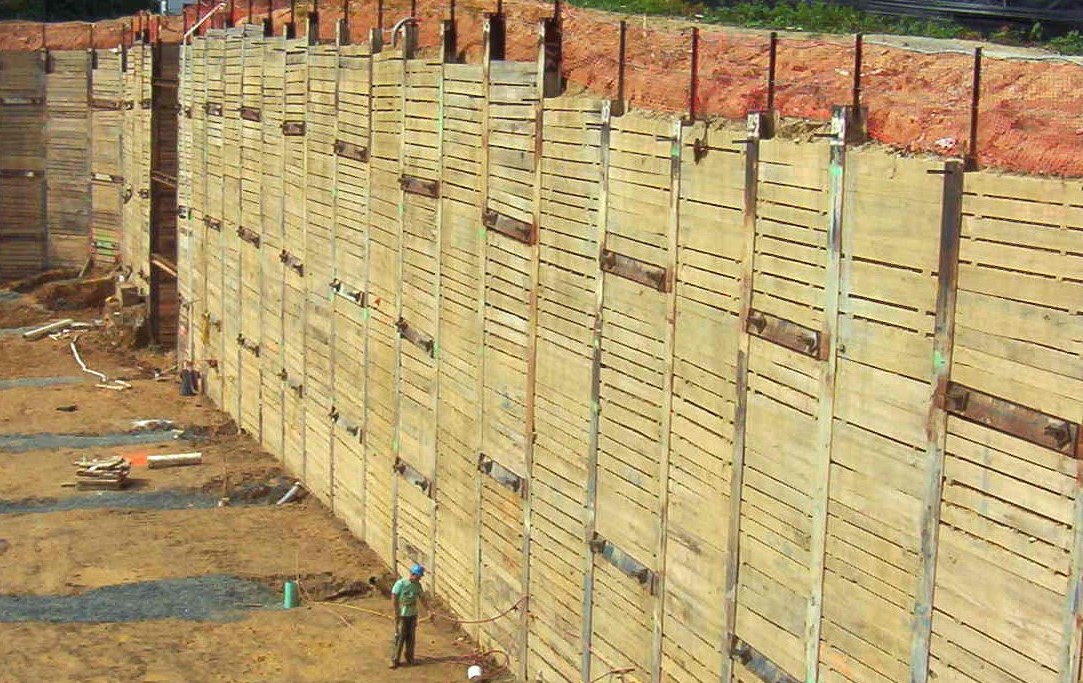
You would think a wall this impressive would have elicited a comment from at least one witness. Actually, Rajchman does make a relevant comment on page 68 of his book:
“Since the pits became narrower as they grew deeper, and the earth along the sides would crumble.”
According to the Occupational Safety and Health Administration (OSHA), narrowing a pit as you dig deeper, sloping, is a legitimate substitute for shoring. The only problem for Rajchman is that this standard only applies to a depth of 20 feet.[17] Rajchman claims the pits were twice that deep. Therefore, Rajchman’s pits would have to have involved some sort of barrier like the one above. But if there was such a barrier, Rajchman’s comment that “the earth along the sides would crumble” makes no sense. The earth along the sides of the pit would have been covered and thus invisible to the workers.
Another problem here is the width of the pit described by Rajchman. Thirty meters is 97.5 feet. So, to dig out the middle of the pit, the boom of the excavator would have to have been 49 feet long. But based on the picture below of two German guards taking a ride on the bucket of an excavator in the Treblinka I Labor Camp – not the Treblinka II Death Camp Rajchman claims to have been in – the boom appears short.
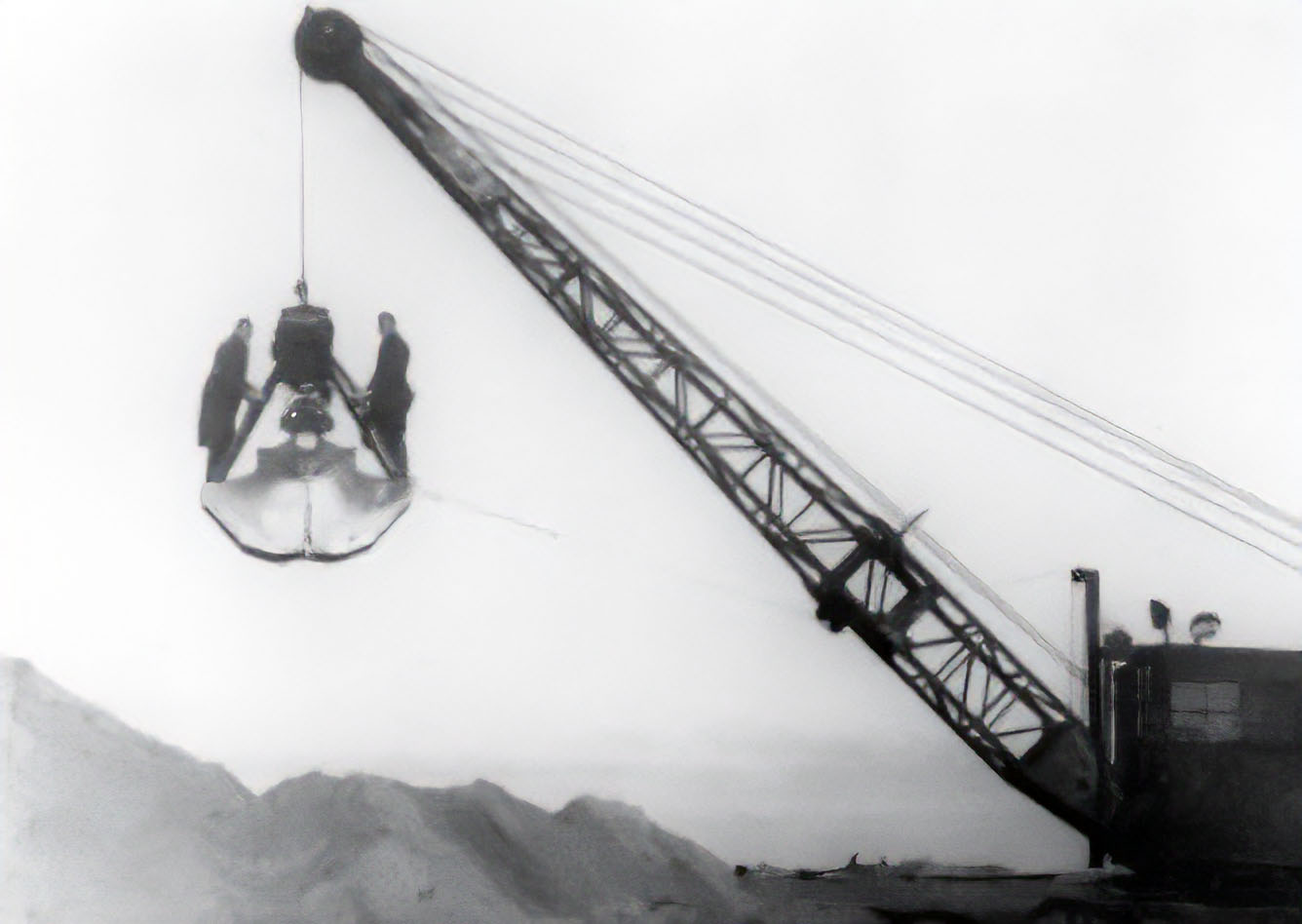
I think it’s safe to assume that, if the Germans did dig burial pits in Treblinka II, the excavator they used would have been very similar, if not identical, to the one pictured here in Treblinka I. If we estimate that the guard on the right is roughly six feet tall, it is possible to estimate the length of the boom at around 38 feet. If the sides of the pit were not shored up as described above, the heavy excavator would have to have stayed clear of the edge of the pit to avoid toppling in. So, if the excavator was set back another five feet from the edge of the pit, its boom could only have reached 33 feet, a third of the width of the pit. This means the middle third of the pit would have been unreachable. Thus, the burial pits, if there were any, could not have exceeded a width of 20 meters. Not a huge mistake by Rajchman when compared to all the others, but it adds one more to a growing list. Keep in mind that, if Rajchman is not a credible witness and none of the other witnesses are, there is no reason to believe there were any large burial pits at Treblinka; in fact, there is reason to believe there weren’t any.
Page 66: “In general, even in summer, the victims tried to arrive at the gas chambers as quickly as they could during the final passage along the Schlauch [path to the gas chamber]. The gas chambers offered protection from the beatings, and people wanted to get everything over with as quickly as possible.”
Get everything over with? Here it sounds like Rajchman is saying the Jews already knew on the path that they were going to their deaths. So, again, what would have been the point of cleaning the path and the gas chambers between every transport, of having dummy shower heads in the alleged gas chamber, and of lining the gas chamber corridor with towels and flowers?
Page 68: “When great piles of this kind of finished ash had accumulated, the Germans began to carry out various experiments with a view to getting rid of it and erasing every trace of the murders that had taken place. […] After the experiments they decided to bury the ash deep in the ground under thick layers of sand.
A shallow layer of ash was poured into the deep pits from which the corpses had been exhumed, then on top of that a shallow layer of sand, and so forth until they had reached the level of about 2 metres below the surface. The last 2 metres were filled only with sand. In this way they reckoned that they would erase forever the traces of their horrible crimes.”
Here, Rajchman is talking about how the Germans supposedly disposed of the inmates’ ashes after they’d been burned. In this rare instance, Rajchman’s account is in line with the mainstream, but interestingly not with The Black Book. In The Black Book, Soviet propagandist Vasily Grossman, the same author whose long article was appended to Rajchman’s book, said it happened this way:[18]
“Charred bones and ashes were carried outside the camp grounds. Peasants from the village of Wulka were mobilized by the Germans to load the stuff on carts and strew it along the roads leading from the death camp to the Polish labor camp.”
Also in The Black Book, Russian-Armenian correspondent and novelist Vagram Apresian claimed it happened still another way:[19]
“Millions of people had been murdered here by the Germans. This dreadful black road cut through the Treblinka field. It was black because, for three kilometers, it was covered with human ashes. Tons of ashes had been brought here in carts. Eleven thirteen-year-old prisoners shoveled the ashes along the road. They were called ‘the children from the black road.’”
Apparently, these last two accounts of the disposal of ashes fell out of favor with mainstream historians, who decided to go with the ash-burying story, probably because it was consistent with the Russians not finding any. Ultimately, it doesn’t matter which way the historians went, because there is no physical evidence to corroborate either story. Isn’t it interesting that no mainstream historian has ever commented on how divergent these “eyewitness” accounts are? The historians just picked one and went with it, witness credibility be damned. When partners in a criminal conspiracy are taken into custody, the police separate them to prevent them from comparing notes and agreeing on an exculpatory set of claims. Orthodox Holocaust historians, on the other hand, have been free for decades to coordinate and get their story straight. And yet, it still appears to be a work in progress.
Page 68: “The Jewish workers who were employed in the emptying of the pits nevertheless used every opportunity to leave behind in the earth some remains of human bones. […] every time the Germans and their informers were absent the workers would bury as many bones as they could beneath a layer of sand.”
Ultimately, there is no way to check the veracity of this story, because when the Russians took the area of Poland around Treblinka in August of 1944 and went to where the camp once stood, they apparently didn’t bother to look for physical evidence of remains. Unlike the Germans, who, while the war was still waging, extensively excavated the site of a Soviet massacre of more than 4,000 Polish officers in Russia’s Katyn Forest, the Russians chose not to perform a single excavation at the site where it was alleged that close to a million Jews had been massacred. This is beyond peculiar, especially considering the top Soviet war propagandists at the time, Ilya Ehrenberg and the afore-mention Vasily Grossman, were Jewish themselves. In November of that year, a Jewish-Polish commission led by a Polish judge did finally excavate the site, but, unfortunatley for orthodox historians, found very little in terms of human remains and ashes, certainly nothing to warrant a belief in the orthodox story that there were located five gigantic mass graves.[20]
As for Western attempts to find the evidence, which didn’t happen until 65 years later due to the fact that a Soviet “Iron Curtain” descended over Eastern Europe after the war, virtually nothing was found. In 2010, a British forensic archeologist by the name of Caroline Sturdy Colls made the attempt, sort of. As an archeologist, she certainly knew that digging is the best way to unearth the past, but the Jewish religious authorities in Poland denied her that opportunity. Instead, she and her team were left with employing ground-penetrating radar. Not surprisingly, very little was found, her boast of finding definitive proof of the Holocaust notwithstanding. While one may understand the sensibilities of the religious authorities and their decision to forbid Sturdy Colls from digging on the former camp grounds, it seems strange considering it might have confirmed beyond any doubt that some 800,000 Jews had died there at the hands of the Germans. If the remains were there, not allowing them to be found would seem to be the greater desecration. On the other hand, if they weren’t, allowing digging at the site could have resulted in a public-relations catastrophe for Israel and Zionists everywhere. Could that possibility have influenced the Polish Rabbis’ decision?
By the way, it’s doubtful Colls’s archeological expedition was authentic. It was filmed and made into a BBC documentary, most likely in order to rehabilitate the orthodox history, after Western revisionists had poked numerous holes in it. A devastating documentary critiquing Colls’s work titled The Treblinka Archeological Hoax can be found on Rumble.
Page 72: “He assures our section chief that from now on the work will go much better. He lays down ordinary long, thick iron rails to a length of 30 metres. Several low walls of poured cement are built to a height of 50 centimetres. The width of the oven [pyre] is a metre and a half. Six rails are laid down, no more. He orders that the first layer of corpses should consist of women, especially fat women, placed with their bellies on the rails. After that anything that arrives can be laid on top: men, women, children. A second layer is placed on top of the first, the pile growing narrower as it rises, up to a height of 2 metres.”
While it is true that women on average have a slightly higher body-fat content than men by nature, and that fat is the thing that burns most readily on humans, it is not true that putting women on a pyre first would have been particularly advantageous. A scientific study that looked at the cremation of 50 men and 50 women concluded that, while obesity is a factor, gender is not:[21]
“The body fat percentage seems to have a direct correlation with the highest temperature reached during the oxygenation phase. […] At the same time, the age and sex of the subjects does not seem to be a relevant variable.” (Emphasis added)
So, if the Germans were paying attention, they wouldn’t have bothered with this. But the notion is a good one, if you want to spice up your story a bit.
As for the fat women Rajchman speaks of, where would they have come from? During the war, there were no fat people to speak of in Europe, man or woman. Due to the war’s disruption of food production and distribution, the confiscation of crops and livestock within the territories occupied by Germany, and the British naval blockade of the entire continent, famine was widespread in Europe. In Poland, for instance, where many of the Treblinka inmates would have come from, the population got by on just 600 calories per day,[22] less than a fourth of what the average American consumes today. As to the Jews, specifically:[23]
“The daily rations for Polish Jews amounted to a derisory 184 calories. The majority of the 100,000 Jews who died in the Warsaw ghetto succumbed to starvation.”
I should mention here that during the war millions of people of numerous ethnicities, not just Jews, starved to death, and regrettably have been all but forgotten.
Regardless of who was placed on the pyre first, the cremation process described by Rajchman couldn’t possibly have worked. It doesn’t provide for enough wood. Earlier, he says the grate was only about 20 inches high. This is significant, because it limits the amount of wood that can be used at any one time. Then, on the next few pages, Rajchman goes on to establish that there was only one time. On page 73, he states:
“In this way some twenty-five hundred corpses are piled on. Then the specialist orders dry twigs placed underneath and lights them with a match. After a few minutes the fire flares up so strongly that it is difficult to get any closer to the oven [pyre] than 50 metres [162.5 feet].”
And on page 75, he goes on to indicate that the intense heat wasn’t just an initial condition of the fire, but was one that persisted throughout the incineration:
“The Artist [the alleged German designer of the process] is still not satisfied. He sees that the work is hampered by the intense fire, which does not let anyone get close to the oven [pyre].”
Incidentally, another Treblinka survivor, Jankiel Wiernik, concurred with Rajchman. In chapter 11 of his book One Year in Treblinka, Wiernik described it this way:
“The pyres sizzled and crackled. The smoke and heat made it impossible to remain close by.”
So, according to these two “eyewitnesses,” adding more wood to the fire after it had started was impossible.
Therefore, is a pile of wood 20 inches high enough to fully cremate a stack of bodies two meters high?
A somewhat analogous process to the alleged cremations at Treblinka is the traditional outdoor Hindu funeral pyre, which, according to Wikipedia, uses anywhere from 500 to 600 kilograms of wood per body.[24] Is this a fair comparison? Well, on the one hand, a Hindu pyre is considerably more efficient, because it involves only one body, and the one body is placed directly on the wood as opposed to on a grate like that described by Rajchman. When a grate is present, more heat from the fire gets dissipated as the wood is consumed, and shrinks away from the grate and the bodies on top of it. Also, Hindu cremations use hardwoods that produce around 50% more heat than soft woods,[25] like the pine the Germans would have had available. Lastly, a Hindu cremation uses seasoned (dried) wood, compared to the unseasoned (freshly cut) wood the Germans supposedly used. Seasoned wood puts out roughly twice the heat by volume as freshly chopped wood.[26] On the other hand, the bodies of the alleged victims at Treblinka would have been smaller due to the famine, and would have burned more readily because they would have lost moisture due to putrefaction while buried for up to six months. Hence, although it isn’t a scientific analysis, I think it’s more than fair to the orthodox view to equate the two processes.
So, how many kilograms of pine wood would have fit beneath the grate Rajchman described? To simplify the math, we will determine the amount of wood that would have fit beneath a single column of bodies as opposed to the entire length of the pyre. So, what would the dimensions have been? As you’ll see explained below, I estimate the average width of the alleged victims to be 15 inches. Rajchman gives us the other two dimensions, 20 inches for height of the grate and a meter and a half or roughly 60 inches for the width of the pyre. If you multiply the three dimensions (15 in × 20 in × 60 in), you get a total volume of 18,000 cubic inches or 10.42 cubic feet. The most common variety of pine in Poland is called Scots Pine (pinus sylvestris).[27] Freshly cut, it weighs 52.75 pounds per cubic foot.[28] Multiplying 10.42 cubic feet with 52.75 pounds per cubic foot, we get around 550 pounds or around 249 kilograms. That’s less than half of the roughly 550 kilograms used in Hindu cremations to fully cremate just one human body, not a pile of bodies stacked ten layers high (I calculated the probable number of layers stacked further below). So, not only is the space under the grate described by Rajchman inadequate for the amount of wood that would have been needed for the cremation, it was off by a factor of 20. Put another way, if all the wood that was needed in Rajchman’s story was placed under the grate at the same time, the grate would have been over 33 feet in the air!
After having gone through all that, I must admit that there’s a simpler explanation. Rajchman and Wiernik lied when they said it was impossible for anyone to get close to the fire. Exaggerating for dramatic effect does seem to be a thing among Holocaust “eyewitnesses.” In this instance, it’s worse than you might think. Considering the initial amount of wood was woefully inadequate and, therefore, that the fire would have died down way before the job was done, both Rajchman and Wiernik seem to be implying that the stack of bodies themselves caught fire and created the inferno that kept the workers at bay. Hopefully, from the above discussion regarding the amount of wood required for cremation, it should be self-evident that bodies don’t burn without fuel. They don’t catch fire when some twigs are lit beneath them, and then keep burning on their own. So, the choice is to either believe in a manifestly unbelievable story, or accept the fact that Rajchman simply lied.
Lastly, there is Rajchman’s claim that 2,500 bodies could be placed on the pyre. Rajchman says the bodies were stacked to a height of two meters (78 inches). However, he doesn’t mention whether that’s measuring from the ground or from the grate which he says was around 20 inches off the ground. But if he was measuring from the grate, that would mean the workers had to pile the bodies to a height of 98 inches, over eight feet high, or over two feet above their heads. So, I think it’s fair to assume he was measuring from the ground. Even then, the top layer would have been over the heads of nearly all the workers. So, if we subtract 20 inches, the height of the grate, from 78, the overall height of the pile Rajchman claimed, we get 58 inches for the height of just the stacked bodies. The average depth of an adult American (front to back) is around eight inches.[29] But we’ll go with six, because some of the alleged victims were children, all were malnourished and, as mentioned above, most would have lost body mass due to decomposition. (Note: about 7% of those allegedly cremated at Treblinka weren’t buried, but went straight from the gas chamber to the pyre. So, nearly one out of ten bodies would not have suffered moisture loss.) If we divide 58, the height of the pile of bodies in inches, by 6 inches, the depth of a human body given the conditions, we get the number of layers of bodies. Rounded up, it comes to 10 layers. So, how many bodies would be in each layer? The average width of a human body is roughly 17 inches on average, 18 inches at the shoulders and 16 at the hip.[30] If we subtract a couple of inches from this average for the reasons just mentioned, we get 15. Rajchman described the pyres as 30 meters (1,170 inches) long. If we divide this figure by 15, we get 78 bodies on the first layer of the pyre. He also said the pile of bodies narrowed as it went up. So, if we subtract one body from each layer as the pile rises, 77 on the second layer, 76 on the third, and so on, we get a total of 735 bodies, not 2,500. Even if you go with a full two-meter pile of bodies, an additional three layers, the total would still have only come to 936.
So, why did the so-called eyewitnesses tell such an outlandish lie? I think the answer is time. In order for the “eyewitnesses” to make their claim plausible that the Germans, to hide their crime, managed to cremate some 800,000 bodies in just 122 days,[31] a realistic cremation method of placing one layer of bodies on the pyre at a time was turned into 10 layers, and the number of bodies that made up a layer more than tripled.
Page 75: “Every day new ovens [pyres] are constructed, more and more of them. After a few days there are six of them.”
Perhaps subconsciously realizing he had a problem, Rajchman triples the number of pyres here. But as you can see on the two maps of Treblinka below, circled in red, the historical consensus is still two.
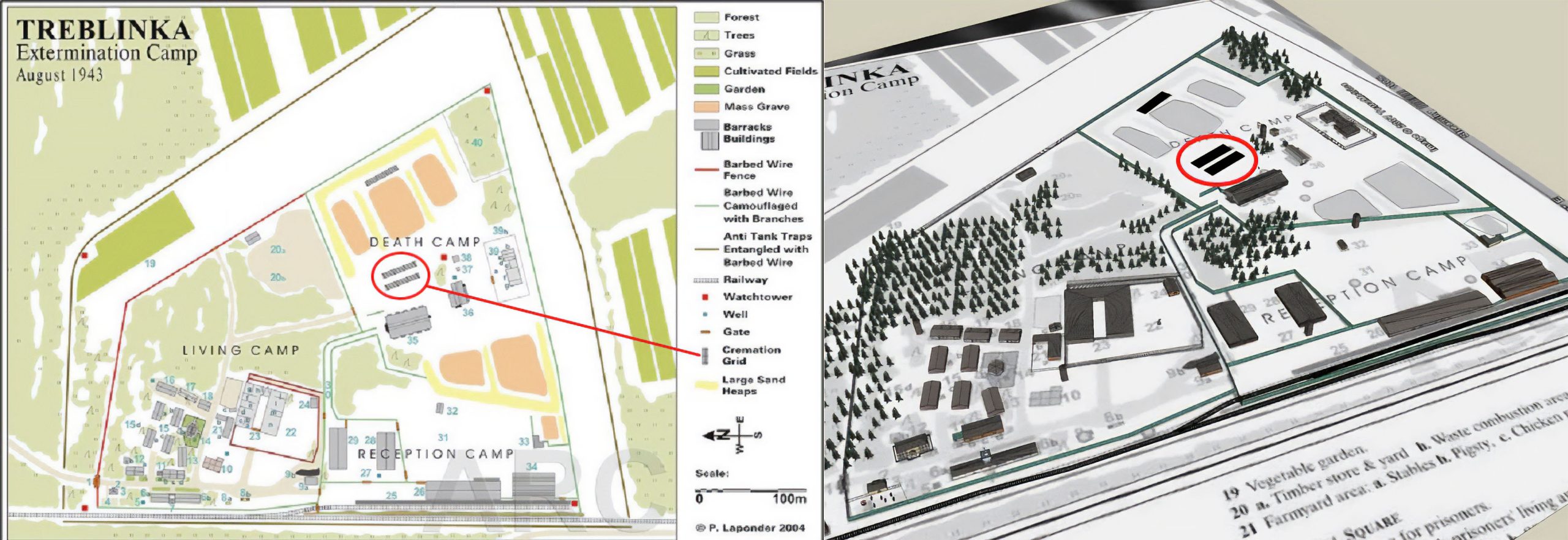
Looking at the maps, I use the word map loosely here, it doesn’t appear that there was enough room for any more than that in the alleged killing area of the camp. Of course, that there were any pyres at all is based only on the accounts of eyewitnesses like Rajchman. No physical evidence of the pyres, the burial pits, or the gas chamber was ever produced by the Soviets, who after the war had control of Poland and exclusive access to the grounds where the camp once stood.
Page 76: “From day to day the work improves. The ovens are moved from place to place, closer to the pits, so that the path is shorter and less time is wasted. It once happened that an oven was moved close to a huge grave where perhaps a quarter of a million people were buried. As usual the oven was loaded with the proper number of bodies and in the evening it was lit. But a strong wind carried the fire over to the huge grave and engulfed it in flames. The blood of some quarter of a million people began to flare, and thus burned for a night and a day. The whole camp administration came to look upon this marvel, gazing with satisfaction at the blaze. The blood came up to the surface and burned as if it were fuel.”
Referring back to the two maps of Treblinka above, it doesn’t appear that there would have been much room for the Germans to move the pyres “from place to place.” Regardless, even if we assume the pyres were close enough for the flames to reach the alleged burial pit, the pit could not have ignited. As mentioned earlier, human bodies don’t burn on their own, much less blood, which is mostly water. Blood is not “fuel.” It doesn’t behave like gasoline. If the blood of the alleged victims burst into flames, it would have been more than a “marvel,” it would have been a miracle.
By the way, since the story is that the Jews were gassed to death, not shot or stabbed to death, what percentage of them would have been bleeding badly when thrown into the pits? Rajchman claims that at least some of the victims were stabbed by bayonets on the way to the gas chamber, but apparently none so deeply that they couldn’t keep going. And when Rajchman describes the women whose hair he cut in the gas chamber, he makes no mention of them bleeding or being woozy from loss of blood. So, what is the likelihood that the bodies that were allegedly thrown into the burial pits were swimming in so much blood that the pressure of the weight of the bodies and soil on top of them could have pushed it to the surface, assuming that’s even possible? Doing a rudimentary search on the internet, I was unable to find any other examples of this phenomenon outside the context of the Holocaust.
Page 84: “By the end of June the space of the eleven pits, where hundreds of thousands of bodies had lain, was completely cleared. The earth was smoothed out and sown with lupins.”
The maps of Treblinka shown earlier indicate there were five burial pits of a variety of sizes. Below is a model of the camp constructed after the war which, once again, shows only five pits.[32]
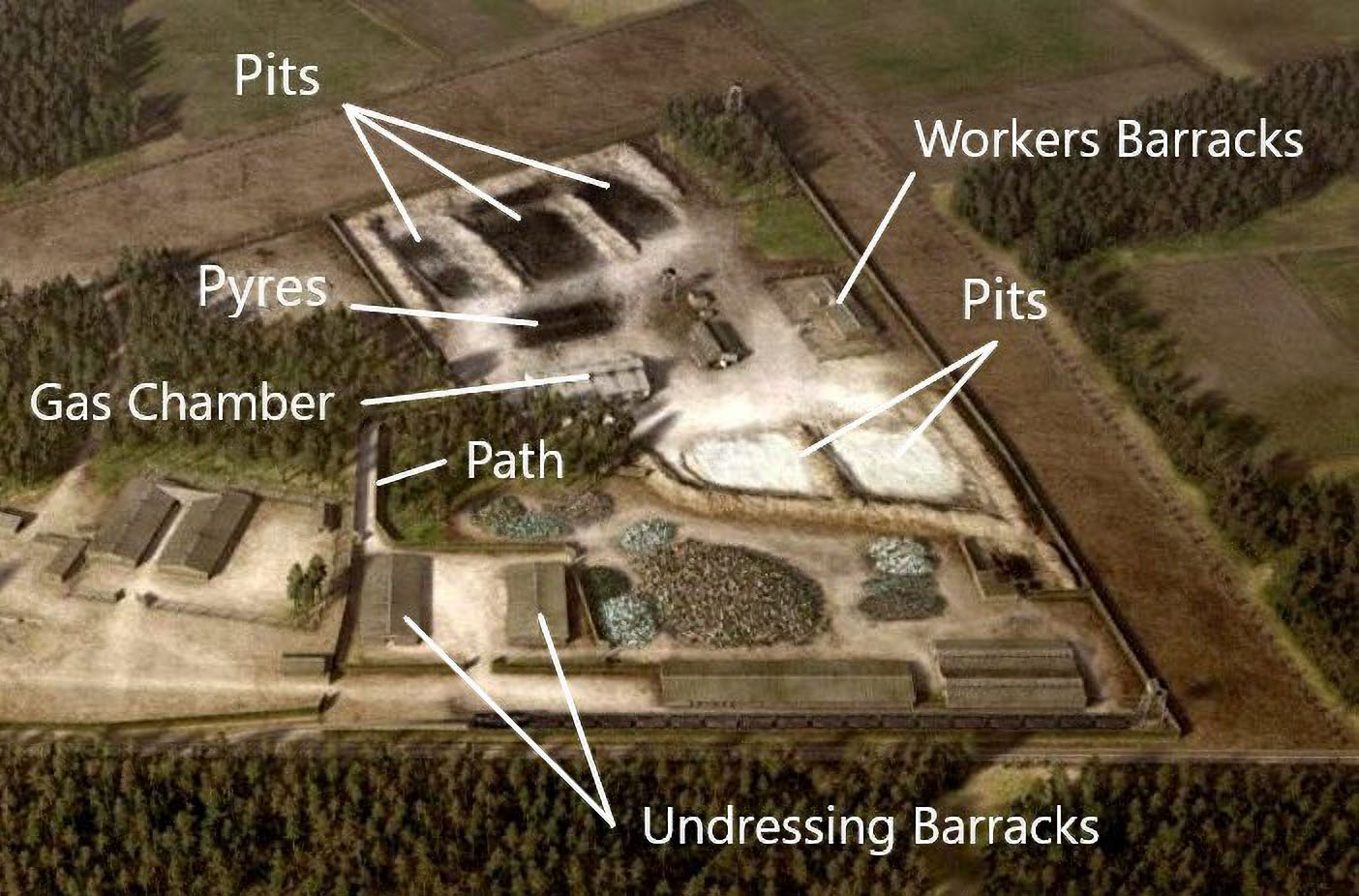
It appears therefore that Rajchman is at it again, this time more than doubling the orthodox number of burial pits.
This is not to say that the orthodox number of pits has anything to do with reality either, just that mainstream holocaust historians disagree significantly with Rajchman here. In other words, even they don’t believe him. Bottom line, there is no physical evidence, at least none that would hold up in a neutral court of law, that there were any large burial pits at all in Treblinka.
And don’t get confused: The model shown above is simply a representation of what a few people said; people who may have been motivated to lie.
Page 98: “I recall the night of the seder: several comrades performed the ceremony. It was breezy outside, the ovens were burning, and the flames were flaring. That evening ten thousand Jews were burning; in the morning no trace would be left of them. And we carried out the seder according to all the rules.”
A common theme among alleged survivors is the Germans committing atrocities on Jewish holy days or while Jews were engaged in religious services. In this instance, Rajchman claims the cremations took place during a seder, a ritual meal commemorating Passover. This theme is so common it suggests that it may have been a tactic used by the alleged witnesses to make the Jews appear more pious. As part of a propaganda campaign, this theme would have worked particularly well back in the 1940s, when people were generally more religious than they are today.
Gratuitous piety aside, given the two pyres that mainstream historians say they had to work with, how believable is Rajchman’s claim that the Germans cremated 10,000 corpses in a single night? There would have been six steps involved in the process:
- carrying the wood to the pyre and stacking it under the grate;
- carrying the bodies from the burial pits and stacking them on the pyres;
- burning the bodies and teeth to ashes;
- sifting out the bones and teeth from the ashes;
- pulverizing the bones; and
- burying the wood ash and pulverized material in the burial pits.
According to Treblinka Museum in Poland, 300 workers were tasked with this job.[33] However, not all of them could have been working at the same time, for the simple reason that not all of them could have slept at the same time. The alleged workers barrack is too small.
Below is a closeup of a section of the “death camp” area shown in Figure 4 that shows the workers barrack area in greater detail. Referring to the key below, the gray square structure designated “39-f” was the alleged “Men’s Quarters.” If you refer back to Figure 4, it is possible using its distance key to estimate that the barrack was only 35 feet long and wide. That comes to a total of 1,225 square feet, the size of a two-bedroom apartment. If they stacked the sleeping quarters four high and limited each worker to three feet of sleeping space, it could only have accommodated 150 workers at a time. If we assume the workers needed at least eight hours of sleep per day, the workers could have been organized into two 16 hour shifts of 150 workers each, with an overlap of eight hours where all 300 were working at the same time, or they could have been organized into three shifts of 100 workers each with two shifts overlapping at all times. In other words, with 200 workers on the job at all times. For simplicity’s sake, we will go with the latter. Either way, it works out to the same in terms of overall work hours. So, how long would it have taken 200 workers to complete the six tasks?
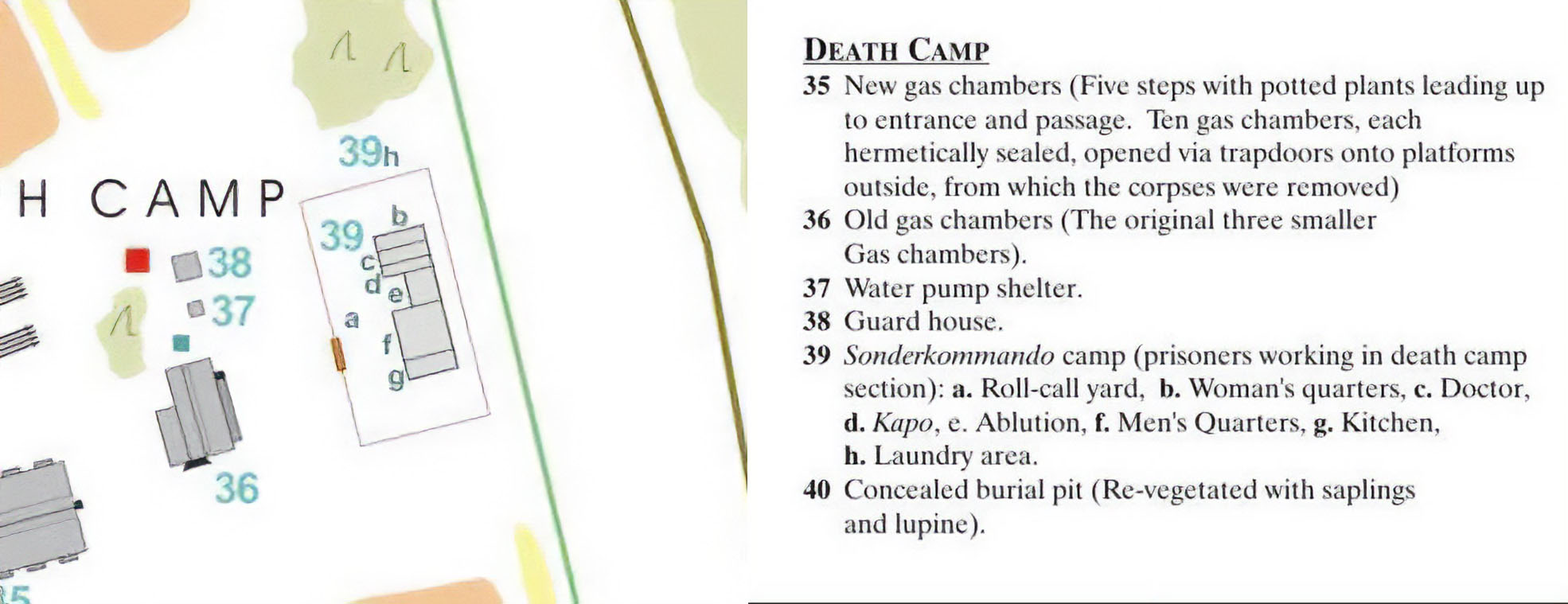
The first two steps could have taken place at the same time. One hundred workers could have hauled and stacked wood while the other 100 were carrying and stacking bodies. As for how much wood needed to be carried and stacked before each cremation, if we take the amount of wood that would have been placed beneath a single column of bodies, 550 pounds (see above) and multiply that by the 78 bodies on the first layer of the pyre (see above), we get a total of 42,900 pounds per pyre. Then, if we divide the 100 workers dealing with the firewood into two crews, 50 workers for each pyre, and further divide each crew into 40 haulers and 10 stackers, each hauler would have to carry around 1,072 (42,900 ÷ 40) pounds of wood. That’s 30 trips from the woodpile to the pyre carrying around 36 pounds and 29 trips back to the woodpile. Thirty-six pounds might not sound like a lot, but keep in mind the workers would have been malnourished, would have been working 16-hour shifts, and the wood under the pyre would have had to be replenished another 19 times (see above) over the course of each cremation. Even with the help of the stretcher carriers at this point, after the fire was started, each wood hauler still would have had to make an additional 253 round trips to the wood pile for each cremation, that’s a total of 283 round trips carrying a total of 21,440 pounds.
Unfortunately, there is no way to know how much time each trip to the woodpile would have taken, because no witness ever mentioned a huge woodpile in the so-called killing area of the camp. You’ve been shown three maps and a model of the camp. Do you recall seeing anything that indicated a huge pile of firewood anywhere? There also doesn’t appear to be a gate through which a truck could have delivered the wood. By the way, Rajchman only uses the word “wood” four times in his book, and only as a substitute for the word, “forest,” never in the context of cremations. Guesstimating, at a little under two minutes per trip to the wood pile and back, this step would have taken the workers roughly an hour.
As for the task of carrying the bodies from the burial pits, Rajchman claimed that the workers used stretchers to carry the bodies, and it takes two workers to carry a stretcher. From the calculations above, we also know that the number of bodies needed to be carried and stacked on the pyres would have been around 1,500. Further, using the map with the distance key (Figure 4), it is possible to estimate the length of the average round trip at around 120 meters (130 yards). We can also reasonably speculate that, if there were 100 workers on this task, perhaps 80 were stretcher carriers, 10 placed the dead bodies on the stretchers, and 10 stacked them on the pyre. If the workers took two bodies at a time on the stretchers on average, each two-worker team would have taken 19 round trips (1,500 ÷ 2 bodies ÷ 40 teams). If we estimate it would have taken the carriers five minutes to complete each trip: two minutes carrying the bodies to the pyre, one minute to walk back to the burial pit, a minute to load the bodies at the burial pits and a minute to offload the bodies at the pyre, the process would have taken roughly an hour and a half. Now, if the wood haulers, who would have finished in an hour, jumped in and helped out with the bodies, perhaps this task could have been finished in an hour and 15 minutes.
As for the third step, the burning of the bodies, it allegedly took a flat five hours according to Wikipedia.[34] But this is likely a gross underestimation. As we established above, the Hindu funeral-pyre process is more or less comparable to the alleged cremation process at Treblinka, in terms of the time it takes to burn a body to ash. And, according to a source familiar with Hindu cremations, they normally take three to four hours.[35] And since there were supposedly 10 layers of bodies placed on the pyre at Treblinka, the amount of time to completely cremate them would have taken 30 to 40 hours. Since we are only concerned with what was possible, we’ll go with the lower figure of 30.
As for the rest of the steps, there’s no way to tell how long they would have taken with any certainty whatsoever. But we’ll do our best. On page 176 of Arad’s book (mentioned earlier) he describes how the bones left over after the cremation were handled:
“Another special prisoner team, known as the ‘ash group’ (Aschkolonne) had the task of collecting the ash and removing the remains of the charred bones from the grill and placing them on tin sheets. Round wooden sticks were then used to break the bones into small fragments. These were then run through a tightly woven screen made of metal wire; those bone fragments which did not pass through the screen were returned for further smashing.”
How long would this process have taken? In a January 1, 1993 article, Arnulf Neumaier suggested “it might have been possible for a man to break up and sift two skeletons per hour in the manner specified.”[36] But considering the bones would have been friable, easily crumbled, let’s say it could have been done a bit faster; one skeleton every 20 minutes. If all 200 workers took part in this task, although it’s doubtful there would have been enough room, then it could have been accomplished in two and a half hours (1,500 skeletons ÷ 200 workers × 20 minutes). After all the bones had been crushed, the workers would then have to haul them and the wood ash to the burial pits and spread them around. For this part of the process, let’s add another hour.
Because the process is stretching into a second day, there most likely would have been meal breaks and rest breaks. If we add three half-hour meal breaks and three 15-minute rest breaks, the total number of hours to complete one cremation comes to 37 hours. So, instead of the Germans cremating 10,000 bodies in a single evening like Rajchman claimed, it would have taken a little over 10 complete days (10,000 bodies ÷ 1,500 bodies × 37 hours ÷ 24 hours = 10.28 days). And the most that could have been cremated in the 122 days that the cremations allegedly lasted is around 118,677 (122 ÷ 10.28 × 10,000), way, way short of the alleged 800,000. Keep in mind, this is not to say the Germans cremated anybody at Treblinka. It is simply further proof that Rajchman’s claim that they did should be taken with a serious grain of salt.
Page 104: “I am already outside [the camp…]. I manage to run a few dozen metres when I see that the murderers are coming after us. […] We run in various directions. The murderers pursue us from all sides. I notice that the peasants working the fields and the shepherds are running away out of fear.”
Describing his escape, the author, probably unintentionally, reveals, if we are to believe his story at all, that the Treblinka camp was not in some isolated location where the Germans could conduct their alleged secret gassing operation unseen, but rather was in the midst of working farms with dozens of potential witnesses so close to the camp they supposedly ran away too when the Germans started pursuing the escapees.
Believe it or not, that is pretty much all Rajchman had to say of any substance in his 111 page book about his time in Treblinka. All the rest was little more than filler, full of mental images of the satanic nature of Germans and Ukrainians, and what he did after escaping the camp.
Now, if you think I chose an eyewitness without any mainstream credibility and status to pick on here, the most famous, most honored of all Holocaust survivors, Elie Wiesel, wrote the preface to a later version of Rajchman’s book, retitled The Last Jew of Treblinka: A Memoir, in which Wiesel called the book, “an important, heart-rending contribution to our search for truth.” In addition, the US Justice Department found him credible enough to call him decades later to testify at the 1980 trial of suspected Treblinka camp guard John Demjanjuk.[37]
Nobody denies the existence of concentration camps, nor that the Germans imprisoned millions of Jews in them. But based on the dearth of physical evidence and the lack of credible eyewitnesses, the proof that millions of Jews were gassed to death in gas chambers disguised as shower rooms in any of these camps simply isn’t there. Ironically, very few Jews were imprisoned, much less gassed, in Treblinka. Revisionist historians are convinced it was merely a transit camp, where prisoners had their personal property confiscated, their lice-infested clothing taken, received clean camp uniforms, had their heads shaved, were showered, deloused and then sent to various work camps based on their skill sets. If you watch the documentary on Rumble titled The Jewish Gas Chamber Hoax, you’ll see over a dozen Jewish “survivors” who were transited through Treblinka describing how they were fed, showered, asked about their trade or profession, and put back on a train to another camp.
Now, if you’re thinking it doesn’t matter how the Jews died, only that they did die, then consider this: For the better part of a century now, the shocking story of Jews being gassed to death during WWII has been used to insulate Jewish Zionists from accusations of political overreach in the US and Europe, and also Israel from criticism over its brutal decades-long military occupation of the Palestinians, numerous invasions of Lebanon and bombings of Syria, even Israel’s deliberate attempt to sink the American signals intelligence ship USS Liberty in 1967. It has also enabled Israel to collect hundreds of billions of dollars in German reparations and American aid, receive American protection from international sanction, and convince America to go to war with its biggest rivals, Iraq and Iran. So, while you may not think it matters, it matters a great deal to Zionists. So much so that Zionists have managed to make publicly questioning how the Jews died during the war, if at all, a crime in most of Europe, Canada and Australia.
Up until now, the US has been protected from such laws by the First Amendment. But the Zionists are chipping away at that as well, implementing laws against “hate speech” and anti-Semitism that disguise their true intentions. Take for instance H.R. 6806, the Antisemitism Response and Prevention Act of 2025, sponsored by Representative Jarold Nadler (D-NY), a huge Jewish supporter of Israel. While it doesn’t outlaw criticism of Israel per se, it does, to my mind, contain a rather troubling clause. After the qualifier that criticism of Israel is political speech protected by the First Amendment, it goes on to say “when not motivated by or expressed through antisemitic tropes or discrimination against Jews.”[38] There are two problems with this: First, who is qualified to discern another person’s motivation?
Second, who gets to decide what exactly constitutes an “antisemitic trope or discrimination against Jews”?
Is it an “antisemitic trope” to call Israel an apartheid state, even though Israel defines itself as a state for the Jews, discriminates in a myriad of ways against its Arab Palestinian citizens, and brutalizes and steals from Palestinian Arabs living under its occupation?
Is it “antisemitic” to say Israel’s recent invasion of Gaza was a genocide, even though, on September 16, 2025, the United Nations Human Rights Council concluded that, “The State of Israel bears responsibility for the failure to prevent genocide”?[39] (Seems an odd way of putting it; as if someone else committed the crime.)
Is it an anti-Jewish trope to point out that pro-Israel Jewish billionaires like Larry Ellison, Miriam Adelson, Paul Singer, Haim Saban and Jan Koum spend hundreds of millions of dollars to influence our elections in favor of pro-Israel politicians, even when they come right out and say that’s what they’re doing? Jewish billionaire and dual citizen Haim Saban once said in an interview:[40]
“I’m a one-issue guy, and my issue is Israel.”
Is it anti-Jewish to publicly state that Jewish multi-billionaire Larry Ellison bought TikTok as part of an Israeli social-media strategy to censor criticism of Israel, even though Ellison’s company, Oracle, is “squelching criticism of Israel internally,”[41] and Israeli prime minister Benjamin Netanyahu is on record saying as much?[42]
Is it anti-Jewish to say AIPAC should be required to register as a foreign agent under the Foreign Agents Registration Act, even when it’s public knowledge that it’s Israel’s lobby in America?
Is it anti-Jewish to say you think pro-Israel Jewish students during the recent protests against Israel’s genocide in Gaza exaggerated how unsafe they felt on campus to get their universities to crack down on other students, including Jewish students?
Is chanting, “Free, free Palestine” anti-Jewish?
Is it anti-Jewish to openly challenge the veracity of Holocaust survivors like Rajchman?
And isn’t it just possible that millions of Americans who criticize Israel do so, not out of hatred for Jews, but rather out of concern for the lives of the people it kills and oppresses with the help of our tax dollars and increasingly our military?
You decide – while you still can.
Endnotes
| [1] | The Black Book, pp. 410-412 |
| [2] | Eric Hunt, The Jewish Gas Chamber Hoax (2014), 8:55 to 9:30, https://rumble.com/search/all?q=The %20Jewish%20Gas%20Chamber%20Hoax. |
| [3] | The Black Book, p. 410 |
| [4] | The Black Book, p. 412 |
| [5] | Dean Irebod, One Third of the Holocaust, 2006, at 1:01:42; https://holocausthandbooks.com/video/one-third-of-the-holocaust/ |
| [6] | The Black Book, p. 410 |
| [7] | The Black Book, p. 410 |
| [8] | Eric Hunt, The Jewish Gas Chamber Hoax, op. cit., at 10:20 |
| [9] | Wikipedia, Electric Shaver, https://en.wikipedia.org/wiki/Electric_shaver. |
| [10] | “Treblinka I & II map.,” HIST 1049, https://hist1049-20.omeka.fas.harvard.edu/exhibits/show/treblinka/operations |
| [11] | Treblinka II – Maps of the camp, Muzeum Treblinka, https://muzeumtreblinka.eu/en/informacje/maps-of-the-camp/. |
| [12] | The United States Holocaust Memorial Museum, Holocaust Encyclopedia, “Treblinka,” “The End of the Treblinka Camps,” https://encyclopedia.ushmm.org/content/en/article/treblinka. |
| [13] | Yankel Wiernik, A Year in Treblinka, American Representation of the General Jewish Workers’ Union of Poland, 1945, chapter 5. (book isn’t paginated) |
| [14] | SimplyForensic.com, “Mechanism of Rigor Mortis and Its Medicolegal Importance,” section “Phases and Progression of Rigor Mortis: A Time-Sensitive Indicator”; https://simplyforensic.com/mechanism-of-rigor-mortis-and-its-medicolegal-importance/ |
| [15] | T. Krompecker, “Experimental evaluation of rigor mortis. VI. Effect of various causes of death on the evolution of rigor mortis,” Forensic Science International, Volume 22, Issue 1, July 1983; https://www.wikigenes.org/e/ref/e/6618356.html. |
| [16] | Vasily Grossman, The Hell of Treblinka, Foreign Languages Publishing House, Moscow, 1946 |
| [17] | OSHA.com, “Trench Excavation Safety: What Are OSHA Trenching Standards?” section “How Deep Can a Trench Be Without Shoring?”; https://www.osha.com/blog/trenching-standards. |
| [18] | The Black Book, p. 424 |
| [19] | The Black Book, p. 430 |
| [20] | Treblinka | Holocaust Encyclopedia; https://holocaustencyclopedia.com/instruments/camp/pure-extermination-camp/treblinka/889/ |
| [21] | Dario Innocenti, Francesco Simonit, Lorenzo Desinan, “Burning temperature and bone modification: The cremation dynamics,” Legal Medicine, Volume 67, March 2024, p. 102376; https://doi.org/10.1016/j.legalmed.2023.102376. |
| [22] | Cunningham L., The Taste of War: World War Two and the Battle for Food, The Penguin Press, New York, 2012, p. 5. |
| [23] | Aiguanli, “The Hunger Wars: How Famine Reshaped Europe During and After WWII,” June 14, 2025; https://ancientwarhistory.com/the-hunger-wars-how-famine-reshaped-europe-during-and-after-wwii/. |
| [24] | Pyre | Wikipedia; https://en.wikipedia.org/wiki/Pyre |
| [25] | “The Difference Between Hardwood and Softwood for Burning,” August 15, 2025; https://seasonedfirewoodforhomes.com/2025/08/15/the-difference-between-hardwood-and-softwood-for-burning/. |
| [26] | “Seasoned Vs Unseasoned Firewood: Efficiency (5 BTU Insights)”; https://chainsawnerds.com/seasoned-vs-unseasoned-firewood-efficiency/ |
| [27] | https://en.wikipedia.org/wiki/Forests_of_Poland. |
| [28] | “How Heavy Is Scots Pine Wood?” https://ezgardentips.com/how-heavy-is-scots-pine-wood.html. |
| [29] | “Average Depth of a Person: AP Torso Measurement (2024 Data),” by livescore, January 26, 2026; https://onelearning.blog/average-depth-person-torso-measurement-55639. |
| [30] | “Anthropometrics: Human sizes” – Roy Mech; https://roymech.org/Useful_Tables/Human/Human_sizes.html. |
| [31] | Treblinka | Holocaust Encyclopedia; https://holocaustencyclopedia.com/instruments/camp/pure-extermination-camp/treblinka/889/ |
| [32] | http://www.deathcamps.org/websites/peter/treblinkastudy.html, Treblinka-BBC-TV-Virtual Image |
| [33] | Prisoners | Muzeum Treblinka; https://muzeumtreblinka.eu/en/informacje/prisoners/. |
| [34] | Treblinka extermination camp | Wikipedia; https://en.wikipedia.org/wiki/Treblinka_extermination_camp. |
| [35] | HINDU CREMATIONS | Facts and Details; https://factsanddetails.com/world/cat55/sub388/entry-5652.html. |
| [36] | Arnulf Neumaier, “The Treblinka Holocaust,” January 1, 1993, Committee for Open Debate on the Holocaust; https://codoh.com/library/document/the-treblinka-holocaust/. |
| [37] | https://en.wikipedia.org/wiki/Chil_Rajchman |
| [38] | H.R. 6806, 119th Cong. § 3 (2025) |
| [39] | United Nations Human Rights Council, “Legal analysis of the conduct of Israel in Gaza pursuant to the Convention on the Prevention and Punishment of the Crime of Genocide,” A/HRC/60/CRP.3, 16 September 2025. https://www.un.org/unispal/wp- content/uploads/2025/09/a-hrc-60-crp-3.pdf. |
| [40] | Andrew Ross Sorkin, “Schlepping to Moguldom,” The New York Times, September 5, 2004. |
| [41] | Eli Clifton, “Oracle execs: Love Israel or maybe this isn’t the job for you,” responsiblestatecraft.org, Oct 3, 2025, https://responsiblestatecraft.org/oracle-tiktok-israel- 2674151514/. |
| [42] | https://youtu.be/IewE1aIt87I |

Bibliographic information about this document: Inconvenient History, 2026, Vol. 18, No. 2
Other contributors to this document:
Editor’s comments: