
In Defense of Liberty
Prelude
In the spring of 1993, Germar Rudolf’s expert report on The Chemistry of Auschwitz, as it is called these days, was published by the defense team of one of the defendants for whom it had been prepared. As a result, the German legal authorities started a criminal investigation against Rudolf. Unfazed by this persecution through prosecution, Rudolf kept publishing further works on the Holocaust, its revision and related topics. Most prominently, he issued the first German edition of the mighty anthology Dissecting the Holocaust in late November 1994, which was to become the fundament upon which the colossal series Holocaust Handbooks was to be erected. Needless to say, the German authorities were displeased. They initiated new criminal proceedings against Rudolf for this book as well, and for a growing list of cases after that, a few of which shall be mentioned here.
The next case was launched in early 1995 for a paper in which Rudolf critiqued the chemical study of three Polish authors surrounding masonry samples taken from delousing facilities as well as alleged homicidal gas chambers at the former Auschwitz Camp. It was first published in the bimonthly periodical of the same publishing outlet – Grabert of the southwest German city of Tübingen – which had also published Dissecting the Holocaust (Deutschland in Geschichte und Gegenwart, Vol. 43, No. 1, pp. 22-26). After having suffered a major police raid and confiscation of office equipment in March 1995 for Dissecting, Grabert’s offices were again raided by the police a short while later for this very article. Rudolf himself was informed only in writing that a new criminal investigation had been initiated against him. That was the last time anything Rudolf had written was touched by Grabert. When Rudolf tried to publish a revealing exchange of letters he had with the lead scientist of the Polish chemists, Grabert declined, but a little outlet in Berlin called Verlag der Freunde, run by Peter Töpfer, volunteered to publish it in their periodical called Sleipnir (issue no. 3 of 1995, pp. 29-33). Shortly afterwards, Mr. Töpfer also had a confiscating visit from the German police, while Rudolf once more received only a letter from the local district attorney announcing the new case against him. A revised version of both papers about the three Polish chemists is now included as the chapter titled “Polish Pseudo-Scientist” in Volume 18 of the Holocaust Handbooks, titled Auschwitz Lies (on pp. 47-88 of the 4th edition of 2017).
That was still not the end of it. In the years 1994 and 1996, Rudolf had several articles published in the small right-wing periodical Staatsbriefe, which was mainly a platform for political discussions. This periodical was published and edited by Munich historian Dr. Hans-Dietrich Sander. CODOH has translated three of these, which are available in the CODOH online library as follows:
- “Freedom of Science as a Fundamental Human Right”; original: “Die Freiheit der Wissenschaft als Grund- und Menschenrecht,” Staatsbriefe, Vol. 5, No. 11, 1994, pp. 27-29; https://web.archive.org/web/D/Staatsbriefe/Rudolf5_11.html
- “On the Causes of Hostility towards Jews”; original: “Zu den Ursachen der Judenfeindschaft,” Staatsbriefe, Vol. 6, No. 8-9, 1995, pp. 56-63; https://web.archive.org/web/vho.org/D/Staatsbriefe/Rudolf6_89.html
- “Semitic Revisionism”; original: “Semitischer Revisionismus,” Staatsbriefe, Vol. 6, No. 11, 1995, pp. 25-27; https://web.archive.org/web/vho.org/D/Rudolf6_11.html

Gottfried Dietze, born in Kemberg, Saxony-Anhalt, in 1922, studied foreign studies, law, philosophy and politics in Berlin, Göttingen, Hamburg, California and Harvard. He got a PhD in law from Heidelberg University, with a dissertation on human rights written under Walter Jellinek. (As a Jew, Walter Jellinek was not allowed to teach in the Third Reich. He helped Dr. Dietze to his professorship at Johns Hopkins University, as did former Reich Chancellor Brüning, who was Dr. Dietze’s advisor at Harvard); Ph.D., Princeton, with a dissertation on the concept of “free government” in America, written under Alpheus T. Mason; S.J.D. at the University of Virginia with a comparative law dissertation on property. Dietze taught comparative government at Johns Hopkins University since 1954 until his passing.
See also https://mises.org/mises-daily/who-was-gottfried-dietze
https://www.historynewsnetwork.org/blog/29199
https://de.wikipedia.org/wiki/Gottfried_Dietze
The last paper on this list, plus a brief satirical paper on absurd Holocaust claims written by a third person under the pen name “Ole Caust,” led to criminal investigations against both Rudolf for his paper and Dr. Sander as the publisher of both. In a valiant attempt to defend himself against this onslaught on the inalienable civil right to freedom of expression as enshrined in the UN Charter of Human Rights, Dr. Sander managed to obtain the support of Prof. Dr.Dr.Dr. Gottfried Dietze, who had been teaching political sciences at Johns Hopkins University in Baltimore since 1954. In defense of Dr. Sander, Prof. Dr. Dietze issued a statement on October 11, 1996, which is reproduced below in English translation.
Before we let you read it, however, Dr. Dietze needs to be properly introduced. Dietze was born in 1922 in Sachsen-Anhalt, Germany, but grew up in Silesia (Prussia). After the war, he studied law, politics and philosophy at various German universities, graduating in 1949 under Walter Jellinek, professor of constitutional law, with a PhD thesis on civil rights. He then moved on to the United States, where he first enrolled at Harvard, but then switched to Princeton, where he earned his second PhD, this one in political sciences on the term of “free government,” which was later published as a rather influential book titled The Federalist. He then received another PhD in law (actually, SJD) from the University of Virginia on property rights. He joined the faculty of Johns Hopkins in 1954, where he taught “comparative government” for more than 50 years until his passing. As a staunch conservative libertarian, Dietze became friends with Friedrich August von Hayek, the Nobel-Prize winning leading thinker of the Austrian School of Economics. He also became personal friends with Dr. Joseph Ratzinger, the later Pope Benedict XIV. Dietze’s many other books include: Natural law in the modern European constitutions (1956), Judicial review in Europe (1957), The Federal Republic of Germany (1958), The Federalist (1960), In Defense of Property (1963), Essays on the American Constitution (1964), Magna Carta and Property (1965), America’s Political Dilemma (1968), Youth, University and Democracy (1970), Champions of Freedom (1976, co-editor), Liberalism Proper and Proper Liberalism (1984).
Dietze remained interested and invested in the fate of his native Germany. In his later years, he became increasingly worried about the deterioration of civil rights in Germany, and the rise of an all-powerful, censoring state suppressing dissent and critique. His experience of this kind of oppressive government during the Third Reich had led him on his long journey of intellectually defending and justifying liberty. He was pained to see it all go to naught, in particular after Germany’s reunification in 1990. One early book addressing this issue appeared only in German: Der Hitler-Komplex (1990), which addresses modern Germany’s paralyzing trauma and paranoia about the Hitler years. In later years, he joined the ranks of authors writing in Dr. Sander’s Staatsbriefe, calling there for Germany’s liberation from its current oppressive zeitgeist, for instance in his article “Liberation in the Luther Year, Anno Domini 1996?” (“Befreiung im Lutherjahr, Anno Domini 1996?”), which is a mighty roar to finally end the seemingly never-ending, self-denigrating and self-destructive German Guilt Trip. We have translated this piece and added it to CODOH’s online library as well. (The German original is archived at https://web.archive.org/web/vho.org/D/Staatsbriefe/Dietze7_9-10.html)
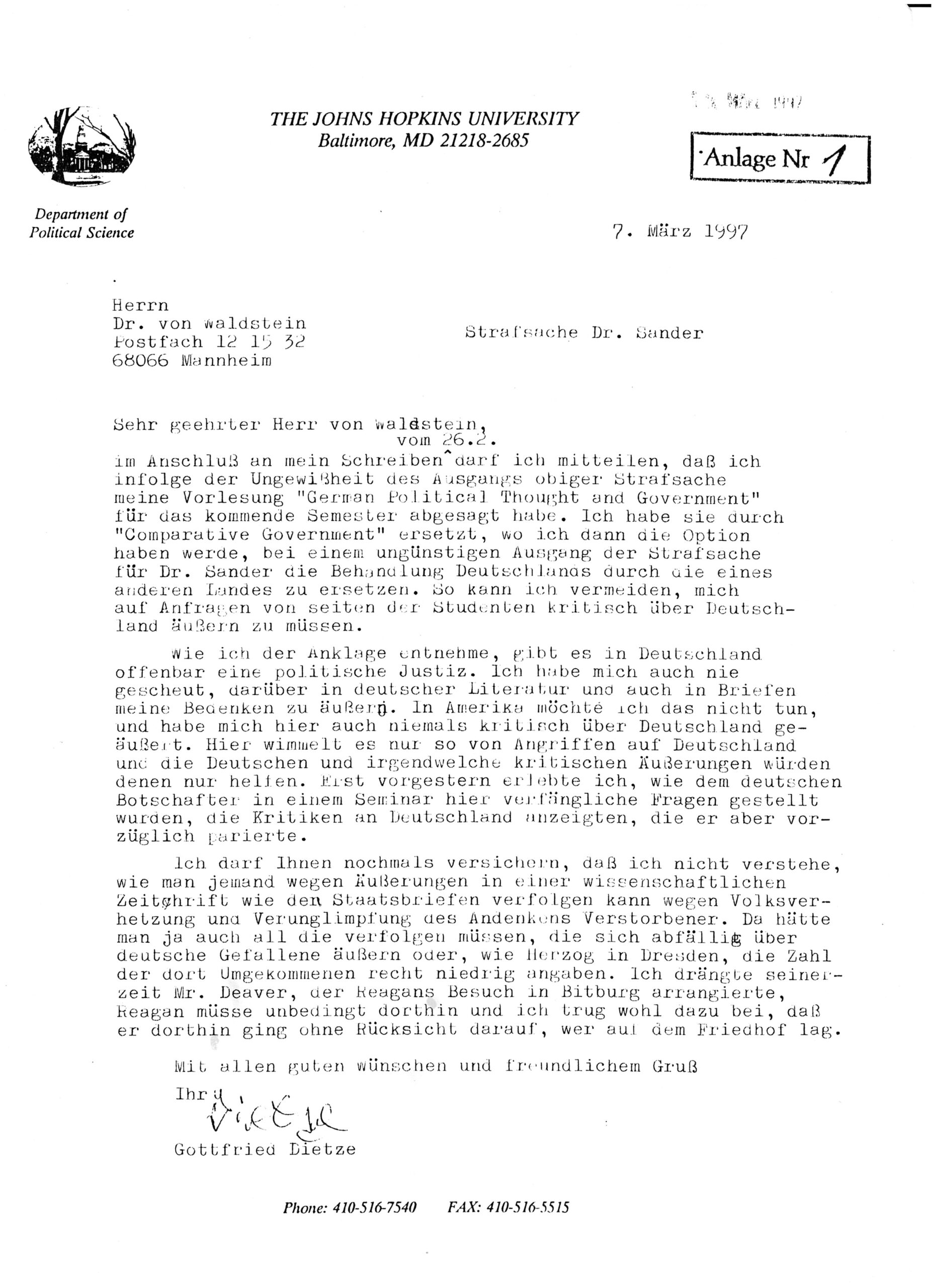
Reading through the prosecution’s effusions on Dr. Sander’s alleged thought crimes, Dr. Dietze became utterly disillusioned about Germany’s current political system. In a letter to Dr. Sander’s defense lawyer, he wrote:
“As I glean from the indictment, there exists in Germany a political justice. I never shied away from expressing my concerns about this in German literature and in letters. But I do not want to do this in America, and have never expressed myself critically about Germany here. This country is teeming with attacks on Germany and the Germans, and any critical remarks would on help them.”
He also informed Dr. Sander’s lawyer that he had cancelled his lecture on “German Political Thought and Government”, replacing it with a neutral one on “Comparative Government”, so he would not maneuver himself in a situation where he has to make critical remarks about Germany.
We at CODOH do not think that staying silent in the face of persecution and oppression is the proper way to act. Germany has not learned the proper lessons from its past, and this needs to be made clear.
THE JOHNS HOPKINS UNIVERSITY
Baltimore, MD 21218-2685
Department of Political Science
October 11, 1996
Dr. von Waldstein, Augustaanlage 21-23, 68165 Mannheim
Reg. No.: 0111/96/40/T/AB, Criminal case Dr. Sander
Dear Dr. von Waldstein,
In the following I would like to submit my statement requested by you on October 1, 1996.
Summary
- Article 130 of the German Penal Code is incompatible with Western civilizational concepts of freedom of expression (including and a fortiori the right to express scientifically acquired views) and strikes them in the face in a manner reminiscent of the Hitler dictatorship.
- Since the Basic Law [Germany’s surrogate constitution] was conceived as a reaction against the Third Reich as a Western constitution, the German Federal Constitutional Court, which the Basic Law appointed to preserve it, should review whether this paragraph is in line with the Basic Law.
- If this is the case, I consider the charges to be unfounded, since the publications at issue are academic in nature and, due to both their content and their small readership, cannot constitute incitement to hatred.
- Prior to a conviction, it should be examined whether prosecutions make any sense at all, since history has shown that opinions cannot be suppressed, and that banning them helps their dissemination. Moreover, such persecutions create martyrs, as was the case under National Socialism, and many may want to become martyrs.
* * *
- Freedom of expression occupies a prominent place among human rights. It deserves far-reaching protection, which may only be duly restricted in exceptional cases. If we get to the bottom of it, its extraordinary position among fundamental rights becomes clear. This freedom reflects the recognition under public law of another freedom that stands out among all the freedoms of the individual in that it cannot be subjected to any restrictions by governments: freedom of thought. This is what constitutes being human. Cogito ergo sum – I think, therefore I am. Perhaps German philosopher Immanuel Kant was thinking of this when he remarked in “What is Enlightenment?” that the sprout for which nature cares most tenderly is the “inclination and vocation to think freely.” This tender concern provides people with absolute immunity from the forces around them. With their own thoughts come their own opinions, and no one has power over them. Since this cannot be said of any other human right, freedom of thought appears to be the most natural of all fundamental rights, the human right in and of itself.This right may give pleasure and comfort, and certainly has often done so. But one can follow Kant’s view in “What does it mean to orient oneself in thought?” and say that it does not mean all that much if one cannot express what one thinks inside to the outside world.Freedom of expression thus appears as a confirmation of the human right in and of itself, elevating it above all other fundamental rights.Such a priority is evident in well-known classical documents. The Bill of Rights of the U.S. Constitution gives freedom of expression a privileged place at its beginning, and this preference was reemphasized by Chief Justice Stone in 1930 (U.S. v. Carolene Products Co., 304 U.S. 144, 152) because of its necessity to the democratic process, so much so that free expression has since been called a “preferred freedom.” In John Stuart Mill’s essay “On Liberty”, freedom of expression comes first, even if it should open the door to heresies in the face of common views (common in democracies). Let me quote two passages from this probably best-known essay on liberty:
“Popular opinions, on subjects not palpable to sense, are often true, but seldom or never the whole truth. They are a part of the truth; sometimes a greater, sometimes a smaller part, but exaggerated, distorted, and disjointed from the truths by which they ought to be accompanied and limited. Heretical opinions, on the other hand, are generally some of these suppressed and neglected truths, bursting the bonds which kept them down, and either seeking reconciliation with the truth contained in the common opinion, or fronting it as enemies, and setting themselves up, with similar exclusiveness, as the whole truth. The latter case is hitherto the most frequent, as, in the human mind, one-sidedness has always been the rule, and many-sidedness the exception. Hence, even in revolutions of opinion, one part of the truth usually sets while another arises. Even progress, which ought to superadd, for the most part only substitutes, one partial and incomplete truth for another; improvement consisting chiefly in this, that the new fragment of truth is more wanted, more adapted to the needs of time, than that which it displaces. Such being the partial character of prevailing opinions, even when resting on a true foundation, every opinion which embodies somewhat of the portion of truth which the common opinion omits, ought to be considered precious, with whatever amount of error and confusion that truth may be blended… We have now recognised the necessity to the mental well-being of mankind (on which all their other well-being depends) of freedom of opinion, and freedom of the expression of opinion, on four distinct grounds; which we will now briefly recapitulate.
First, if any opinion is compelled to silence, that opinion may, for aught we can certainly know, be true. To deny this is to assume our own infallibility. Secondly, though the silenced opinion be an error, it may, and very commonly does, contain a portion of the truth; and since the general or prevailing opinion on any subject is rarely or never the whole truth, it is only by the collision of adverse opinions that the remainder of the truth has any chance of being supplied. Thirdly, even if the received opinion be not only true, but the whole truth; unless it is suffered to be, and actually is, vigorously and earnestly contested, it will, by most of those who receive it, be held in the manner of a prejudice, with little comprehension of feeling of its rational grounds. And not only this, but, fourthly, the meaning of the doctrine itself will be in danger of being lost, or enfeebled, and deprived of its vital effect on the character and conduct; the dogma becoming a mere formal profession, inefficacious for good, but cumbering the ground, and preventing the growth of any real and heartfelt conviction, from reason or personal experience.” “On Liberty and Representative Government” (R.B. McCallum (ed.), Oxford 1946, pp. 40f., 46f.)
Freedom of expression existed not only for the benefit of individual citizens, but also for the good of the government. Kant also saw this. According to him, the inclination and vocation to think freely “affects the mindset of the people (whereby they gradually become more capable of acting freely) and finally even the principles of the government, which itself finds it beneficial to treat man, who now is more than a machine, in accordance with his dignity.” The serf becomes a citizen.
It will now be objected that the far-reaching protection of the expression of opinion has always been restricted in America and England as well. That is true, but it was duly limited to the protection of other individuals, e.g. from insult and defamation, and served the cause of peace. If one further interprets the view expressed by Oliver Wendell Holmes in 1919 in the Schenck case that, exceptionally, Congress could, despite the absolute prohibition against doing so, pass laws restricting the right of free speech protected by the First Amendment, it can be answered that Holmes allowed exceptions only in the case of a “clear and present danger” in which, according to him, the United States found itself during the war.
No such danger existed when Section 130 was passed in Germany [the 1994 amendment]. Nor does it exist today. I consider democracy in the Federal Republic of Germany to be established and secure, and I tend to agree with Chancellor Kohl when he said that we didn’t need any extra lessons. This paragraph should not have been passed, and we should have followed the well-known words of the author of the American Declaration of Independence, Thomas Jefferson. In his inaugural address as the newly elected president, he expressed his delight that the previous election campaign had demonstrated free debate. He added that erroneous opinions should be tolerated where reason is free to combat them. It seems to me that the drafting of Article 130 was motivated less by reason than by feelings of guilt about the Third Reich, which shows that many Germans have not yet freed themselves from Hitler. When Mill published his essay dedicated to Wilhelm von Humboldt, he did not oppose laws restricting freedom of expression. These no longer existed in England in his day, which was one of the reasons why Marx went there. Mill opposed Victorian morality and its condemnation of some views. Therefore, Section 130 takes us back to a time when there were not just moral but legal prohibitions on free speech, one before Mill and the American fathers of the Constitution. It is a step back into police-state intolerance. It is reminiscent of Rousseau’s statement that man is born free but everywhere in chains. It goes beyond the framework of the classical constitutional state created as a reaction to the police state. It is treading on the slippery ground of a mere power-drunk constitutional state, a state that in its day prompted National Socialists to present their state as a constitutional state as well.
- The outrageous monstrosity with which Article 130 opposes the long-cherished and nurtured legal protection of the expression of opinion, and thus disregards the framework of what is generally recognized, raises the question of whether it also falls outside the framework of Germany’s constitution, the Basic Law, and must be declared unconstitutional. The creation of the Basic Law was a welcome decision against the National-Socialist power state. Efforts at the time to prevent a relapse into a dictatorship are understandable, even if they restricted fundamental rights in this respect. In view of the fact that there is no danger of such a relapse, it is doubtful whether a provision such as Article 130 of the German Criminal Code is justified almost half a century later, and I would like to answer in the negative. But I am merely giving an opinion here, and am not a judge. Therefore, the question, serious and far-reaching as it is, should be decided by the German Federal Constitutional Court, whose creation as guardian of the classical constitutional state created in the Basic Law I have often welcomed, even if I did not like some of its decisions.
- If Article 130 is deemed to be constitutional, I consider a prosecution on the basis of this provision to be unfounded in the present case. Incitement to hatred requires aggressive behavior. However, the periodical in questions, Staatsbriefe (State Letters) are defensive in nature. They defend Germany against attacks from within and without, and there is certainly much to be done and to be uncovered. They are not so much addressed to the people in Schopenhauer’s sense, and for this reason alone their contributions cannot be incitement to hatred. They are addressed to a select small circle, similar to that which Kant had in mind in his essay on Enlightenment. The Staatsbriefe are academically oriented and, if I remember correctly, Dr. Sander left the editorship of another nationally oriented periodical because it was not academic enough for him, and he founded the Staatsbriefe, to which I, who only ever published in academic journals, was happy to contribute because of their academic character, and will continue to do so, all the more so as the Staatsbriefe have come under fire. For if freedom of expression should not be restricted, then certainly not the free expression of scientific opinions, since the latter come about through the search for truth. Veritas vos liberabit – Truth will set you free.
- The principle just mentioned is not only the motto of Johns Hopkins University, but also of the University of Freiburg im Breisgau. Its universal recognition has led not only to the recognition of the freedom of science, but also of the freedom of expression per se. Since the desire for freedom is insatiable, it will never be possible to suppress opinions in the long term, no matter how much of the truth or how little of it they may contain. Suppression of human rights has always led to the struggle for these rights and finally to their recognition. It therefore seems pointless to suppress opinions. Since such suppressions have shown, especially in modern times, that there is a real appetite for them, we should keep our hands off them. In Germany, the application of Article 130 is likely to cause more bad blood than the opinions it criminalizes. German criminal law should not create martyrs.
Yours sincerely
Gottfried Dietze
This statement, together with several other documents, was submitted to the German court handling Dr. Sander’s case with a motion to suspend the trial and have the German Constitutional High Court assess whether the law under which Dr. Sander was being prosecuted is unconstitutional. That motion was denied.

Bibliographic information about this document: Inconvenient History, 2025, Vol. 17, No. 3
Other contributors to this document:
Editor’s comments: