Challenging Holocaust Orthodoxy: A German National’s Fight for Free Speech
The Barnes Review Interviews Germar Rudolf
By Germar Rudolf ∙ July 2, 2025
Last updated on
On May 25, 2025, at 6:30pm Eastern Time, José Niño of The Barnes Review (TBR) conducted an audio-only interview with Germar Rudolf. It took a long while for The Barnes review to post this interview on their site, but now it finally happened:
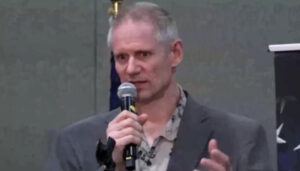
Germar Rudolf lecturing during the 1st JP Conference in Kentucky on June 25, 2024.
On this episode of TBR Radio’s “The TBR History Hour,” host José Niño welcomes a German chemist Germar Rudolf for a provocative discussion about alternative historical narratives surrounding the Holocaust, the academic persecution faced by Holocaust revisionist scholars, and the ongoing battle for intellectual freedom in contemporary Europe and the United States.
This episode explores the controversial terrain of historical revisionism and the institutional pressures that silence dissenting voices. The German scholar shares his personal experiences of professional ostracism, legal challenges, and social isolation that followed his research into alternative interpretations of the Holocaust.
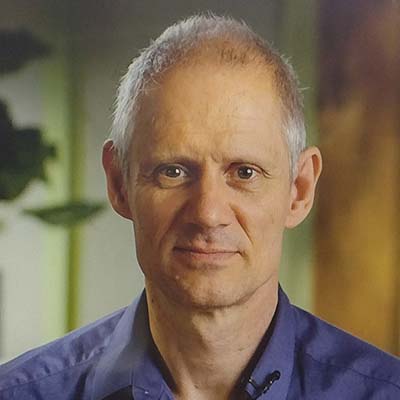
Germar Rudolf was born on October 29, 1964, in Limburg, Germany. He studied chemistry at Bonn University, where he graduated in 1989 as a Diplom-Chemist, which is comparable to a U.S. PhD degree. From 1990-1993, he prepared a German PhD thesis at the Max Planck Institute for Solid State Research in conjunction with the University of Stuttgart, Germany. Parallel to this and in his spare time, Rudolf prepared an expert report on chemical and technical questions of the alleged gas chambers of Auschwitz (see The Chemistry of Auschwitz). He conclude in it that "the alleged facilities for mass extermination at Auschwitz and Birkenau were not suited for the purpose as claimed." As a result, he had to endure severe measures of persecution in subsequent years. Hence, he went into British exile, where he started a revisionist publishing outlet. When Germany asked Britain to extradite Rudolf in 1999, he fled to the U.S. There he applied for political asylum, expanded his publishing activities, and in 2004 married a U.S. citizen. In 2005, the U.S. granted him an immigrant visa based on his marriage, but seconds later arrested and subsequently deported him back to Germany in crass violation of U.S. law. In Germany, where he was put in prison for 44 months for his scholarly writings, some of which he had published in the U.S., where they are perfectly legal. Since not a criminal under U.S. law, he managed to immigrate permanently to the U.S. in 2011. Rudolf has published more than 90 books (currently available through Armreg US and Armreg UK), among them the 54 volumes of the Holocaust Handbooks. He has compiled 9 documentaries and authored 20 non-fiction books, among them the bestselling Holocaust Encyclopedia. With a brief interruption, he has managed the free-speech organization Committee for Open Debate on the Holocaust since 2014, where we defend free speech at the forefront of corporate censorship and governmental persecution. In 2017, he became chief editor of CODOH’s quarterly periodical Inconvenient History. In early 2025, he launched the Holocaust Academy, dedicated to bringing critical thinking to Holocaust education. In that context, he organized the 2026 Holocaust Summit, dedicated to “Tackling the Most-Harmful Ideology Undermining Peace, Truth and Freedom Worldwide”.
In recent times three major figures of the Holocaust revisionist movement, Ernst Zündel, Germar Rudolf, and David Irving, were arrested and are going to be put on trial for denying the Holocaust. Zündel and Rudolf in Germany, and Irving in Austria. Germany and Austria both have harsh laws that proscribe Holocaust revisionist viewpoints. In the…
In a legal decision rich with irony, a jury in a federal court case in Denver, Colorado, has found that the Anti-Defamation League (ADL), a powerful Jewish special interest group, had defamed a local couple. On April 28, 2000, the jurors awarded $10.5 million in damages to William and Dorothy Quigley. This is the first…
Prelude In the spring of 1993, Germar Rudolf’s expert report on The Chemistry of Auschwitz, as it is called these days, was published by the defense team of one of the defendants for whom it had been prepared. As a result, the German legal authorities started a criminal investigation against Rudolf. Unfazed by this persecution…
On June 11 the Canadian government's Security Intelligence Review Committee announced it was postponing indefinitely hearings on whether Ernst Zuendel represented a danger to the Canadian state. This followed by one day a brilliant argument by Zuendel's superb attorney, Doug Christie (ably assisted by Barbara Kulaszka) in an “apprehension of bias” motion against the SIRC…
Since February 2009, German lawyer Horst Mahler has been serving his cumulative 12-year prison term for a number of convictions due to his writings in which he both contests the orthodox Holocaust narrative and justifies as well as recommends repeating some of the NS measures against the Jews, among other things. Horst Mahler Suffering from…
The internet has become a powerful tool for information, free speech and exchange of ideas. Years ago in this chat, Ernst Zundel and Bernard Klatt, very much ahead of their time, were already anticipating censorship of the World Wide Web. Ernst Zundel talks to Bernard Klatt about the attacks on Free Speech by Jewish Supremacists in British Columbia. The Zionists…