Censorship Map of Europe
An Update
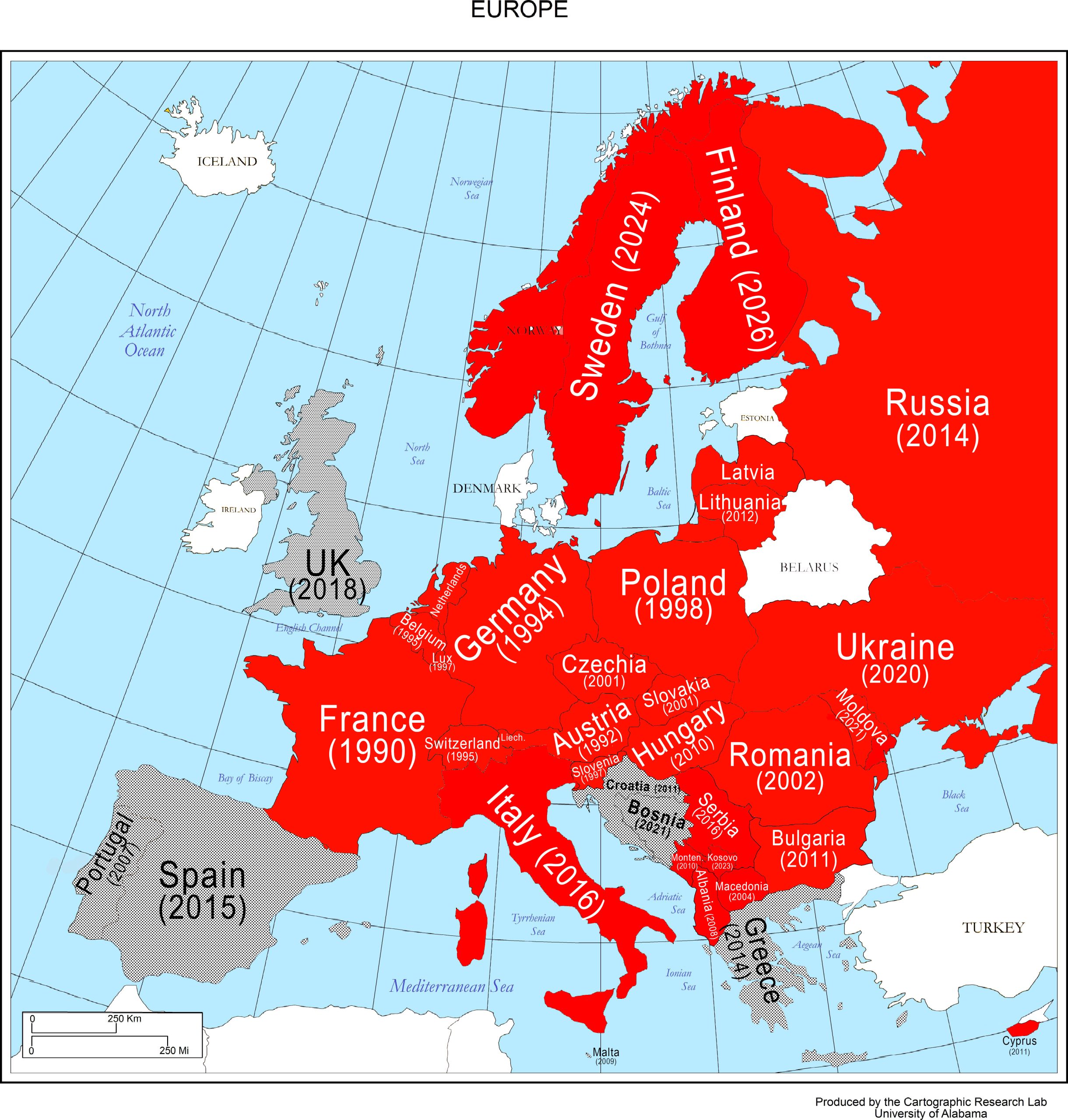
On page 33 of the first, 2014 edition of his book Breaking the Spell, Dr. Nicholas Kollerstrom included a map showing the countries in Europe that had enacted laws dictating Holocaust historiography at gunpoint. (The map is on p. 34 of the 7th, 2024 edition.) I remember spending quimanaged to resistste some time creating this map, using various online resources to figure out which country has which laws. Over the years, I have updated this map, and included a simple list in my Holocaust Encyclopedia in its entry on censorship.
When the latest case of a law banning Holocaust skepticism was enacted in Finland in early 2026, I wrote an article about this. I mention in this article that one motivation for Finland to introduce such a law was pressure from the European Union. I wondered back then how Finland could succumb to that pressure while other European nations which are already in the EU or strive to be accepted managed to resist, especially in the Balkans.
While writing my most-recent book in History at Gunpoint, I revisited the issue with the aim of getting things updated. During my research, I stumbled across an excellent resource in this regard on the Bosnian website trial.ba of the organization Trial International, which grew out of a dedication to document the massacres committed by all sides during the war fought mainly on that country’s territory between 1992 and 1995, to help victims and hold perpetrators accountable. This organization compiled a list containing information for all European countries regarding any laws they have enacted banning denial of the Holocaust and/or of other genocides or mass atrocities.[1] This table was uploaded in February of 2020, hence cannot contain legislative changes made after that date.
Going through that table, I realized that my map and related table had been incomplete all along: Northern Macedonia had introduced a general anti-genocide denial law already in 2004, hence three years before the European Union 2007 issued its decision to make such a law mandatory for all member states. While pure denial can get you between one to five years in that country, if it is combined with the “intent to instigate hate, discrimination or violence,” a prison term of at least four years is imposed, with no upper limit given, probably meaning that even a life sentence is theoretically possible.
Albania followed a year after Europe’s mandate, but its general ban on genocide denial is embedded in a law regulating online offenses, so denial is punishable only if it is “deliberately disseminating to the public through computer systems.” The punishment threatened is between 3 and six years.
Malta followed a year later, in 2009, albeit only if general “genocide denial” is done in a way likely to incite to violence or hatred, or likely to disturb public order. Therefore, I changed the color of Malta on the new map from red (unconditional ban) to grey (conditional). Also, I added Malta to the list of countries in the encyclopedia, where it had been omitted for some inscrutable reason. The threatened punishment is 8 months to two years imprisonment.
Montenegro enacted a general ban on genocide denial in 2010 for cases conducted “in a manner which can lead to violence or cause hatred against a group,” and if that genocide has been declared a fact by “a final and enforceable judgment of a court in Montenegro or of the International Criminal Tribunal.” The threatened punishment is between six months and five years. The expression “a manner that can lead to violence or cause hatred” is too diffuse to qualify as a conditional ban. Even the most rational and unemotional scrutiny of a genocide can lead someone to develop feelings of hate, and push some deranged mind to resort to violence. At least words like “is likely to cause” are needed to qualify a law to be a conditional ban only. Hence, I have given Montenegro the red card on the map.
2011 saw three European countries introduce laws banning genocide denial in general, Croatia made it conditional by mandating that the offense needs to be perpetrated “in a manner likely to incite to violence or hatred,” while Cyprus did not include such a qualifier. Bulgaria made it conditional on the offense posing “a risk of violence or hatred”, but there is no qualifier on how high the risk must be, so it doesn’t count as a conditional ban. Croatia imposed prison terms of up to 3 years, Cyprus of up to 5 years, and Bulgaria from a minimum of one year up to five years. Cyprus defines genocides as something that has been determined by an “irrevocable decision of an international court,” meaning that the findings of the IMT show trial probably also count as incontestable.
After Spain’s High Court had thrown out that country’s first, 1995 attempt at banning Holocaust denial as unconstitutional, Spain introduced a general ban on genocide denial in 2015, making that act an offense, if it “promotes or favors a climate of violence, hostility, hatred or discrimination.” That law has led to the conviction of Holocaust skeptic and National-Socialist activist Pedro Varela in 2024, whose considerable activities of promoting National-Socialist ideas was moreover judged to be an indirect justification of that past regime’s genocidal acts. Denial plus NS ideology pushed the judiciary over the edge, sending Varela to prison for 18 months. Spain’s new anti-denial law was criticized by Spanish legal scholars as unconstitutional, especially since its “qualifier” requires a mere hypothetical risk of “violence, hostility, hatred or discrimination” by merely favoring a climate.[2] It can’t be more wishy-washy. Varela’s case is currently moving through the various appellate stages, and may be heard by the Constitutional High Court within five years or so. Until then, I have given Spain a conditional status, as denial itself isn’t able to trigger the law, but very much its convolution with NS propaganda.
Next on the list of countries I missed is Serbia, which introduced its law in 2016, with a thin conditional veneer of acts that “could lead to violence or incitement to hate.” Defining genocide like Montenegro via decisions of national courts or the ICC, Serbia imposes of six months to five years on convicted offenders. That’s a red card for Serbia.
Before we move on the rest of the Balkan countries and some special cases, an explanation is due regarding the UK, which does not have a formal law banning Holocaust skepticism at all, as many have rightly observed. I have included it on the map and in my list anyway, with the year given 2017. This is not based on the adoption of any law, but on case law created by the case of musical artist Alison Chabloz. She was indicted under Section 127(1) of the Communications Act of 2003 for communicating via “a public electronic communications network” (internet) messages that the judges considered “grossly offensive.” The offenses are said to have been committed by satirical songs on Holocaust survivors and their tales which Chabloz wrote and performed. I loved the songs when I listened to them back in 1916 and 1917. I thought the melodies were pleasing, voice and instrumentals were excellent, and the lyrics were written with wit and intelligence. But turning Holocaust skepticism from dry scholarship into living art evidently is a crime.[3] Therefore, the UK definitely meets the criterion of conditionally banning Holocaust skepticism, if combined with disrespectful statements about victims and/or survivors. This was highlighted with the case of Ian R. Millard, who mixed general expressions of disbelieve in the mainstream Holocaust narrative with anti-Jewish statements.[4] Castle Hill Publishers and their successor Armreg Ltd, the two most-productive media outlets of Holocaust skepticism in this century, have operated from the UK since 1998, and have never been impeded or harassed. It is therefore safe to say that, as long as it is boringly scholarly, Holocaust skepticism is legal in the UK. But I changed the year to 2018, the year of Chabloz’s first conviction.
Bosnia had the new Article 145a of its penal law banning general genocide denial imposed by that country’s High Representative in 2021.[5] It was not well received by many among the country’s Serbs, hence caused quite some tensions. It requires that denial be done in a “manner likely to incite to violence or hatred,” and comes with prison terms between six months and five years. It defines genocide by a final court verdict, hence the IMT probably qualifies. Bosnia’s law is primarily designed to ban denials of genocidal killings committed during that country’s civil during the 1990s war rather than directed against Holocaust skeptics.[6] The expression “likely to incite to violence or hatred” was taken straight from a EU Framework Decision on Combating Racism and Xenophobia.[7] While this expression is suppose to prevent the stifling of academic freedom, member states are free to include or omit such a requirement. Bosnia has included it, making this a case of conditional banning of genocide denial. This turns the country grey on my map (it has been red so far).
Moldova has two laws, one banning general genocide denial (Art. 135² of its Criminal Code, one to three years imprisonment) and one introduced also in 2021 specifically banning Holocaust denial (Article 1761), likewise with prison terms between six months and five years. It defines the Holocaust as “the systematic persecution,” “annihilation and extermination of a large number of members of the Jewish community by Nazi Germany, as well as by its allies and collaborators, during the period 1933-1945” (Art. 13419).[8] Denial is not a crime, however, if done “in the interest of art or science, research or education.” I am reluctant to grant Moldova the grey conditional status for this, because any popular but non-polemical statement could be denied that privilege, and judiciaries have the tendency to define the “interest” of science and research by that community’s consensus, which tends to exclude skeptic voice. So that’s a red card for Moldova.
Armenia’s Article 136 of its penal code, completely overhauled in 2022, threatens with up to four years imprisonment those who deny genocides in general “for the purpose of provoking hatred, discrimination or violence.”[9] It’s neighbors Turkey and Azerbaijan have so far refused to adopt similar laws, as those nations’ citizens at times engage in that kind of activity regarding the genocide Armenians suffered during the First World War. I grant Armenia a conditional status, which more radical faction in its society don’t like, who want to tighten that law even more.[10]
Also in 2022, Belarus implemented a law against genocide denial. However, their law merely bans the denial, minimization or justification of the genocide committed against the Belarusian people by German forces during World War II, even though no such thing occurred. The massacres presumably committed by the German wartime Einsatzgruppen against both local Jews and Jews deported to Belarus from central and western Europe were rebranded by Alexander Lukashenko’s regime as victims of the general populace.[11] While the law effectively denies Jews their main-victim role, its primary function is to suppress modern political dissent, in particular by stigmatizing pro-democracy opposition groups as ideological “descendants of Nazi collaborators.”[12] Of course, strictly speaking, all countries with such laws use it to oppress what they stigmatize as “Nazis” or “Nazi” sympathizers, whether that label is accurate or not. Since Belarus’s law does not ban Holocaust skepticism as such, but only events that are said to have happened on Belarussian soil, I have not shaded that country on my map.
The last country to add to the new list is Kosovo. Mimicking its big sister Albania, Kosovo followed suit a year later, in 2023, by adopting a similar law unconditionally banning general genocide denial if disseminated to the public through computer systems, also with prison terms between 3 and 6 years.[13]
Therefore, if we ignore the European Union as an umbrella organization with its framework decision, 41 countries currently enforce the writing of history to one degree or another at gunpoint.
Hence, leaving aside Belarus, only six European countries have not (yet) formally banned Holocaust skepticism in one form or another: Iceland, Ireland, Denmark, Estonia, Azerbaijan and Georgia:
| # | Year | Country | Max. Term |
|---|---|---|---|
| 1. | 1986 | Israel | 5 years |
| 2. | 1990 | France | 1 year |
| 3. | 1992 | Austria | 20 years |
| 4. | 1994 | Germany | 5 years |
| 5. | 1995 | Belgium | 1 year |
| 6. | 1995 | Netherlands (conditional) | 1 year |
| 7. | 1995 | Liechtenstein | 2 years |
| 8. | 1995 | Switzerland | 3 years |
| 9. | 1997 | Luxembourg | 2 years |
| 10. | 1997 | Slovenia | 2 years |
| 11. | 1998 | Poland | 3 years |
| 12. | 2001 | Slovakia | 3 years |
| 13. | 2001 | Czechia | 3 years |
| 14. | 2002 | Romania | 3 years |
| 15. | 2002 | Australia (HRC)* | – |
| 16. | 2004 | Macedonia | 5 years |
| 17. | 2007 | European Union (framework law) | 3 years |
| 18. | 2007 | Portugal (conditional) | 5 years |
| 19. | 2008 | Albania (computer distribution only) | 6 years |
| 20. | 2009 | Latvia | 5 years |
| 21. | 2009 | Malta (conditional) | 2 years |
| 22. | 2010 | Hungary | 3 years |
| 23. | 2010 | Montenegro | 5 years |
| 24. | 2011 | Croatia (conditional) | 3 years |
| 25. | 2011 | Bulgaria | 5 years |
| 26. | 2011 | Cyprus | 5 years |
| 27. | 2012 | Lithuania | 2 years |
| 28. | 2014 | Russia | 3 years |
| 29. | 2014 | Greece (conditional) | 3 years |
| 30. | 2015 | Spain (conditional) | 4 years |
| 31. | 2016 | Serbia | 5 years |
| 32. | 2016 | Italy | 6 years |
| 33. | 2018 | UK (conditional) | 2 years |
| 34. | 2021 | Ukraine | 5 years |
| 35. | 2021 | Bosnia (conditional) | 5 years |
| 36. | 2021 | Moldova | 2 years |
| 37. | 2022 | Armenia (conditional) | 4 years |
| 38. | 2022 | Belarus (very limited, see text) | 5 years |
| 39. | 2022 | Canada | 2 years |
| 40. | 2023 | Kosovo (computer distribution only) | 6 years |
| 41. | 2024 | Sweden | 2 years |
| 42. | 2026 | Finland | 2 years |
| conditional: only in conjunction with verbal abuses and/or threats, likely to cause violence or hatred.
* a human-rights commission can issue a cease-and-desist order. If ignored, it can lead to prosecution for ignoring a government order. |
|||
Endnotes
| [1] | trial.ba/wp-content/uploads/2020/02/Table-overview-of-denial-laws-in-other-countries.pdf |
| [2] | Carmen Alastuey Dobón, “El derecho penal ante el negacionismo. Comentario a la sap de Barcelona de 9 de septiembre de 2024 (Caso de la Librería Europa III),” Revista de Derecho Penal y Criminología, Vol. 32, no. 3, July 2024, pp. 483-520; https://revistas.uned.es/index.php/RDPC/article/download/44193/31985/133342. |
| [3] | See Alison’s blog at https://alisonchabloz.com/; see Laura Bliss, “Magistrates Court: Social Media: ‘A Theme Park just for Fools’ – R v Alison Chabloz,” The Journal of Criminal Law, Vol. 82, No. 4, 2018, pp. 301-304; https://doi.org/10.1177/0022018318792937; Frank Cranmer, “Is Holocaust denial a crime in England and Wales? No – but see R v Chabloz,” Law & Religion UK, 15 Feb. 2019; https://lawandreligionuk.com/2019/02/15/is-holocaust-denial-a-crime-in-england-and-wales-no-but-see-r-v-chabloz/. |
| [4] | Timothy Edgley, “Disgraced New Forest barrister posted antisemitic hate online,” Salisbury Journal, 15 March 2024; https://www.salisburyjournal.co.uk/news/24187095.disgraced-new-forest-barrister-posted-antisemitic-hate-online/. |
| [5] | https://www.ohr.int/high-representative-valentin-inzko-introduced-today-amendment-to-the-bh-criminal-code/ |
| [6] | https://trialinternational.org/wp-content/uploads/2021/07/Legal-prohibition-of-denial-of-adjudicated-war-crimes-concerns-all-victims-of-war-Analysis.pdf |
| [7] | European Council, Framework Decision 2008/913/JHA, 28 November 2008, on combating certain forms and expressions of racism and xenophobia by means of criminal law; https://eur-lex.europa.eu/legal-content/EN/TXT/?uri=celex%3A32008F0913. |
| [8] | https://bwcimplementation.org/sites/default/files/resource/MD_Code%20No.%20985%20of%202002_EN.pdf |
| [9] | Harut Sassounian, “Pashinyan rejects committing crime of Armenian Genocide denial,” Armenian Weekly, Feb. 5, 2025; https://armenianweekly.com/2025/02/05/pashinyan-rejects-committing-crime-of-armenian-genocide-denial/ |
| [10] | Gayane Saribekian, “Opposition Again Seeks Tougher Punishment for Armenian Genocide Denial,” Radio Free Europe/Radio Liberty, Sept. 03, 2025; https://www.azatutyun.am/a/33520882.html. |
| [11] | Kamil Kłysiński, “The anti-Western narrative in Belarus’s historical policy becomes harsher,” Ośrodek Studiów Wschodnich, 14. Jan. 2022; www.osw.waw.pl/en/publikacje/analyses/2022-01-14/anti-western-narrative-belaruss-historical-policy-becomes-harsher. |
| [12] | Oxford Belarus Observatory et al. (eds.), “WWII Collective Memory and its Politics in a Real War Context, in Belarus,” August 22, 2022; obo.web.ox.ac.uk/files/wwiicollectivememorypdf. |
| [13] | Article 277A; see https://gzk.rks-gov.net/ActDocumentDetail.aspx?ActID=84232, p. 4. |

Bibliographic information about this document: Inconvenient History, 2026, Vol. 18, No. 2
Other contributors to this document:
Editor’s comments: