
Zyklon B and the German Delousing Chambers
Today at the former German concentration camp at Dachau, it is no longer claimed that Jews or anyone else were ever killed in the gas chamber there. In the room that is supposedly a gas chamber, one can clearly read a sign written by the museum authorities in five languages which says, “THE GAS CHAMBER disguised as a ‘shower room’ – never used as a gas chamber.”[1] Although the room was completed in 1942, it was never used for its intended purpose – presumably, it was used for other purposes; perhaps it was used as a shower room after all.
At the western end of the crematorium building which houses the so-called gas chamber “disguised as a shower room,” one can today see and walk through four delousing chambers which were used to fumigate clothing.[2] The only explanation regarding these chambers is a sign above them, also in five languages, which simply says “Fumigation cubicles” in English and Desinfektionskammern in German. There is no mention anywhere within the camp of the important fact that these chambers used Zyklon-B to fumigate clothing as well as other articles placed within the chambers.
The “shower room” is not a gas chamber at all, but the so-called “fumigation cubicles” are gas chambers. Moreover, the “fumigation cubicles ” are extremely well-designed gas chambers which represented, and may still represent, the state of the art in gas chamber design. They were the product of more than 20 years of research and development into the application of hydrocyanic acid (often referred to simply as cyanide) for the extermination of vermin. This is clearly shown by the extensive German technical literature from the end of World War I through World War II on this subject.[3]
The delousing chambers at Dachau were far superior in design to the gas chambers which are still used in this country for the execution of criminals. As a consequence of their design, the operating procedures for the delousing chambers at Dachau were quite simple; for example, although gas masks had to be available, the operators were only required to use them in emergencies or in special situations. By contrast, the American gas chambers for executions still require the use of gas masks during the normal post-execution procedures. Compared to the American gas chambers, the German delousing chambers at Dachau were also safer to operate and far less expensive to construct.[4]
At the end of this article I have added a translation of one of the many articles that can be found in the German wartime technical and medical literature discussing the proper use of Zyklon-B for the control of typhus through the extermination of its principal carrier, the body louse. (See appendix.) The article by Emil Wustinger is especially important because of the numbers it gives to show the extent to which the Zyklon-B delousing technology was actually used by the Germans to save people from the ravages of typhus. According to Wustinger, 25 million people had already had their clothing and personal belongings fumigated from the start of the war until the beginning of 1944. This number is, interestingly enough, the same as the one which appears in the Gerstein statement as the number of people who had been “killed” in gas chambers.
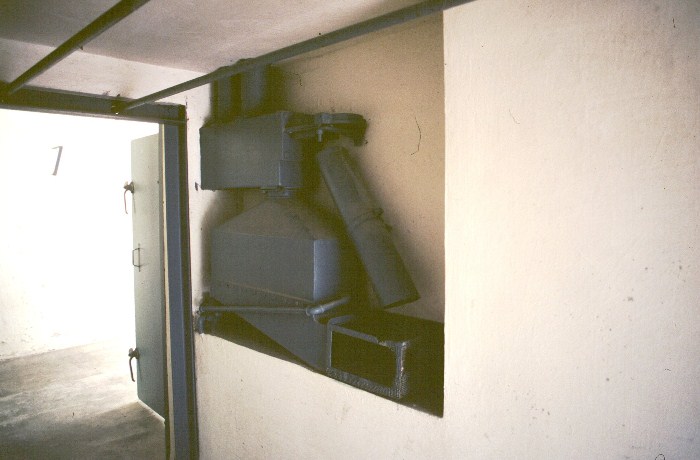
Figure 1: One of the four delousing chambers as it can be seen today in Dachau. (Note the heater, wire-mesh basket and other equipment visible through the open doorway.)
The delousing chamber represented by the drawing in Wustinger’s article is the standard ten-cubic-meter model which seems to have been used most often. It is essentially identical to the four chambers – “fumigation cubicles” – that one can still see today in the Dachau crematorium building. Even the interior dimensions are the same: The interior length is four meters, the interior height is 1.9 meters and the interior width is 1.35 meters, which gives a total interior volume of about ten cubic meters. The only significant difference between the delousing chamber portrayed in the drawing and the four chambers that one can still see in Dachau is that the cutouts in the walls containing some of the circulatory system apparatus are in the upper left corners of the chambers instead of in the lower left corners. The blowers above each chamber, a separate blower for each chamber, are no longer present although most of the piping, including the vent piping, remains.
The blowers, in effect, drove the entire fumigation process. Initially, each blower would accelerate the evaporation of hydrocyanic acid out of the porous Zyklon-B granules placed inside the chamber by forcing warm air through the granules and then circulating the resulting air and hydrocyanic acid gas mixture throughout all of the clothing and articles within the chamber. Finally, each blower forcevented the lethal gas mixture out of the chamber up a vent pipe through the roof to atmosphere and replaced the lethal gas with fresh air so that the chamber doors could be opened without endangering the operator.
Each chamber was designed so that it would normally be operated without the operator having to wear a gas mask except in an emergency. According to Dr. Gerhard Peters, writing in 1940 about the recently perfected gas chamber design:
Last but not least, it is an essential requirement that the operating personnel not come into direct contact with the hydrocyanic acid and also not be hindered unnecessarily with gas masks. The new design therefore provides that the entire process and even the venting occur behind closed doors; the equipment can be controlled from outside without anti-gas protection (ohne Gasschutz) since the hydrocyanic acid container is opened automatically only within the chamber. (Gas masks need only be available for special situations.) [emphasis as in the original][5]
The most significant feature of these designs is that a chamber so equipped for generating the gas and for controlling circulation can be operated without anti-gas protection. Thanks to the special arrangement of the equipment, one can ventilate with the doors closed which can be regarded as an especially great advantage . . . [emphasis as in the original]
Without doubt this design has had the greatest significance on the mass application of hydrocyanic acid fumigation facilities for mass delousing since it is only with such installations that dependable results can be achieved in unusually short periods (1 hour treatment).[6]
An accurate explanation of the role of the delousing chambers with their blowers would, no doubt, have caused many visitors to wonder why the Germans never used these devices for mass-murder. Each of the four delousing chambers had an interior floor space of 5.4 square meters and certainly could have been used to kill several dozen people at a time. And yet such an application for these chambers has never been alleged. One problem would have been that some of the circulatory system apparatus – including the four-way valve, the can-opener and the heater – is exposed to the interior and could have been damaged quite easily by anyone trapped inside. This apparatus could, however, have been shielded by some kind of metal grill – but there is no evidence that any such shielding was ever present.
The four delousing chambers could have been adapted for mass-extermination in another way which would have been obvious to many visitors. Instead of blowing the hydrocyanic acid vapors to atmosphere through the vent pipe at the end of a typical fumigation cycle, the same gas could have been blown through another pipe into the “shower room” located approximately in the middle of the same building about 60 feet away. As soon as a sufficiently lethal concentration of cyanide vapors had been attained inside the 44shower room, ” the blowers could have been shut down for as long as needed, several minutes would probably have been enough, to allow the gas to kill its victims. Afterwards, the blowers could have been restarted to ventilate the shower room by blowing fresh air into the room. Such a method would have worked, although for reasons which will be given later on, the arrangement would have been far more effective if it included some piping or ductwork to circulate the air-gas mixture. Ideally, some vent piping should have also been provided for the shower room so as to cause the potentially lethal gas to be discharged above the roof of the building instead of into the surroundings near ground level.
Wustinger’s article also discusses the advantages of hydrocyanic acid gas chambers over delousing chambers which used hot air. The hot air method and a steam method (not discussed in the article) both relied on high temperature to kill lice and other vermin. Both methods were somewhat safer since they did not involve the use of a poisonous substance. However, both of these alternatives had other problems. If a high enough temperature was not maintained long enough, particularly in the center of the chamber, which would have been insulated somewhat by the presence of a load of clothing, the delousing procedure would not have been effective. In addition, maintaining a high temperature within a chamber meant that the chamber had to be far better insulated and for this reason required a heavier, more expensive structure. A great deal of precious fuel also had to be consumed in order to generate the necessary heat. High temperatures tended to damage leather goods, foods, and some types of equipment which required fumigation from time to time.
The high temperature approach, whether it involved steam or hot air, was used more often in Eastern regions occupied by the Germans. This was because of the shortage of the trained specialists which were needed whenever one worked with Zyklon-B. The Zyklon method was generally employed within the Reich itself.
Zyklon B
Until the introduction of DDT by the Americans and by the Germans in 1944, the delousing of not only clothing but also living quarters, especially barracks, and~railroad trains in order to kill body lice was the only effective means of controlling the spread of typhus. Until the arrival of DDT, the most effective pesticide for killing body lice, i.e., for delousing, was Zyklon-B.
When Exterminationists claim, as Raul Hilberg did in The Destruction of the European Jews (1961 edition, pp. 565-67) that Zyklon-B was simply the commercial name for prussic acid (hydrocyanic acid is the chemical term generally used for prussic acid), or that it was hydrogen cyanide solidified in pellets which passed “immediately” into the gaseous state upon being dropped into a gas chamber, they merely show that they have no idea as to what their great murder weapon really was.
Zyklon-B was, and still is, essentially a porous material with liquid hydrocyanic acid absorbed into it with a small amount of chemical stabilizer and warning ingredient added.[7] The absorbent material was generally diatomaceous earth but paper discs were also used, especially in the United States. After the hydrocyanic acid had completely evaporated, the porous material – now completely harmless – could be returned to a Zyklon dealer and refilled.
The speed with which hydrocyanic acid evaporates out of the Zyklon granules or paper discs is not instantaneous. Although the hydrocyanic acid does immediately begin to leave the porous material as soon as a can of Zyklon-B is opened, that does not mean it leaves all at once. On the contrary, it still takes about half an hour for most of the cyanide to leave under normal conditions and under normal room temperature, about 68 F. Even more time is needed for all the cyanide to leave the granules.
According to Dr. Gerhard Peters, who was the managing director of DEGESCH and who from the early 1930’s through World War II was probably the most prolific advocate of Zyklon-B:[8]
. . . As a general rule, the material is spread out in a layer which is 1/2 to 1 cm thick, after which most of the hydrocyanic acid has already evolved after half an hour.[9]
Although the process begins immediately, it is nonetheless a gradual process. It can be speeded up by dispersing the granules in thinner layers or by using smaller granules to begin with or – what is most important in order to understand how the standard delousing chambers worked – by forcing air through the granules and/or by the addition of heat.
The importance of heat not only to prevent condensation during the venting of a cyanide gas chamber but also during the gassing phase itself is evident from the very title of a German patent which was granted to DEGESCH in 1940. The title of patent no. 700469 which took effect retroactively on July 26, 1934 reads:
Method for generating the necessary heat for the vaporization of poisonous substances for gases used for pest control [emphasis added]
The text of the patent explains at some length the need for heating in order to accelerate the release of fumigating gases such as hydrocyanic acid. The patent includes a schematic drawing showing the same circulatory equipment arrangement which was probably used in all of the standard DEGESCH gas chambers.
The importance of heat to the venting process is spelled out in the following text from Peters and Wüstinger.
. . . As a consequence of the extensive preheating of the fresh air entering at D, the venting of the chamber is completed in 10 to 15 minutes. The carts can then be driven out and the articles of clothing can be immediately returned to their owners who in the meantime have had their bodies deloused.[10]
The Fumigation Cycle in the German Delousing Chambers
The fumigation cycle consisted of two phases: (1) a circulation (Kreislauf) phase, known in non-technical jargon simply as the “gassing” phase, and (2) a venting (Lüftung) phase.[11] Switching from one phase to the other was accomplished by simply turning a crank handle 180 degrees on the outside of the chamber. The crank handle was linked to a special four-way valve located on the inside of the chamber (see figure 1 in the translation of the article by Emil Wustinger).
The circulation phase lasted about an hour and the ventilation phase lasted at least fifteen minutes. In practice, however, it seems to have taken longer. There is, for example, a well-known photograph of an American soldier in Dachau looking at one of the delousing chamber doors upon which there is a notice in German which says that the fumigation time (Gaszeit) was from 7:30 until at least 10.[12]
To start the delousing process, a can of Zyklon-B inside the chamber was opened from outside the chamber by means of the specially designed can-opener with the chamber doors shut. Once the can was opened, the next step was to turn the crank handle on the outside of the chamber 180 degrees to the “Kreislauf” (circulation) position which in turn caused the Zyklon-B can inside the chamber to be turned upside down, thereby dumping the Zyklon-B granules through a chute into a wire-mesh basket. Meanwhile, air was circulated by the blower through a closed loop which consisted of the chamber itself as well as the four-way valve, the basket and a heater. The air was heated before it passed through the granules in the basket. The heated air drove the hydrocyanic acid out of the granules so that the circulating air became mixed with an increasingly lethal dosage of cyanide. The resulting lethal gas mixture was circulated throughout the chamber – hence the name: “circulatory gas chamber” – to insure thorough penetration into all possible hiding places within the clothing and articles being fumigated.
After at least an hour, the operator could begin the venting phase by turning the crank handle 180 degrees to the “Luftung” (venting) position. The blower continued to operate as before. The four-way valve would now allow fresh air to be drawn into the chamber from the opening surrounding the crank handle stem in the outside wall of the chamber. As the fresh air passed through the valve and then the heater, it was heated above the boiling point of hydrocyanic acid, which is 78.6 °F.[13] The warm air then continued on through the Zyklon-B granules in the basket and drove any remaining traces of hydrocyanic acid out of the granules. The air then entered the chamber as a whole and eventually left the chamber from an opening at the extreme end of the opposite side of the chamber, returned to the blower, and then went down into the four-way valve once again, but this time instead of going around again in a closed loop, the gas mixture was directed up the vent pipe by the four-way valve and discharged into the atmosphere. The gas mixture was discharged high enough so that the otherwise lethal gas was so diluted by fresh air that people in the vicinity were not affected. In the process, the temperature of the entire chamber, including the chamber walls, was raised above the boiling point of hydrocyanic acid in order to prevent any subsequent condensation of the cyanide vapors either in the clothing, in any other articles, or on the walls. The walls, floor and ceiling were specially coated to minimize absorption of cyanide into the structure itself.
One final step which was sometimes stressed in the German technical literature was that the articles that had been fumigated still should be aired in the open for at least five minutes before they were returned to their owners
The Circulation Principle (Kreislautprinzip)
The importance of good circulation to the proper operation of the German delousing chambers cannot be overemphasized. In the German literature, especially the material from the DEGESCH company itself, circulation of the air-cyanide mixture was always and still is emphasized as a major feature of all of the standardized gas chambers and of good gas chamber design in general.
As recently as 1979, the DEGESCH company was still promoting its own design of fumigation chambers for Zyklon-B with the following information in English:
Whether the fumigation chamber is a permanent installation or mobile, a DEGESCH circulatory device makes it possible to operate safely and quickly, and ensures success. [emphasis added]
Mobile fumigation chambers are of great advantage: As they can be attached to any tractor or lorry, their possibilities for use are almost unlimited. They are economical in price and running. The standard sizes are 2 ml, and 20 m3, other sizes can be constructed according to special requirements.
Stationary chambers are made from steel, bricks or concrete. If constructed from bricks or concrete they must be sealed by applying a suitable coating.
Neither service personnel nor unauthorized persons come into contact with the gas; one person alone can operate the fumigation chamber; a gas-mask need not be worn. The gas-air-mixture is circulated, thus accelerating penetration and reducing exposure time. [emphasis added] After treatment, the gas can be cleared quickly and safely.[14]
The terminology “DEGESCH circulatory device” was used to identify the mechanical equipment such as the four-way valve, heater, can-opener and blower which DEGESCH sold.[15] The structure – walls, floor and ceiling – without the mechanical equipment seems to have generally been built by the customer himself or by an independent contractor.
Zyklon-B and cyanide do not have magic properties. The cyanide does not hunt down living creatures “like radar” as has been advertised for at least one currently popular insecticide. On the contrary, cyanide must obey the same laws of nature that steam or hot air have to obey in a similar situation. The advantage cyanide has as far as its distribution is concerned is due primarily to its low boiling point and its small molecular size. Although cyanide does indeed have great penetrating power, the penetrating rate is severely reduced by obstructions such as clothing unless those obstructions are overcome by some means such as forced circulation through a well-designed chamber with good flow patterns for the gas.
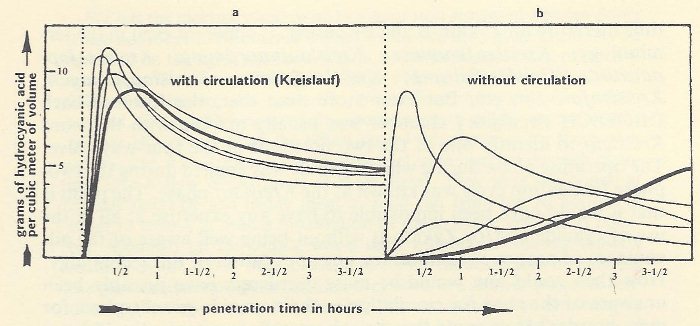
Figure 2: Development and distribution of the gas concentration in a filled gas chamber with and without circulation
- with circulation, i.e., with exchange of the air-gas mixture,
- without circulation, the gas must find its own path.
(the heavy lines represent concentrations in the center of the chamber while the other lines represent concentrations in various corners of the chamber.)(original source: DEGESCH)[16]
Figure 2 shows just how essential good circulation is to the design of an effective gas chamber. It was apparently based upon careful tests in which cyanide concentrations in various parts of a standard gas chamber were measured over at least two separate, three hour periods. One group of tests was made with the blower operating and with the four-way valve in the “circulation” position. The second group of tests was made with the blower idle.
The test results in Figure 2 are not at all surprising. They are generally just about what common sense would tell us to expect. It is a pleasant surprise, however, to be able to see the importance of proper circulation illustrated so clearly. The test results were obviously published first by DEGESCH and then by others in order to re-emphasize the importance of circulation as clearly as possible.
With circulation, the cyanide levels are relatively high and uniform throughout the chamber within about one hour. Without circulation, the cyanide levels are relatively high after one hour in only one corner, presumably the corner nearest to the basket with the Zyklon-B granules. Without circulation, comparable cyanide levels are achieved in the center of the filled chamber only after three hours; after only one hour, the gas hardly penetrated at all to the center of the chamber.
The emphasis upon circulation or Kreislauf, not only in the DEGESCH literature but also in countless articles in the German wartime literature on Zyklon-B and delousing, is apparent even in the terminology: Kreislaufkammer, Kreislaufanordnung, Kreislaufapparatur, Kreislaufleitung, Kreislaufgeräte, Kreislaufanlagen, Kreislaufprinzip, etc. But even more than that, the front of each DEGESCH circulatory chamber was usually marked with the word Kreislauf to identify one of the two positions of the four-way valve.
The operating phase during which cyanide was applied during the two-phase fumigation cycle was known as the Kreislauf phase. The point is that it would have been impossible to have any expertise at all in the use of cyanide and/or Zyklon-B without being well aware of the advantages of proper circulation for any application of this technology. How then could any would-be mass murderers have possibly been unaware of the need for circulation in their cyanide gas chambers for mass-murder? How could they have been oblivious to the significance of Kreislauf? And yet, they must have been oblivious – that is precisely what must have happened if one is to take the “Holocaust” literature at all seriously.
In any event, the would-be mass murderers – even if they had been totally illiterate amateurs, wholly ignorant of the importance of circulation – would have seen that something was seriously wrong with their method after one or more botched attempts at exterminating people with cyanide in chambers without circulation.
Hydrocyanic Acid Gas Chambers for Mass-Murder?
Although the murder weapon is the focus of a great deal of investigation and analysis in any ordinary murder case, alas, when one is dealing with the “Holocaust” story one finds nothing comparable regarding what were supposedly the greatest murder weapons in history.
In the main camp of the Auschwitz concentration camp complex, a gas chamber was supposedly used until the end of 1942 to murder about 76,000 people. That room can be visited today in its “reconstructed state.” In design and appearance it is nothing more than a dreary cellar, just like most cellars, except for some holes in the ceiling.[17] Zyklon-B granules were supposedly dumped through these holes into the chamber where they would have fallen upon the heads and among the feet of the intended victims. The room is separated only by a door from another room containing crematorium ovens and has no ventilating equipment at all. For these reasons as well as for others which are beyond the scope of this article, many of which have however been given in the past by Dr. Robert Faurisson and Ditlieb Felderer, the claim that this room was a gas chamber for mass murder is pure rubbish.
Probably the most plausible description of a gas chamber using cyanide for mass murder is the following description from Filip Muller of the cellar in Krematorium 2 in Auschwitz-Birkenau in which 3,000 people were supposedly killed at a time:
We left the mortuary and came to a huge iron-mounted wooden door; it was not locked. We entered a place which was in total darkness. As we switched on the light, the room was lit by bulbs enclosed in a protective wire cage. We were standing in a large oblong room measuring about 250 square meters. Its unusually low ceiling and walls were white-washed. Down the length of the room concrete pillars supported the ceiling. However, not all the pillars served this purpose: for there were others, too. The Zyclon B gas crystals [sic] were inserted through openings into hollow pillars made of sheet metal. They were perforated at regular intervals and inside them a spiral ran from top to bottom in order to ensure as even a distribution of the granular crystals as possi ble. Mounted on the ceiling was a large number of dummy showers made of metal. These were intended to delude the suspicious on entering the gas chamber into believing that they were in a shower-room. A ventilating plant was installed in the wall; this was switched on immediately after each gassing to disperse the gas and expedite the removal of corpses.[18]
Although a “ventilation plant” is mentioned by Muller, that does not mean there was anything even remotely comparable to the kind of ventilation and circulation which would have been needed.
According to Muller, the “Zyclon B gas crystals”[19] were dropped, presumably from the outside of the chamber, into hollow perforated pillars with spirals. The Zyklon granules (not crystals at all) would have slid down the spirals to the bottom of the pillars.
The ventilation plant was supposedly “switched on immediately after each gassing.” [emphasis added] In other words, during the gassing itself, the ventilation plant must have been off; there could have been no circulation of the air-gas mixture through the gas chamber during the gassing itself.
Although cyanide vapors would have gradually left the granules, their path would have been obstructed first by the “perforated” sheet metal pillars and then by those intended victims who were crammed into the spaces around the pillars. If one takes at all seriously the accounts of three thousand victims being killed at a time, the perforated pillars would have been surrounded rather tightly by the intended victims. Those who were in the immediate vicinity of the pillars would have probably been affected by the cyanide in just a few minutes but – on the basis of figure 2 – many, if not most, of the others would have been unaffected by the cyanide until hours later.
But let us give the benefit of doubt to the Exterminationists for the sake of this analysis. Perhaps Muller was somewhat mistaken and perhaps the “ventilation plant” had been switched on during the actual gassing. What then?
Even if the ventilation plant had been switched on during the gassing phase, there is no evidence that the necessary piping or ductwork was present to permit proper circulation. On the contrary, the bottom of each “perforated” pillar would have been, in effect, a cul-de-sac through which there could not possibly have been the kind of air or gas flow which circulated through the wire-mesh baskets in the standard delousing chambers even if there had been some provision for returning the ventilation plant discharge back to the gas chamber through some kind of closed loop arrangement. Any conceivable closed loop could not possibly have included the Zyklon granules themselves since they would have been isolated at the bottoms of the perforated pillars. The evaporation of the cyanide out of the Zyklon-B granules would have taken hours rather than minutes. And yet, according to the so-called confession of Rudolf Höss, the former camp commandant of Auschwitz, the gassing process was so short that after only half an hour the gas chamber doors were opened, the ventilating machinery was turned on, and workers without gas masks immediately began to remove the bodies.
Obviously, the Muller account and the Höss “confession” are nothing more than badly contrived horror stories. The mechanics, reminiscent of Rube Goldberg inventions, may seem plausible at first glance but simply do not stand up to critical examination.
The Railroad Delousing Tunnels
The abundance of Zyklon-B delousing chambers, even within concentration camps, is in itself a major problem for the accepted “Holocaust” story because here were well-designed pilot plants for committing mass-murder on a relatively small scale before attempting to kill on a massive scale; here were the ideal models to follow in order to construct scaled-up versions for mass-murder. Here was the proper technology for mass-murder with cyanide – but this technology, the delousing chamber technology, was supposedly never used for such a purpose.
More surprising is the fact that large, scaled-up versions of the small delousing chambers actually did exist in locations which were far more accessible than any of the so-called extermination camps. Those chambers employed the same circulatory principle and used Zyklon-B to fumigate railroad trains – but, those chambers were never used for mass-murder either.
Larger chambers for fumigating entire railroad trains existed throughout German-occupied Europe in about a dozen different locations including Cologne, Poznan (Posen), Potsdam, and Budapest.[20] They had become a standard feature of the railroad network in order to prevent the spread of typhus, particularly from Eastern Europe, where typhus had always been endemic.
The would-be murderers could have simply brought railroad cars filled with Jews into these large chambers, one or two cars at a time, killed the intended victims and then ventilated the cars within just a few hours. Each gassing, including venting of one or two railroad cars, would have still taken at least one-and-a-half hours – far longer than the half-hour which is all that was supposedly needed at Auschwitz according to Hoss and others.[21]
By using the railroad delousing tunnels, which ranged in size from about 400 cubic meters to as much as 1700 cubic meters, the mass-murderers would not have had to transport their intended victims halfway across Europe in the midst of a war in which Germany was desperately trying to conserve meager resources such as railroads and fuel.
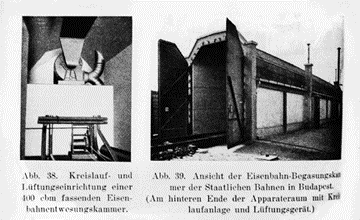
Left: Circulation and venting arrangement of a 400 cubic meter railroad disinfestation chamber.
Right: Railroad fumigation chamber of the state railways in Budapest. (At the far end one can see the equipment room for the circulation and ventilation apparatus)
Figure 3: Railroad delousing tunnels.[22]
Typhus
Throughout World War II severe outbreaks of typhus occurred in the German-occupied East. Especially in the last year of the war, with disaster falling upon Europe and with millions of people fleeing to the West from parts of Europe where typhus had always been endemic, Zyklon-B became the great life-saver. Although DDT and some other substances such as the IG Farben product “Lauseto” had become available, the quantities were severely limited by the bombing of German chemical and pharmaceutical plants. Without Zyklon-B carrying on in the role it had established for itself in the early years of the war, the horrible scenes in isolated places such as Bergen-Belsen in the spring of 1945 would have certainly been repeated on a far more spectacular scale. What actually happened was bad enough.
There could have been a repeat of what had happened during and after World War I in Eastern Europe. The situation in Russia during that period had been described by the eminent American medical historian Hans Zinsser as follows:
. . . Will historians of this period remember that, throughout the struggles which led to the establishment of the Soviet Republic, Russia suffered – in addition to war and armed revolution – from two cholera epidemics, from a famine unequaled since the Thirty Years War, from typhus, malaria, typhoid, dysentery, tuberculosis, and syphilis to an ex tent unimaginable except to those who were helpless spectators? Tarassewitch estimated (statistics of accuracy were impossible) that be tween 1917 and 1923 there were 30,000,000 cases of typhus with 3.000.000 deaths in European Russia alone.[23]
The losses in the Ukraine, the Balkans and Poland were probably comparable to those suffered in Russia but the historians have forgotten.
During World War II, the losses in Eastern Europe may have been even worse than those indicated by Zinsser and Tarassewitch for the earlier period. However, the true statistics would not serve the interests of the Soviet Union and for this reason they will probably never be available.
In the West the true statistics are also kept quiet but for a different reason: they would diminish the sense that Jews had been the victims of an extermination policy. The proof of this statement is in the speeches of President Reagan and Chancellor Helmut Kohl and in the news coverage in 1985 regarding Reagan’s visit to Bitburg and Bergen-Belsen. At that time, the truth as to what had happened in Bergen-Belsen at the end of the war should have been made public as part of the media coverage which began several months before the visit – but it was not. Although it has long been conceded that the true horrors of Bergen-Belsen had nothing whatever to do with an extermination policy, the President, the media and even the chancellor of West Germany did their best to portray Bergen-Belsen to the general public as proof of an extermination program against the Jews.
There is a substantial body of statistical evidence which shows that during the first two years of the war more than three-fourths of all cases of typhus in Poland occurred among Jews and that the remaining cases arose in large part from contact with Jews.[24] It was on the basis of this evidence that special regulations were introduced to restrict the movement of Jews. The wall around the Jewish Warsaw ghetto was one such measure. A thorough discussion of this subject is, however, beyond the scope of this article. In any event, Jews in concentration camps after 1941 certainly benefited from the presence of the delousing chambers in the camps.
Rather than having been the victims of Zyklon-B in murderous gas chambers, the Jews were probably the principal beneficiaries of Zyklon-B and its proper, life-saving application in well-designed German delousing chambers such as the ones which can still be seen in Dachau.
Conclusions
We have been blinded by our tears of sympathy for the supposed victims. We have been blinded by our tears of shame for deeds which people just like ourselves might have committed. But if we dare to wipe those tears away and look at the “Holocaust” evidence critically with sober heads, we find that there are no grounds for any such tears at all.
The mass-murder technology that was supposedly used to kill millions of people would not have worked. However, a mass-murder technology based upon the hydrocyanic acid delousing chambers would have worked quite well indeed. The SS certainly had an abundance of expertise in this technology since they were employing it themselves, daily, with their own specially trained personnel – and even had their own school for pesticide specialists.[25]
Surely Adolf Eichmann and some of the people around him must have had considerable expertise in railroad transportation. How could they have been unaware of the existence of the railroad delousing tunnels and their potential for mass-murder?
The purpose of the delousing chambers was to save lives – and that is not denied except by the most passionate Exterminationist. No doubt, many hundreds of thousands of people, possibly millions, including countless Jews, owe their lives to these chambers and the German technology based upon Zyklon-B.
How could the same Germans – particularly, the SS and the people from DEGESCH – who used a highly developed technology to kill lice in order to save countless human lives have simultaneously tried to use a pathetically primitive technology, which could not have even worked in the manner alleged, to destroy millions of human lives? How could they have used well-designed gas chambers with circulation to try to save millions of people from typhus while at the same time trying to use badly designed chambers without circulation to kill millions of people? How could they have been using an advanced technology to save people who were in many cases the very same people, namely Jews, that they were simultaneously trying to kill but with the most primitive variations of the same technology?
There are no answers to these reasonable questions even after forty years nor are there ever likely to be any answers consistent with an extermination thesis. In the absence of any proof based upon forensic evidence of even one case of death by gassing with cyanide at the hands of the Germans or of any other reliable evidence – the “evidence,” such as it is, consists almost exclusively of “confessions” and fantastic anecdotes of “survivors” – one should reject the “Holocaust” claims as self-serving propaganda. What is clear from any careful technical analysis of the supposed gas chambers for mass extermination is that the “Holocaust” story is absurd.
Appendix
Increased Use of Hydrocyanic Acid Delousing Chambers
Paper given at the Hydrocyanic Acid Conference of the Labor Committee for Room Disinfestation and Contagious Disease Prevention of January 27/28, 1944,
by Emil Wüstinger, engineer Frankfurt am Main, Gesundheits-Ingenieur, Vol. 67 (1944) on. 179-80.
In delousing chambers, for reasons which are easily understood because of their special function, one expects maximum performance with minimum gas concentration and penetration time. A penetration period of only one hour should have the same effect as a 16-, 20-, or 24-hour period during a room disinfestation. This is demanded because of the pressing need to process massive quantities.
Such requirements can only be met successfully, even with the highly effective hydrocyanic acid, when all of the conditions for fumigation are ideal, in other words when the following conditions exist: quickest possible release and distribution of the gas, sufficient airtightness of the room, good room temperature and proper arrangement of the articles to be fumigated within the chamber. On the basis of its collected experiences with its own fumigation chambers, the German Company for Pest Control, G.m.b.H. [DEGESCH] had already developed years ago special vaporizers (Vergasergeräte) and circulatory systems (Kreislaufanordnungen) which take into consideration all the requisites: fastest gas generation, best gas penetration and sufficient heating with simultaneous improvement in the ventilation piping.
After the first year of the war, during which a string of hydrocyanic acid facilities had been built in several regions and equipped with DEGESCH circulatory systems for Zyklon hydrocyanic acid [Zyklon-Blausäure or, as it is generally abbreviated, Zyklon-B][26], some of which have already been used to delouse hundreds of thousands of pieces of clothing, there arose a significant increase in demand as even government bodies and industrial factories began to take stringent measures to control lice.
The motivation for the increased use of hydrocyanic acid delousing chambers arose primarily from an official government requirement that the large numbers of foreign workers who were being used had to be deloused periodically at prescribed intervals and, therefore, the factories which employed the largest numbers of foreign workers had to build their own delousing facilities.
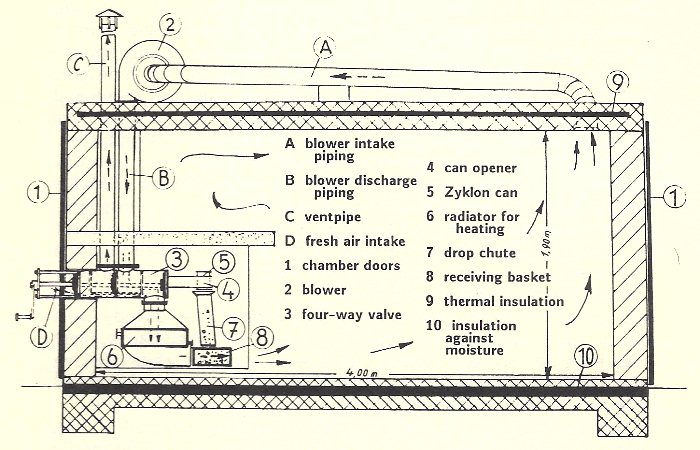
Figure 1: Elevation drawing of a delousing chamber with a DEGESCH circulatory system (“DEGESCH Kreislaufanordnung”)
This requirement was expanded by the official camp regulation from the Reich Minister of Labor which came into effect in the summer of 1943 regarding camp accommodations for workers for the duration of the war. Article 9 stipulates: “All rooms must be cleaned daily. The rooms and their inhabitants must be regularly examinedfor instances of vermin. Proper installations for the extermination of vermin must be available.” [emphasis added]
Recently there have even been an increasing number of instances where hot air chambers were rebuilt in order to be adapted with hydrocyanic acid circulatory systems. Many other large disinfestation facilities in which only hot air has been used until now are being expanded with hydrocyanic acid chambers in order to fumigate equipment and clothing which could easily be damaged in hot-air chambers – for example, fur and leather goods.
One result of these measures and the favorable judgments about hydrocyanic acid chamber delousing is that there is a steady increase in demand for hydrocyanic acid installations so that in just the last year alone as many installations went into operation as in the first three years of the war put together.
For the entire war until now, at 226 different sites, a total of 552 chambers with hydrocyanic acid circulatory fumigation systems and an additional 100 or so chambers without such equipment, but using hydrocyanic acid nonetheless, are either completed or under construction almost exclusively for the purpose of delousing. 300 of these chambers at 131 different facilities have been completed or are still under construction just since January of the past year alone. Almost one-fourth of these, i.e., 131 chambers, are distributed among government and administrative district labor offices, especially in the Alpine and Danube countries, as well as among city administrations and health departments. 249 hydrocyanic acid delousing chambers are either completed or under construction for the armaments industry.
And so, it becomes ever more apparent that the generally incorrect reservations which had been previously held against the use of highly toxic gases in delousing chambers have been thoroughly dispelled. This is illustrated by the fact that in just the last year alone as much hydrocyanic acid has been expended exclusively for the disinfestation of articles in delousing chambers as had been used in all of Germany for large area disinfestations in 1939. During the war the clothing and equipment of approximately 25 million people have already been fumigated with hydrocyanic acid. [emphasis added] Fortunately, there have been no reported accidents of a serious nature while working with Zyklon hydrocyanic acid [Zyklon-B] in the chambers equipped with circulatory systems.
Facilities employing circulatory systems are now being built so that they are suitable not just for the use of hydrocyanic acid but primarily for other evaporable liquids as well. Fortunately, these changes can be achieved without extensive modifications in the apparatus so that there is no increase in the already difficult procurement problems; although the DEGESCH circulatory systems could be delivered with relative ease during the first years of the war and, most important of all, could be delivered on short notice, increasing demands have also led to more and more procurement problems because of the fact that the increasing demands have to be surmounted by an ever decreasing number of workers. One should note at this point that hydrocyanic acid delousing chambers have the advantage over hot air chambers of reduced construction costs and, most important of all, require less iron and metal. Consequently, far fewer man-hours are needed for fabrication and so it should not be too surprising that the hydrocyanic acid chamber equipment which has already been installed has been built despite great difficulties by only a few companies with only a small number of workers. Of the manufacturers, one is specialized in the delivery of the blowers, air heaters, and piping and even installs the equipment. The other supplier manufactures the special appliance, the so-called four-way valve with a built-in can opener, which is the centerpiece of the entire system. This second factory usually had only two or three skilled workers available for these tasks who were not at all times capable of working because of physical disabilities.
Thanks to the many delousing facilities which are already in operation and to the other stringent preventive measures, it has been possible, fortunately, to reduce dramatically the number of cases of typhus and the mortality in stark contrast to the earlier years. Nonetheless, a great many new facilities with fumigation chambers will be necessary just for delousing because the use of foreign workers and the crowding of these workers into common barracks is still increasing and, especially in the East, the number of hydrocyanic acid delousing chambers that are available is still far from sufficient.
The increasingly widespread, harmless application of hydrocyanic acid, in itself highly toxic, in delousing chambers equipped with DEGESCH circulatory systems is a good indication of the dependability of this method, which is generally regarded as one of the most effective delousing methods. This is also spelled out in a decree from the Reich Minister of the Interior
Notes
| [1] | A useful source of information about Dachau as it exists today and some of its post-war history is: Andrew Mollo, “Dachau,” After the Battle (London: Battle of Britain Prints Ltd., 1980), Number 27, pp. 1-29. |
| [2] | Although the four delousing chambers are in the crematorium building and share a common roof and foundation, they are separated from the rest of the building by an open breezeway, i.e., a passageway extending from one side of the building through to the opposite side without any doors. The breezeway is a logical safety feature. If doors had been installed, an accidental accumulation of cyanide gas could have developed in the passageway since it was also adjacent to the hydrocyanic acid delousing chambers and could have eventually penetrated into other parts of the building injuring anyone present. This well thought-out arrangement contrasts sharply with the arrangement of the supposed gas chambers for mass-murder in Auschwitz which were far larger than the four delousing chambers at Dachau but, amazingly enough, had no comparable protection for the occupants of the buildings housing those chambers. |
| [3] | One excellent official source on the development of hydrocyanic acid, with many technical design details about the gas chambers themselves, is: Puntigam, Breymesser, and Bernfus, Blausäuregaskammern zur Fleckfeberabwehr [Hydrocyanic Acid Gas Chambers for the Prevention of Typhus] (Berlin: Sonderveroffentlichung des Reichsarbeitsblattes, 1943). There is nothing even remotely comparable in the English language to this classic work or to many other German works on this subject, many of which are listed in the extensive bibliography. That almost certainly applies to all other languages as well. |
| [4] | Thanks to the research of Dr. Robert Faurisson, a great deal of information about the chambers used in this country for the execution of criminals with cyanide and the detailed and complex procedures for such executions is available – some of which will be published shortly by this journal. The gas chambers for executing criminals in the USA still used, long after World War II, the so-called “pot” or “barrel” method to generate cyanide gas by dropping cyanide salt tablets into a pot of sulfuric acid. This method had generally been abandoned for industrial uses throughout most of the world, including the U.S.A., as soon as Zyklon-B became available in the early 1920’s. A major drawback of the “pot” method, aside from the problem of disposing of a pot of sulfuric acid containing cyanide, is that a significant amount of cyanide gas is absorbed by the liquid in the pot itself and then released, but only gradually, even after the rest of the chamber has been thoroughly vented. This is probably one of the main reasons why gas masks have to be worn in the gas chamber as part of the complex procedure for removing the body of an executed prisoner. |
| [5] | Dr. Gerhard Peters and Emil Wustinger, “Sach-Entlausung in Blausäure-Kammern,” Zeitschrift für hygienische Zoologie (Berlin: Duncker & Humboldt, 1940) Heft 10/11, p. 194. |
| [6] | Dr. Gerhard Peters, “Die hochwirksamen Gase und Dämpfe in der Schädlingsbekämpfung [The Highly Effective Gases and Vapors in the Field of Pest Control],” Sammlung chemischer und chemisch-technischer Vorträge (Stuttgart: Ferdinand Enke Verlag, 1942), Neue Folge: Heft 47a, p. 40. |
| [7] | By 1944 Zyklon was being supplied to Auschwitz without the warning ingredient but the reason for this exceptional practice was a supply shortage rather than any desire, as alleged by Exterminationists, to deceive potential murder victims. One cause of considerable concern to some of the German technicians at the time was that since the warning ingredient also contributed to the chemical stability of the Zyklon-B, its removal could present a serious hazard to the end-user. One result of the removal of the warning ingredient seems to have been the shortening of the shelf-life of even properly sealed cans of Zyklon-B. |
| [8] | Peters was put on trial in 1949 for complicity in the extermination of the Jews but was given only a five-year jail sentence. After a second retrial he was found not guilty in 1955. His colleague Dr. Bruno Tesch, who had shared the distribution rights for Zyklon-B, was put on trial earlier and executed by the British. Throughout the 1930’s and until the end of the war, Peters probably wrote more articles than anyone else on the effectiveness of Zyklon-B for the prevention of disease, especially typhus. |
| [9] | Dr. Gerhard Peters, “Blausäure zur Schädlingsbekampfung [Hydrocyanic Acid for Pest Control], ” Sammlung chemischer and chemisch-technischer Vorträge (Stuttgart: Ferdinand Enke Verlag, 1933), Neue Folge – Heft 20, p. 64. Although this work contains no discussion of the delousing chambers – patents for the standard versions were granted in Germany only after 1938 – the article does contain an artist’s rendering of a railroad fumigation tunnel for hydrocyanic acid on page 41. |
| [10] | Peters and Wüstinger, “Sach-Entlausung in Blausäure-Kammern,” p. 196. The term “D” refers to the fresh-air inlet just as in the diagram referred to by Wustinger in “Increased Use of Hydrocyanic Acid.” |
| [11] | Peters, “Die hochwirksamen Gase,” pp. 36-41. |
| [12] | A.R. Butz, The Hoax of the Twentieth Century (Torrance: Institute for Historical Review, 1976) p. 191 or Andrew Mollo, p. 17. |
| [13] | It was sometimes recommended that the air-gas mixture be heated to at least ten degrees above the boiling point of hydrocyanic acid in order to compensate for the cooling through evaporation of the liquid hydrocyanic acid. Heating was especially critical for the venting phase when large amounts of cold air were drawn into the chambers. In hot summer months this heating process was not always essential but of course during the rest of the year, especially during a Polish or German winter, when typhus was generally most prevalent, it was essential. The absence of any provision for heating of the air-gas mixture in the alleged gas chambers for mass-murder is further evidence that the claim is a lie. |
| [14] | Deutsche Gesellschaft fur Schädlingsbekämpfung m.b.H., Zyklon for Pest Control (Frankfurt a. M.: DEGESCH, undated), p. 21. |
| [15] | From the context, it is quite clear that the expression “circulatory device” is a translation of Kreislaufanordnung which I prefer to translate as “circulatory system” just as it was translated for Wustinger’s article. |
| [16] | Puntigam, Breymesser & Bernfus, p. 33. |
| [17] | According to the present-day Auschwitz authorities, this gas chamber had supposedly been disguised as a mortuary (Leichenkeller) until late 1942 but was rebuilt subsequently to serve as a bomb shelter by subdividing the room with interior walls. After the war, the room was “restored” by removing the interior walls except for a portion needed to retain an anteroom next to a door to the outside. In a similar manner, the supposed gas chambers in Krematoria 2 and 3 at Birkenau were supposedly disguised as mortuaries when they were built in 1943. Although they were intended originally to serve as mortuaries, they seem to have been modified to serve as bomb shelters also. This is consistent with a surprising passage in Dr. Miklos Nyiszli, Auschwitz (Greenwich, Conn: Fawcett, 1960), p. 97 in which the author describes a brief stay, probably during August or September of 1944, in the “gas chamber” when it was serving, at least temporarily, as a bomb shelter during an Allied bombing raid. In other words, at least one of the four gas chambers at Birkenau supposedly did double-duty; on the one hand, it served as a gas chamber to kill 3,000 people every day while at the same time being available as a bomb shelter-fantastico! |
| [18] | Filip Muller, Eyewitness Auschwitz: Three Years in the Gas Chambers (New York: Stein & Day, 1979), pp. 60-1. |
| [19] | This remark about “gas crystals” already shows that Muller has no idea as to what he is writing about even though he supposedly worked in the gas chambers for three years. He seems to be confusing Zyklon-B granules with mothballs which do sublimate to a gas directly from the solid state. Zyklon is quite different. |
| [20] | Dr. Ludwig Gassner, “Verkehrshygiene und Schädlingsbekämpfung [Transportation Hygiene and Disinfestation],” Gesundheits-Ingenieur, Vol. 66 (1943) Heft 15, pp. 174-76. |
| [21] | To those readers who believe it would have been far more difficult to ventilate a freight car filled with dead bodies as compared with a passenger car containing upholstery and intricate paneling and cabinet work, I suggest that anyone using the railroad delousing tunnels for mass-murder would have been able to provide additional ventilation time simply by pulling out any railroad car filled with dead bodies and parking it somewhere on a railroad siding. Furthermore, the movement of such a railroad car, perhaps to a site some distance away for the disposal of the corpses, would in itself have provided additional ventilation in fresh air before anyone would have had to come into direct contact with corpses containing potentially hazardous amounts of cyanide. |
| [22] | Peters, “Die hochwirksamen Gase und Dämpfe in der Schädlingsbekämpfung,” p. 52. One can also see on pp. 514 photographs of some of the other large fumigation chambers, also known as “tunnels,” for disinfesting railroad trains which also used the circulatory (Kreislauf) principal with powerful blowers and heaters. In Romania there was at least one railroad disinfesting chamber with an internal volume of 1500 cubic meters – see p. 54. |
| [23] | Hans Zinsser, Rats, Lice and History (Boston: Little, Brown and Company, 1963), p. 213. |
| [24] | Only one of many articles from the German literature is: Dr. Joseph Ruppert, “Gesundheitsverhältnisse und Seuchenbekämpfung im Generalgouvernement [Sanitary Conditions and Contagious Disease Control in the Generalgouvernement],” Der praktische Desinfektor, Vol. 33 (Berlin: Hygiene Verlag Erich Deleiter, July 1941) Heft 7, pp. 72-3. |
| [25] | R. Queisner, “Erfahrungen mit Blausäure bei Großraumentwesungen [Experiences with Hydrocyanic Acid in the Fumigation of Large Areas],” Zeitschrift für hygienische Zoologie and Schädlingsbekämpfung, Vol. 36 (Berlin: Duncker & Humboldt, 1944), pp. 130-37. The title of the article is preceded by the note that the article was taken from the exterminator school (Desinfektorenschule) of the Waffen-SS in Oranienburg, near Berlin, with the name of the director: SS-Hauptsturmfuehrer Dr. H. Grundlach. Grundlach is identified in the Gerstein statement as the man who made murderous experiments on women in Ravensbrück. |
| [26] | Some readers may object to the claim that Zyklon-B was an abbreviation for Zyklon-Blausäure. Although the “B” may have originally been intended merely to reflect a sequential numbering of another “Zyklon” product since there had been a Zyklon-A until about 1920 and even a Zyklon-C for a brief period, by at least the beginning of World War II the German literature used the terms “Zyklon,” “Zyklon-B” and “Zyklon-Blausäure” interchangeably. The longest form was used least often and generally only at the beginning of a piece of text in order to identify clearly the principle ingredient. The fact that Zyklon-B and Zyklon-Blausäure are synonymous is also shown by the fact that in German both terms are almost always hyphenated. |

Bibliographic information about this document: The Journal of Historical Review, vol. 7, no. 1 (spring 1986), pp. 73-94
Other contributors to this document: n/a
Editor’s comments: n/a