Caroline Sturdy Colls’s New Book on Treblinka
Fictitious Discoveries, Omissions and Misrepresentations
Finding Treblinka: Forensic and Archaeological Discoveries by Caroline Sturdy Colls. Cornell University Press, 2026. Paperback, 464 pages, notes, index, ISBN: 978-1-5017-8650-1. $33.95.
Caroline Sturdy Colls’s new book, titled Finding Treblinka: Forensic and Archaeological Discoveries (Cornell University Press, Ithaca/London, 2026), which received an excellent review by David Skrbina,[1] fully confirms the vacuity of the British forensic archaeologist’s research, which I had documented in detail in my critique of her previous writings.[2] Despite the use of the most advanced technologies, her work appears superficial and amateurish; as for the results, they are clearly far inferior to those obtained at Bełżec and Sobibór by the Polish archaeologist Andrzej Kola using a simple hand-held auger.
1. False Assumption
Caroline Sturdy Colls’s forensic results are completely invalidated by a very serious initial error: When Sturdy Colls visited the former campgrounds in 2010, she assumed that its condition, in terms of soil stratification, was identical to that of 1943, when the Germans abandoned the camp. However, this does not correspond to reality at all, and she knew this perfectly well.
On November 6, 1945, Judge Z. Łukaszkiewicz drafted a “Report on the Judicial Activities Conducted on Site During the Investigation into the Treblinka Death Camp” regarding his inspection of the camp. He described his observations as follows:[3]
“The entire terrain of the camp is currently covered with holes, pits and craters [dołkami, dołami i lejami] of various sizes. They can be found everywhere, even in places covered by the forest, however they are grouped more densely in the hill described in Point 2, where, in an area of about 2 hectares, every part of the ground is literally covered with them. The depth of some craters reaches 7 meters, the diameter to 25 meters. Near the craters there are unexploded airplane bombs and artillery shells, as well as numerous pieces of shrapnel. The mayor of the village of Wólka Okrąglik explains that the holes and pits were made by the local population in search of gold and jewelry, while the craters were caused by the bursting of airplane bombs and shells by Red Army soldiers, who were stationed at the Kosów Lacki Railway Station.”
On November 7, 1945, a delegation from the Central Jewish Historical Commission also visited Treblinka. In January 1946, Rachel Auerbach, who had been a member of the delegation, wrote about it:[4]
“All kinds of scavengers and marauders come here in droves, shovels in hand. They dig, search, and ransack; they sift the sand, they drag parts of half-rotten corpses from the earth, bones and scattered refuse in the hope that they may come upon at least a coin or a gold tooth. These human jackals and hyenas bring along live artillery shells and unexploded bombs. They explode several of them at once, tearing huge craters into the desecrated, blood-drenched soil which is comingled with the ashes of Jews.”
In an article published in 2008, Piotr Głuchowski and Marcin Kowalski described the devastation of the grounds of the former Treblinka Camp, beginning in 1944, by hordes of diggers searching for valuables:[5]
“Jackals in human form cut holes in the sacred ground. In the autumn of 1944, Ukrainian and Russian guards appeared again in Treblinka – this time in the service of Stalin. With their arrival, the village excavations turned into an industry. The Soviets brought mines and unexploded shells from the airport located 10 km away in Ceranów. The charge was buried in a mass grave, the Soviets detonated it, and Jewish corpses flew through the air. […] The area has been dug and searched, the pits are 10 meters deep, […].”
Sturdy Colls was not unaware of these facts; on the contrary, she confirms them and documents them further. Vasilli Kostikov, one of the first Soviet soldiers to arrive at Treblinka, recounted the work of clearing the area of mines, and stated that the mines “were exploded on the spot.” These activities were confirmed by Dominik Kucharek, Józef Kermisz, and Martin K. A. Morgan (pp. 153f.). She admits: “These acts would have undoubtedly caused considerable landscape change” (p. 153).
Regarding Łukaszkiewicz’s investigations, she notes (pp. 167f.):
“It was also noted that many pits characterized the aforementioned ‘hill,’ some of which had been created by ‘aerial bombs and shells,’ others by ‘locals looking for gold and valuables.’”
She reports that “[a]n identified bomb crater was excavated, first to a depth of 6m and then to a depth of 7m” (p. 168), and confirms what I noted above (p. 169):
“Various excavations also took place on November 11 within visible bomb craters, the largest of which was 25 meters in diameter and 6 meters deep.”
Again, in early April 1947, representatives of the Central Jewish Historical Commission found “10m deep holes” in Treblinka (p. 174).
Sturdy Colls then refers to “areas of postwar looting activity” (p. 301) and “a bomb detonation” (p. 142), but she also lets slip an even more serious admissions (p. 177):
“Certainly, the geophysical surveys that my team and I undertook revealed significant disturbance across the full extent of the site, making it difficult at times to distinguish between contemporary and postabandonment deposits. However, as we will see, this was not impossible.”
However, this was so only thanks to purely conjectural interpretations, as we shall see.
Later on, she is even more explicit (p. 294):
“The exact number of mass graves that were created across the whole camp landscape is difficult to discern, especially given the amount of ground disturbance and looting that took place from the end of 1943 onward.”
Had she taken these acts of destruction and looting into account, it is obvious that the very idea of a non-invasive investigation of the current site of the former Treblinka Camp – based on the presence of mere “anomalies” in the soil stratification – would have seemed nonsensical.
A serious investigation, aimed at ascertaining the truth rather than confirming ideology, would have regarded such an investigation not as an end in itself, but as a preliminary mapping of soil anomalies in preparation for a series of excavations that would reveal whether these anomalies were attributable to the activities mentioned above or to actual objects (ruins of buildings and mass graves).
This demonstrates that Sturdy Colls was fully aware from the very beginning that her non-invasive investigations could not lead to any real discoveries. Consequently, this attests to their nature as mere Holocaust fiction set in the former Treblinka Camp, whose purpose is all too clear, even if never explicitly stated in the book.
As early as 2015, she had in fact written that “[u]ncovering and presenting the physical evidence of the Holocaust has a role to play in combating Holocaust revisionism and denial in all of its forms.”[6] In her eyes, it evidently does not matter if this “physical evidence” is purely fictitious.
2. Flawed Method
To this false assumption, Sturdy Colls adds a fallacious method consisting of a systematic diversion aimed at presenting her insubstantial findings as evidence unequivocally supporting the “extermination camp” hypothesis. For her, the discovery of very small quantities of bones and ashes, a few intact corpses and (alleged) mass graves represent “traces of extermination” (p. 177):
“Hence, the traces of extermination had not disappeared.”
The various items found on the former campgrounds and carefully described in her Chapter 11 become the “traces of the murdered” (p. 308, title of the chapter in question). On p. 236, she publishes a photograph from that period showing “(bottom right) one of the mechanical excavators used to dig mass graves and exhume corpses.” An excavator also appears in the photograph on p. 251, again in reference to the “death camp.”
Sturdy Colls was well aware that there was a huge sand quarry at Treblinka I, since she mentions it frequently (pp. 283, 294, 296, 297) and even publishes one of her own photographs of it from 2017 (p. 21). Over a couple of pages, she also describes the work carried out there (pp. 31-33), but carefully omits to mention that it was performed precisely by excavators.
In our book on Treblinka, Jürgen Graf and I documented that the supply of sand was managed by the “Sonderkommando Treblinka.”[7] Just the two documents we published[8] show deliveries of 130 railcars of sand, which certainly could not have been excavated and loaded by hand. According to Sturdy Colls, however, the excavators were used exclusively to dig mass graves and exhume corpses.
The most absurd attempt at misdirection, however, concerns the discovery of objects near the alleged remains of the “gas chambers” – the existence of which, as I will clarify immediately, she has not proven at all, but has merely hypothesized. She states that Józef Kermisz of the Central Jewish Historical Commission wrote that he and his colleagues “found the remains of the gas chambers, including pipes, wires, and ducts that would have been attached to the ceiling, and even the tiles that were used to imitate a bathhouse” (p. 174). However, all she is able to show are two photographs from that period. The first bears the following caption (p. 175, Figure 6.11A.):
“Mr. Zilberberg, Dr. Nachman Blumental, Dr. Józef Kermisz, and an unknown man standing behind a probable pipe”!
In the other photograph (p. 176, Figure 6.12.), one can see above a tile a pipe with a device attached to its end that looks very similar to a suction strainer for wells (German: Saugkorb) – which Thomas Kues discussed with great insight.[9] The former camp’s well supplied, among other things, the camp showers, which obviously also required plumbing. On page 186, Sturdy Colls herself refers to such a device (“suction strainers for wells”), but without any comment. In her caption, she explains the aforementioned photograph as follows:
“A tile and pipework believed to have been from the gas chambers at Treblinka II, discovered during the second visit by Dr. Józef Kermisz in April 1947.”
She then mentions the well-known request for materials from camp commander Eberl dated June 19, 1942 (“an assortment of copper and iron pipes, soldering wire, light fittings and bulbs, and electrical items,” pp. 185f,), but the request is much broader and has been translated in full and adequately annotated by Thomas Kues.[10]
Sturdy Colls then refers to Eberl’s request dated June 26, 1942, which she summarizes and interprets as follows (p. 186):
“Notably, a bending iron (most likely for pipes) and several items that may well have been used to start an engine (starter and ignition cables/wires and a 12-volt battery) were also included; although it cannot be definitively proven, it is possible that these could have been used in the gas chambers where the Jews sent to Treblinka were murdered.”
A completely unfounded allusion designed to conjure up the “gas chambers.” She fails to mention the at least strange fact that all of Eberl’s requests bear the heading “Betrifft: Arbeitslager Treblinka,” “Subject: Treblinka Labor Camp.”[11]
Sturdy Colls places great emphasis on the discovery of several tile fragments Eight such fragments, undoubtedly the best-preserved pieces, are reproduced in her photograph on p. 263. The fact that they were found “during excavations in 2013 in the area of the Old Gas Chambers” gives them, in her view, almost probative value, not least because some “eyewitnesses” to the “gas chambers,” such as Abraham Krzepicki, saw that “‘the floor was covered with orange terra cotta tiles’” (p. 254), but even that proves nothing, because the “eyewitnesses” to the “steam chambers” also saw the floor covered with tiles:[12]
“The floor in the chambers has a terra-cotta inlay which becomes very slippery when water is poured over it.”
In conclusion, none of the objects cited by Sturdy Colls can be unambiguously and necessarily linked to “gas chambers” and extermination, but all of them are perfectly consistent with the transit camp theory as well; therefore, they have no value whatsoever for her extermination-camp hypothesis, not even as circumstantial evidence.
3. The Pretext of Jewish Law
In order to justify her so-called research, Sturdy Colls invoked the Halacha, which specifically required a “non-invasive” approach (p. 11):
“The stipulation in Halacha (Jewish law) that, under most circumstances, disturbance of the ground above a grave is forbidden meant that conventional archaeological methods that centered on excavation appeared to be at odds with religious law.”
This rabbinic rule – which, by Sturdy Coll’s own admission, has no absolute validity (“under most circumstances”) and applies only to graves – was absurdly extended by her to include artifacts as well, under the pretext that she wanted to avoid “disturbance to the remains,”[13] or “unnecessary disturbance to the memorial area and the buried remains” (p. 259). Her own book demonstrates, however, that this is merely a pretext. In an unintentionally revealing manner, Sturdy Colls describes in a dedicated paragraph the investigations conducted by the “Institute of National Remembrance (IPN) and Pomeranian Medical University in Szczecin” (p. 141):
“In November 2019, exhumations were initiated at the execution site by IPN as part of an investigation presided over by the prosecutor from their Szczecin branch.69 The work had initially been planned for May 2019, but concerns raised by the Jewish community about its invasive nature led to its cancellation. When the investigation eventually took place some six months later, excavations were still carried out: by hand and, at a greater depth, using a mechanical excavator (accompanied by a small-scale GPR survey). IPN argued that the bodies of victims from multiple groups were likely to be present and that the discovery of human remains (as part of previous archaeological searches) necessitated a more detailed investigation according to Polish law. […] A representative of the Rabbinical Commission (whom I joined at their request) was present during the works, but this did not limit the scale of the digging.”
In other words, this representative of an evidently Jewish rabbinical commission was unable to insist on “minimally invasive” excavations.
Sturdy Colls provides further information on this matter (pp. 144, 145):
“During the IPN investigations, seven individual burials were also exhumed.”
“This grave was reexcavated alongside the other six suspected graves in 2019. As I was present during these excavations, I was able to observe that the bodies found therein were all buried in a coffin [!], and two had metal wreaths placed on top, the remnants of which were also recovered.”
She even publishes two of her own photographs, which show a “mass grave discovered at the execution site by archaeologists working for the IPN in 2019” (p. 143) and “Four of seven individual burials excavated at the execution site by archaeologists working for IPN in 2019” (p. 145).
Sturdy Colls also mentions another invasive excavation campaign (p. 352):
“However, a new project has recently begun, led by the Warsaw University of Science and Technology, during which large-scale excavations are being carried out at Treblinka II. Following the highly invasive excavations at other Holocaust sites such as Sobibór, […].”
Hence, if her reference to the Halacha is a pretext regarding the excavation of mass graves and subsequent exhumations, this reference becomes ridiculous when made in relation to the excavation of building ruins. Here, too, Sturdy Colls contradicts herself. Treblinka I also had a “Jewish Camp” (p. 55), so the Halacha should apply to it as well. However, Sturdy Colls had excavations carried out there nonetheless, such as those that unearthed the “remains of the punishment bunker” (p. 64). But even within the area of the former alleged “extermination camp,” she carried out an “Excavation in an area believed to have contained the arsenal at Treblinka II” (p. 240, her photograph).
In her “Acknowledgments,” Sturdy Colls first mentions the Treblinka Museum, but she also addresses the Polish rabbinate (p. 355):
“I am exceptionally grateful also for the unwavering support of Chief Rabbi of Poland Michael Schudrich, and my good friends and colleagues Alexander Schwartz and Agnieszka Nieradko from Fundacja Zapomniane for their advice regarding Halacha and their expert oversight during my fieldwork campaigns.”
The relevant question to ask here is: does the area of the former camp fall under the jurisdiction of the Treblinka Museum – and thus Polish authorities – or the Polish rabbinate? The question is clearly rhetorical in nature. Anyone who chooses to abide by Halacha, as Sturdy Colls evidently did, therefore imposes from the very outset insurmountable limits on their research. Sturdy Colls’s choice was precisely intended to provide a religious pretext that would prevent her from having to conduct excavations not only in the area of the alleged mass graves but also in that of the alleged gas chambers.
All of this renders Sturdy Colls’s investigations completely insubstantial, and reveals what they truly are: an attempt to lend credibility to the testimonies through fictitious investigations. The archaeological “confirmations” of her research that she claims on p. 344 – “archaeological findings have confirmed and enhanced descriptions provided by witnesses” – are fallacious and illusory.
It is well known that highly invasive excavations were carried out by archaeologist Andrzej Kola on the former grounds of the Bełżec Camp, where he unearthed various structures, including the ruins of a large automotive repair shop;[14] archaeologists furthermore unearthed the foundations of the alleged “gas chambers” at Sobibór.[15]
The decision not to proceed in the same manner as had been done without any difficulty at Bełżec and Sobibór was evidently based on the well-founded fear that any excavations would dash Sturdy Colls’s hopes of finding the ruins of the “gas chambers.” For her agenda, it was evidently better to speculate rather than to verify! And this applies all the more to the mass graves, as I will demonstrate below.
4. Fabricated Findings Regarding the “Gas Chambers”
In fact, as I have already mentioned, thanks to LiDAR surveying (Light Detection and Ranging), she detected simple electromagnetic “anomalies” that she interpreted as “ground disturbance”; using this system, she mapped the Treblinka camp area, where she identified “the presence of two depressions in a grassy area to the south-east of the memorial obelisk.” In this area, she conducted a survey using Ground Penetrating Radar (GPR), which “revealed structural remains measuring 22 × 15m. Based on the size and orientation of these remains, it seemed likely that they could be the old gas chambers building. An area of debris measuring 44 × 20m was also recorded. It seemed possible that this could be the remains of the new gas chambers.”[16]
However, the hypothesis that these anomalies were caused by remains of the old and new “gas chambers” is methodically inconsistent and contradicts the testimonies. As I noted earlier, starting in the fall of 1944, artillery shells and aerial bombs had been brought to the camp and detonated, leaving the camp area pockmarked with craters – some of which were 7 or 10 meters deep and had a circumference of 25 meters. The foundations of the masonry buildings were shattered by the explosions, and bricks, tiles, pieces of pipe and fragments of reinforced concrete were scattered in all directions. When the camp area was later leveled by the Poles and took on its current appearance, these building debris were also mixed together.
Given these circumstances, the discovery of areas containing a few bricks, a few tiles and a few fragments of concrete obviously means nothing.
In her book under review here, Sturdy Coll claims to have detected “the presence of a roughly rectangular feature measuring approximately 22m × 15m” and even a “large rectangular feature visible on the GPR data” (p. 276), which she interprets as remnants of the new “gas chambers.” However, these are clearly far-fetched interpretations, because the images she published – Figure 9.15 on p. 275 and, above all, Figure 9.5 on p. 260 – show crater-like depressions with undefined contours, tending to be rounded, but certainly not rectangular.
Here, too, everything is left to conjecture: “this structure could plausibly be the Old Gas Chambers” (p. 259); “the locations of what are believed to be the remnants of the New Gas Chambers” (p. 275).
But then these conjectures inexplicably turn into certainties (p. 277):
“Historical and archaeological research undertaken at Treblinka II between 2010 and 2017 was able to confirm the exact location of the Old and New Gas Chambers for the first time, revealing important new information about their spatiality and aesthetic.”
Since the aforementioned anomalies do not have a defined geometric shape – much less a rectangular one – the dimensions she states – 44 × 20 meters and 22 × 15 – have no basis in reality and are purely fictitious; moreover, as I pointed out in my critique, these measurements contradict the official ones (which are themselves contradictory):
| Wiernik | Goldfarb | Arad | Sturdy Colls | |
|---|---|---|---|---|
| Old Chambers | 15 × 5 m | 15 m × 4 m or 12 m × 5 m | 12 m × 4 m | 22 m × 15 m |
| New rooms | 49 × 16 m | 36 × 14 m | 40 × 10 m or 20 × 18 m | 44 m × 20 m |
5. Evading the Fundamental Problem of the “Steam Chambers”
In my study on the “Operation Reinhardt” camps, I documented that the story of the Treblinka gas chambers originated from the lengthy report dated November 15, 1942, drafted by the underground resistance movement in the Warsaw Ghetto, titled “Likwidacja żydowskiej Warszawy” (The Liquidation of Jewish Warsaw), which contained a detailed account of the Treblinka Camp.[17] It provided a meticulous description of the camp and the two killing facilities, referred to as “houses of death” (dom śmierci) Nos. 1 and 2. The first, “according to an eyewitness account,” was a brick building consisting of a corridor, three rooms and a boiler room (kotłownia) directly connected to the building. Along the north side of this building ran a corridor, from which, through doors, one could enter the chambers, which were equipped with an outward-swinging door; outside was a “ramp,” that is, a sort of balcony.
The operation of the system is explained as follows:
“Inside the boiler room there is a large boiler for producing steam [wewnątrz kotłowni znajduje się duży kocioł do wytwarzania pary wodnej] and, through pipes that run along the death chambers [a za pomocą rur, które przebiegają przez komory śmierci] and have an adequate number of holes, the superheated steam is released into the chambers [przegrzana para wodna wydostaje się na zewnątrz do komór].”
“Death House” No. 2 was a structure measuring 40 by 15 meters; construction began around mid-August 1942 and was nearly complete by the first half of September. A three-meter-wide corridor ran down the center, and on each side there were five chambers, each two meters high. The area of each chamber was approximately 35 square meters. The facility was equipped with doors and external “ramps” similar to those of House No. 1. Here, too, extermination was carried out using water vapor.[18]
In the aforementioned book, I demonstrated – with the help of original Polish texts and various camp maps – that Jankiel Wiernik, in his famous booklet A Year in Treblinka, published in New York in 1944, shamelessly plagiarized the aforementioned report, transforming the “steam chambers” into “gas chambers.”[19] This report had been illustrated by members of the ghetto resistance using various diagrams, which follow the numbering system of objects adopted in the text.[20]
One of these plans is the one published in Sturdy Colls’s book (Figure 9.3, p. 252), which bears the following caption:
“A sketch of the Death Camp area showing the Old and New Gas Chambers, preserved in the Oneg Shabbat Archive.”
In the text, the British archaeologist writes (pp. 250f.):
“In one of the first known drawings of the gas chambers in the Oneg Shabbat Archive (produced early September 1942), an unknown author provides a sketch showing three chambers with a ‘kotłownia’ (boiler room) at the rear (figure 9.3).”
Thus, she passes off “steam chambers” as “gas chambers.” In this falsehood, she was preceded by a far more authoritative figure, Yitzhak Arad, who, in his work Belzec, Sobibor, Treblinka. The Operation Reinhard Death Camps (Indiana University Press, Bloomington and Indianapolis, 1987), wrote with reference to the report of November 15, 1942 (pp. 354f.):
“This report is the first in which there is a comprehensive description of the Treblinka extermination camp. The facts are, for the most part, correct. Their source is escapees from the camp who reached the Warsaw ghetto and who gave testimony for the Ringelblum Archive and to Jewish underground groups in the Warsaw ghetto. This report is based therefore on the descriptions of witnesses who had seen for themselves the process of extermination, who had lived in the camp for days or weeks as prisoners, who had been employed at various jobs, and who had succeeded in escaping.”
In his summary, Arad specifically changed “steam chambers” to “gas chambers”;[21] in fact, however, he endorsed the description of “steam chambers” as real and reliable.
In the aforementioned map of Treblinka – an enlarged version of which I published in my book[22] – the “house of death” No. 1 is labeled “Stare kąpieliska,” and No. 2 “Nowe kąpieliska,” that is, the old and new bathhouses, which later became, as Sturdy Colls states, the old and new “gas chambers” (“‘Alte Gaskammern’ (Old Gas Chambers) and ‘Neue Gaskammern’ (New Gas Chambers,” p. 246).
The steam chambers are marked with the letter “K” (Komora). Building No. 1 is numbered 13, and its three steam chambers are marked with the number 14; 15a is the boiler room, 15 is the “ramp”; Building No. 2 is designated by the number 11, and the number 10 designates the central corridor. The circle marked with the number 16 is explained as “studnia,” meaning “well.” This numbering appears identical in the text of the report dated November 15, 1942. The description of the Treblinka Camp contained therein, as I have already mentioned, is illustrated by various maps. One of these appears in Wiernik’s booklet A Year in Treblinka, with identical numbering: thus, House No. 1 is labeled with the numbers 13 (building), 14 (three rooms), and 15a (the “boiler room” becomes, for Wiernik, the room containing the gassing engine); House No. 2 is numbered 11 (building) and 10 (central corridor).[23]
Prior to the aforementioned booklet, Wiernik had written a three-page handwritten report titled “Relacje Żyda, uciekinieraz Treblinki, Janika Wiernika, zamieszkałego w Warszawy przy ul. Wołyńska 23, aged 53,” in which he wrote regarding the “gas chambers”:[24]
“On the roof – a safety hatch used in the case of killing people with chlorine. After throwing the appropriate amount of chlorine, the hatch closes hermetically.”
In subsequent accounts, which draw largely on Wiernik, this trapdoor became a small window whose function was explained in conflicting ways; one of these, mentioned by Sturdy Colls, was to oversee the gassing procedure (p. 250).
The British archaeologist cites Wiernik’s booklet A Year in Treblinka (pp. 151 and 163). She also reproduces the floor plan subsequently drawn by this “witness” (p. 212), which differs from the one appearing in the aforementioned booklet. However, she pretends not to notice that Wiernik, in his drawing of the “gas chambers,” had copied the shape of the “steam chambers,” merely changing the numbers of the various rooms.[25] Not only that, but she even dares to assert that “Wiernik’s model and plan of the camp […] are generally regarded as the most reliable depictions of its layout”! (p. 218).
Abraham Isaak Goldfarb, another witness celebrated by the British archaeologist, in turn plagiarized Wiernik’s plagiarism, as I have documented in my book.[26] All the other witnesses who spoke of gassings using engine-exhaust fumes drew inspiration from Wiernik’s or Goldfarb’s account, but the story of the “steam chambers” continued to be regarded as credible – indeed, the most credible – so much so that it received official recognition as historical truth at the Nuremberg International Military Tribunal (IMT). In the Polish government’s report on German crimes in Poland – prepared for the IMT and submitted by the Soviets as Document USSR-93 – the following is stated regarding Treblinka:[27]
“When the process of exterminating Jews was initiated, Treblinka became one of the first camps to which victims were brought. They were put to death in gas chambers, by steam and electric current.”
The story of the “steam chambers” at Treblinka was notably the subject of another official report by the Polish government. It described “Charge No. 6” against Hans Frank as follows:[28]
“The German authorities acting under the authority of Governor General Dr. Hans Frank established in March 1942 the extermination-camp at Treblinka, intended for mass killing of Jews by suffocating them in steam-filled chambers.”
Sturdy Coll completely ignores these facts and dismisses this fundamental issue in a few insubstantial lines (p. 288):
“Many other rumors circulated about the use of steam and hot water to carry out the killings, particularly in the Soviet press, but these were never verified”
Her claim that these “rumors” circulated “particularly in the Soviet press” is false, because they circulated mainly in the Polish and Western press, while the assertion that “these were never verified” is meaningless, because no rumor – starting with that of the “gas chambers” – was ever “verified.”
In note 43 on p. 424, she writes:
“Some early reports suggested that the gassings were carried out with water vapor, but other accounts contemporary to this suggest the engine was already in use at this time.”
What does this mean? That the alleged killings were carried out with steam and, at the same time, with the exhaust fumes of an engine? Why, then, did the initial reports mention only water vapor?
6. Omissions and Manipulations
At that time, yet another story regarding the extermination method at Treblinka was still widely circulated: that of air being sucked out of the chambers. This version was put into circulation by witnesses questioned by the Soviet and Polish commission of inquiry (August–September 1944). For instance, on August 24, 1944, the commission drafted its first official report on the Treblinka I and II camps. Regarding Treblinka II, the commission stated:
“Behind the ‘bathhouse’ there was a machine that sucked the air out of the room.”
Sturdy Colls summarizes this report in two pages (pp. 151f.), mentioning the “bathhouse” (“bania”) but omitting the reference to the air-extraction machine.
On September 15, 1944, a Soviet-Polish commission drafted a “Protocol of a Preliminary Investigation and Provisional Inspection at the Former ‘Tremblinka’ Concentration Camp,” which summarized the findings of the Soviet military justice system. The methods of killing were described as follows:
“In the beginning, the method of pumping the air out of rooms by means of a small car motor was employed. Then, as a result of the great number of those destined for death, they began to use chemicals.”
Summarizing this report, Sturdy Colls attempts to support the gas chamber theory by omitting the references to air extraction and chemical substances: in her view, the report described “[h]ow these people were then forced from the trains, made to undress and ‘run with raised hands in the direction of the bania [bathhouse; euphemism for gas chambers]’” (p. 164). She also cites the original document (GARF, 7021/115/11, Protocol of the Preliminary Investigation and Statement Regarding the Former Concentration Camp “TREMBLINKA,” ), citing pages 43, 44, and 47 (notes 61, 63–65 on p. 402), but page 44 is also the one where the pumping of air is mentioned.
According to the Soviet journalist Vasily Grossman as well:[29]
“The second method adopted at Treblinka, the one used most-frequently, was pumping the air out of the chambers with special pumps [откачивание с помощью специальных насосов воздуха из камер / otkačivanie s pomoš’ju spetzial’nykh nasosov vozdukha iz kamer] – death began from causes roughly similar to carbon-monoxide poisoning: people were deprived of oxygen.”
Sturdy Colls summarizes Grossman’s booklet (Treblinka Hell) on two pages, mentions “gas chambers” twice, but here too omits the method described above (pp. 158-160).
This account was also repeated by various witnesses questioned by Judge Łukaszkiewicz in late 1945. For example, Abe Kon, who was also cited as a witness by Caroline Sturdy Colls (p. 268), stated on October 9, 1945, that at Treblinka people were killed “by extracting the air from the chambers (przez wyciągania powietrza z komór).”[30] As early as August 22, 1944, he had stated that “[b]ehind the ‘bath’ stood a machine. It pumped the air out of the compartments. The people suffocated within 6 to 15 minutes.”[31]
The story of killing by means of engine exhaust fumes is therefore not as simple and straightforward as Sturdy Colls would have us believe. Like professional Holocaust historians, she assumes a priori that all testimonies – no matter how absurd or contradictory – are truthful and independent of one another; but, being an archaeologist, she lumps them all together into a senseless jumble, even though they are mutually exclusive. She claims that the killing methods invented by Jewish-Polish black propaganda were all real, and in fact refers to them as “various killing methods” (p. 292), “alternative techniques” (p. 305), and “different killing methods” (p. 305).
To say the least, Sturdy Colls comes across as rather gullible and confused, but also unscrupulous in her use of sources, to the point of misrepresentation. The most striking example concerns Rudolf Höß. She writes, in fact (p. 287):
“During his visit to Treblinka, Camp Commandant of Auschwitz-Birkenau Rudolf Höß, was told that the motors did not always work well enough, and so victims only became unconscious and had to be shot.”
The source (note 71 on p. 431) is: “ITS, 1.1.2.0/82344521, notes of the former camp commander Rudolf Höß.” “ITS” stands for International Tracing Service, Bad Arolsen. Verification shows that the reference pertains to the typewritten transcript of the famous handwritten “Notes” (Aufzeichnungen) drafted by Rudolf Höß in the Krakow prison between late 1946 and early 1947, but the code number is incorrect (it refers to document NO-3666). The correct number is 823446821. The account of Höss’s alleged visit to Treblinka begins in the last three lines of this page and continues on the following page. The entire passage can be found on p. 170 of the book Kommandant in Auschwitz. Autobiographische Aufzeichnungen des Rudolf Höss (edited by Martin Broszat. Deutscher Taschenbuch Verlag, Munich, 1981), and on pp. 42f. of the English translation Death Dealer: The Memoirs of the SS Commandant at Auschwitz (edited by Steven Paskuly. Da Capo Press, 1996).
On the page cited by Sturdy Colls, only the following sentences appear:
“At Treblinka, I witnessed the entire process. There were several chambers there, each holding several hundred people, built directly next to the railroad tracks. On a ramp…”
“In Treblinka sah ich den gesamten Vorgang. Es waren dort mehrere Kammern, einige Hundert Personen fassend, unmittelbar am Bahngleise erbaut. Über eine Rampe…”
On the page corresponding to code number 823446822,[32] the text continues as follows:
“… at the level of the railcars, the Jews, still fully clothed, went directly into the chambers. In an engine room built next to it were various engines from rather large trucks and tanks, which were started up.”
“…in Höhe der Waggons gingen die Juden direkt – noch bekleidet – in die Kammern. In einem daneben erbauten Motorenraum befanden sich verschiedene Motoren größerer Lastwagen und Panzern, die angeworfen wurden”
Paskuly’s aforementioned translation (p. 42) erroneously states:
“[…] but I saw the entire operation at Treblinka. Treblinka was built directly near the railroad tracks and had several chambers capable of holding hundreds of people.”
The rest of the passage (also on p. 42) is fairly accurate:
“The Jews went straight into the gas chambers without undressing by way of a platform which was level with the railroad cars. An engine room equipped with various types of engines taken from large trucks and tanks had been built next the gas chambers”
Constantine FitzGibbon’s translation is more precise:[33]
“[…] but in Treblinka I saw the whole operation. The latter had several chambers, capable of holding some hundreds of people, built directly by the railroad track. The Jews went straight into the gas chambers without undressing, by way of a platform which was the height of the cars. A motor room had been built next to the gas chambers, equipped with various engines taken from large trucks and tanks.”
Thus, according to Höss, the “gas chambers” – which he claimed were powered by “various engines,” including those from “tanks” (both pieces of information contradict the Holocaust narrative) – were located next to the railroad tracks – so close, indeed, that the victims entered them directly from the railcars, thus in the Auffanglager (reception camp) – whereas they should have been at the other end of the camp, in the Totenlager (death camp)! Sturdy Colls intentionally omits this absurdity, which alone renders Höss’s “testimony” about Treblinka laughable. And she also omits an even more absurd detail, namely Höss’s claim to have visited Treblinka in 1941 or (contradictorily) in the spring of 1942, when it did not yet exist![34]
Previously, she had falsely claimed that Höss had been at Treblinka in 1943:[35]
“In fact, a testimony written by Rudolf Höß, the camp commandant of Auschwitz-Birkenau, stated that this was common practice when he visited the camp in 1943 (Notes of the former camp commander Rudolf Höß, 1.1.2.0/ 82344521, ITS Digital Archive, USHMM).”
Here, Sturdy Colls cites the same incorrect reference, the accession number 82344521.
It may be that she made a mistake the first time and inadvertently repeated it the second time. The fact remains, however, that this error is very useful to her, because it prevents readers who are not well acquainted with Höß’s statements from verifying the original text and discovering the silly manipulations I have pointed out.
On the other hand, why did she – who is, after all, an archaeologist, not a historian – cite such a specialized reference instead of quoting an English translation of Höß’s “Annotations,” such as those by FitzGibbon or Paskuly?
Sturdy Coll’s manipulations are therefore evident and undeniable.
7. Pseudoscientific Arguments: Carbon Monoxide and “Gas Chambers”
David Skrbina focused on the ineffectiveness of gassing using a diesel engine. As early as 1994, engineer Friedrich Paul Berg demonstrated – as he succinctly summarized in the title of his article – that such an engine is “Ideal for Torture – Absurd for Murder.”[36] The issue is also important for another reason. Sturdy Colls wrote (pp. 261 and 263):
“Although it seemed highly likely at this point that the discovered masonry belonged to the Old Gas Chambers, samples of them were sent to the Nicolaus Copernicus University in Toruń for further tests. Thermal Desorption Spectroscopy (TDS), which measures the absorption of molecules to a surface, revealed that the bricks and mortar had a higher emission rate of carbon monoxide compared to the reference samples tested, which ‘may indicate the presence of chemically bound CO [carbon monoxide],’ as opposed to carbon monoxide naturally absorbed from the environment. Therefore, it may indicate exposure to carbon monoxide, consistent with the descriptions provided by witnesses about how the gas chambers functioned.”
In the corresponding footnote (78 on p. 426), she provides this reference:
“Nicolaus Copernicus University in Toruń, ‘Conservation Studies of Brick and Concrete Structures from the Former Labor and Extermination Camp in Treblinka,’ unpublished report, 2013; Caroline Sturdy Colls and Kevin Colls, Finding Treblinka: Archaeological Evaluation, Project No. P13-02 (Center for Archaeology, Staffordshire University, 2013), 22 and Appendix 3.”
The issue has been thoroughly addressed, from a chemical perspective, by Germar Rudolf in a highly technical article.[37] In this regard, one can simply refer to Google’s AI response to the question of whether carbon monoxide can be absorbed by building materials:
“Carbon monoxide (CO) is not significantly absorbed or retained by ordinary clay bricks or stone. Porous building materials can allow gases to pass through their pores or micro-cracks if there is air pressure or a draft, but they do not possess chemical properties capable of capturing or absorbing carbon monoxide. […].
Behavior of CO: Carbon monoxide is an extremely volatile, colorless, and odorless gas. It tends to mix with the air and spread throughout rooms without binding to walls or terracotta structural components.”
And the answer to the question of whether carbon monoxide that comes into contact with building materials can form chemically bonded compounds is:
“Under normal environmental conditions, carbon monoxide (CO) does not react with or form stable chemical bonds with common building materials (such as concrete, bricks, plaster, or stone).”
The final question – whether Thermal Desorption Spectroscopy (TDS) can detect carbon monoxide that came into contact with a building material 70 years ago – receives this answer:
“No, Thermal Desorption Spectroscopy (TDS) cannot detect carbon monoxide (CO) that was in contact with a building material 70 years ago.
Although TDS is an extremely sensitive analytical technique, there are insurmountable chemical and physical reasons that make this type of retroactive detection over such a long period impossible.
Carbon monoxide is a stable molecule in the air, but over the course of 70 years, any infinitesimal amounts that may have been trapped would undergo oxidation processes (transforming into carbon dioxide, CO2), due to the action of atmospheric oxygen, humidity, ultraviolet light, or surface bacterial activity.
What does TDS do instead? Thermal desorption spectroscopy (TDS) involves heating a sample under controlled conditions (often under ultra-high vacuum) to measure the gases released at that precise moment. It is used in materials science to study hydrogen absorption in metals or fresh surface contaminants, but it cannot serve as a historical ‘black box’ for volatile gases that came into contact with the material over the past century.”
I therefore fully endorse what Germar Rudolf noted on this subject in the aforementioned article:
“I even doubt that this is what the researchers at the Nicolaus Copernicus University claim in their unpublished report. Dr. Sturdy Colls may have misunderstood what they did.”
This is confirmed by various facts. First of all, Nicolaus Copernicus University conducted “Conservation Studies of Brick and Concrete Structures from the Former Labor and Extermination Camp in Treblinka”; therefore, it was not some sort of expert analysis of the CO content of these objects, as Sturdy Colls would have us believe. The detection of CO in the aforementioned materials has never been mentioned by either the Treblinka Museum or any Polish historian, who certainly would not have overlooked this chemical “confirmation” of the “gas chambers” at Treblinka.
Although the aforementioned study dates back to 2013, in the thirteen years since then, it has never been published in Polish or any other language, nor have any excerpts or citations from it appeared.
This is very strange if it truly contains such a sensational “discovery.” Even the British archaeologist, in a 480-page work, limits herself to quoting half a sentence (“may indicate the presence of chemically bound CO [carbon monoxide]”), which, as I have shown above, makes no sense.
8. Purely Speculative Mass Graves
The problem of locating the mass graves at Treblinka is another fundamental aspect that demonstrates the utter absurdity of Sturdy Colls’s investigations. Before addressing this issue, a fundamental point must be clarified. The fact that human bones and ashes were found at Treblinka (as well as at Bełżec, Sobibór and Chełmno) simply means that deportees perished there and were cremated there – a fact that has never been disputed by any serious revisionist. But what makes the essential difference between an extermination camp and a transit camp is the order of magnitude of deaths and remains found. There were victims in all German labor and concentration camps, including Treblinka I, but this fact certainly does not make them extermination camps. The discovery of “fragmented bones” (p. 304) and “large quantities of ashes mixed with sand” (p. 300) has no particular significance, because these are not fragmented bones of hundreds of thousands of corpses, nor are they thousands of metric tons of human ashes.[38]
Sturdy Colls provides photographic evidence of about ten corpses and 5 or 6 skulls (p. 124), of 3 or 4 skulls and about ten bones (p. 168), of one skull and some bones (p. 178), and mentions decomposing human bodies or tissues (pp. 171, 183, 205, 297). And these are all her “findings.”
In her book, the British archaeologist blandly summarizes what she had already written previously, but with the pretense of presenting “an expanded version of this research, taking into consideration newly available sources that emerged after fieldwork concluded” (p. 292).
In reality, the scope of her research is more limited, because she had previously “identified” 11 mass graves, the outlines of which she had drawn in the area of the former campgrounds.[39] I have summarized them as follows:
| Treblinka I | Treblinka II | ||||
|---|---|---|---|---|---|
| Dimensions [m] | Area [m²] | Dimensions [m] | Area [m²] | My Number | Sturdy Colls’s Label |
| 7.4 × 6.5 | 48.1 | 34 × 12 | 408 | 3 | G 50 |
| 9.2 × 6 | 55.2 | 19 × 12 | 228 | 5 | G 51 |
| 19.2 × 17.6 | 337.9 | 22 × 15 | 330 | 2 | G 52 |
| 18 × 7 | 126 | 5 | G 53 | ||
| 20.8 × 14 | 291 | 4 | G 54 | ||
| 26 × 17 | 442 | 1 | ? | ||
| 10 × ? | ? | ? | ? | ||
| Total: | 441.2 | Total: | 1825+ | ||
Of these 11 mass graves, the British archaeologist provided complete dimensions for only 6; for one, she mentioned only the length of one side (10 meters). The remaining 5, for which she did not specify the dimensions (including the one with a 10-meter side), were on average no larger than pit No. 4, so for all 5, we can assume a total area of (160 × 5 =) 800 m²; the total area is therefore approximately (1,825 + 800 =) 2,625, or, rounded, approximately 2,600 m².
In her book, Sturdy Colls included three maps showing the locations of the various mass graves along with their designations (p. 222), namely: G1, G4, G32, G36, G38, G44, G50, G51, G52, G53, and G54, hence 11 graves. Furthermore, she clarifies that grave G38 likely belonged to the “lazaret” and was therefore not a mass grave.
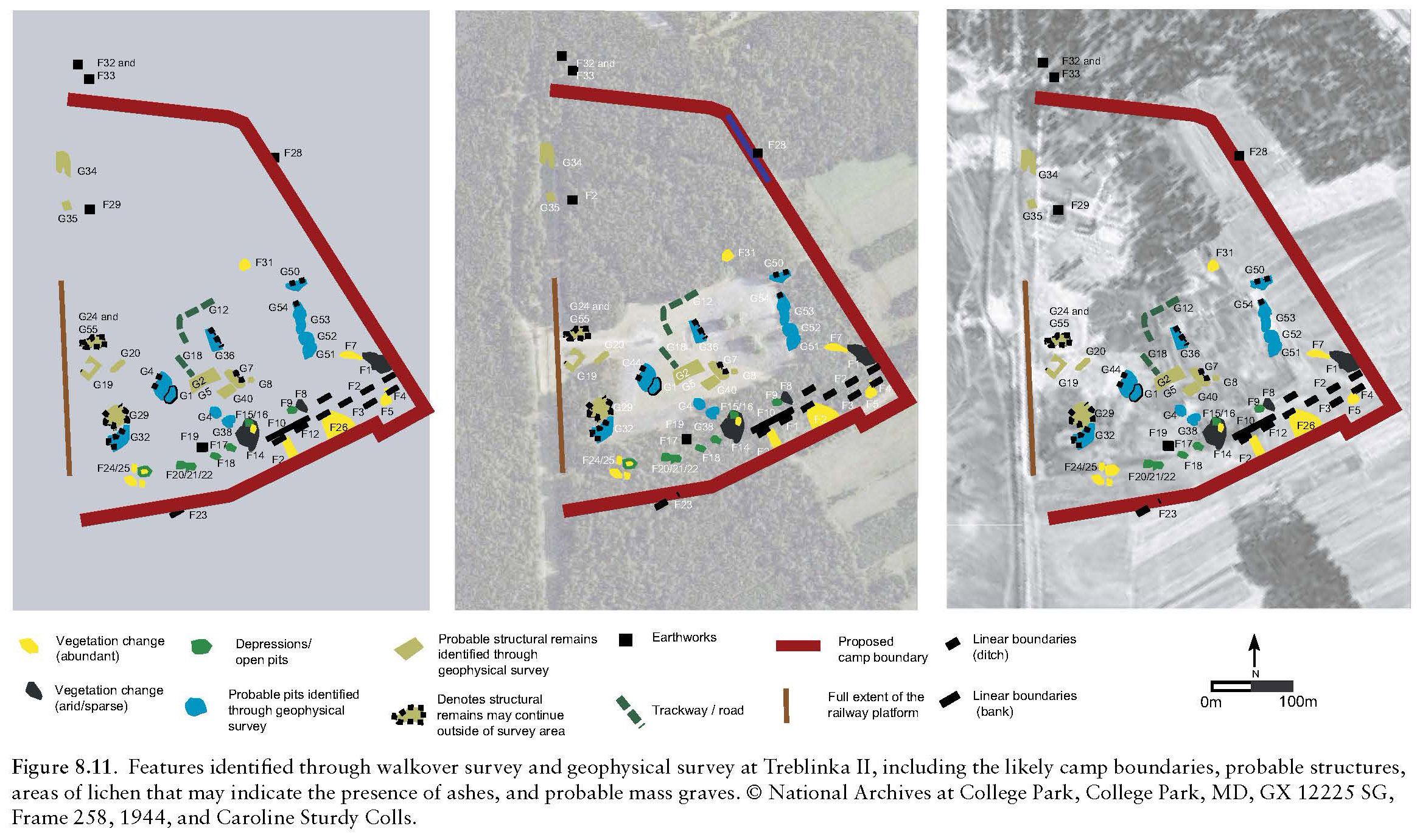
She clearly identifies, along with their dimensions, only graves G50–G54 (p. 301), and publishes their GPR images (p. 303). However, these show highly irregular outlines that have no geometric shape whatsoever, least of all a rectangular one; therefore, interpreting them as rectangles of the aforementioned dimensions is not only misleading but also ridiculous.
Her comment is highly questionable (p. 301):
“While it could be argued that they might represent areas of postwar looting activity, their linearity suggests that they likely predated such actions even if they were later affected by them.”
However, the very fact that they are scattered haphazardly, without any order, as well as the peculiar and unique shape of these “anomalies” support the hypothesis of contiguous excavations and rule out that of mass graves. If anything, the excavation activities would have expanded the contours of the original pits – which obviously would have been geometric – on all sides, so that these would have been much smaller than what is indicated in the GPR images.
Furthermore, as mentioned earlier, the British archaeologist admits that it is difficult to ascertain the exact number of mass graves due to the looting that took place in the camp area. However, these are purely theoretical discussions, because Sturdy Colls explicitly states that “[w]ithout intrusive activity it is not possible to conclusively determine the nature of these pits” (p. 304), thereby undermining the archaeological and historical value of her “discoveries.”
As for the location of the mass graves, Sturdy Colls presents a “plan of Treblinka II showing the evolution of the camp in phases 2–5” (p. 215). It shows three large areas of “mass graves” in the southern part of the camp, one labeled with 29 and two with 30 (this number is assigned to two areas). Based on the scale of the drawing, these areas measure:
- 29: approximately 50 m × 35 m = 1,750 square meters
- 30(a): approximately 110 m × 40 m = 4,400 square meters
- 30(b): approximately 126 m × 90 m = 11,250 square meters,
for a total of 17,400 square meters.
But the 11 mass graves she claims to have identified have a total area of only some 2,600 square meters, which means that the aforementioned areas are purely imaginary. Furthermore, these 11 alleged mass graves contradict the witnesses’ statements in terms of number, size and location.
On the map of Treblinka drawn up by Red Army investigators based on the testimony of Trawniki soldier Sergei Vasilenko, three round pits appear in the “gas chambers” sector (p. 219), as well as in Nikolai Skakodub’s map (p. 272). Philipp (Pylyp) Levchyshyn’s map (p. 270) also contains three pits, vaguely elliptical in shape, with uncertain outlines. On p. 294, Sturdy Colls writes:
“Trawniki man Fedor Fedorenko stated that the graves situated 200m from the gas chambers were as large as 80m × 20m, while his fellow guard Nikolai Senik suggests that there were pits measuring 30m–40m in diameter [and were therefore circular].”
The model of the camp created by the Treblinka Museum depicts three rectangular mass graves (p. 249, Figure 9.1). The map used during German trials, on the other hand, shows four rectangular mass graves (p. 218). In my book, I have reported the statements of several witnesses regarding mass graves.[40] Jankiel Wiernik spoke of pits (without specifying their number) measuring 100 × 25 × 15 meters in depth. According to Elias Rosenberg, the pits measured 120 × 15 × 6 meters. Chil Rajchman mentioned 11 pits, about 50 meters long, about 30 meters wide, and as deep as a four-story building. The eleventh pit, one of the largest, contained about 250,000 bodies.
9. Grave Omissions on Essential Issues
Sturdy Colls does not even address the question of how the bodies of 800,000 or even “nearly a million people” (p. 150) could have fit into the 11 pits she claims to have identified. She immediately attempts to sidestep the issue by stating that the equipment at her disposal allowed for surveys only up to a depth of 4 meters (p. 301), so the volume of the pits remains undetermined. However, as David Skrbina noted in his review:
“high-frequency scanners are limited to perhaps 4 or 5 meters, but lower-frequency units can go much deeper, to 30 meters or more. Could Sturdy Colls, with her wealthy sponsors, not afford the appropriate scanner?”
Archaeological research indicates that the average depth of the mass graves at Bełżec was approximately 3.60 meters, while that of the deepest pits at Sobibór was approximately 4.60 meters. At Treblinka, the depth of the pits (craters) found by Judge Łukaszkiewicz was 7–7.5 meters, but the British archaeologist observed that the alleged gas chambers had been buried “under almost a metre of sand.”[41] She attributed to this the fact that the camp had apparently disappeared; in Bełżec and Sobibór as well, the discoveries were made by digging into the ground, so they too were covered by a layer of sand. This layer clearly distorts the measurement of the depth of the mass graves. Furthermore, the ground at Treblinka was not level but completely uneven, full of craters, holes and small mounds. Therefore, Łukaszkiewicz’s measurement does not reflect the original condition of the ground. I have therefore assumed a depth of 6 meters (useful capacity), almost identical to the maximum depth attributed to the pits at Sobibór (5.8 meters) and, for what it’s worth, identical to that stated by E. Rosenberg. This corresponds to a depth of (6 + 1 + 0.5[42] =) 7.5 meters from the current ground surface.
It can therefore be reasonably assumed that the actual volume of the 11 mass graves allegedly identified by the British archaeologist is at most (2,600 × 6 =) 15,600 cubic meters.
Another issue completely overlooked by Sturdy Colls is the number of bodies that could fit into one cubic meter of a mass grave. In Chapter V, where she discusses Treblinka I, the labor camp, in great detail, she mentions 59 mass graves measuring 10 × 5 meters and 2–2.5 meters deep (p. 117), with a total area of 2,900 square meters and a volume of 7,250 cubic meters, in which a maximum of 12,000 bodies had been buried (p. 120) – that is, fewer than two bodies per cubic meter. The first layer of bodies lay beneath a 50-centimeter layer of sand (pp. 117, 120, 121, 125), a measurement that must be subtracted from the depth of the pits measured from the ground surface to obtain the actual capacity.
If we consider that at Treblinka I, the burial of 12,000 bodies required a pit volume of 7,250 cubic meters, it is absurd to claim that 800,000 or 1,000,000 were buried in 15,600 cubic meters, which would imply a density of 51 to 64 bodies per cubic meter!
In my studies on the camps at Bełżec, Sobibór and Treblinka,[43] I considered a maximum density of 8 bodies per cubic meter, explaining my reasoning, but in the book on the Reinhardt camps, to provide a stronger argument, I assumed 10.[44] It follows that the 15,600 cubic meters of the alleged mass graves presumably located by Sturdy Colls could have held at most (15,600 × 10 =) 156,000 corpses. So, where would have been put the remaining (800,000 – 156,000 =) 644,000 or (1,000,000 – 156,000 =) 844,000 bodies?
The British archaeologist similarly sidesteps the other fundamental question: that of the cremation of 800,000 or 1,000,000 bodies. Based on forensic studies, she highlights the difficulty of achieving complete cremation, which can occur only in a crematorium at temperatures of approximately 870–980°C (1,600–1,800 degrees Fahrenheit, p. 299), but she draws no conclusions from this. She states that cremation took place on five or six grates measuring 10 × 4 meters (p. 295), each of which allegedly burned 1,000 bodies within five hours (p. 295), or even 3,000 (p. 296). She mentions a Feuerkolonne (burning group) and an Aschkolonne (ash brigade, p. 296). But she dismisses the issue of the actual cremation itself with just a few lines (p. 296):
“[…] experiments were conducted with the use of crude oil and other accelerants, and other techniques were developed such as layering women on the bottom of the piles of bodies (because they burned faster).”
Sturdy Colls makes no mention whatsoever of the Waldkolonne (or Waldkommando), the team of prisoners tasked with cutting wood in the surrounding forests for the cremation of corpses, nor does she ever mention wood, the essential fuel for cremations.
These omissions follow a very specific logic, as they aim to evade another fundamental question for the history of the “extermination camp”: how much wood was needed to cremate a corpse? And where was it cut?
In my frequently cited book, and based on various experimental data and the weight of exhumed corpses proposed by blogger Roberto Muehlenkamp (18.95 kg),[45] I calculated a need for approximately 134 kg of dry wood and approximately 255 kg of green wood per corpse.[46] This corresponds to a factor of (255 ÷ 134 =) 1.9 times more fresh wood needed than dry wood. The wood-to-tissue ratio for dry wood is (134 ÷ 18.95 =) 7 – that is, 7 kg of dry wood for every kg of body weight. Forensic experiments conducted in 2018 by researchers at the School of Civil Engineering at the University of Queensland in Brisbane, Australia, concluded that, for the cremation of a fresh pig carcasses (considered very similar to human bodies),[47]
“under ideal conditions (smaller carcasses and continuous feeding of fuel) a minimum of 5 times the weight of the body in dry wood is necessary to achieve almost complete destruction of all organic matter (<10%).”
It should be noted that a body exhumed after months in the ground has lost most of its combustible material (fat and protein), which must be compensated for by a greater supply of heat from the outside,[48] so that the aforementioned 7:1 ratio can be considered more than reliable; therefore, the consumption figure of 255 kg of green wood, or 0.255 metric tons, is also valid.[49]
It follows that the cremation of the alleged corpses at Treblinka would have required (800,000 to 1,000,000 × 0.255 =) between 204,000 and 255,000 metric tons of green wood.
An additional challenge would have been: who, where and when would have cut (and transported to the camp) these immense quantities of wood? The answers drawn from Holocaust literature are as follows:
- According to Chris Webb and Michal Chocholatý, the Holzfällerkommando (lumberjacks’ commando) was “small in number, probably only a few dozen prisoners.”[50]
- However, based on the maximum number of prisoners attributed to Sobibór, I have generously assumed a force of 100 people.
- The wood was cut in the forests surrounding the camp.
- The cremation of the bodies lasted from April to July 1943, approximately 122 days, and this was also the period during which the wood would have been cut.
German documents on wood cutting in forests indicate that the daily output of a prisoner of war – comparable to that of a prisoner in the Treblinka Waldkommando – was approximately 0.63 metric tons,[51] meaning 63 metric tons per day for 100 prisoners.
To cut the 204,000 or 255,000 metric tons of wood needed to cremate the alleged victims of the “gas chambers,” the Waldkommando would therefore have required (204,000 to 255,000 ÷ 63 =) between 2,238 and 4,047 days, or between six and eleven years, compared to the 122 days available! But that’s not all. Documentation from the “Regierung des Generalgouvernements, Hauptabteilung Forsten” (Government of the General Government, Main Forestry Department) shows that, in the entire Warsaw District, from 1943 through January 21, 1944, approximately 168,500 metric tons of wood were cut, of which only approximately 81,800 metric tons had been hauled away.[52]
Therefore, during the four months of 1943 in which the Treblinka Waldkommando is said to have operated, this unit alone would have had to cut 204,000 or 255,000 metric tons of wood in the vicinity of the camp and transport it into the camp, whereas the total amount of wood cut in the entire Warsaw District over the course of the entire year was 168,500 metric tons, and the amount hauled away was 81,800 metric tons!
The final issue, which has also been consistently ignored by mainstream Holocaust historiography, concerns weather conditions, since it is obvious that rain can have a decisive impact on outdoor cremations. Now, at Treblinka, as I have already mentioned, cremations took place from April to July 1943, over 122 days, and each day an average of (800,000 to 1,000,000 ÷ 122 =) 6,557 to 8,196 corpses were cremated on a maximum of six grates measuring 10 × 4 meters = 40 square meters, for a total of 240 square meters. During this period, the weather station in Ostrów Mazowiecka, located approximately 20 km NNE of the camp as the crow flies, recorded 49 days of rain of varying intensity: 27.5 millimeters of rain fell in April, 20.2 in May, 65.3 in June, and 167.1 in July, for a total of 280.1.[53] This amounts to 280 liters of rain on every square meter of cremation grate; therefore, the six grates mentioned above would have received a total of (280 × 240 =) 67,200 liters of rain. This certainly would not have facilitated the cremation of 6,557 to 8,196 bodies daily!
10. Conclusions
In conclusion, the following assessment of Caroline Sturdy Colls’s book can be made:
- She relies exclusively on contradictory testimonies, which she considers a priori truthful and independent, and she manipulates them as needed.
- She attributes a positive value to the contradictions contained in these testimonies, transforming them into “various killing methods,” “alternative techniques,” and “different killing methods.”
- She ignores the fundamental importance of the “steam chambers” in the creation of the myth of the “gas chambers.”
- She has not demonstrated the existence of the ruins of “gas chambers” on the campgrounds; what she has found are mere electromagnetic “anomalies,” for which she has provided a purely conjectural interpretation.
- The same applies to her 11 mass graves, which can likewise be attributed to simple “anomalies”; by her own admission, these cannot be declared mass graves without being excavated.
- The British archaeologist intentionally omitted discussion of the essential issues concerning the number and capacity of the mass graves, and the amount of wood required for the cremation of the bodies; I emphasize “intentionally,” since, in note 47 on p. 414, she refers to the book on Treblinka written by Jürgen Graf and myself (Treblinka: Extermination Camp or Transit Camp? Theses & Dissertations Press, Chicago, 2004), in which these issues are examined in detail. Can she seriously believe – or would she have her readers believe – that her 11 alleged mass graves, with a total volume of approximately 15,600 cubic meters, could have contained 800,000 or even 1,000,000 corpses, that is, 51 to 64 per cubic meter?
- Similarly, she has also intentionally omitted the issue of the amount of wood required for cremation (and all related problems), to the extent that, in relation to the “extermination camp,” she does not even mention the terms “wood” or “firewood.”
All of this renders the book Finding Treblinka: Forensic and Archaeological Discoveries archaeologically and historically inconsistent and utterly devoid of any scientific value.
Endnotes
| [1] | “Truth Lost, Truth Found. A Review of Finding Treblinka by Caroline Sturdy Colls,” CODOH, August 1, 2026; https://codoh.com/library/document/truth-lost-truth-found/. |
| [2] | I campi dell’ “Azione Reinhardt”. Bełżec, Sobibór, Treblinka. Propaganda nera, ricerche archeologiche, riscontri materiali.. Effepi, Genoa, 2024, pp. 252–277: English: The “Operation Reinhardt” Camps. Treblinka, Sobibór, Bełżec. Black Propaganda, Archaeological Research, Expected Material Evidence. Castle Hill Publishers. Uckfield, UK, 2021, pp. 246–269. Subsequently referred to as Reinhardt, with first page numbers referring to the Italian, the second to the English edition. |
| [3] | Ibid., p. 244/238f. |
| [4] | Ibid., p. 265/239. |
| [5] | Ibid., p. 265/257f. |
| [6] | Ibid., p. 267/259. |
| [7] | Treblinka. Extermination Camp or Transit Camp? Theses & Dissertations Press, Chicago, 2004, pp. 115f., and Documents 16f., pp. 342f. |
| [8] | Ibid., Documents 16f., pp. 342f. |
| [9] | C. Mattogno, T. Kues, J. Graf, The “Extermination Camps” of “Aktion Reinhardt.” An Analysis and Refutation of Fabricated “Evidence,” Deceptions, and Flawed Argumentation by the “Holocaust Controversies” Bloggers. Castle Hill Publishers, United Kingdom, 2013, pp. 874f. |
| [10] | Ibid., pp. 872ff. |
| [11] | See the photocopies of the letters in the booklet by J. Gumkowski and A. Rutkowski, Treblinka. Council for the Protection of War and Martyrdom Monuments, Warsaw, 1961. |
| [12] | Reinhardt,p. 110/109. |
| [13] | Ibid., p. 255/249. |
| [14] | Ibid., Document 37 on p. 355/324. |
| [15] | Ibid., Documents 39-56, pp. 357-367/326–337. |
| [16] | Caroline Sturdy Colls, Michael Branthwaite, Treblinka Archaeological Investigations and Artistic Responses. Centre of Archaeology Book Series: Special Issue. Staffordshire University, 2016, p. 50. |
| [17] | Reinhardt, entire third chapter, pp. 91-197/ 93–192. |
| [18] | Ibid., pp. 109f./108f. |
| [19] | Ibid., Subhapter 3.9.1., “Jankiel Wiernik and the Report of November 15, 1942: An Analysis of Plagiarism,” pp. 175–183/171–178. |
| [20] | Ibid., Documents 2, 3, 11, 12, and 14, pp. 329f., 338f., 341/298f., 307f., 310. |
| [21] | Ibid., pp. 173f./169f. |
| [22] | Ibid., Document 15 on p. 342/311. |
| [23] | Ibid., Document 7 on p. 344 (floor plan from Wiernik’s pamphlet) and Docs. 2–3 (original floor plans of the steam chambers), pp. 329f./303, 298f. |
| [24] | Ibid., p. 127/125. |
| [25] | Ibid., pp. 177-180 and Documents 12 and 13, pp. 339f./173-175, 308f. |
| [26] | Ibid., Subchapter 3.9.2., “Abraham Isaak Goldfarb and Jankiel Wiernik: Plagiarizing a Plagiarism,” pp. 183-186/178-181. |
| [27] | URSS-93, p. 44. The paragraph on Treblinka is followed by a chapter titled “A soap factory using human fat.” |
| [28] | Document PS-3311, IMT, Vol. 32, pp. 153-158, here p. 154. |
| [29] | Reinhardt, p. 150/pp. 146. |
| [30] | Ibid., p. 159/155. |
| [31] | Ibid., p. 140/137. |
| [32] | This page mentions that the engines did not always run smoothly. |
| [33] | C. FitzGibbon, Commandant of Auschwitz: The Autobiography of Rudolf Höss. The World Publishing Company, Cleveland/New York, 1960, p. 221. |
| [34] | See my book Le “confessioni” di Rudolf Höss. Analisi storico-critica delle dichiarazioni dell’ex comandante di Auschwitz. Effepi, Genoa, 2018, pp. 187 ff. English translation: Commandant of Auschwitz: Rudolf Höss, His Torture, and His Forced Confessions. Academic Research Media Review Education Group Ltd, London 2024, pp. 200 ff. |
| [35] | C. Sturdy Colls and Michael Branthwaite, “‘This is Proof’? Forensic Evidence and Ambiguous Material Culture at Treblinka Extermination Camp,” in: International Journal of Historical Archaeology, No. 22, 2018, p. 442. |
| [36] | Friedrich P. Berg, “The Diesel Gas Chambers: Idea for Torture – Absurd for Murder,” in: E. Gauss (ed.), Dissecting the Holocaust: The Growing Critique of ‘Truth’ and ‘Memory’. Theses & Dissertations Press, Capshaw, Alab., pp. 435-465. The original German edition was published in 1994. |
| [37] | G. Rudolf, “The Chemistry of Treblinka,” in: CODOH, August 1, 2026; https://codoh.com/library/document/the-chemistry-of-treblinka/. |
| [38] | Nearly 2,900 metric tons of ashes and unburned remains for 781,000 alleged victims (official figure). Reinhardt, p. 301/293. |
| [39] | Ibid., Document 91 on p. 395/258, 362. |
| [40] | Ibid., pp. 268f./260f. |
| [41] | C. Sturdy Colls, Holocaust Archaeologies: Approaches and Future Directions. Springer. New York, 2015, p. 349. |
| [42] | The layer of sand covering the mass graves, as explained earlier. |
| [43] | Bełżec nella propaganda, nelle testimonianze, nelle indagini archeologiche e nella storia. Effepi, Genoa, 2006. English: Belzec. Propaganda, Testimonies, Archaeological Research, and History. Academic Research Media Review Education Group Ltd. London, 2024; C. Mattogno, J. Graf, Treblinka: Extermination Camp or Transit Camp? Academic Research Media Review Education Group Ltd., London, 2024; J. Graf, T. Kues, C. Mattogno, Sobibór: Holocaust Propaganda and Reality. Academic Research Media Review Education Group Ltd., London, 2024. |
| [44] | Reinhardt, pp. 282f./275-277. |
| [45] | C. Mattogno et al., The “Extermination Camps” of “Aktion Reinhardt,” pp. 1285–1292. |
| [46] | Reinhardt, pp. 288f./282. |
| [47] | This important study was noted by G. Rudolf in his review “Open-Air Pyre Cremations Revisited,” CODOH, September 1, 2024; https://codoh.com/library/document/open-air-pyre-cremations-revisited/. See also my article “Incontrovertible Facts on Cremation in National-Socialist ‘Extermination Camps,’” CODOH, February 18, 2025; https://codoh.com/library/document/incontrovertible-facts-on-cremations-in-national-socialist-extermination-camps/. |
| [48] | It is also true that this body loses a large portion of its water, but the heat produced by its combustible substances is much greater than that required for the vaporization of its water. Engineer Wilhelm Heepke, in his heat-balance analysis of a standard cremation in a coke-fired crematorium furnace at 800°C, calculated a heat loss of 60,000 kcal due to the vaporization of water (and the superheating of the steam) and a heat input of 105,000 kcal from the combustible substances in the corpse. See my work I forni crematori di Auschwitz. Studio storico-tecnico con la collaborazione del dott. Ing. Franco Deana. Effepi, Genoa, 2012, Vol. I, p. 129. English: The Cremation Furnaces of Auschwitz: A Technical and Historical Study. Academic Research Media Review Education Group Ltd, London, 2024, Part I, p. 114. |
| [49] | In Crestone, California, outdoor cremation is performed in a structure consisting of two concrete walls lined internally with firebricks, standing waist-high for an average person, open at the top, front and back, with a steel grate positioned roughly halfway up, on which the body is placed. The area below serves as the combustion chamber, where the wood burns; here, one of the two walls has a rectangular opening for combustion air (on the side). The amount of juniper wood used is one-third of a cord, a volume measure equivalent to 128 cubic feet, or approximately 3.6 cubic meters. One cord of dry juniper corresponds to 3,151 pounds, or about 1,429 kg; thus, the amount of wood consumed in a single cremation is (1,429 × 0.33 =) approximately 470 kg of dry wood. Assuming an average body weight of 70 kg, the ratio is approximately 7:1. “Crestone End of Life Project. Ceremony Photo Gallery,” in: https://crestoneendoflifeproject.org/about/photo-gallery/; “From the Flame To Eternity,” at: https://www.sciencefriday.com/articles/from-the-flame-to-eternity/; “What is a cord of firewood? A Cord of Firewood Dimensions and Weight Explained,” in: https://bostonfirewood.com/our-kiln-dried-firewood/what-is-a-cord-of-firewood; “Is Juniper Good Firewood? A Guide to Heating & Cooking with Juniper Wood,” in: https://www.backyardboss.net/juniper-firewood/. |
| [50] | Reinhardt, pp. 291f./284. |
| [51] | Ibid., pp. 286-289/280f. |
| [52] | Ibid., pp. 289-291/282-284. |
| [53] | Ibid., p. 298/290f. |

Bibliographic information about this document: Inconvenient History, 2026, Vol. 18, No. 3
Other contributors to this document:
Editor’s comments: