Jewish Losses during World War II
On the dispute between Giuseppe Fallisi and Vincent Reynouard
I state that I express my point of view on the issue on the express invitation of the manager of Andrea Carancini’s Blog.
First of all, it should be made clear that considering Reynouard a sort of “traitor” passed to the “enemy,” as Fallisi seems to have done, is frankly ridiculous. On the contrary, he should be praised and thanked for the enormous revisionist work he has produced, and in particular for the excellent, well-documented compendium SHOAH: Une synthèse après trente ans de travaux, published by him in PDF and also as a documentary, which is essentially dedicated to the demolition of the history of “extermination camps” and “gas chambers”, drawing on all the best revisionist literature available and on his own research.
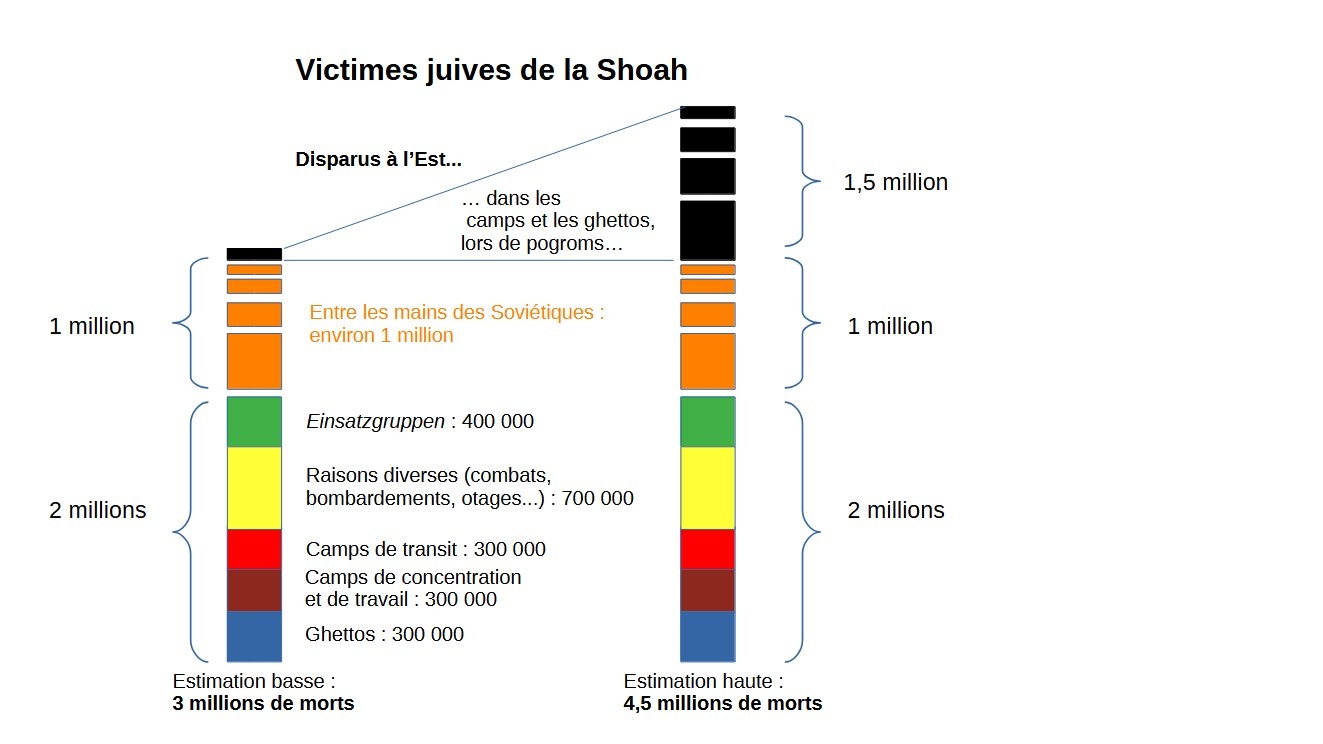
The question of the “Jewish Victims of the Shoah”, which is summarized in a graph on p. 223 of his book, is in my opinion completely marginal, because – in principle – even if the number of victims were really 6 million, this would not automatically demonstrate the reality of a planned extermination plan and implemented in gas chambers. This is also explained clearly by Reynouard:
“’The missing 6 million in 1945 demonstrate the existence of this plan [of extermination].’ We answer: ‘No, this estimate has no relationship with reality. Between one and three million Jews died in the camps, ghettos and the East because of the Germans. The question is: have they been massacred within the framework of a systematic extermination plan, or have they been victims of circumstances related, in one way or another, to war?” (p. 228)
Mr Reynouard proposed the following ‘General budget (very approximate)’ of Jewish losses:
“– 8 million pre-war Jews in what was to be the German sphere of influence
– survivors in 1945: between 3.5 and 5 million;
– disappeared: between 3 and 4.5 million” (p. 223)
Much can be discussed about the distribution of these victims that appears in the above chart, and I will do so at the end of this article, but that is not the problem. The important fact is that the chart is based on a statistical study by Germar Rudolf[1] that comes precisely to the following conclusion:[2]
“According to our calculations, 3.46 to 5 million of them [Jews] survived the ‘Holocaust,’ and 3.1 to 4.64 million did not.”
He also stated:[3]
“Consequently, the number of possible real Holocaust victims – according to official data provided by Israel – is probably less than 3 or even 2 million Jews.”
Reynouard distinguishes between the Shoah on the one hand, which for him is the catastrophe that Jews suffered during World War II, in practice their persecution, and the Holocaust on the other hand, which is to be understood as the claimed systematic and planned extermination.
In my opinion, in a possible statistic, it would be necessary to introduce the categories of “died” (for whatever cause), “murdered” and “disappeared,” all of which fall into the general category of “losses.”
For example, the victims of the concentration camps and ghettos fall into the category of those who simply “died,” while victims of the Einsatzgruppen were “murdered,” and deportees who passed through the camps of Action Reinhard and Chełmno have “disappeared.” In my book The “Operation Reinhardt” Camps Treblinka, Sobibór, Bełżec: Black Propaganda, Archeological Research, Expected Material Evidence (Castle Hill Publishers, Uckfield, UK, 2021), I explained and demonstrated in abundance why they cannot be considered “murdered.”
All assessments of Jewish losses inevitably start from two data: the number of Jews present in what was to become National Socialist-occupied Europe in the pre-war (1939) and the post-war period (1945). However, these numbers are not as certain as is believed. The result of these calculations varies according to the sources used. This is striking that, for Gerald Reitlinger, Jewish losses range from a minimum of 4,194,200 to a maximum of 4,581,000,[4] while Raul Hilberg wrote about 5,100,000.[5]
According to Danuta Dąbrowska, Stanisław Waszak, Henryk Grynberg, 2,642,000 Jews lived in Poland in 1939; Peter-Heinz Seraphim indicated the figure of 2,719,000; Eugene Kulisher and Malcolm Proudfoot relied on that of 2,845,000;[6] Hilberg preferred the figure of 3,351,000.[7] Already these data involve a maximum difference of 709,000 people, who can be considered or not “victims” depending on the choice of the sources you adopt.
Regarding the losses related to Poland and the Soviet Union, Wolfgang Benz, who assumes 2,700,000 deaths for the former and 2,100,000 for the latter, recalls in the introductory paragraph “Realistic Assessments” of the book he coordinated[8] that the relative minimum and maximum figures adduced by G. Reitlinger and the Yad Vashem Institute are 2,350,000-2,600,000 and 1,211,500-1,316,500, respectively, with a minimum difference of 883,500 and a maximum of 1,238,500, which, even in this case, may or may not be considered victims. These great differences depend simply on the numerical data of departure chosen and the methods adopted.
The problem of the number of survivors in 1945 is even more complicated. First of all, the mythical-symbolic character of the 6-million victims should be kept in mind, as was well-documented by Thomas Dalton, who turned his attention to multiple articles published by the New York Times from 1869 to 1938, according to which the Jews of Central and Eastern Europe, invariably 6 million, always appeared threatened with extermination by hunger and disease.[9]
On June 25, 1940, the New York Times reported the following statement by Nahum Goldmann, President of the World Jewish Congress:[10]
“Six million Jews in Europe are condemned to destruction if the victory of the Nazis were to be final.”
This figure was repeated by Jewish propaganda throughout the war. Reynouard refers to articles of newspapers of November 1944 that informed about the publication of the Soviet Black Book, in which the figure of 6 million was consecrated (p. 218). Post-war statistics were compiled to “prove” this propaganda assumption. No statistician dared to explicitly cite the figure of 6 million victims – this would have been too brazen! ‒ but everyone approached it with considerable approximation.
The statistics relating to surviving Jews in the post-war period, even assuming very charitably that they were not rigged for the above reason, cannot be trusted.
In the article “Losses of the Jewish Population in the German Sphere of Influence during World War II,”[11] Jürgen Graf, commenting on Germar Rudolf’s above-mentioned study, put forward compelling arguments on this point:
“Benz’s basic assumption is that every Jew who no longer lived in 1945 in the place where s/he had lived until 1939 was murdered by the Germans.”
The specialists Benz coordinated did not take into account the territorial changes that occurred after the end of the Second World War. The most important cases, Graf continues, are those of Poland, Hungary and Romania:
“Poland lost its eastern provinces, where Jews had been particularly numerous, in favor of the Soviet Union. In return, it acquired vast German territories in the West, where few Jews lived before the war.
Hungary acquired Romanian, Czechoslovak and Yugoslav territories, only to lose them again in 1945. Romania was forced in 1940 to cede Bessarabia to the Soviet Union. Now, Jews who lived in these respective areas and who died during the war, really or presumably, are counted by Benz twice. Thus, 100,000 Jews from Bessarabia who, according to Benz, were exterminated by the Germans and their Romanian allies, appear twice in the statistics of the victims.
G. Rudolf showed that this double count yielded about 533,000 fictitious victims.
But the problem also concerns the survivors, as is clearly evident from the method used to determine their numbers.
In France, those who showed up in 1945 at the Ministry of Former Fighters were considered survivors.[12] In Poland, the general list of Jewish survivors was compiled on 15 June 1945 by the Centralny Komitet ͐Żydów Polskich (Central Committee of Polish Jews).[13] It is clear that, in order to be registered, they too had to present themselves to some ministry. And it can be considered well founded that such a practice was customary throughout Europe. But how many survivors preferred not to return to their country of origin? And how many preferred not to go and declare that they were alive?
Among the approximately 75,700 Jews deported from France, about 26,300 were Polish, 7,000 Germans, 4,500 Russians, 3,300 Romanians, 2,500 Austrians, 1,200 Hungarians:[14] can you imagine that the survivors of the deportations in 1945 rushed to return to France to be declared alive by the competent ministry?
And the surviving Polish Jews of Galicia (where Lwów/Lemberg is located), which was incorporated into the Soviet Union, went to Warsaw to be registered as being alive?
The changes in religion or identity of survivors, which applies in particular to the Soviet Union, should also be considered. As J. Graf found:
“According to the 1939 census, there were 3.02 million Jews in the Soviet Union. The first post-war census, which took place in 1959, provided a figure of just 2.26 million Jews, but all Western Zionists agree that this figure was unrealistically low. According to Soviet practice, every citizen could choose for himself which nationality to belong to, and a considerable part of Soviet Jews was already assimilated: they considered themselves as Russians, Ukrainians etc. Moreover, at that time, the political atmosphere was not particularly favorable to Jews, so many of them preferred not to be identified as such.”
To this is added the emigration of the immediate post-war period, especially to Palestine, the countries of Latin America, the United States and other English-speaking countries.
In this regard, J. Graf mentions an emblematic case:
“A short article that appeared on November 24, 1978 in an American newspaper The State Time (Baton Rouge, Louisiana), illustrates better than long and complicated statistics what really happened to the missing Jews:
‘The Steinbergs once lived in a small village in Poland. This was before the camps of Hitler’s death. Now more than 200 survivors dispersed to the world and their descendants are gathered here to share a special four-day celebration that appropriately began Thanksgiving. Relatives came Thursday from Canada, France, England, Argentina, Colombia, Israel and at least 13 U.S. cities. ‘It’s fabulous,’ said Iris Krasnow of Chicago. ‘There are five generations here – from three months of age to 85. People are celebrating and having a wonderful time. It’s almost like a World War II refugee meeting.’’”
To conclude, the statistics relating to Jews in 1939 are somewhat dubious, while those relating to 1945 are extremely dubious; therefore, any statistics based on this comparative method are rather unreliable.
Returning to Reynouard, while his absolute numbers were taken from Germar Rudolf, their breakdown is conjectural and moreover unfounded. Reynouard proposes a lower estimate of 3 million victims, and an upper one of 4 and a half million. The victims are divided into 6 identical categories, plus a seventh (1,500,000 victims), which applies only to the upper estimate and concerns “Disappeared in the East… in camps and ghettos, in pogroms…” It is unclear where this figure comes from and why he excluded it from the lower estimate.
The other 6 categories are:
1) “in the hands of the Soviets: about 1 million”. Even here it is not known where this figure comes from and what it means: how and why did these Jews die? In this regard, consider the following observation of the commander of the Einsatzgruppe C in the “Ereignismeldung” (event report) No. 81 of 12 September 1941:[15]
“While in the first weeks there were still Jews in large numbers, in the territories of central and eastern Ukraine it was possible to see that in many cases 70-90% of the Jewish population had fled, in some cases 100%. In this we can see an indirect result of the work of the Security Police, since the gratuitous expulsion of hundreds of thousands of Jews – for the most part, according to interrogations, beyond the Urals – represents a considerable contribution to the solution of the Jewish question in Europe.”
But Soviet territories were also the destination of the Jews who passed through the transit camps (see below, Point 4), more than 1,400,000 of them, so the number of Jews who passed alive “in the hands of the Soviets” should be around 2 million.
2) “Einsatzgruppen: 400,000.” Reynouard practically rounds up the proposed figure of Siegfried Verbeke (387,000, p. 439), but also reports my count in my study on the Einsatzgruppen: 727,871 victims, of which 274,149 are recorded in the reports without indication of place and date; from this, rounding the digits, he calculates the number of 750,000 – 270,000 = 480,000 victims, which would confirm the Verbeke’s figure (p. 443).
In my study, when discussing the above figure of 727,871, I stated:
“The unverifiable data are therefore 40.7% of the total figure! To these problems is added that of the exaggerations, because, even if the executions are reported with precise date and place, in most cases there is no certainty that the figures indicated are accurate.”
For this reason, I concluded, “the only way to assess the reliability of the figures in the Ereignismeldungen [the Einsatzgruppen‘s event reports] remains the examination of the findings of corpses and/or their destruction in the framework of the so-called ‘Aktion 1005,’”[16] a theme to which I have dedicated a special volume, in which I have examined in detail the alleged activity of all the “Sonderkommandos” of the alleged “Aktion 1005” (the exhumation of bodies from mass graves and their cremation on open-air pyres), eyewitness accounts, Soviet reports and photographic evidence, and I have come to the following conclusion (Point 4):[17]
“Between the figures of the executions proclaimed in the various German reports and the number of corpses actually found [and supposedly cremated] there is such an immense disproportion that it can reasonably be considered that they are far exaggerated.”
A report dated September 12, 1941 clearly shows that the Einsatzgruppen did not have as their main task the killing all the Jews they encountered, so the numerical exaggerations in these reports cannot be due to their eagerness to appear before their Berlin superiors as particularly efficient exterminators.
3) “Miscellaneous reasons (combats casualties, bombings, hostages…): 700,000.” This figure is disproportionate. According to the Yad Vashem Institute, about 240,000 Jewish soldiers died in battle, about 200,000 of them within the Red Army,[18] so it is not realistic to hypothesize 460,000 victims for bombing and hostage killings.
4) “Transit camps: 300,000.” For Reynouard, the camps of Bełżec, Sobibór, Treblinka and Chełmno were transit camps. Here the only toehold could be mainstream Holocaust historian Dieter Pohl, according to whom up to 5% of the deportees could die of hardship during the journey.[19] Since some 1,420,000 Jews were deported to these camps according to the Korherr Report, this would amount to approximately 71,000 deaths. How did Reynouard get to 300,000?
5) “Concentration and labor camps: 300,000.” This is another decidedly exaggerated figure. German orthodox historian Karin Orth wrote:[20]
“At least one-third of the more than 700,000 inmates registered in concentration camps in January 1945 died, perhaps even half, in death marches or mass mortality of the camps; the percentage of Jewish inmates among the dead was high.”
The death toll resulting from this would therefore have been 230,000-350,000 inmates. Even assuming that this estimate is well-founded, how many of these deaths were Jews? In this regard, there is no complete data, but some significant examples serve to give an idea of the order of magnitude.
In their analysis of the Sterbebücher (death records) of Auschwitz, Thomas Grotus and Jan Parcer found that, out of a total of 68,384 deaths documented between 1941 and 1943, those of Jews were 29,125, or 42.6%.[21] On 21 August 1944, 104,891 registered prisoners were in Auschwitz, 45,876 of them Jewish (43.7%).[22] In addition, there were some 30,000 unregistered Jews in the transit section (Durchgangslager). However, as a rule, they remained there only for a few days before getting transferred to other camps. Therefore, the mortality of Jewish prisoners was reasonably less than 50% of the total deaths toll, which was about 135,500.[23]
As noted in the Mauthausen Camp’s death records, Jewish inmates who died in this camp between 1938 and 1945 numbered 14,356 out of a total of 68,874,[24] hence about 21% of the total. It is therefore highly unlikely that the number of Jewish deaths in concentration camps reached 50% of the alleged 350,000 mentioned above, i.e. 175,000 deaths. The labor camps cannot have caused the remaining 125,000 deaths, so the 300,000 figure is also blatantly unfounded.
6) “Ghettos: 300,000.” It seems obvious to me that Reynouard refers to the Polish ghettos, because the Baltic and Soviet ones already fall into what I have indicated as the seventh category (“Disappeared in the East… in camps and ghettos, in pogroms…”). But, according to the orthodox Holocaust narrative, many of the Einsatzgruppen’s victims came from the ghettos, who are therefore counted twice.
The two largest ghettos – those of Warsaw and Lodz, which had a maximum number of about 400,000 and 160,000 residents, respectively ‒ recorded 69,355 deaths in Warsaw in the period January 1941 to June 1942,[25] and 47,372 in Lodz from 1938 to August 1944,[26] hence a total of 116,727. For the remaining ghettos ‒ very numerous but also much smaller ‒ there no data exists; most of them moreover suffered drastic population reductions in the second half of 1942 due to deportations to the eastern camps, so it is not realistic that there were about 183,000 people missing to get to 300,000. This figure therefore remains conjectural.
In conclusion, from a revisionist perspective, it is easy to accept (on the basis of the uncertain assumptions set out above) a death toll of 3 or 4.5 million Jews. The challenge is to explain how and where they died.
Endnotes
| [1] | In: G. Rudolf (Ed.), Dissecting the Holocaust. The Growing Critique of “Truth“Truth” and “Memory”.” Theses & Dissertations Press, Chicago, 2003, pp. 181-213 (pp. 171-202 in the current, 4th edition of 2024). |
| [2] | Idem, p. 210 (2024 edition: p. 199). |
| [3] | Ibid. |
| [4] | G. Reitlinger, La Soluzione Finale. Il tentativo di sterminio degli Ebrei d’Europa 1939-1945. Il Saggiatore, Milan, 1965, p. 612. |
| [5] | R. Hilberg, La distruzione degli Ebrei d’Europa. Giulio Einaudi editore. Turin, 1995, p. 1319. |
| [6] | F. Golczewski, “Polen,” in: Wolfgang Benz (edited by), Dimension des Völkersmords. Oldenbourg, Munich, 1991, p. 419. |
| [7] | R. Hilberg, La distruzione degli Ebrei d’Europa, p. 1313. |
| [8] | The work was written by 17 specialists from individual countries under the supervision of Benz. To simplify, I refer to Benz as the author. |
| [9] | T. D. Dalton, Debating the Holocaust. A New Look at the Both Sides. Theses & Dissertations Press. New York, 2009, pp. 50-56. |
| [10] | The New York Times, June 25, 1940, p. 4. |
| [11] | Historia Magistra Vitae / Chapter 10, pp. 109-117. Can be purchased online at: https://www.lulu.com/shop/j%C3%BCrgen-graf/historia-magistra-vitae/paperback/product-1z424zk8.html? page=1&pageSize=4 |
| [12] | S. Klarsfeld, Le mémorial de la déportation des Juifs de France, édité et publié par Beate et Serge Klarsfeld, Paris, 1978, p. 10 (my numbering). |
| [13] | ‘Statystyka ludności żydowskiej w Polsce’, in: Biuletyn Głównej Komisji Badania Zbrodni Niemieckich w Polsce, Vol. I, 1946, p. 203. |
| [14] | S. Klarsfeld, Le mémorial de la déportation des Juifs de France, p. 23. |
| [15] | Klaus-Michael Mallmann, Andrej Angrick, Jürgen Matthäus, Martin Cüppers (edited by), “Die Ereignismeldungen UdSSR 1941”. Dokumente der Einsatzgruppen in der Sowjetunion I. Wissenschaftliche Buchgesellschaft, Darmstadt, 2011, p. 452. |
| [16] | Gli Einsatzgruppen nei territori orientali occupati. Genesi, compiti e attività. Vol. I. Effepi, Genoa, 2016, pp. 257f. For the English edition, see https://holocausthandbooks.com/book/the-einsatzgruppen-in-the-occupied-eastern-territories/ |
| [17] | Gli Einsatzgruppen nei territori orientali occupati. L’“Azione 1005.” Vol. II. Effepi, Genoa, 2017. vol. II, p. 335. |
| [18] | Jewish Soldiers in the Allied Armies, online at https://www.yadvashem.org/holocaust/about/combat-resistance/jewish-soldiers.html |
| [19] | D. Pohl, “Massentötungen durch Giftgas im Rahmen der ‘Aktion Reinhardt’: Aufgaben der Forschung” in: Günter Morsch, Betrand Perz (ed.), Neue Studien zu nationalsozialistischen Massentötungen durch Giftgas: Historische Bedeutung, technische Entwicklung, revisionistische Leugnung. Metropol, Berlin, 2011, p. 194. |
| [20] | K. Orth, “The Genesis and Structure of the National Socialist Concentration Camps,” in: Encyclopedia of Camps and Ghettos, 1933–1945. Vol. 1, Part A. Indiana University Press, Bloomington and Indianapolis, 2009, p. 194. |
| [21] | T. Grotum, J. Parcer, “EDV-gestützte Auswertung der Sterbeeinträge”, in: Staatliches Museum Auschwitz-Birkenau (ed.), Sterbebücher von Auschwitz. G. Saur, Munich/New Providence/London/Paris, 1995, p. 249. |
| [22] | Archive of the Central Commission of Inquiry on Crimes against the Polish People – National Memorial. NTN, 155, pp. 96 and 115. |
| [23] | See my book Auschwitz: Trasporti, Forza, Mortalità. Effepi, Genoa, 2019, p. 276. For the English edition, see https://holocausthandbooks.com/book/the-real-auschwitz-chronicle/, Vol. 2. |
| [24] | H. Marsalek, Mauthausen. La Pietra, Milan, 1977, pp. 115 and 204. |
| [25] | T. Berenstein, A. Eisenbach, B. Mark, A. Rutkowski, Faschismus – Getto – Massenmord: Dokumentation über Ausrottung und Widerstand der Juden in Polen während des zweiten Weltkrieges. Röderberg Verlag, Frankfurt am Main, 1960, pp. 138f. |
| [26] | J. Baranowski, The Łódź Ghetto 1940-1944. Vademecum. Archiwum Państwowe w Łodzi & Bilbo, Łódź, 1999, p. 86. |

Bibliographic information about this document: Inconvenient History, 2026, Vol. 18, No. 3; translated from the Italian original "La controversia tra Giuseppe Fallisi e Vincent Reynouard sulle perdite ebraiche durante la seconda guerra mondiale" as posted at https://www.andreacarancini.it/2026/08/carlo-mattogno-la-controversia-tra-giuseppe-fallisi-e-vincent-reynouard-sulle-perdite-ebraiche-durante-la-seconda-guerra-mondiale/
Other contributors to this document:
Editor’s comments: