
From Rothstein to Thirty Eight: A Reassessment of Treblinka Transit Cases
Introduction
Mainstream Holocaust historiography maintains that Treblinka functioned as an extermination camp where nearly all Jewish deportees were murdered within hours or days of arrival, with the exception of a small number selected for forced labor. Revisionist, however, argue that Treblinka served as a transit camp, temporarily holding Jews before they were deported further east. Orthodox Holocaust historians counter that no evidence supports the claim that Treblinka – or the other Aktion Reinhardt camps, Sobibór and Chełmno – served as transit camps. Researcher Roberto Muehlenkamp even offered a financial reward to Holocaust deniers if they could produce a single documented example of a Jew who was transported through the Reinhardt camps to the “East.”
Revisionists answered this challenge. Several cases have been presented in which Jews deported from Treblinka, Sobibor or Belzec were later transferred to other camps such as Majdanek, Auschwitz or Bergen‑Belsen. More on these intra‑camp transfers can be found in Panagiotis Heliotis’s studies “(Many?) Jews Transited through Treblinka” (Inconvenient History, Vol. 11, No. 2, 2019, pp. 219-224) and “Jews Transited through Belzec & Sobibór” (Inconvenient History, Vol. 12, No. 2, 2020, pp. 144-147). An additional and more exceptional attempt appeared in the article “One Survivor, One Single Survivor! Treblinka Transitees” by Germar Rudolf (Inconvenient History, Vol. 9, No. 2, 2017, pp. 186-193), which presents two such cases.
Case Study 1: Minna Grossova
Germar Rudolf writes:
“Carlo Mattogno has pointed out a particularly illuminating case of a Jewish individual transited through Treblinka. It concerns the fate of a certain Minna Grossova, born on Sept. 20, 1874. On October 19, 1942, this 68-year-old lady was deported to Treblinka – at a time when on average some 5,000 Jews are said to have been killed and buried there every single day. But instead of getting killed there, she was sent to Auschwitz, where she… no, was not sent to the gas chambers either, although she was most certainly not ‘fit for labor,’ but lived there another 14 months, finally dying there on December 30.”
This example is an evidence of a deportee transited through Treblinka to another camp.
Case Study 2: Siegmund Rothstein
The second example is far more significant, as it concerns a deportee who was sent to Treblinka but ultimately died in Minsk, Belarus – in contrast to Minna Grossova, who was transferred from Treblinka to other camps.
Rudolf writes:
“How about Jews actually transited to ‘the East’? Jean-Marie Boisdefeu has documented an interesting case he stumbled over while skimming Yad Vashem’s database of Holocaust victims. It concerns the Berlin Jew Siegmund Rothstein, born in 1867, who was first deported to the Theresienstadt Ghetto for elderly Jews in August 1942. Barely a month later, however, on September 26, he was deported to Treblinka at the age of 75. But that was not his end at all, because the German authorities found life signs of him further east, as they finally determined that Rothstein died in Minsk, the capital city of Belarus, some 240 miles east of Treblinka.”
Rudolf continues:
“I doubt 75-year-old Mr. Rothstein jumped off the train prior to arriving at Treblinka and ran all the way to German-occupied Minsk. Hence, he must have traveled there by train… Rather, he must have made that journey on a deportation train together with hundreds or thousands of fellow deportees from Theresienstadt.”
Boisdefeu found out that none of the elderly Jews deported from Theresienstadt are listed in German memorial books as having been killed at Treblinka, but instead appear with various death locations or places where they were last heard from.
Expanding the Search: Additional Cases from Yad Vashem
After examining the Yad Vashem database – Israel’s official institution for Holocaust remembrance – I searched for individuals who were on the same transport as Siegmund Rothstein. I found multiple additional cases of Jewish victims who were deported from Theresienstadt, sent to Treblinka, but listed as having died in Minsk City, Belarus. This indicates that Rothstein is not an isolated case.
The September 1942 Transports from Theresienstadt
In September 1942, several large transports of elderly Jews were sent from Theresienstadt to Treblinka.[1] These included the transports of 19, 21, 23, 26, and 29 September 1942. They formed part of eight so‑called Alterstransporte (“elderly transports”) sent in September and October 1942. Yad Vashem explicitly identifies the transports of 26 September (Br, ~2,004 persons) and 29 September (Bs, ~2,000 persons) as Theresienstadt → Treblinka transports.[2]
Examples of Transports trough Treblinka
From the 26 September transport alone, I found the following individuals listed as Treblinka deportees but Minsk deaths:
- Anna Beermann (1866)
- Mary Mosessohn (1867)
- Elise Lippmann (1858)
- Elsa Vogelsang (1875)
- Max Borinski (1870)
- Pine Bendit (1871)
- Sara Gerechter (1867)
- Franziska Salomon (1868)
- Bertha Lewkowitz (1874)
- Julius Yitzkhak Unger (1873)
- Elsbeth Stehning (1873)
- Oskar Winter (1870)
- Paula Jacob (1867)
Notably, all are elderly – individuals who, according to mainstream historians, would not have been spared upon arrival at Treblinka.
The pattern is not limited to 26 September. I found similar cases in the transports of:
- 19 September – 13 examples
- 21 September – 1 example
- 26 September – 14 examples
- 29 September – 9 examples
This yields a total of 38 cases, including Rothstein.
Selected Case Studies
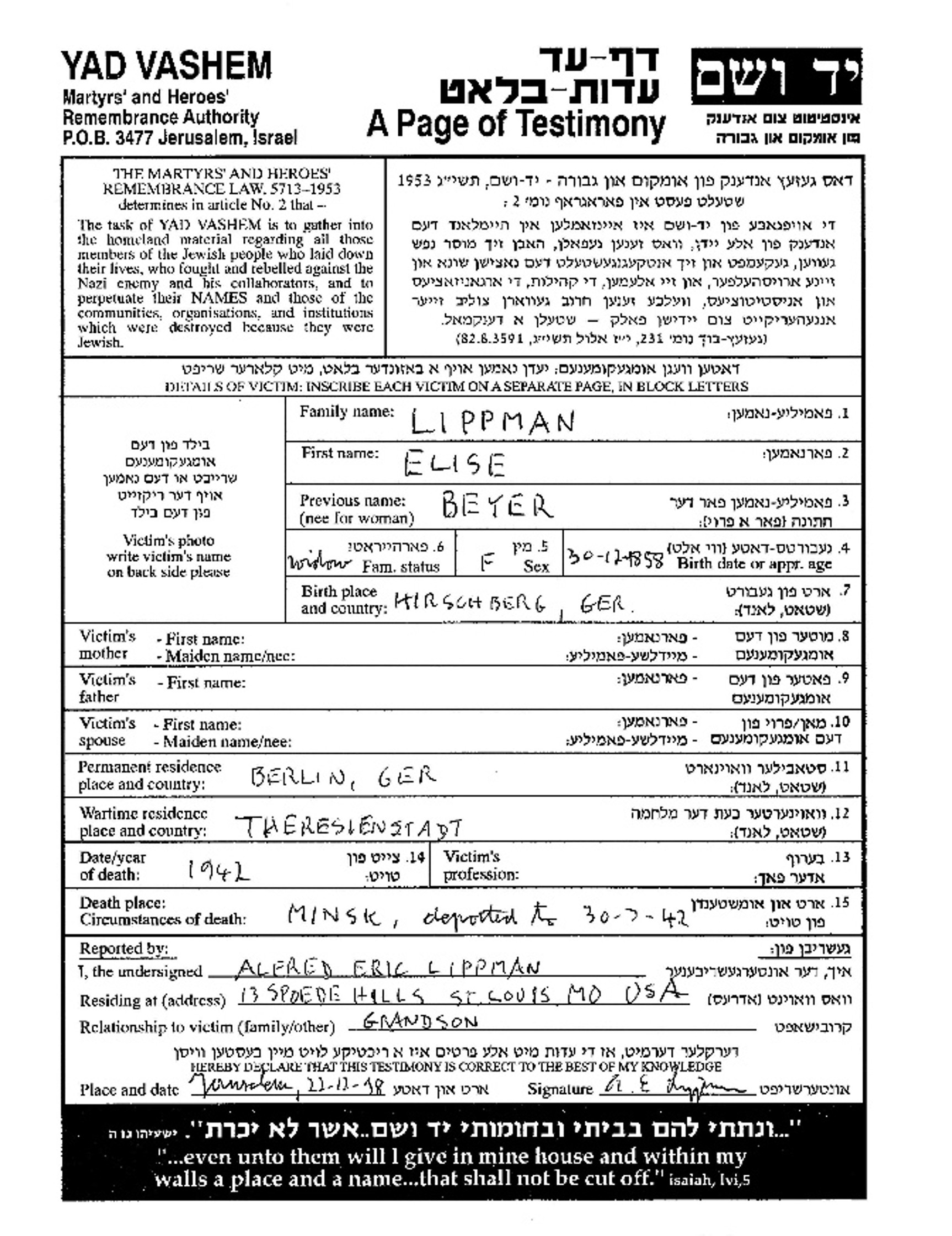
One particularly illustrative example is that of Elise Lippmann (Beyer), born in 1858. Prior to the Second World War, she lived in Berlin, Germany. On 30 July 1942, she was deported to the Theresienstadt Ghetto, and nearly two months later, on 26 September, she was placed on a transport to the Treblinka Camp. Yet according to the Yad Vashem database, her place of death is listed as Minsk City, not Treblinka. This information is not based on secondary speculation but on a Page of Testimony submitted by her grandson, Alfred Eric Lippmann, who explicitly stated that she died in Minsk (see Illustration 1 below).[3] This case therefore represents a documented trajectory of Theresienstadt → Treblinka → Minsk City.
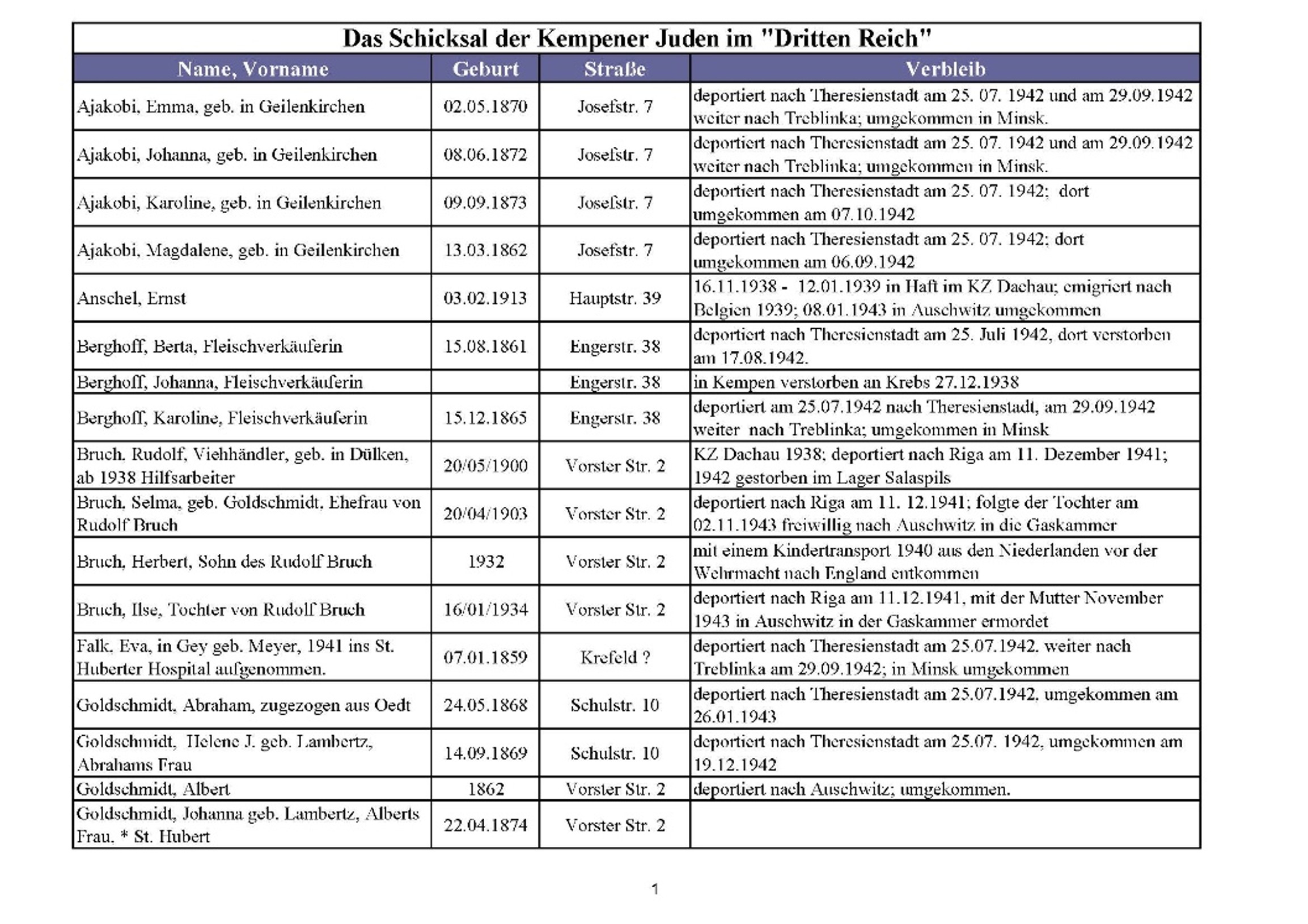
Another example is Karoline Berghoff, born in 1865. She was deported to Theresienstadt on 25 July 1942, and subsequently sent to Treblinka on 29 September. In the Kempen municipal document Das Schicksal der Kempener Juden im “Dritten Reich”, Berghoff is recorded as having been deported to Treblinka, and that she “died in Minsk” (“in Minsk umgekommen”). The same document lists Eva Falk (born 1858) and Emma Ajakobi (born 1870; see Illustration 2) with identical trajectories: deportation to Theresienstadt, subsequent transport to Treblinka, and death recorded in Minsk City. These cases appear in official regional documentation rather than revisionist literature, and they follow the same pattern found in the Yad Vashem database.
It is important to emphasize that these individuals are listed as having died in Minsk City, not in the Maly Trostenets Camp near Minsk. Cases involving Maly Trostenets were examined separately. In total, I found seven examples of Jews who followed the route Theresienstadt → Treblinka → Maly Trostenets, and these were excluded from the main dataset, because Maly Trostenets is itself considered a killing site.
Taken together, these cases contribute to a total of 38 documented examples (including Siegmund Rothstein) of Jews who were deported from Theresienstadt to Treblinka and subsequently recorded as having died in Minsk City. This pattern suggests that Rothstein is not an isolated anomaly. Further research is required, and it is likely that additional cases exist.
Conclusion
The data presented in this study significantly expands the scope of what was previously known about Treblinka’s function within Aktion Reinhardt. When Germar Rudolf published the Rothstein case in 2017, it was dismissed as an anomaly – an isolated irregularity that allegedly proved nothing. Yet the newly identified cases documented here demonstrate that Rothstein was not an exception at all, but rather the first visible example of a much broader and systematically overlooked pattern.
Across multiple transports from Theresienstadt in September 1942, we find elderly deportees officially recorded as having been sent to Treblinka, yet later documented – by German authorities, regional memorial books and Yad Vashem itself – as having died in Minsk City, hundreds of kilometers east of Treblinka. The fact that these individuals were not registered as having perished at Treblinka, but instead appear in Minsk death records, strongly suggests that their journey did not end at Treblinka. Instead, the evidence points toward the existence of a deportation route in which Treblinka served not as a final destination, but as an intermediate stop on the way to the East.
With at least thirty‑eight documented cases now identified, the long‑standing assertion that “no Jew was ever transported through Treblinka to the East” can no longer be maintained without qualification.
Notes
[1] United States Holocaust Memorial Museum (USHMM), Holocaust Encyclopedia, “Theresienstadt: Key Dates,” which states that on 19 September 1942 approximately 2,000 elderly Jews were deported from Theresienstadt to the Treblinka killing center and that this transport was one of eight transports of elderly Jews to Treblinka in September and October 1942; see also USHMM, Holocaust Encyclopedia, “Treblinka: Key Dates.”
[2] Terezín Initiative Institute, Transport Database – Transports out by date, which records the Theresienstadt → Treblinka transports of 19 September (Bo), 21 September (Bp), 23 September (Bq), 26 September (Br), and 29 September (Bs) 1942. Terezín Initiative Institute – Transport Database (https://katalog.terezinstudies.cz/eng/ITI/database/tr_out_date) Holocaust.cz, Transport Bp (21.09.1942 Terezín → Treblinka) and Transport Bq (23.09.1942 Terezín → Treblinka).
Yad Vashem, Transport Br from Theresienstadt, Ghetto, Czechoslovakia to Treblinka, Extermination Camp, Poland on 26/09/1942. Yad Vashem identifies Br as departing on 26 September 1942, carrying 2,004 inmates, and explicitly describes it as the fourth in a series of eight transports of sick and elderly Jews (“Alterstransporte”). Yad Vashem, Transport Bs from Theresienstadt, Ghetto, Czechoslovakia to Treblinka, Extermination Camp, Poland on 29/09/1942. Yad Vashem identifies Bs as departing on 29 September 1942 with 2,000 inmates, and describes it as the fifth in the series of eight “Alterstransporte.”
[3] Yad Vashem – Pages of Testimony Names Memorial Collection, https://collections.yadvashem.org/en/names/13326223.

Bibliographic information about this document: Inconvenient History, 2026, Vol. 18, No. 3
Other contributors to this document:
Editor’s comments: