
Hiroshima and Nagasaki After 50 Years
The Ethics of War
Gregory P. Pavlik wrote this essay as an editor for The Freeman, published monthly by the Foundation for Economic Education (30 S. Broadway, Irvington-on-Hudson, NY 10533). It is reprinted from the September 1995 issue. Pavlik is also editor of the 1995 work, Forgotten Lessons: Selected Essays of John T. Flynn.
The first use of an atomic bomb in warfare took place on August 6, 1945. The weapon was dropped on the Japanese city of Hiroshima by the US bomber Enola Gay, instantaneously destroying four square miles in the middle of the population center. The blast killed 66,000 men, women, and children, and injured an additional 69,000. A full 67 percent of Hiroshima's buildings, transportation systems, and urban structures were destroyed.
The next (and only other) atomic bomb to be dropped in warfare was detonated over the Japanese city of Nagasaki three days later. That blast killed 39,000 civilians and injured another 25,000; 40 percent of the city was destroyed or unrepairable. The Japanese government surrendered to the US government on August 10, 1945.
Since the last “good war,” a debate has ensued over the moral legitimacy of the use of nuclear weapons, particularly against civilians. The critics hold that it is a crime to incinerate civilians en masse; defenders commonly claim that the bombing was necessary to bring the war to a close, thereby saving countless American lives. Most of those who make this claim do so in earnest. The problem is that this defense is both historically false, and taken to its logical conclusion, extremely dangerous.
But a discussion of the bombing of Hiroshima and Nagasaki cannot proceed without an overview of the imperialist motives for Japanese military aggression, which reflected the age-old drive for power through military intimidation and conquest. The Japanese desired a series of conquests, to constitute the Greater East Asian Co-Prosperity sphere. This involved, most importantly, penetration into Korea, Manchuria, China, French Indochina, Malaya, and Burma.
What was clearly not their goal was a prolonged conflict with the United States or any of the other Allied Powers. After establishing their Asian imperium and a defensive perimeter, the Japanese expected to reach a negotiated peace.
It should be clear that the attack on the American military base at Pearl Harbor was not a part of the long-term planning of the Japanese government. Indeed, conservatives and isolationists have long held the view that the Roosevelt administration provoked the Japanese into their aggressive stance as a back door to war in Europe.
Consider the facts leading up to the attack: Roosevelt had made a commitment to Churchill that the United States would enter into the Asian conflict if the British were attacked; the United States was shipping ammunition to both Russia and Great Britain; Roosevelt had placed an embargo on oil and metals against Japan; and in the most egregious example, had sent the “unofficial” Flying Tigers to attack the Japanese in China in 1941. All were violations of US neutrality and acts of belligerency.
Vocal critics on the Old Right – such as John T. Flynn and Harry Elmer Barnes – held that the Roosevelt administration was aware of the attack in advance, both from decoded transmissions and intelligence reports. The weight of history has ironed out the appearance of radicalism from the latter contention. Whatever the truth of the Peal Harbor affair, an extended war with the United States was not a desire of the Japanese.
Japanese Objectives
Apologists for the bombing of Hiroshima and Nagasaki need to consider the overall thrust of the Japanese objectives. These objectives do not square with the notion that Japan was intractably set into a policy of mortal combat with the Americans. Not that the Japanese were not willing to fight – they did so for four bloody and grueling years. Yet the oft-repeated claim that the Japanese were willing to sacrifice every last individual before ending the war is nonsense.
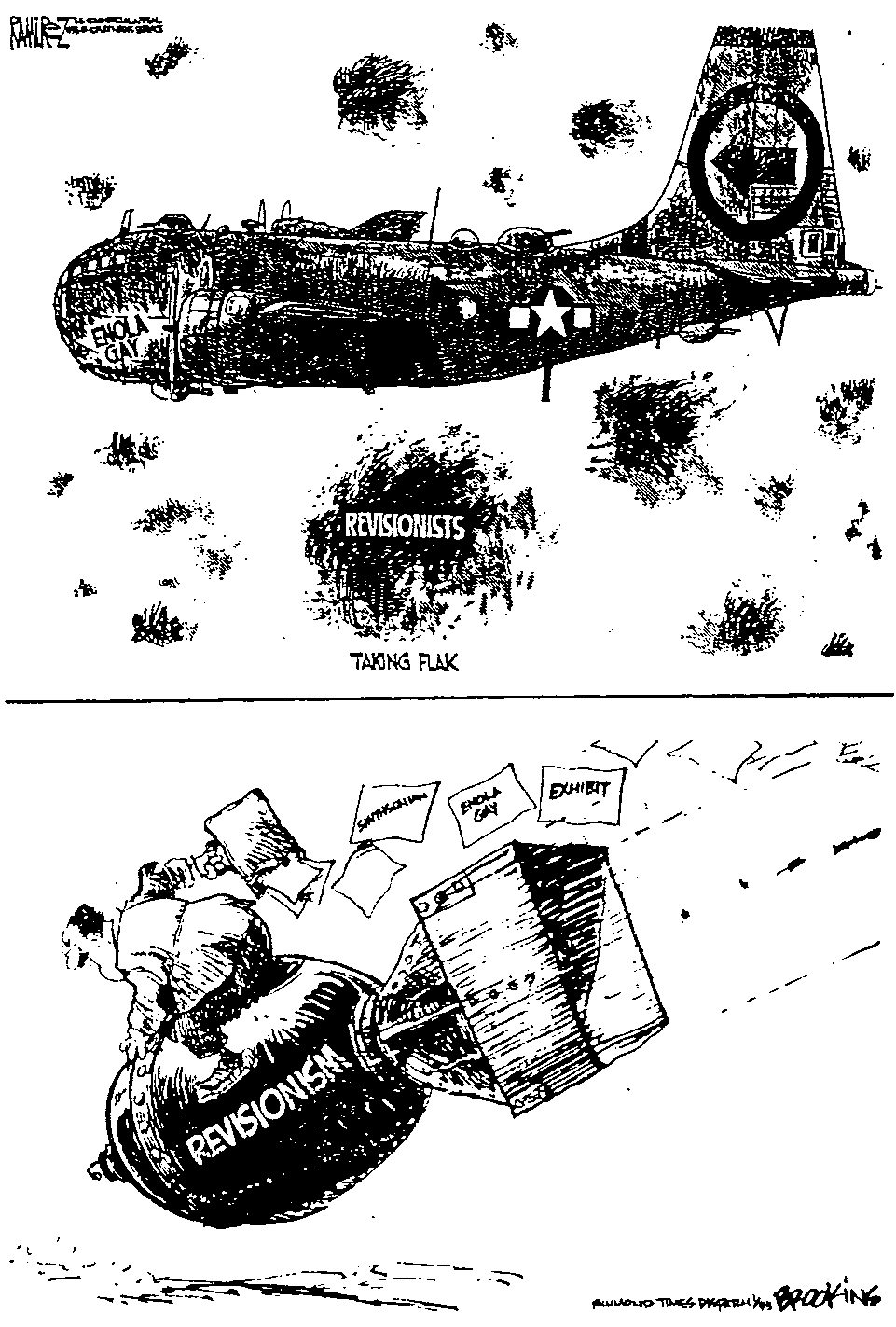
Editorial cartoons take aim at the “revisionism” of a Smithsonian Institution exhibit on the bombings of Hiroshima and Nagasaki, which was cancelled in early 1995 after veterans' groups and others protested its critical portrayal of President Truman's use of the atomic weapon.
In reality, the Japanese were willing to end hostilities with the United States as quickly as they began. Startlingly neglected is the January 1945 offer of the Japanese government to surrender. As the eminent English jurist Frederick J. P. Veale pointed out in Advance to Barbarism [p. 352]:
Belatedly it has been disclosed that seven months before it [the atomic bomb] was dropped, in January 1945, President Roosevelt received via General MacArthur's headquarters an offer by the Japanese Government to surrender on terms virtually identical to those accepted by the United States after the dropping of the bomb: In July 1945, as we know, Roosevelt's successor, President Truman, discussed with Stalin at Babelsberg [Potsdam] the Japanese offer to surrender.
Clearly, then, the bomb did not have to be dropped to save the lives of American soldiers. The war in the Pacific could have ended prior to the European conflict. One suspects that the conflagration's extension beyond the confines of necessity had more to do with the politics of war than military strategy. The fact that consultation with Stalin played a key role in the decision tends to implicate both what historian William L. Neumann pointed to as “the historic ambitions of Russia in Asia” and “the expansionist element in Stalinist Communism.”
The Japanese offer to surrender came at a time when surrender made sense. Consider the strange apology for the bombing offered by the historian Robert R. Smith, the logic of which may escape even the most alert reader:
Allied air, surface, and submarine operations had cut the home islands from all sources of raw materials. The effective and close blockade of the Allies established around the home islands would ultimately have made it impossible for the Japanese to supply their military and civilian components with even the bare essentials of life. An early surrender was inevitable, probably even without the impetus supplied by the atomic blasts. It was better for both the Allies and the Japanese the end came when it did.
Even if the Japanese had showed no signs of surrender and had remained obstinate in belligerency, the notion that the most human carnage possible must be inflicted on the civilians of an enemy government to force a surrender and minimize the losses of one's own troops is perverse. Consider the consequences of adopting a policy of total war. Logically, if you expect an enemy to pursue this strategy, you will do everything in your power to do the same before the enemy has the opportunity to annihilate you.
It's a step beyond the Cold War policy appropriately referred to as Mutually Assured Destruction. These doctrines place their backers alongside such military strategists as Ghengis Khan, Attila the Hun, and the Assyrian king Tigleth Pileser who delighted in the erection of pyramids of human skulls. To adopt this justification for the bombing is to ask any putative future enemy to assume we mean to destroy him, and to alert him to the necessity of killing as many American civilians as is possible before we do the same to him.
Indeed, by this logic, the United States should have dropped nuclear weapons in the heart of Christendom to bring Germany to her knees as quickly as possible, a prospect that any civilized person must contemplate with horror. Yet, this was how many of the scientists working on the bomb, including Albert Einstein, hoped the American government would use it.
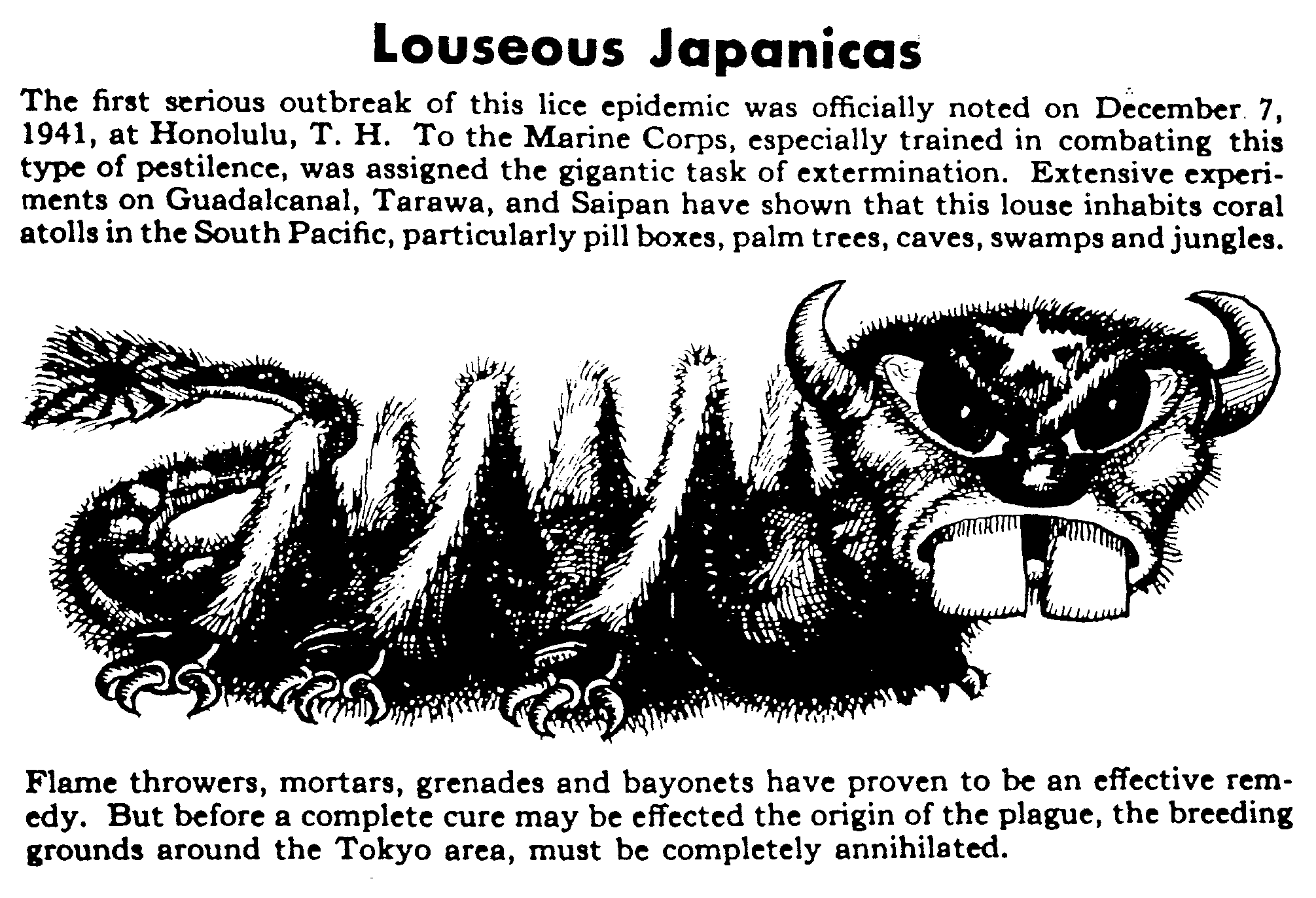
Japanese are depicted as vermin, fit only for “extermination,” in this item published in the US Marine Corps magazine “Leatherneck,” March 1945, the same month that the United States began low-level incendiary bombing of Japanese cities.
The Canons of Warfare
Many opponents of the use of the bomb point to the canons of civilized warfare in Europe, developed over 1,500 years. Again, Veale explains: “the fundamental principle of this code was that hostilities between civilized people must be limited to the armed forces engaged,” and in his book he lists a splendid array of examples of European leaders holding to these principles, even at the price of victory.
In fact, the professional conduct of European soldiers was such that in 1814 Marshal Davout was reproached sternly and threatened with a “war crime trial” for his ugly treatment of the residents of Hamburg before his surrender – not by the Prussians, but by his own people. He was charged with having “rendered the name of Frenchman odious.”
The crucial flaw in relying on the European military codes as an attack on the bombing of the Japanese is implicit in the explanation provided by Veale. By “civilized people,” the European codes referred only to Europeans. That is, the rules and restrictions of civilized warfare applied only to so-called “secondary” wars, or intra-European wars, and not to “primary” wars that involved the clash of European and non-European powers. In the latter case, the limitations on aggression against civilians literally had no bearing on the conduct of the belligerents.
A number of cases that have a special bearing on our subject come to mind. The Japanese city of Kagoshima was destroyed by the British navy under Admiral Kuper in 1863 for the sole purpose of winning trade concessions. So the rules of conduct in war only extended so far. Nor was America shy about using military aggression against the Japanese. The United States had a long history of belligerent tactics against Japan, starting with the “gunboat diplomacy” of Commodore Perry in 1854. US ships were also involved in the destruction of the city of Shimonoseki in 1864, an operation essentially directed in the interests of British imperialism.
In 1908, President Theodore Roosevelt was not above sending the United States fleet to the very shores of Japan. This type of militaristic diplomacy formed the basis of the foreign policy of Franklin Roosevelt, who was also a committed Sinophile. Much of the administration's early naval build-ups and movements in the Pacific, starting as early as 1934, were aimed at intimidation of the Japanese. Roosevelt's policy rested on Western and US precedent.
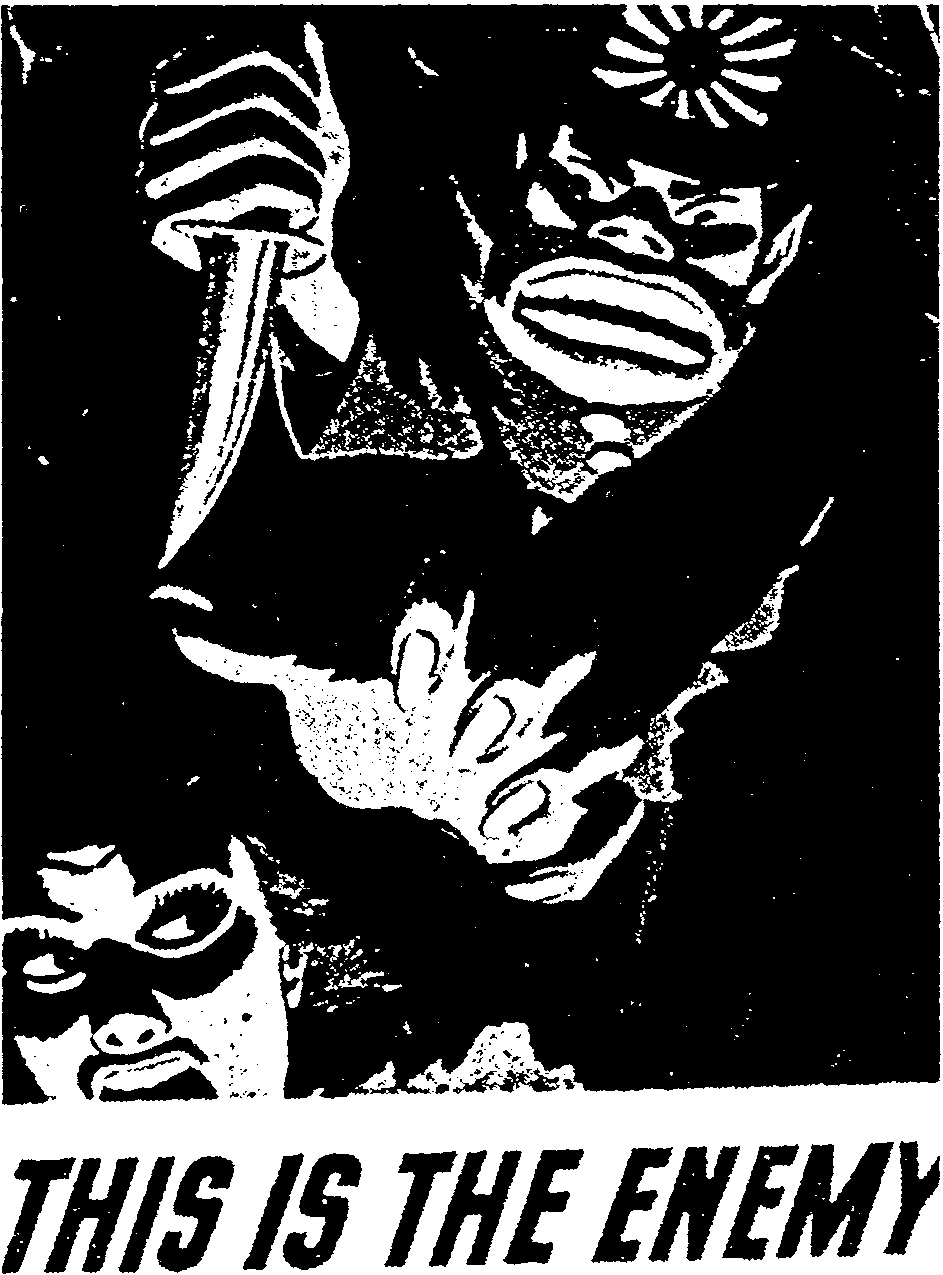
World War II Allied magazines, newspapers and motion pictures portrayed the Japanese as grotesque, barely human killers. Typical was this American wartime propaganda image, designed to foster hatred of the Japanese.
In fact, it seems plausible at first glance to argue that by the centuries-old standards of European civilized conduct in war, the bombing of Japan was an acceptable method of battle. (Incidentally, the use of atomic weapons against Germany was not and could never be.) For obvious reasons, contemporary defenders of the bombing are loath to broach this defense, as it smacks of the twentieth-century heresy of racism. But there is also a caveat to this argument. However much the doctrine of the sanctity of noncombatant life was limited in practice, there existed a long tradition in European ethics that held that the killing of noncombatants was morally offensive and wrong. Christianity, the faith of the West, is a religion imbued with a limited universalism in content, derived from the belief that Christ died on the cross for all men. Hence, the moral teachings of the Christian faith regarding the sanctity of human life can reasonably be understood to have been intended to apply universally.
Saint Augustine, Huguccio, and Grotius
Saint Augustine held that taking the life of a noncombatant was murder. Even before Christianity had begun its penetration into the northern lands of Europe, fundamental teachings regarding the conduct of war were being developed. Nor did these doctrines change with the development of Catholic teaching throughout Europe and the emergence of Thomistic Scholasticism. As early as the twelfth century, Huguccio, a professor at Bologna, had revised the patristic teachings regarding natural law in his Summa of 1188. There he developed the notion that private property was a natural right, not subject to the interference of private persons or the state, under normal conditions.

This British portrayal of Japanese soldiers as ape-like monsters, originally from the London “Daily Mail,” was reprinted in a mid-1943 issue of the “New York Times Magazine.”
This fundamentally libertarian teaching laid the groundwork for the ethical considerations of the rights of noncombatants in war. Indeed, the early twentieth-century international agreements regarding the rules of war were an outgrowth of this doctrine, based largely on the natural law analysis of the Dutch Scholastic Hugo Grotius. In fact, the work of Grotius is foundational to understanding both the Hague and Geneva Conventions.
Grotius identified four fundamental precepts of natural law, from which he developed his theory of international law. They were: (1) no person or body of persons, including the state, may legitimately initiate violence against another person or body of persons; (2) no person or body of persons may seized the property of another; (3) both persons and bodies of persons are bound by contracts or treaties that they might enter into; (4) no person or body of persons may commit a crime.
These libertarian postulates were extremely influential. Through practice and judicial development, nuances and adaptations were made in the rules of conduct. However, they were derived from Christian teachings that were meant to apply universally.

This cartoon, similar to many others published in wartime US newspapers and magazines, depicts the Japanese as brutish, diminutive subhumans. Originally appearing in the “Detroit News,” August 1945, it was reprinted in the Sunday “New York Times.”
Critics of the bombing have made a strong moral case against the action. This is why the defenders of the bombing use strongly moralistic terms themselves. One of the results is possibly the most bizarre and obviously wrong.
Most veterans and defenders of the bombing of Hiroshima and Nagasaki claim that whatever the reasons for the bombing and its support, racism was not among them. This is simply not true. The US War Department and related agencies that specialized in producing hate propaganda and lies developed specifically racialist attacks on the Japanese.
Propaganda films, shown to theaters across the country, whipped Americans into war hysteria with films attacking the Japanese with their “grinning yellow faces.” American movie audiences were encouraged to cheer as they watched images of the “upstart yellow dwarfs” meeting their timely ends. The government played on and encouraged prejudice and specifically racial animosity against the Japanese. To be fair, the Japanese held – and still hold – similar views of Americans, views not discouraged by their government.
The most revealing aspect of this latter point is not that racism was involved in drumming up the war spirit, but rather that the truth of the matter has been so thoroughly obscured.
Oddly enough, many apologists are conservatives, who should be the first to recognize that the essence of government is its monopoly on violence. This is a paramount consideration in their analysis of the role of the government in domestic affairs. Consistency demands that conservatives begin to apply their principles across the board – to foreign policy as well as domestic policy. The alternative is the road we now travel, and it leads to a total war and the total state.

Bibliographic information about this document: The Journal of Historical Review, vol. 16, no. 3 (May/June 1997), pp. 14-18; reprinted from The Freeman, September 1995.
Other contributors to this document: n/a
Editor’s comments: n/a