
Gibbs Revisits the Treblinka Revolt
A Review
Chad S. A. Gibbs, Survival at Treblinka: Geography, Gender, and Social Networks in Jewish Resistance. The University of Wisconsin Press, 2026. Hardcover, 214 pages, notes, bibliography, index, ISBN: 978-0-299-35600-2. $79.95 hardcover, also available Open Access.
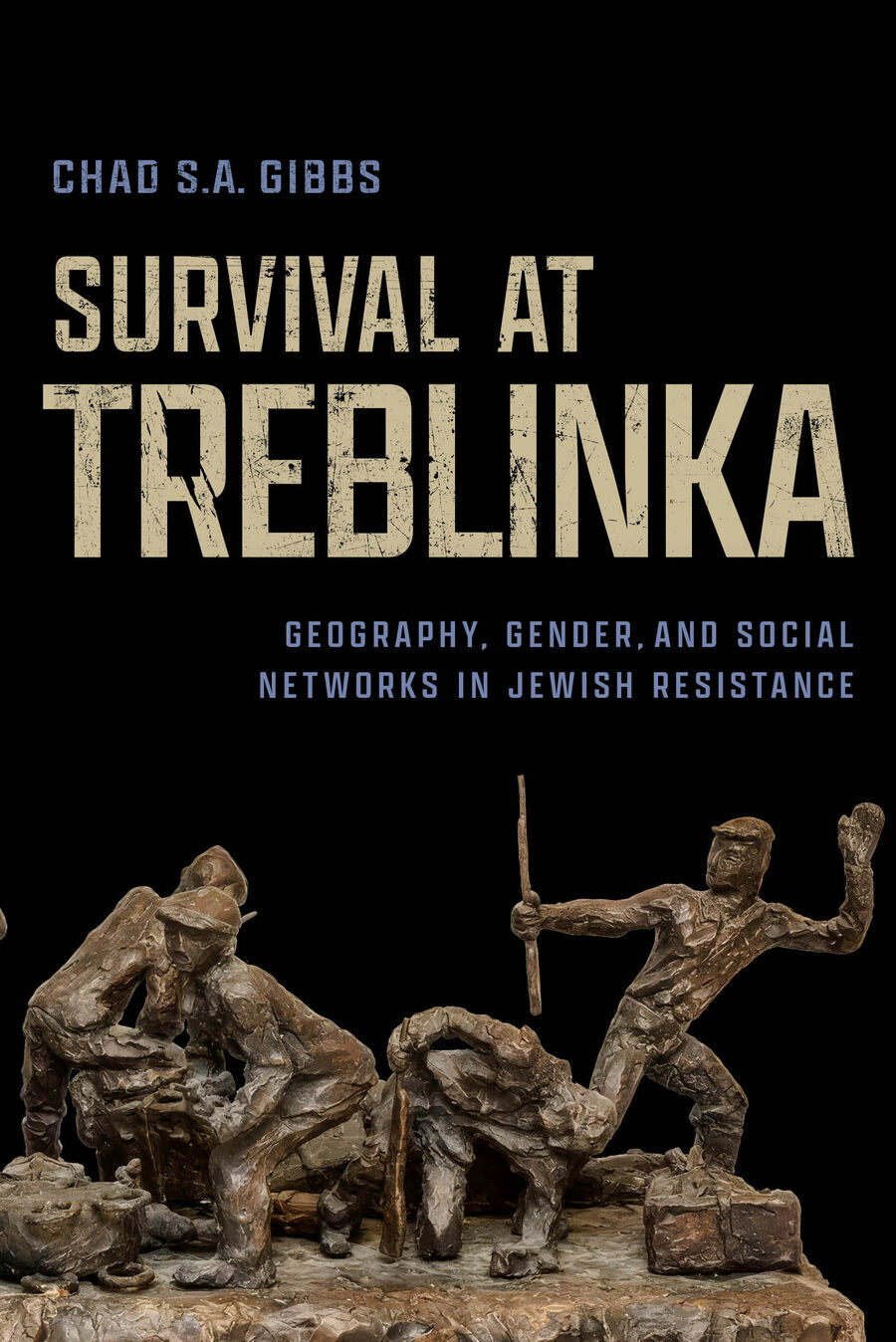
The prisoner revolt at the Treblinka II “extermination camp” has been the subject of numerous studies by historians. According to conventional accounts, it was the first successful uprising at one of the Nazi “death camps,” was directly inspired by news of the Warsaw ghetto uprising, and heralded the end of the camp. Chad Gibbs’s recent book Survival at Treblinka: Geography, Gender, and Social Networks in Jewish Resistance focuses on how changes in the layout of the camp itself influenced the ability of prisoners to plan the uprising. The revolt has generally been narrated as a sequence of events culminating on August 2, 1943, but Gibbs is more interested in exploring the conditions that made collective planning and resistance possible.
One complaint about orthodox Holocaust historiography is that authors delve into more archives for newly discovered, obscure documents but tell the same histories about people, places and events. Alan Confino has defined the problem:[1]
“One has a sense of déjà vu. It seems that many contributions to the historiography of the Holocaust confirm yet again the well-known thesis of an influential study (the role of the Wehrmacht in mass murder, the importance of racial ideology in a given social or professional group) or validate a well-known argument in great detail based on an unused trove of documents. The accumulation of facts in massive studies is accompanied by diminishing interpretative return. We know more of the same things.”
Gibbs takes a different approach, using a smaller number of well-known and relatively widely available sources to ask narrowly tailored questions about the Treblinka II Camp. This is in contrast to Caroline Sturdy Colls’s recent book Finding Treblinka (also published in 2026), which examines archaeological investigations and new archival sources. While neither approach is preferable over the other, Colls asks how newly available evidence can reinforce an accepted history; Gibbs asks what a different analytical framework can reveal in documents that historians have had for decades.
Gibbs’s main sources are almost exclusively Jewish eyewitness accounts, with a few exceptions like Gitta Sereny’s interview reports of camp commandant Franz Stangl and Claude Lanzmann’s interview of SS guard Franz Suchomel. Because he is primarily interested in relationships and movements among inmates, and changes in the camp’s organization and physical layout, seemingly incidental details in survivor accounts can become significant evidence. A witness who mentions where he lived and worked or when relationships were made or broken can provide information about the social geography of the camp in the months preceding the revolt.
It is acknowledged that Holocaust testimonies can be contradictory, uneven and of limited evidentiary value. Gibbs explains his approach to this problem, writing that he compares multiple witness accounts, weighs them against each other, and seeks unanimity among accounts on specific details (pp. 56f.). One drawback of the limited number of sources he consults is that he cannot trace differences among a witness’s testimony over time, and only superficially examines the circumstances under which various accounts were given. Witnesses generally get one entry each in his bibliography, with a few receiving multiple. For example, Jankiel Wiernik’s only entry is the partial English translation of his book One Year in Treblinka as contained in Alexander Donat’s book The Death Camp Treblinka: A Documentary.
Because Gibbs’s focus is narrow, he does not provide an extended account of the gas chambers or various methods used to kill Jews, nor does he attempt to catalog the many forms of violence described in survivor accounts. Beatings, hangings, shootings, dog attacks and other acts of abuse receive little or no attention, unless they bear directly on the organization for resistance. He also largely avoids discussing the physical characteristics of mass graves, the logistics of excavating and cremating corpses, and the sensory environment of the camp that feature prominently in many survivor statements and histories of Treblinka. These omissions are a result of how carefully Gibbs has defined his subject. While many of the witnesses he cites discuss these aspects of camp life – sometimes in great detail – they are often relevant for the book only when they reveal where prisoners were located, with whom they interacted, and how their relationships developed.
Survival at Treblinka is divided into five chapters but comprises three separate lines of inquiry. The first three chapters form the core of his analysis of personal networks among prisoners and spatial relationships, as the camp evolved. The next two chapters explore the role of women (Chapter 4) and ways to define survivorship of Treblinka (Chapter 5). An appendix lists over 260 potential survivors of the camp in various categories.
The main focus of the book is the planning for the August 2, 1943 uprising in Treblinka. Gibbs uses this event to explore the personal relationships among the Jewish prisoners, highlighting that these networks were able to develop and strengthen in early 1943, as the camp’s layout was reorganized, and prisoners were housed closer together. He follows Richard Glazar’s division of the camp’s history into four phases (p. 22). The most important phases for Gibbs are Phase Three (early 1943 to approximately May) and Phase Four (approximately May to August 2).
A particularly important development that Gibbs highlights was the construction of a single barracks for all laborers in Camp 1 (also commonly referred to as the “lower camp,” and not to be confused with the Treblinka I Labor Camp, which was geographically distinct). This was the so-called “ghetto barracks,” which was built around the beginning of 1943, and marked the transition to Phase Three in the history of the camp.
Because this structure was built in the middle of the camp, it discouraged individual escape attempts, which were more common earlier in the camp’s existence, while making group planning for a revolt more feasible (29). Gibbs argues that planning for collective resistance before this spatial change was nonexistent, as prisoners lacked the ability to establish groups, conspire together, or gain access to tools and locations necessary to execute the plan (p. 58). Gibbs cites Oskar Strawczynski to support the contention that the new spatial arrangement allowed groups of prisoners to meet more frequently, and develop a sense of community. For instance, technical specialists and general laborers had been segregated before this point, but were now housed together, and realized more opportunities to plan for collective resistance (pp. 39f.). Women laborers were also housed in the “ghetto barracks,” working mainly in the laundry, kitchen and tailor’s workshop (p. 41).
The geographical origins of the prisoners before entering the camp were also important in the creation of networks. Groups from Warsaw and Czestochowa were able to form “tightknit prisoner communities” (p. 37). Members of these communities sometimes worked together in various detail assignments, gaining access to locations throughout the camp (p. 42). This helped bring prisoners together, although they also waged an internal war against informants, which may have included prisoner courts and executions of traitors (p. 47).
Because Gibbs emphasizes collective resistance, he does not discuss an early act of individual resistance: the killing of SS guard Max Biela by Jewish prisoner Meier Berliner in September 1942. This event predates the organizational developments that are central to Gibbs’s analysis, and was an individual attack rather than a collective act. It did not inspire an immediate uprising among other prisoners. While an understandable omission, analyzing it may have provided Gibbs a useful complement to the argument that collective planning became feasible only after the camp’s spatial rearrangement in early 1943.
Additionally, several witnesses, including Richard Glazar and Jankiel Wiernik, describe early rebellion plans that failed to come to fruition. Gibbs explains these failures from the perspective of changes to the personal networks or spatial arrangements of prisoners. He identifies several events that derailed early planning efforts: one of the lead conspirators, Zelomir Bloch, was transferred from Camp 1 to Camp 2, a typhus epidemic killed or disabled numerous conspirators, and several leaders of the revolt’s planning organization were killed (pp. 59-61). It was only by June 1943 (shortly after Phase Four began) that the prisoner networks stabilized enough to plan another serious attempt. Additionally, Bloch’s transfer to Camp 2 influenced resistance planning there, and contacts were established between both resistance groups through Wiernik’s access to the entire camp (p. 62).
In sum, planning for the uprising at Treblinka was shaped by inmates’ access to particular spaces, which made personal networks easier to form, and to resist internal and external adversity. The camp was not static, and changes in the physical organization of buildings affected encounters between prisoners, leading to long-term planning for organized resistance. Gibbs’s emphasis on networks shifts the history of the revolt away from a handful of heroic conspirators and toward the social conditions that allowed a cohesive resistance organization to emerge.
In his chapter on the role of women in Treblinka, Gibbs explores where women lived and worked at the camp, and how they may have contributed to planning for the revolt. He also examines why many testimonies and memoirs fail to mention women, despite the presence of several dozens of them working throughout the camp. Some accounts barely mention women at all, while others diminish their presence, or primarily cast negative aspersions on their behavior and “partying” with the Nazi and Ukrainian guards (pp. 78-82).
This section of the chapter is useful in drawing attention to a group who are often left out of histories of the camp and revolt. At the same time, it feels somewhat disconnected from the book’s exploration of spatial and network interactions. The preceding chapters even have some of this chapter’s material integrated into them, with nearly identical footnote discussions (p. 187, note 73; p. 191, note 41). This gender analysis adds another dimension to the study but does not fundamentally alter the analysis of how the revolt was organized.
Gibbs also suggests the existence of a little-studied “brothel” in the upper camp area (“death camp”) of the camp. However, this claim rests on a very narrow evidentiary base, and its location makes the absence of corroboration from earlier accounts particularly notable. Given that the 1944 Soviet and 1945 Polish investigations sought to document Nazi crimes in considerable detail, the absence of any apparent reference to a Camp 2 brothel does not automatically disprove Gibbs’s assertion. However, the claim would benefit from substantially more corroboration. Gibbs examines in general why early accounts and the more popular memoirs of Treblinka fail to mention a brothel, but does not analyze any particular early account in detail, or where its absence should be apparent. In any case, the brothel is so lightly substantiated that it can be considered a potential historical lead more than an aspect of the camp that Gibbs has discovered.
The main problem is that there are only two sources Gibbs relies upon to establish the presence of the brothel: Eliahu Rosenberg’s 1947 statement and Szlomo Helman’s 1961 testimony (p. 69).[2] Rosenberg identifies three women assigned to kapos[3] for their “private use,” and says that other kapos were permitted to visit them in the evening, but does not identify a particular room or building. Helman’s brief reference to a “waiting room” establishes another physical space associated with the Ukrainian guards and the revolt but does not identify its purpose. Gibbs may be correct about the brothel’s existence, but has moved too quickly from the thin evidence to claims of a specific institutional and spatial arrangement. He connects these testimonies to reconstruct a brothel within the workers’ barracks, with the waiting room apparently serving the Ukrainian guards, who left their firearms there (pp. 83f.). Based on just these two accounts – one of them produced decades after the end of the war – the surviving evidence does not establish the existence of a Camp-2 brothel with the confidence that Gibbs gives it.
The final chapter discusses the definition of “Treblinka survivor,” and Gibbs identifies a variety of categories: revolt survivors, escapees and through-transit survivors who spent limited time at the camp before being transited elsewhere. Individuals from each of these groups could have had radically different experiences, so by distinguishing them, Gibbs attempts to make the surviving population itself an object of historical analysis rather than treating “Treblinka survivor” as a single group.
While escapees and revolt survivors were self-evidently engaged in resistance, Gibbs extends this definition to through-transport survivors as well, even if they only spent hours or days at the camp. Jews who arrived at Treblinka II were occasionally selected to work at Treblinka I, and they attempted to take family members with them. During the 1943 Warsaw-Ghetto uprising, prisoners were sent to Treblinka II to be sorted before being sent to other camps. Others would jump lines to be counted as workers (pp. 101f.).
This final chapter also serves as an introduction and guide to the Appendix, which contains entries for over 260 individual survivors. Gibbs states that his list builds upon the early work of Alexander Donat, and he has compared this with other lists from the Treblinka Museum and from Chris Webb and Michal Chocolatý’s book The Death Camp Treblinka. In the Appendix, Gibbs categorizes each person, and points out sources where they have been identified explicitly as Treblinka survivors (in their own accounts or those of others). He also highlights some that may be questionable: potential duplicates of other people under different names or possible survivors of the Treblinka I Labor Camp rather than Treblinka II.
The survivor list may ultimately prove to be one of the book’s most useful contributions for other researchers. In addition to basic biographical details, where available, he includes relevant references to published and archival documents as well as variant name spellings for the same person. An outlier category that Gibbs does not address is unidentified or anonymous accounts, such as the one in the Ringelblum Archive that is attributed only to an “unidentified Czestochowa resident.” However, such accounts may comprise a qualitatively different type of list.
One bibliographical gap is particularly notable from the perspective of recent Treblinka research: Gibbs does not make use of the extensive 1944 Soviet investigations of Treblinka, which contain numerous interrogations and reports containing the names of various potential survivors. This is not a major deficiency of the overall historical narrative, as many of the people interviewed by the Soviets subsequently gave testimony elsewhere, and Gibbs references some of those accounts. Nevertheless, the Soviet reports could provide additional contemporary sources of information about the planning of the revolt or clarifying names on the survivor list. They would also give Gibbs more contradictory material to weigh against other sources in his analysis of networks and spatial relationships. More importantly, they would allow the survivor list to be checked against a substantial body of documentation produced in the final stages of the war. One main collection of these documents is the 2021 Russian-language book Treblinka: Issledovanija, vospominanija, dokumenty (“Treblinka: Research, Memories, Documents”), which Gibbs may not have had access to while writing his dissertation but could have utilized when editing it for publication as Survival at Treblinka.
Thesis Days Re-Revisited
Survival at Treblinka represents the culmination of a long-running project for author Chad Gibbs, who began working on the material for the book in his 2016 master’s thesis “To Sell Your Life at a Higher Price: Social and Spatial Networks of Resistance at Treblinka.” He expanded that thesis for his 2021 dissertation “Against that Darkness: Perseverance, Resistance, and Revolt at Treblinka,” including new research related to gender and the definition of survivorship, along with an extensive list of Treblinka survivors.
Comparison of these prior works displays an unusually high degree of textual continuity. The central argument of the master’s thesis is not merely revisited in the dissertation; large portions of its structure and prose, including entire paragraphs, are reproduced word-for-word or with minor changes. The same material from the thesis then forms much of the dissertation, while the additional chapters from the dissertation form the final two chapters and appendix of the 2026 book.
One example is this paragraph which was slightly altered over the three works:
“Belzec, Sobibor, and Treblinka occupied a distinctive position set apart from the wider ‘concentration camp universe.’ The Aktion Reinhard camps reported directly to Higher SS and Police Leader for the Lublin District Odilo Globocnik and through him to the Reichsführer-SS Heinrich Himmler personally. The standard chain of camp command through the SS Inspectorate of Concentration Camps was not involved. The Reinhard camps would contribute to Nazi German state finances by sending belongings stolen from their victims back to Germany, but they would not provide any labor income to the SS Main Economic and Administrative Department, as was the practice of concentration camps. The purpose of the Reinhard camps was simple. Inside their small wire walled spaces what Nazi ideologues termed Europe’s ‘Jewish Question’ would receive its ‘Final Solution.’” [Thesis, p. 5]
“Belzec, Sobibor, and Treblinka occupied a distinctive position set apart from the wider ‘concentration camp universe.’ The Aktion Reinhard camps reported directly to Higher SS and Police Leader for the Lublin District, Odilo Globocnik, and through him to the Reichsführer-SS Heinrich Himmler, personally. The standard chain of camp command through the SS Inspectorate of Concentration Camps was not involved. The Reinhard camps contributed to Nazi German state finances by sending belongings stolen from their victims back to Germany, but they did not provide any labor income to the SS Main Economic and Administrative Department, as was the practice of concentration camps. The purpose of the Reinhard camps was simple. Inside their small, wire-walled spaces, what Adolf Hitler and his fellow Nazi ideologues termed Europe’s ‘Jewish Question’ would receive its ‘Final Solution.’” [Dissertation, p. 6]
“Nazi authorities designed the Treblinka extermination camp and the other two Aktion Reinhard camps of Belzec and Sobibor to carry out the total annihilation of European Jewry and to leave no witnesses to tell the tale. These three camps held a distinctive position set apart from the wider ‘concentration camp universe,’ reporting directly to Odilo Globocnik, Higher SS and Police Leader for the Lublin District, and, through him, to the Reichsführer-SS Heinrich Himmler personally. The standard chain of camp command through the SS Inspectorate of Concentration Camps was not followed. The Reinhard camps contributed to Nazi German state finances by sending belongings stolen from their victims back to Germany, but they did not provide any labor income to the SS Main Economic and Administrative Department, as was the practice of concentration camps elsewhere. The purpose of the Reinhard camps was simple. Inside their small, wire-walled spaces, what Adolf Hitler and his fellow Nazi ideologues termed Europe’s ‘Jewish Question’ would receive its ‘Final Solution.’” [Survival at Treblinka, p. 7]
The continuity extends beyond individual paragraphs to sequences of paragraphs. For instance, the section “Work Detail Networks” contains a sequence of eight paragraphs carried over from the thesis into the dissertation and then into the book, with only minor alterations. The corresponding passages appear on pp. 77-81 of the thesis, pp. 105-110 of the dissertation, and pp. 38-40 of Survival at Treblinka.
The significance of this continuity is not that Gibbs returned to a subject he had studied before. Such development is normal in academic research, and a dissertation can legitimately grow out of a master’s thesis. Rather, the striking feature here is the extent to which the original thesis has been carried over nearly wholesale. The thesis was not substantially rewritten for the 2021 dissertation, with new material integrated and synthesized. Instead, the dissertation incorporated much of that work with only minor editing, and added the gender and survivorship studies as two additional chapters. The 2026 book then largely preserves both. The Acknowledgments section traces Gibbs’s personal and intellectual history with the subject – his first visit to Treblinka as an undergraduate student, his gratitude towards advisors and fellow students – but he nowhere notes that the book is the third iteration of a text first written in 2016.
The editing over the three works was deliberate as the intended form of the work changed. A short example illustrates this:
“The timing of the revolt on August 2 returns this thesis to its first page.” [Thesis, p. 115]
“The timing of the revolt on August 2 brings the reader back to the beginning of the narrative.” [Dissertation, p. 153]
“The timing of the revolt on Monday, August 2, brings us back to the first page of this book.” [Survival at Treblinka, p. 67]
The change from “thesis” to “narrative” in the dissertation, and then from “narrative” to “book” in the published work is minor but revealing. The underlying sentence and reference to the beginning of the text remain unchanged, while the terminology is adjusted to fit the form in which the material now appears.
The dissertation’s major expansion lies not in a restructuring of the original argument but in the addition of the chapters on gender and survivorship, and Gibbs’s list of survivors. These chapters read more as distinct mini-studies that are themselves appended to the chapters carried over with minor wording changes from the thesis. Survival at Treblinka streamlines the dissertation, moving many block quotations into paragraphs, and smoothing out some of the more stiff academic language, while retaining the underlying narrative and analysis. The dissertation’s heavily methodological chapter “Finding the Treblinka Archive” is omitted entirely from the book. The book does contain updates beyond the dissertation, particularly in its expansion of the survivor list and in selected references to more recent works such as Jacob Flaws’s 2024 book Spaces of Treblinka: Retracing a Death Camp.
The most obvious transformation from dissertation to book is therefore in its presentation rather than its arguments. Block quotations set apart in the dissertation have generally been incorporated into the surrounding paragraphs, retaining the source material while reducing interruptions to the narrative flow. Transitions are more economical, and some prose is less recognizably academic. The result is a more accessible monograph, but not one that substantially builds upon the research project begun in 2016.
The transformation from dissertation to book is therefore real, but the continuity between the 2016 thesis and the 2026 book goes beyond the normal maturation of a research project into a monograph. Entire paragraphs and paragraph sequences appear across all three works with only cosmetic changes to wording. This is the kind of recycling that in other contexts would raise questions of self-plagiarism. Readers encountering Survival at Treblinka as Gibbs’s mature statement on geography, gender and social networks at Treblinka should understand that its core analytical chapters were substantially fixed in 2016, and that the 2021 and 2026 revisions did not materially rework that material.
Conclusion
Gibbs succeeds in illustrating how much more can be explained using existing accounts of Treblinka when those documents are systematically reread through a different lens, and new questions are asked. Paradoxically, the book’s narrow analytical focus broadens the historical perspective. The book’s spatial and network analysis does not revise the familiar narrative of the revolt so much as expand its context. The August 2 uprising becomes a culmination of months of fluid personal relationships, movements of prisoners and guards throughout the camp, and responses to radically changed circumstances.
The book also illustrates the difficulties of analyzing a historical event from survivor testimony alone. The same close reading that allows Gibbs to identify relationships and to highlight the role of women in the camp can also lead to increasingly elaborate reconstructions from fragmentary evidence. The proposed Camp-2 brothel is the clearest example, as this “revelation” goes beyond what the surviving testimony can securely establish. Gibbs’s method is therefore most persuasive when physical arrangements and social relationships can be connected through multiple accounts, but less so when ambiguous details are stitched together to produce a single narrative.
The value of Survival at Treblinka lies in its willingness to look again at evidence that historians might otherwise regard as exhausted. Instead of discovering new archival documents, Gibbs’s contribution is to show that well-worn accounts can yield new insights when examined through a limited but focused lens. That contribution, however, sits inside a text that is, structurally, mostly a decade old: the core analysis dates back to his 2016 thesis, and was carried into the 2021 dissertation and 2026 book with limited revision. Readers should weigh the book’s interpretive achievement against how little of its argument has materially changed since it was first written.
Endnotes
| [1] | Alan Confino, “A World Without Jews: Interpreting the Holocaust,” in The Holocaust and Historical Methodology, Making Sense of History, volume 16 (Berghahn Books, 2012), 28. |
| [2] | In the text of the book, Gibbs describes Helman’s testimony as originating from the 1961 trial of Adolf Eichmann. This must be a mistake, and in the notes he correctly identifies a Yad Vashem testimony that contains the relevant information. |
| [3] | Kapos were prisoners in Nazi concentration camps who supervised other inmates or handled administrative tasks. |

Bibliographic information about this document: Inconvenient History, 2026, Vol. 18, No. 3
Other contributors to this document:
Editor’s comments: