
Oskar Strawczyński and the Institutionalization of Holocaust Memory
Holocaust witness testimony is often treated as a direct record of experience, as though the testimony itself was the endpoint of historical inquiry. But early witness accounts were produced within particular social and documentary settings, each of which had its own procedures, objectives, and constraints that left their mark on what survivors said and how they said it. Survivors encountered one another, exchanged information, conveyed their knowledge to investigators, and gave statements to institutions that preserved their accounts. The historical record, therefore, is made up of both what the witnesses recounted and the circumstances in which their accounts were shaped, communicated, and recorded.
The early testimonies of Treblinka camp survivors offer an especially useful case for examining these interactions, and Oskar Strawczyński’s experience is particularly revealing of this process. A Treblinka prisoner who escaped during the August 1943 revolt, he participated in nearly every major effort to document the camp. He wrote his memoirs while living with Jewish partisan veterans of the Warsaw underground, was interrogated by Soviet investigators, joined a postwar circle of Treblinka survivors, hosted a gathering of survivors and representatives of a Jewish historical commission, and testified before a Polish judge investigating Nazi crimes. This trajectory spans nearly the full range of formal and informal settings in which early Treblinka testimony was produced.
Holocaust scholarship has increasingly examined the social networks through which individuals experienced and responded to the Nazi occupation period.[1] This article extends that approach to Holocaust testimony itself, examining how interpersonal and institutional interactions reshaped what a particular survivor knew personally, learned from others, and incorporated into his accounts. Strawczyński’s testimony emerges not as a fixed document written in isolation but a series of narratives influenced by his participation in overlapping groups and organizations.
Strawczyński in Holocaust Historiography
Strawczyński has received relatively little sustained analysis in studies of Treblinka. Historians have generally relied on his memoir, published in English in 2007, and on his 1945 testimony before a Polish judicial investigation.[2] In standard histories, Strawczyński’s statements are most frequently cited instrumentally to illustrate specific details or corroborate information contained in other survivor accounts, with no examination of the interpersonal relationships he formed with other witnesses.
Scholars often introduce him in the most minimal terms, presenting him as “a Jewish prisoner who was put to work at sorting” (Arad), a “revolt survivor” (Gibbs), or simply a “Treblinka survivor” (Berger), without establishing his background, camp experience, or the context of a given statement. In other works, such as those by Caroline Sturdy Colls, Jacob Flaws, and Chris Webb and Michal Chocholatý, statements first appear without any contextual framing, treating the text as a disembodied repository of eyewitness observation.[3] Alexander Donat limits his treatment to identifying Strawczyński in a group “reunion” photograph and a list of camp survivors.[4]
Other works further illustrate this lack of contextualization or distortion of facts. Gitta Sereny includes him in a list of witnesses at a trial, offering few details regarding his testimony or the limits of his knowledge.[5] Michael Bryant, discussing the same trial, entirely omits Strawczyński’s involvement, despite analyzing the testimony of other survivors.[6] In his history of the camp, Witold Chrostowski writes that members of the Treblinka revolt planning organization occasionally met at the Strawczyński brother’s car body shop at night; however, the available evidence identifies Oskar as a tinsmith and his brother Zygmunt as a clothing sorter, leaving the basis for Chrostowski’s assertion unclear.[7]
Revisionist literature has also paid scant attention to Strawczyński, primarily because his direct knowledge was confined to the lower camp, leaving his descriptions of alleged gassings, mass graves, and cremations in the upper camp (commonly referred to as the “death camp” area) entirely secondhand. Carlo Mattogno examined his statements on transport arrivals into Treblinka and details of the gas chambers, and compared aspects of his account to that of other witnesses. Thomas Kues reviewed the 2007 Yad Vashem publication of Strawczyński’s memoir, focusing on textual inaccuracies, physical exaggerations, and discrepancies with other witnesses. A short entry in the Holocaust Encyclopedia summarizes this limited knowledge base.[8]
Consequently, the existing literature provides an incomplete picture. His interrogations by the Soviets, his participation in a postwar circle of Treblinka survivors, his interactions with early Jewish documentation efforts, and the transmission of his memoir have remained largely unexplored. These materials make it possible to examine not only what Strawczyński said, but the changing circumstances in which his accounts took different forms and reflected different purposes as he moved between audiences, sources of information, and methods of documentation. Reconstructing these interactions allows us to trace where, when, and how his knowledge entered the historical record, and to recognize the reciprocal influences of the groups and institutions in which he participated.
Inside Treblinka: The Limits of Experience
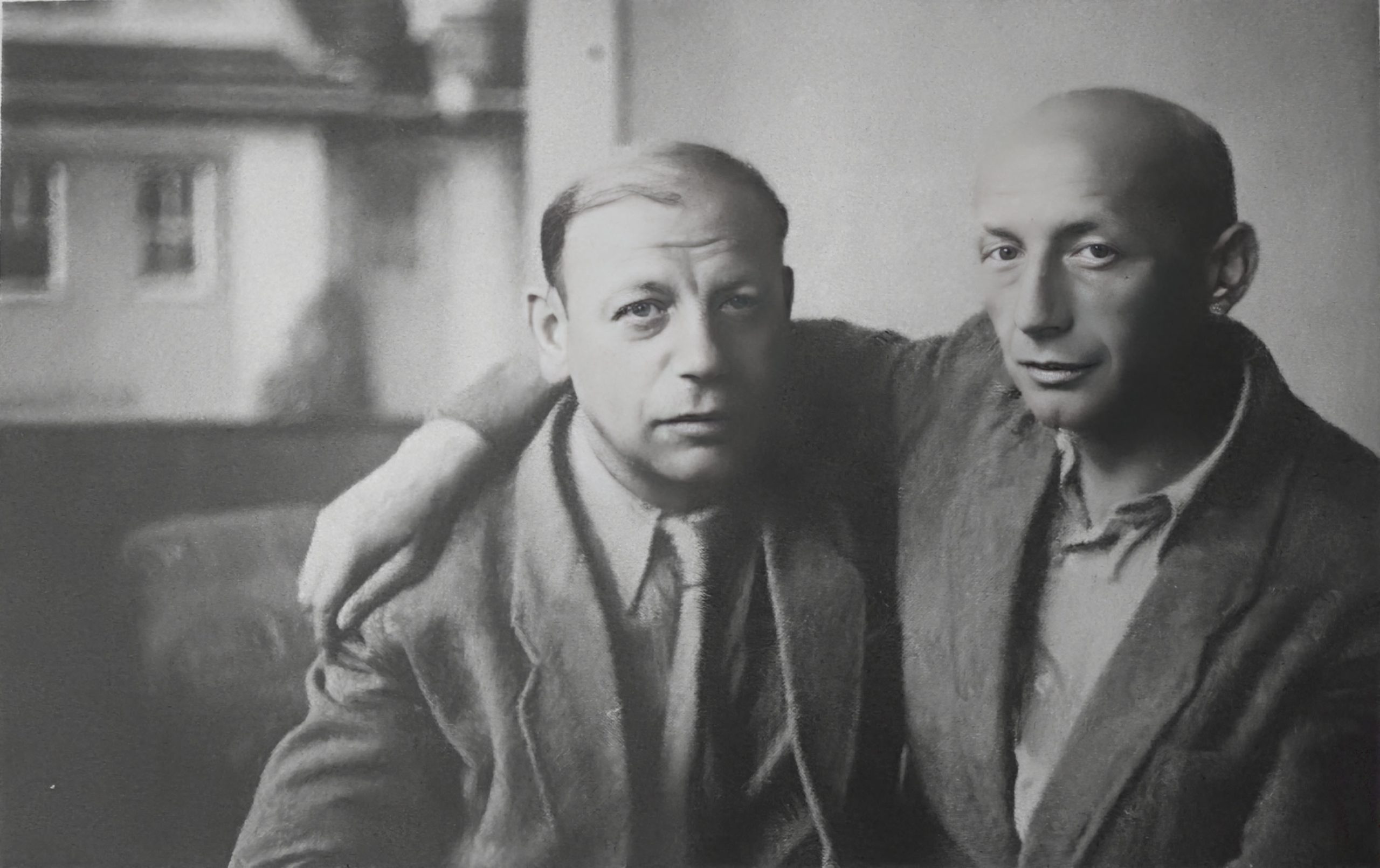
Oskar Strawczyński was born in Łopuszno, Poland, in 1906.[9] He served in the Polish Army from 1925-1926. In 1939, after Germany invaded Poland, Strawczyński’s wife and children moved from Łódź to Częstochowa; Strawczyński himself followed the next year.[10] On October 5, 1942, Strawczyński and his family were deported to the Treblinka II camp, arriving the same day.[11] His family was reportedly killed immediately, while he was selected for labor, eventually working as a tinsmith. Oskar’s brother Zygmunt was captured in hiding and sent to the camp, arriving five days later, on October 10.[12]
Strawczyński was not a firsthand witness to the so-called “death camp” or upper camp area, as he was only in the lower camp for staff and workers. His account of mass murder and cremations comprises the short, penultimate chapter of his memoir, where he claims that his knowledge comes from other prisoners, particularly the blacksmith Hersz Jablkowski and Szymon Goldberg. Strawczyński reports “a few, tremendously huge mass graves, each one filled with tens of thousands of murdered people,” and that motorized pumps were used to draw out blood mixed with water from the bottom of these graves. In terms of the gas chambers, he writes that the “air from inside is sucked out, and fumes from burnt gasoline is forced in,” a process that lasted about ten minutes before everyone had died. There were four large and six smaller chambers in the “bathhouse,” as well as special ditches into which the blood ran.[13] He was involved in planning resistance efforts in the camp and, after several aborted attempts, he participated in the prisoner revolt on August 2, 1943, escaping and hiding in the forest.[14]
Strawczyński’s experience at Treblinka established the limits of his knowledge: he was a participant in the lower camp prisoner community and uprising, but was not a direct witness to the killing processes he described. His post-escape accounts would be shaped by the interactions between his own experience and information acquired from others.
Writing Treblinka Among the Forest Fugitives
For the next few months, Strawczyński hid with Soviet partisans.[15] He then joined a group of Jewish partisans in the forests around Wyszków, about 50 kilometers west of Treblinka II. The group consisted of veterans of the Jewish Combat Organization (Żydowska Organizacja Bojowa, ŻOB) who had participated in the April-May 1943 Warsaw ghetto uprising.[16]
Strawczyński reported that one of the partisans, Gabriel Fryshdorf, urged him to begin recording his Treblinka experiences. Writing materials were procured from a nearby town, and Strawczyński wrote his memoir, with the title page reading “Oskar Strawczyński. Memoirs. 10 Months in Treblinka (October 5, 1942 – August 2, 1943).”[17] The dating of the memoir’s composition is based in part on the text itself: the opening dedication states “April 1944” and the closing memorial to his wife states that “more than 18 months have passed,” also indicating the same month and year.[18]
However, other evidence suggests that the document was not completed in April. In May 1944, a group of Jewish resistance members from Warsaw visited the Wyszków partisans. Vladka Meed, who was part of the visiting group, described the encounter and noted that the partisans included a single Treblinka escapee at that time.[19] In his memoir, Strawczyński recalls reuniting with Szymon Goldberg, who was one of his two sources for information about the “death camp” operations. He writes that Goldberg “escaped during the uprising and we met in the forest 10 months later,” which indicates around June 1944.[20] Goldberg himself left an account, stating that from September 1943 until May 1944, he hid on his own, then joined the partisans from May to August 1944.[21] This suggests Strawczyński may have begun writing around April 1944 but completed the memoir some months later.
The title of Strawczyński’s memoir is strikingly similar to that of Jankiel Wiernik’s booklet “One Year in Treblinka,” which had been printed in Warsaw around late May to early June, 1944. This may be a coincidence if Strawczyński wrote the title in April; however, the existence of pre-publication typescripts of Wiernik’s work provides one possible explanation for how the title could have circulated before the mass-produced version appeared.[22] In addition, the ŻOB, Żegota (the Council to Aid Jews), and Jewish socialist Bund party were involved in the preparation, printing, and distribution of Wiernik’s account, linking the Warsaw Jewish underground to the same circles of resistance in which Strawczyński was now living.[23] Regular communications were maintained between Warsaw and the partisans in the Wyszków forest.[24]
This does not establish that Strawczyński read Wiernik’s book while writing his own, but it provides a plausible route through which its title, and potentially its contents, could have been known to him. It is also possible that the title was added at a later stage of copying or editing and was not present in the original.
Hannah Fryshdorf, wife of Gabriel, made two copies of the memoir.[25] Hannah is a significant figure for the memoir’s transmission and survival, and her wartime and postwar activities overlapped with the Jewish efforts to document the Nazi occupation period. The original manuscript composed in Strawczyński’s hand was lost or destroyed, and one of the copies was also lost after a courier from the Bund, Jacob Celemenski, brought the manuscript to Warsaw around July 1944, hiding it in a bunker that was later destroyed.[26]
Strawczyński’s involvement with the ŻOB partisans connected him to a larger circle of Jewish resistance fighters and provided the circumstances in which his experience at Treblinka was first committed to writing. It also reunited him with fellow Treblinka escapee Szymon Goldberg. After the Treblinka revolt planning organization, this was the first significant group Strawczyński joined, and the memoir was a collaborative product of the resistance network and at least one other Treblinka survivor.
Copying Treblinka: Networks of Preservation
After the loss of the original and one of the copies, the subsequent history of the sole surviving copy is less certain, but this uncertainty is reflective of the fragmented nature of Jewish resistance and documentation in the late wartime and early postwar period.
A copy preserved at YIVO in New York was deposited by Hannah Fryshdorf, who emigrated to the United States in 1949 and began working as a staff researcher there in 1954.[27] The 2007 publication containing Strawczyński’s memoir claims the YIVO document is the “only surviving copy of the original.”[28] However, other copies exist: the Jewish Historical Institute (JHI) records that the memoir was first archived in 1945 in Poland, and Yad Vashem retains a distinct copy, which it dates to 1946, which contains different handwriting.[29] It is unclear whether the Yad Vashem and JHI documents represent the same surviving copy, different versions, or different archival reproductions of the same manuscript.[30]
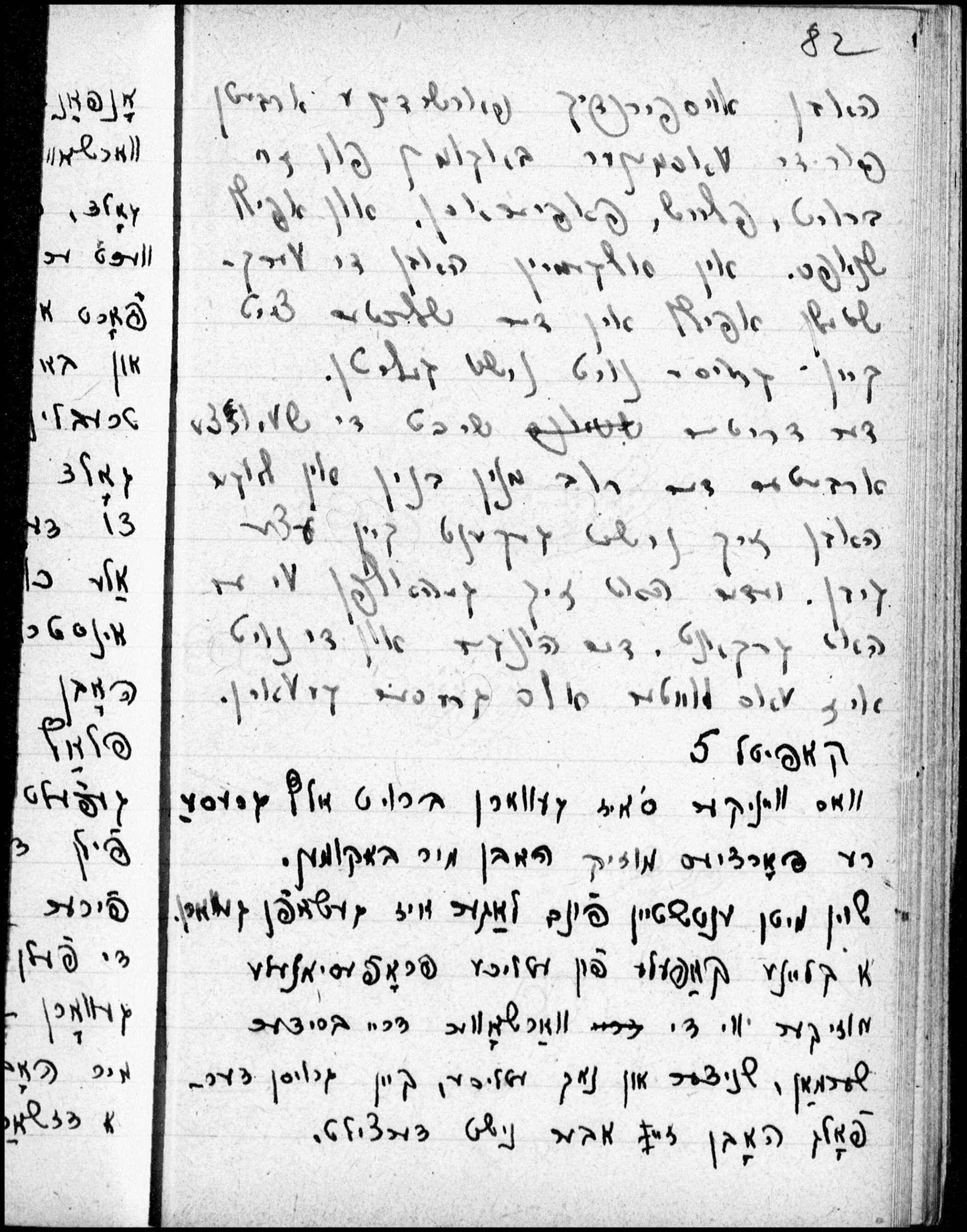
YIVO’s version of the memoir appears to be written in the handwriting of at least three people (see illustration).[31] The 2007 English translation containing a facsimile of this Yiddish manuscript states the handwriting is Strawczyński’s for the first three pages with the remainder by Fryshdorf, although another handwriting sample is also discernible but not identified. Yad Vashem’s copy appears to be handwritten by a single person throughout.[32]
This collective drafting of a first-person Holocaust memoir is not unusual for early witness accounts that were produced and disseminated by underground networks. One version of Jakub (Abraham) Krzepicki’s memoir was composed by two people before being deposited with the underground Warsaw archival group Oyneg Shabes. In addition to working with Oyneg Shabes member Rachel Auerbach to record the second of his two testimonies, Krzepicki joined the ŻOB and died fighting in the Warsaw ghetto uprising.[33] Similarly, a handwritten version of Jankiel Wiernik’s account was drafted by several people. Wiernik was living underground on the Aryan side of Warsaw when his account was written.[34]
The surviving copies of the memoir are divided into numbered chapters, although it is uncertain whether these divisions were present in the original or introduced during subsequent copying and editing. Wiernik’s Polish original, by comparison, was not divided into chapters; chapter divisions and additional paragraph breaks were introduced with later Yiddish and English translations. The precise relationship between the surviving manuscripts, any editorial intervention, and the lost original remains uncertain.
The complex and uncertain provenance of the memoir illustrates how the construction and preservation of early Holocaust memory depended on networks of collective support. Without these intermediaries – partisans who encouraged the writing and copied it, fellow prisoners who supplied information, couriers who tried to protect it, and institutions that preserved it – his memoir might never have been written nor survived.
Fabricating Treblinka: The Soviet Invention of American Victims
After leaving the partisans later in the summer of 1944, Strawczyński moved to Węgrów, Poland, where he lived with fellow Treblinka survivors Alexander (Arie) Kudlik and Samuel Rajzman.[35] After capturing the Treblinka area, the Soviet Red Army began a series of investigations of Treblinka. The first was conducted in August by the 65th Army of the 1st Belorussian Front. In September, the joint Polish-Soviet Commission for the Investigation of German Crimes, the Information and Propaganda Department of the Polish Committee of National Liberation, and the Military Council of the 2nd Belorussian Front conducted a separate investigation.[36] SMERSH, the Soviet counterintelligence agency, interrogated Ukrainians trained at the Trawniki concentration camp who were stationed at Treblinka as guards.[37]
Meanwhile, Jewish historical organizations were beginning to establish their own efforts to document Jewish experiences during the war. At the first constituent meeting devoted to creating a Historical Commission of the Jewish Committee in Lublin on August 29, 1944, members specifically identified Treblinka as an immediate priority. One “comrade” proposed that “lots of material be assembled first of all about Treblinka.” Another, possibly referring to the Soviet investigations, stated that “a commission has already been created which will visit Treblinka. But only our documents will reflect our tragedy,” calling for the collection of the greatest possible number of accounts.[38]
This emerging Jewish documentation effort developed alongside the Soviet investigations. By the time the Soviet Extraordinary State Commission (ESC) turned its attention to Treblinka, numerous interrogations and reports had already been completed. ESC representative Dmitry I. Kudryavtsev took nine witness statements over October 3-4, 1944. Kudryavtsev had recently participated in the investigation of Majdanek concentration camp and would subsequently work on the investigations of Auschwitz, Sachsenhausen, and other camps.[39] He also took part in the late-November 1944 Majdanek trial of German guards.[40]
Strawczyński was interrogated twice in Węgrów on October 3. Both of his interrogation protocols are only a few pages in length. The first focused on the “death camp,” where he described more about the process of disinfecting hair than anything about gas chambers. In terms of the killing process, he stated that people were sent to the “bathhouse” to be exterminated, but offered no specific details.[41]
In the second interrogation, he reported being told by the blacksmith Hersz Jablkowski that American and British citizens were exterminated in the camp. Additionally, Strawczyński himself “personally saw, among a huge pile of passports belonging to murdered people, many American and British passports.” He stated that fellow prisoners Alexander Kudlik and Chaim Ciechanowski could support this claim of hundreds of such victims. Finally, Strawczyński reported knowing of two British citizens, including a cousin of his, who were sent to Treblinka and murdered.[42] In the memoir, Jablkowski was one of Strawczyński’s two main sources for any knowledge of the killing process, but the mass murder of British and American citizens is a claim unique to his Soviet interrogations, which he either downplayed or omitted altogether in later statements.
In early December, draft reports of the ESC Treblinka investigation were written which focused almost entirely on the alleged murder of 1,000 citizens of the United States and Britain in the gas chambers of Treblinka II. Strawczyński’s interrogation is quoted directly, while the report conflates Treblinka I and II by referring to Theodor van Eupen as commandant and Kurt Franz as his assistant.[43] In reality, van Eupen was commandant of Treblinka I and Franz deputy commandant of Treblinka II. These reports remained unpublished, similar to those relating to Sachsenhausen.[44]
It is not clear why Kudryavtsev and the ESC settled on this theme, although they may have been seeking to influence Allied public opinion by asserting that American and British citizens had been deliberately gassed at Treblinka. Whether Kudryavtsev actively shaped this narrative to fit Moscow’s propaganda directives or the survivors tailored their testimonies to meet what they perceived as the interrogator’s interests, the resulting records were a joint product of the Soviet investigative setting and Jewish participants.
Taken together, Strawczyński’s involvement in the ESC investigation is the clearest example of institutional distortion of the historical record. His signed and sworn interrogation protocols reflect the commission’s wartime diplomatic and propaganda objectives more clearly than Strawczyński’s direct knowledge. In no other setting did he express personal awareness of American and British victims, and neither did any of the other witnesses interrogated by Kudryavtsev. This suggests that the ESC produced claims that survivors themselves did not consider part of their knowledge of the camp after leaving the orbit of the Soviet investigators.
This context is essential for interpreting Strawczyński’s accounts. The Soviet commission’s interest lay not in establishing a record for commemoration or legal purposes, but in producing usable propaganda.
Reassembling Treblinka: The Circle of Former Inmates
By January 1945, Łódź and Warsaw had been captured by the Soviets, and the two Strawczyński brothers moved back to Łódź sometime thereafter.[45] Hannah Fryshdorf also settled with them that year.[46] Strawczyński suggested to the Central Jewish Historical Commission (CJHC) that his memoir be published, although the commission declined to do so at the time, reportedly because of the work’s frank discussion of Jewish collaboration with the Germans at Treblinka.[47] Instead, a copy of the manuscript was turned over to the CJHC, later becoming a part of the JHI’s archives.[48]
On January 21, 1945, the CJHC organized the first meeting of former Treblinka prisoners in Lublin, though it is not clear if Strawczyński was present.[49] The participants sought to investigate and commemorate alleged Nazi crimes at Treblinka and to gain recognition for the survivors as partisan veterans of the war. A committee was formed consisting of Treblinka survivors Samuel Rajzman, with whom Strawczyński had lived in Węgrów, and Stanisław Kohn. Both Rajzman and Kohn had previously been interrogated by the Soviets. CJHC members Philip Friedman and J. Morelówna were also included in the committee.[50]
The January meeting was followed by further efforts by the Treblinka survivors for formal recognition. In late April 1945, a group of 35 revolt escapees approached the Łódź branch of the Association of Jewish Partisans in Poland, requesting admission and the appointment of two representatives to its board. Stanisław Kohn and Kalman Potasz represented the survivors. While the group was not admitted as a whole to the Partisans Association, individual members were eventually inducted.[51]
Similar efforts continued over the following months. According to Friedman, the survivors maintained close contacts with one another, and some were living together in Łódź. Friedman, on behalf of CJHC, encouraged them to create a formal organization. This plan was never realized, as survivors left Łódź and eventually Poland altogether, but members of the group became closely involved in the CJHC’s early efforts to gather testimonies regarding Treblinka.[52]
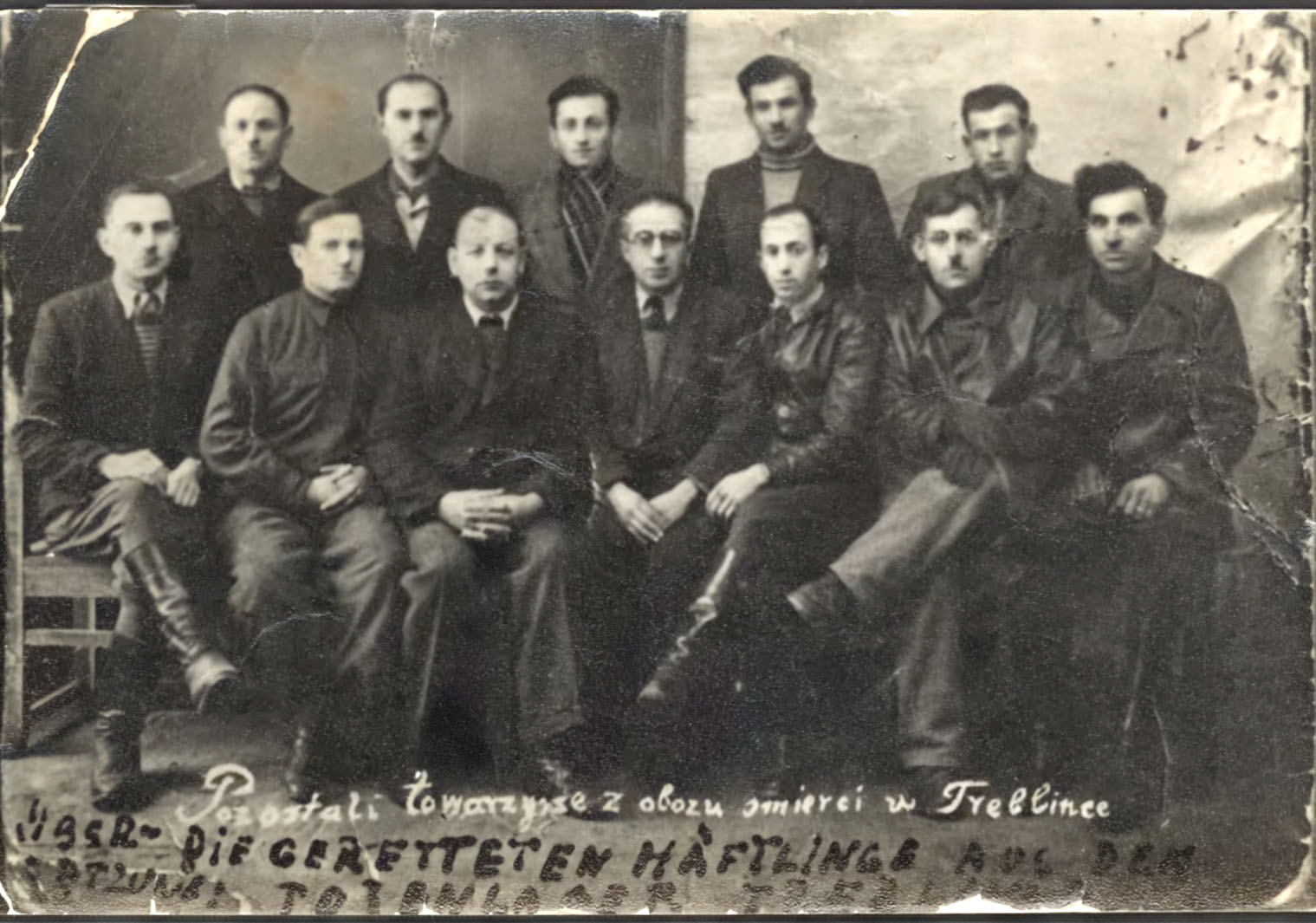
Several gatherings of the survivors are explicitly documented. A photograph preserved by Yad Vashem and reproduced by Alexander Donat shows a “reunion of Treblinka survivors.”[53] Donat dates the reunion to 1944 based on Samuel Rajzman’s identification of the individuals pictured, although Yad Vashem dates it to 1945 in Węgrów. One copy of the photograph was submitted to Yad Vashem by the family of Zygmund Brothandel, a former prisoner of the Treblinka I labor camp who is also in the photo. Participants included Szymon Goldberg, Rajzman, Kudlik, Strawczyński, and others who had been interrogated by the Soviets (see illustration).
In the summer of 1945, a “Circle of Former Treblinka Inmates” convened. On July 15, 1945, the circle and members of the CJHC met at the Strawczyński brother’s home in Łódź. The participants included numerous survivors of Treblinka II, several of Treblinka I, and three CJHC representatives. Among the Treblinka II survivors were Jankiel Wiernik, Szymon Goldberg, Samuel Rajzman, Alexander Kudlik, Chaim Ciechanowski, and nearly a dozen others. Leon Szeftl, Rachel Auerbach and Janina Bukolska represented the Commission.[54] Auerbach reported that the circle assisted the CJHC in “all the research work connected with the Treblinka death camp. Their main task was to record the testimony of individuals who had been in Treblinka.”[55]
The significance of the meeting is not only the number of Treblinka survivors present, but also the convergence of several networks that had operated separately during the war. Resistance fighters, underground activists, and survivor organizations now assembled in a single room to share and record testimonies.
Auerbach had been a member of the Oyneg Shabes underground archive in the Warsaw ghetto and had written a witness account and her own analysis of Treblinka.[56] After leaving the ghetto in March 1943, she became the office assistant for Janina Bukolska and began collaborating with the CJHC in May 1945.[57] Auerbach’s report of visiting Treblinka with some of the witnesses was published by the Commission in late 1945.[58] Bukolska, a Polish psychologist, had worked with Żegota on the Aryan side of Warsaw during the war, where her notary public and translation office served as a storehouse for forged identification documents used by Jews fleeing the ghetto. She conducted the interviews with the “Circle of Former Treblinka Inmates” in summer 1945.[59] Bukolska and Auerbach maintained a lifelong friendship, even after Auerbach left Poland for Israel, and Yad Vashem has recognized Bukolska as a “Righteous Among the Nations.”[60]
The early account of Treblinka attributed to Wiernik had been published by the Warsaw underground in May 1944; he was also a courier for Żegota.[61] In Strawczyński’s memoir, Wiernik is mentioned a single time as the “construction-master” from the upper camp, who came to the lower camp daily with assistants to work on projects, even though the lower camp had numerous carpenters and other workers in various trades.[62] Several other members of the group present at the Strawczyński residence were also interrogated months earlier by the Soviets.[63]
The Łódź meeting also reflected the testimony-collection practices that were being developed by the CJHC. In a July 1945 “Notes on the Methodology for the Historical Questionnaire,” Commission member Dr. Joseph Kermisz observed that survivors might have difficulty recalling events accurately, so recommended that interviewers use an “association method.” This included recounting known events to witnesses and allowing accounts from one survivor to “jog” the memory of another. This provided the justification for bringing witnesses of the same camp together, treating their statements as complementary rather than strictly independent.[64]
Dr. Philip Friedman, the first director of the CJHC and later affiliated with YIVO in New York, described this method as an effort by the historical commissions to overcome the “excessive subjectivity” of individual accounts. Witnesses from the same town or concentration camp could be brought together, existing testimonies could be read to them, and participants could provide “additional information, corrections, etc.” In Friedman’s 1948-1949 retrospective from Munich, he acknowledged that this approach did not always produce greater objectivity, but regarded it as potentially more reliable than individual interviews.[65]
After the Łódź meetings, Bukolska wrote a report on the Treblinka camp which references her July interviews, noting that the survivors’ “testimonies are almost entirely consistent regarding all the essential facts presented here.”[66] Her observation is particularly striking in light of the methodology developed by the CJHC. The witnesses had worked in different areas, with limited communication between the lower and upper camps. Strawczyński reported in his memoir that lower camp laborers were “strictly forbidden” from going to the upper camp, and that if anyone crossed over, even by accident, they could not return to the lower camp.[67]
The method utilized by the circle and the CJHC meant that subsequent accounts given by survivors would reflect a combination of individual recollections and their shared memories. Strawczyński’s further statements illustrate one potential consequence of this collaborative memory construction: when he testified before a Polish investigative judge in October, he gave measurements of the camp’s mass graves consistent with those published in Wiernik’s booklet.
Convergence of Memory in the Polish Investigation
Several months after the meeting, Strawczyński and other Treblinka witnesses provided statements to Judge Zdzisław Łukaszkiewicz of the Main Commission for the Investigation of Nazi Crimes in Poland. The Main Commission and the CJHC maintained a close working relationship, exchanging information, providing expert reports and witnesses for trials, assisting with the collection of materials, and coordinating visits to the Auschwitz-Birkenau, Chełmno and Treblinka camps.[68] Numerous members of the Łódź circle were interviewed, including Wiernik, Kohn, Kudlik, and Samuel Rajzman, among others.
Rajzman provided additional confirmation of the survivor organization’s existence. When describing the whereabouts of potential witnesses, he reported that “people who took part in the uprising established their own association in Łódź recently,” adding that several had departed the city by October 1945. Rajzman, however, did not identify himself as a member, despite being possibly the “dominant witness” of the group and an integral participant in the Łódź survivor circle from its early stages.[69]
By the time of his October 7 interview, Strawczyński’s account had been formulated in the forest with the partisans, then distorted by the Soviet commission for its own propaganda purposes, and subsequently refined through the work of the Łódź circle and the CJHC. It had now become more standardized and suitable for a legal investigation. Strawczyński indicated to Judge Łukaszkiewicz that most of what he knew regarding the gas chambers, mass graves, and cremations came from Hersz Jablkowski, who had been his source for such details in the memoir and the Soviet interrogations.[70]
Strawczyński’s understanding of the camp had expanded. He reported that corpses were cremated on grates on top of brick foundations, with ventilators for air circulation, which began in the winter of 1942-1943. None of these details are in his memoir, although the building of grates for mass cremations is referenced in Wiernik’s book and Soviet reports and witness interrogation protocols.[71]
Strawczyński included at least one highly specific detail in his October interview consistent with Jankiel Wiernik’s published booklet. He stated that mass graves were “10 meters deep and 50 meters long,” which closely matches the measurements Jankiel Wiernik gave of “50x25x10 meters.” Because he was never present in the area where much of Wiernik’s narrative is set, Strawczyński could not have known this personally. Their shared participation in the Łódź circle provides one plausible source of this knowledge, as does his direct reading of Wiernik’s book. He also could have heard it from another survivor or document collector. While the correspondence demonstrates that specific details could move among survivors, the surviving evidence does not establish a specific route.
However, in one respect, Strawczyński’s account had become more constrained. Abandoning the specific and personal claims made in his Soviet testimony, he now stated that he “didn’t know if Jews from other European countries were brought in” to the camp. Instead, he attributed awareness of English – but not American – identification documents to his brother Zygmunt.[72] He made no mention of a British Jewish cousin’s deportation to Treblinka. In his October 1944 Soviet interrogations, Strawczyński stated he had personal knowledge of British and American citizens deported to and killed at Treblinka. A year later, he no longer claimed direct knowledge of these matters.
The refinement of Strawczyński’s knowledge by October 1945 suggests that the Łódź circle’s work within the CJHC’s collective methodology did more than record individuals’ memories. The result of the “association method” was a shared evidentiary base in which each survivor’s recollection could be reshaped by some combination of the reported experiences of others. The resulting records risked reflecting a body of knowledge and interpretation that no single participant had assembled but that accumulated through the collective process itself. Particular claims could be introduced, reinforced, qualified, or discarded within individual accounts and across the group as recollections influenced one another.
This development complicates any simple model in which the appearance of additional details in a witness’s later statements is taken either as evidence of more complete recollection or as evidence of deteriorating memory. Strawczyński’s account became more detailed in areas where his knowledge was derived from other sources, while becoming more cautious about a claim previously presented as firsthand. The change suggests that different evidentiary environments could influence his stated claims in a given context.
Following the interviews and on-site investigations, Judge Łukaszkiewicz wrote two reports on the Treblinka camp. In an official report, he cited the hearsay regarding the possible presence of English citizens in the camp.[73] In his privately-published book on Treblinka, Łukaszkiewicz referenced Strawczyński’s architectural details of the gas chambers to corroborate Wiernik’s account.[74] Strawczyński’s statements were included in official Polish reports alongside the accounts of other survivors to construct the historical and legal record of Treblinka.
Recircling Treblinka in Germany
Strawczyński and his wife left Poland in August 1946, emigrating to Canada in April 1948. By this time, the short-lived survivor organizations that had brought the Treblinka witnesses together were giving way to more durable historical institutions. The accounts generated by the Łódź circle, the CJHC, and others did not disappear with the dispersal of their contributors and collectors.[75] Instead, they became part of the archival collections of permanent organizations like the JHI, YIVO, and Yad Vashem.[76]
The documentation efforts begun by the CJHC also extended beyond the commission itself. When the CJHC was merged into the JHI in October 1947, some of the people involved in its work continued to participate in the new institute and other organizations. In late 1947, for instance, the Association of Jewish Participants in the Armed Struggle Against Fascism ran a competition for accounts of Jewish resistance during the war, with Rachel Auerbach and Joseph Kermisz among the judges.[77] Additionally, in its first year of existence, the CJHC had established contacts with Jewish organizations in Britain, the United States, Palestine, and the Soviet Union.[78] By the mid-1960s, the archives and contacts established in the early postwar period had become a lasting institutional resource.
Nor were the survivors themselves forgotten. Future Treblinka investigations could draw upon records contained in archives to identify potential witnesses who had long since emigrated from Europe and bring them into a new setting: a German criminal tribunal. German prosecutors had copies of Judge Łukaszkiewicz’s official report, and worked directly with Yad Vashem in Israel to locate surviving witnesses.[79] When Strawczyński testified at the 1964-1965 Düsseldorf trial of Kurt Franz and other Treblinka defendants, his participation was made possible by the institutional networks through which the early testimonies had been conserved and made available to investigators.[80] Samuel Rajzman, who had been part of the group of survivors living in Węgrów and the postwar Łódź circle, also testified at the Düsseldorf proceedings, providing another point of continuity between the early survivor groups and the later trial.
Strawczyński’s testimony, given on December 7 and 11, 1964, included both his own recollections and what he had learned from other prisoners. In an interview he gave in Israel in January 1965, Strawczyński recounted being questioned by the court about his deportation to Treblinka and work in the camp. The principal subject of the examination was Kurt Franz, deputy commandant of Treblinka, whom Strawczyński claimed to have witnessed killing prisoners.[81] Gitta Sereny also reported that Strawczyński, Rajzman, and others confirmed that hangings had taken place at Treblinka.[82] A statement from Zygmunt Strawczyński, who lived in Montreal with Oskar, was read into the record in May 1965 at the same trial.[83]
The organizational context of Strawczyński’s testimony at Düsseldorf demonstrates the long-term reach of the early postwar documentation efforts, which had preserved both survivor accounts and the connections needed to locate witnesses decades later.
Conclusion
Between the August 1943 Treblinka uprising and the autumn 1945 Polish judicial investigation, Oskar Strawczyński moved through overlapping circles of resistance, propaganda, documentation, commemoration, and official investigation. His accounts from this period show a continuous expansion and modification of his knowledge of Treblinka beyond what he had personally witnessed, and the surviving record makes it possible to trace those changes each time his testimony was recorded.
His experience at Treblinka was confined to the lower camp, yet he immediately began incorporating secondhand information into his forest memoir, including descriptions of the “death camp,” the layout and operation of the gas chambers, and the disposal of bodies. His Soviet interrogations added a short-lived claim of personal knowledge of American and British victims. After his participation in the Łódź circle and the CJHC’s practice of collective testimony, his interview before a Polish judge contained specific details consistent with another survivor’s published work that he could not have known personally, while his earlier American/British claims had significantly diminished.
Strawczyński was not a passive subject of external pressures. His shifting presentation of the evidence across these settings suggests that he distinguished between testimony given within different contexts. His activity in the Łódź circle, including hosting a meeting of Treblinka survivors at his home and advocating for the publication of his memoir, indicates that he sought to shape his own legacy.
Strawczyński’s journey from forest fugitive to courtroom witness thus reveals not only the evolution of his own knowledge, but also the institutionalization of Holocaust memory itself. More broadly, Holocaust accounts should be understood as developing through an individual’s engagement with networks and organizations and not through personal recollection alone. This invites a reevaluation of other early witness statements; rather than treating mediation as an abstract qualification applied to all survivor accounts, historians can sometimes reconstruct the specific people, organizations, and interactions through which particular claims entered the record.
Endnotes
| [1] | Eliyana R. Adler and Natalia Aleksiun, eds., Entanglements of War: Social Networks during the Holocaust (Yad Vashem, 2022), p. 9. |
| [2] | The memoir was first published in English in Canada in 1979; citations here are to the more readily available 2007 Yad Vashem edition; David Rome, Clouds in the Thirties: On Anti-Semitism in Canada, 1929-1939, Final Section, Vol. 13 (National Archives Canadian Jewish Congress, 1981). |
| [3] | Yitzhak Arad, The Operation Reinhard Death Camps: Belzec, Sobibor, Treblinka, Revised and expanded edition (Indiana University Press Yad Vashem publications, 2018), p. 197; Caroline Sturdy Colls, Finding Treblinka: Forensic and Archaeological Discoveries (Cornell University Press, 2026), p. 231; Jacob Flaws, Spaces of Treblinka: Retracing a Death Camp (University of Nebraska Press, 2024), p. 62; Chad S. A. Gibbs, Survival at Treblinka: Geography, Gender, and Social Networks in Jewish Resistance (The University of Wisconsin Press, 2026), pp. 28f.; Chris Webb and Michal Chocholatý, The Treblinka Death Camp: History, Biographies, Remembrance, Second, revised and updated edition (ibidem, 2021), p. 23; Sara Berger, Experten der Vernichtung Das T4-Reinhardt-Netzwerk in den Lagern Belzec, Sobibor und Treblinka, epub, Studien zur Gewaltgeschichte des 20. Jahrhunderts (Hamburger Ed., 2014), sec. “Unteres Lager: Erschießungen im ‘Lazarett’”. |
| [4] | Alexander Donat (ed.), The Death Camp Treblinka: A Documentary (Holocaust Library, 1979), pp. 267, 290. |
| [5] | Gitta Sereny, Into That Darkness: An Examination of Conscience (Knopf Doubleday Publishing Group, 2011), p. 229. |
| [6] | Michael S. Bryant, Eyewitness to Genocide: The Operation Reinhard Death Camp Trials, 1955-1966, Legacies of War (The University of Tennessee Press, 2014), pp. 117f. |
| [7] | Witold Chrostowski, Extermination Camp Treblinka (Vallentine Mitchell, 2004), p. 87. |
| [8] | Germar Rudolf, “Strawczyński, Oskar,” in: Holocaust Encyclopedia: Uncensored and Unconstrained, accessed August 30, 2026, https://holocaustencyclopedia.com/witness/victim/Strawczyński-oskar/861/; Thomas Kues, “Israel Cymlich and Oskar Strawczyński, ‘Escaping Hell in Treblinka,’” Smith’s Report, No. 168 (2010), pp. 12-15, https://codoh.com/library/document/israel-cymlich-and-oskar-Strawczyński-escaping/; Carlo Mattogno, The “Operation Reinhardt” Camps Treblinka, Sobibór, Bełżec: Black Propaganda, Archeological Research, Expected Material Evidence, 1st ed., Holocaust Handbooks 28 (Academic Research Media Review Education Group Ltd, 2024), pp. 156f., 163, https://holocausthandbooks.com/book/the-operation-reinhardt-camps-treblinka-sobibor-belzec. |
| [9] | Oskar Strawczyński, “Testimony of Oskar Strawczyński, born in Lopuszno, Poland, 1906, regarding his experiences in Czestochowa, Treblinka, with the ZOB, Jewish Fighting Organization, in the Wyszkow Forest and other places,” Memoirs, Yad Vashem, 1965, Item ID 3557650, Yad Vashem, https://collections.yadvashem.org/en/documents/3557650; most sources state Strawczyński was born in Łódź; however, he states in this interview that he was born in Łopuszno. |
| [10] | Oskar Strawczyński, “Ten Months in Treblinka,” in: Escaping Hell in Treblinka, trans. Natalie (Nadia) Strawczyński Rotter (Yad Vashem, 2007), pp. 125f. |
| [11] | Strawczyński, “Ten Months in Treblinka,” op. cit., p. 129. |
| [12] | Strawczyński, “Ten Months in Treblinka,” op. cit., p. 143. |
| [13] | Strawczyński, “Ten Months in Treblinka,” op. cit., pp. 169-71. |
| [14] | Strawczyński, “Ten Months in Treblinka,” op. cit., p. 181. |
| [15] | Strawczyński, “Ten Months in Treblinka,” op. cit., p. 188; Strawczyński, “Testimony of Oskar Strawczyński, born in Lopuszno, Poland.” |
| [16] | Strawczyński, “Ten Months in Treblinka,” op. cit., p. 123. |
| [17] | Strawczyński, “Testimony of Oskar Strawczyński, born in Lopuszno, Poland”; Gabriel died sometime later in an armed conflict with the Germans. |
| [18] | Strawczyński, “Ten Months in Treblinka,” op. cit., pp. 127, 182. |
| [19] | Vladka Meed, On Both Sides of the Wall: A Resistance Fighter’s Firsthand Account of the Warsaw Ghetto, trans. Steven D. Meed (Kensington Publishing Corp, 2025), p. 311. |
| [20] | Strawczyński, “Ten Months in Treblinka,” op. cit., p. 171; Alina Skibińska, “‘My mówimy zamiast nich, mówimy w ich imieniu’: Więźniowie Treblinki II świadkami Zagłady,” in Oto widać i oto słychać: świadkowie zagłady w okupowanej Polsce, Wydanie pierwsze (Stowarzyszenie Centrum Badań nad Zagładą Żydów, 2024), epub. |
| [21] | Nachman Blumental (ed.), Dokumenty I Materiały Z Czasów Okupacji Niemieckiej W Polsce. Tom I. Obozy (Central Jewish Historical Commission in Poland, 1946), sec. Nr. 87. |
| [22] | Jankiel Wiernik, “Rok w Treblince,” Typescript, Manuscript, Warsaw, 1944, 11261collec, Ghetto Fighters House Archives, http://www.infocenters.co.il/gfh/notebook_ext.asp?item=41584&site=gfh&lang=ENG&menu=1; Jankiel Wiernik, “Rok w Treblince,” 1944, AR-A-00065-007, Ghetto Fighters House Archives, https://infocenters.co.il/massuah/notebook_ext.asp?item=18765&site=massuah&lang=ENG&menu=1. |
| [23] | Konstantin Aleksandrovič Pachaljuk (ed.), Treblinka: Issledovanija, vospominanija, dokumenty, Naučnoe izdanie (Яуза, 2021), “A Year in Treblinka,” https://docs.historyrussia.org/ru/nodes/354229. |
| [24] | Meed, On Both Sides of the Wall, op. cit. |
| [25] | Natalie (Nadia) Strawczyński Rotter, “Ten Months in Treblinka,” in: David Rome, Clouds in the Thirties: On Anti-Semitism in Canada, 1929-1939, Vol. 13, Final Section (National Archives Canadian Jewish Congress, 1981), p. I. |
| [26] | Strawczyński, “Ten Months in Treblinka,” op. cit., pp. 188f.; Strawczyński Rotter, “Ten Months in Treblinka,” op. cit., p. I. |
| [27] | Hannah Fryshdorf, “Papers of Hannah Fryshdorf,” Finding Guide, undated, RG 1243, p. 4, Center for Jewish History, https://digipres.cjh.org/delivery/DeliveryManagerServlet?dps_pid=IE2128234. |
| [28] | Strawczyński, “Ten Months in Treblinka,” op. cit., p. 195. |
| [29] | “Zbiór pamiętników Żydów Ocalałych z Zagłady,” Inventory, Jewish Historical Institute, undated, Signature 302. |
| [30] | As of the writing of this article, the Jewish Historical Institute’s digital archive is temporarily offline, so their copy cannot be compared to the other two. |
| [31] | Oskar Strawczyński, “Memoirs: Ten Months in Treblinka (October 5, 1942 – August 2, 1943),” 1949, Reel 8, Folder 266 (RG 104), Center for Jewish History, https://digipres.cjh.org/delivery/DeliveryManagerServlet?dps_pid=IE17964734. |
| [32] | Oskar Strawczyński, “Memoirs of Oskar Strawczyński from Czestochowa, Poland, regarding his experiences in Treblinka camp,” Memoirs, January 14, 1947, Item ID 11060930, Yad Vashem, https://collections.yadvashem.org/en/documents/11060930. |
| [33] | Thomas Olson, “Completed in March, Buried in February: Auerbach, Krzepicki and the Making of a Treblinka Eyewitness Testimony,” Inconvenient History, Vol. 18, No. 2, 2026, https://codoh.com/library/document/completed-march-buried-february-auerbach-krzepicki/; Abraham Krzepicki, “Account of a Treblinka escapee,” Warsaw Ghetto, December 1942; originally published as Relacja uciekiniera z Treblinki, ARG II 378, Center for Jewish History, https://cbj.jhi.pl/documents/727956/0/. |
| [34] | Wiernik, “A Year in Treblinka, Typescript & Manuscript” op. cit. |
| [35] | Strawczyński, “Testimony of Oskar Strawczyński, born in Lopuszno, Poland”, op. cit. |
| [36] | Pachaljuk, Treblinka: Issledovanija, vospominanija, dokumenty, op. cit., sec. 3.3, 3.5. |
| [37] | “Treblinka’s ‘Death Camp’… ‘I was an eyewitness and a participant in the atrocities committed to exterminate civilians,’” Federal Security Service of the Russian Federation, April 10, 2025, http://www.fsb.ru/fsb/history/archival_material/Treblinka.htm. |
| [38] | Laura Jockusch (ed.), Khurbn-Forshung: Documents on Early Holocaust Research in Postwar Poland, Archive of Jewish History and Culture (Vandenhoeck & Ruprecht, 2021), pp. 95f., https://www.vandenhoeck-ruprecht-verlage.com/themen-entdecken/geschichte/juedische-geschichte/57235/khurbn-forshung. |
| [39] | Klaus Schwensen, “The Report of the Soviet Extraordinary State Commission on the Sachsenhausen Concentration Camp,” Inconvenient History, Vol. 3, No. 4, 2011, p. 350, https://codoh.com/library/document/the-report-of-the-soviet-extraordinary-state/; Konstantin Aleksandrovič Pachaljuk (ed.), Majdanek Concentration Camp: Research, Documents, Memories (Pjatyj Rim, 2020; originally published as Koncentracionnyj lager’ Majdanek: issledovanija, dokumenty, vospominanija), p. 302, https://docs.historyrussia.org/ru/nodes/354230; “On the Monstrous Crimes of the German Government at Auschwitz,” Красная Звезда, May 8, 1945, p. 2, https://yandex.ru/archive/catalog/8468dd95-dfdf-4325-8985-9fa2b48582b2. |
| [40] | Gabriel N. Finder, Alexander Victor Prusin, Justice behind the Iron Curtain: Nazis on Trial in Communist Poland, German and European Studies 32 (University of Toronto Press, 2018), p. 32, https://utppublishing.com/doi/book/10.3138/9781487522681. |
| [41] | Pachaljuk, Treblinka: Issledovanija, vospominanija, dokumenty, op. cit., sec. 2.17. |
| [42] | Pachaljuk, op. cit., sec. 2.18. |
| [43] | Pachaljuk, op. cit., sec. 3.7. |
| [44] | Klaus Schwensen, “The Report of the Soviet Extraordinary State Commission on the Sachsenhausen Concentration Camp,” Inconvenient History, Vol. 3, No. 4, 2011, p. 345, https://codoh.com/library/document/the-report-of-the-soviet-extraordinary-state/. |
| [45] | Strawczyński, “Ten Months in Treblinka,” op. cit., p. 189. |
| [46] | Fryshdorf, “Papers of Hannah Fryshdorf,” op. cit., p. 4. |
| [47] | Strawczyński, “Ten Months in Treblinka,” op. cit., p. 124; one chapter in the memoir details “corruption,” and elsewhere Strawczyński harshly criticizes women inmates for partying with the camp guards. |
| [48] | “Zbiór pamiętników,” op. cit., p. 171. |
| [49] | Agnieszka Haska, “‘To Investigate and Reveal’: The Central Jewish Historical Commission (1944-1947),” Zagłada Żydów. Studia i Materiały, Vol. 16, 2020, pp. 857-860, https://doi.org/10.32927/ZZSiM.654. |
| [50] | August Grabski, Żydowski ruch kombatancki w Polsce w latach 1944-1949 (TRIO, 2002), pp. 48f. |
| [51] | Grabski, Żydowski ruch kombatancki, op. cit., pp. 49f. |
| [52] | Skibińska, “‘My mówimy zamiast nich, mówimy w ich imieniu’: Więźniowie Treblinki II świadkami Zagłady”, op. cit. |
| [53] | Donat, The Death Camp Treblinka, op. cit., p. 267; “Wegrow, Poland, a Photo Union of Several Survivors from Treblinka, Including Zygmund Brodshandel, Second from the Left in the Top Row, 1945,” Photograph, 1945, Archival Signature 11801/1, Yad Vashem, https://collections.yadvashem.org/en/photos/12493827. |
| [54] | Edward Kopówka, “The Commemoration of the Extermination Camp in Treblinka. An Attempt at Interpretation,” in: Treblinka Warns and Reminds (Muzeum Treblinka Niemiecki nazistowski obóz zagłady i obóz pracy (1941-1944), 2024), p. 113. |
| [55] | Rachel Auerbach, “In the Fields of Treblinka,” in: The Death Camp Treblinka: A Documentary (Holocaust Library, 1979), p. 27; Haska, “To Investigate and Reveal,” op. cit., p. 12. |
| [56] | Olson, “Completed in March, Buried in February”, op. cit. |
| [57] | Rokhl Auerbach, Warsaw Testament, ed. Samuel Kassow, trans. Samuel D. Kassow (White Goat Press, 2024), p. 298; Jockusch, Khurbn-Forshung, op. cit., p. 789; Haska, “To Investigate and Reveal,” op. cit., p. 12. |
| [58] | Jockusch, Khurbn-Forshung, op. cit., p. 666, note 74; originally published in the CJHC’s newspaper, with an extended version published in 1947 as a booklet. |
| [59] | Rachel Auerbach, “In the Fields of Treblinka,” in The Death Camp Treblinka: A Documentary (Holocaust Library, 1979), p. 27. |
| [60] | “Buskolska Janina,” Righteous Among the Nation Database, undated, Item ID 4014169, Yad Vashem, accessed September 2, 2026, https://collections.yadvashem.org/en/righteous/4014169. |
| [61] | Jankiel Wiernik, “One Year in Treblinka,” in: The Death Camp Treblinka: A Documentary, trans. Alexander Donat (Holocaust Library, 1979); Barbara Engelking, “Organising Help for the Jews on the Aryan Side in Warsaw,” trans. Wojciech Kubiński, Tekstualia, vol. 1, No. 9, 2024, p. 51. |
| [62] | Strawczyński, “Ten Months in Treblinka,” op. cit., p. 168. |
| [63] | Pachaljuk, Treblinka: Issledovanija, vospominanija, dokumenty, op. cit. |
| [64] | Jockusch, Khurbn-Forshung, op. cit., pp. 294f. |
| [65] | Jockusch, Khurbn-Forshung, op. cit., p. 247. |
| [66] | Engelking, “Organising Help for the Jews on the Aryan Side in Warsaw,” op. cit., p. 51; Mattogno, The “Operation Reinhardt” Camps, op. cit., p. 146; Janina Buchholcowa (Bukolska), “Obóz śmierci w Treblince,” 1945, 2/1333/0/3/212.III.1, p. 8, Archiwum Akt Nowych, https://www.szukajwarchiwach.gov.pl/jednostka/-/jednostka/5519374. |
| [67] | Strawczyński, “Ten Months in Treblinka,” op. cit., pp. 170f. |
| [68] | Natalia Aleksiun, “The Central Jewish Historical Commission in Poland, 1944-1947,” in: Making Holocaust Memory, Polin: Studies in Polish Jewry (The Littman library of Jewish Civilization, 2008), p. 82; Natalia Aleksiun, “Philip Friedman and the Emergence of Holocaust Scholarship: A Reappraisal,” in: Simon Dubnow Institute Yearbook, Vol. 1 (Online-Ausg.), EBL-Schweitzer, XI (Vandenhoeck Ruprecht, 2012), p. 337, https://www.dubnow.de/en/publication/jahrbuch-des-simon-dubnow-instituts-simon-dubnow-institute-yearbook-11; Finder/Prusin, Justice behind the Iron Curtain, op. cit., pp. 51, 182f, 193; Laura Jockusch, Collect and Record! Jewish Holocaust Documentation in Early Postwar Europe (Oxford University Press, 2015), pp. 112-116; Roni Stauber, “Laying the Foundations for Holocaust Research: The Impact of the Historian Philip Friedman,” Search and Research: Lectures and Papers, Vol. 15 (Yad Vashem, 2009), p. 21. |
| [69] | Samuel Rajzman, “Samuel Rajzman, Testimony from Court/Criminal Proceedings from 09.10.1945,” interview by Zdzisław Łukaszkiewicz, October 9, 1945, Institute of National Remembrance, GK 196/69, Archive of the Pilecki Institute, Chronicles of Terror, https://chroniclesofterror.pl/dlibra/show-content?id=265; Skibińska, “‘My mówimy zamiast nich, mówimy w ich imieniu’: Więźniowie Treblinki II świadkami Zagłady.” |
| [70] | Oskar Strawczyński, “Oskar Strawczyński, Testimony from Court/Criminal Proceedings from 7.10.1945,” interview by Zdzisław Łukaszkiewicz, October 7, 1945, Institute of National Remembrance, GK 196/69, Archive of the Pilecki Institute, Chronicles of Terror, https://chroniclesofterror.pl/dlibra/show-content?id=276. |
| [71] | Pachaljuk, Treblinka: Issledovanija, vospominanija, dokumenty, op. cit., p. sec. 3.3; Wiernik, “One Year in Treblinka,” op. cit., chap. 8. |
| [72] | Oskar Strawczyński, “Oskar Strawczyński, Testimony from Court/Criminal Proceedings from 7.10.1945,” interview by Zdzisław Łukaszkiewicz, October 7, 1945, Institute of National Remembrance, GK 196/69, Archive of the Pilecki Institute, Chronicles of Terror, https://chroniclesofterror.pl/dlibra/show-content?id=276. |
| [73] | Zdzisław Łukaszkiewicz, “The Treblinka Extermination Camp,” in German Crimes in Poland. Central Commission for Investigation of German Crimes in Poland (Tłoczono w Drukarni św. Wojciecha pod zarządem państwowym, 1946), Vol. 1, p. 105, https://pbc.gda.pl/dlibra/publication/115931/edition/103612. |
| [74] | Zdzisław Łukaszkiewicz, Obóz Straceń w Treblince (Państwowy Instytut Wydawniczy, 1946), p. 11. |
| [75] | Olga Kartashova, “Holocaust History Between Liberation and Sovietization: The Publications of the Central Jewish Historical Commission in Poland 1945-1947” (Thesis, Central European History, 2017), p. 56; leading members of CJHC emigrated to Israel, while Friedman settled in the United States. |
| [76] | Strawczyński, “Ten Months in Treblinka,” op. cit., p. 190. |
| [77] | Grabski, Żydowski ruch kombatancki, op. cit., p. 113. |
| [78] | Feliks Tych, “The Emergence of Holocaust Research in Poland: The Jewish Historical Commission and the Jewish Historical Institute (ZIH), 1944-1989,” in Holocaust Historiography in Context: Emergence, Challenges, Polemics and Achievements (Berghahn Books; Yad Vashem, 2008), p. 234. |
| [79] | Bryant, Eyewitness to Genocide, op. cit., pp. 73-75. |
| [80] | Strawczyński, “Ten Months in Treblinka,” op. cit., p. 126. |
| [81] | Strawczyński, “Testimony of Oskar Strawczyński, born in Lopuszno, Poland”, op. cit. |
| [82] | Sereny, Into That Darkness, op. cit., p. 229. |
| [83] | Bryant, Eyewitness to Genocide, 117-18. |

Bibliographic information about this document: Inconvenient History, 2026, Vol. 18, No. 4
Other contributors to this document:
Editor’s comments: